
What if the draft in your living room isn’t actually coming from the glass, but from a fundamental failure in how your bay window connects to your home’s structure? Many homeowners across the Front Range view these architectural features as simple aesthetic upgrades, yet they often face the silent frustration of sagging frames or moisture creeping behind stucco. When you’re planning a bay window replacement Longmont homeowners often find that standard installations fail to address the underlying mechanics of the building’s complete outer system. It’s a common concern, and it’s vital to address how a new unit will withstand our unique climate.
This article will show you how to integrate a high-performance bay window into your home’s structural system for lasting beauty and moisture protection. We’ll explore a forensic approach to installation that prioritizes long-term stability over quick fixes. You’ll learn about the critical relationship between proper framing and the 2024 International Codes, ensuring your investment meets Colorado’s strict 0.30 U-factor energy standards. We’re moving past superficial repairs to focus on the technical precision required for a truly sound building envelope and a precision-engineered result.
Key Takeaways
- Understand why bay windows are structural projections requiring specialized anchoring to withstand Longmont’s specific environmental stressors and wind loads.
- Discover the importance of a forensic diagnostic to identify the underlying structural origins of window failure before beginning your bay window replacement Longmont project.
- Learn how to integrate high-performance materials and Low-E glass to manage Colorado’s solar gain while maintaining the rigidity of the building’s outer system.
- Identify the critical steps for merging new window units with complex stucco exteriors to ensure long-term moisture protection and prevent structural sagging.
- Explore how a precision-led installation process protects your property investment by focusing on foundational accuracy rather than superficial fixes.
The Structural Dynamics of Bay Window Replacement in Longmont
A bay window is a unique architectural element that projects outward from the main walls of a building, effectively creating a cantilevered extension of your interior space. What is a Bay Window? Historically, these units were designed to maximize natural light and provide panoramic views, but from a construction standpoint, they represent a complex structural challenge. Unlike a standard picture window that sits flush within a load-bearing wall, a bay unit hangs beyond the foundation. This means the entire weight of the glass, heavy framing, and dedicated roof assembly relies entirely on the integrity of the home’s existing structural system.
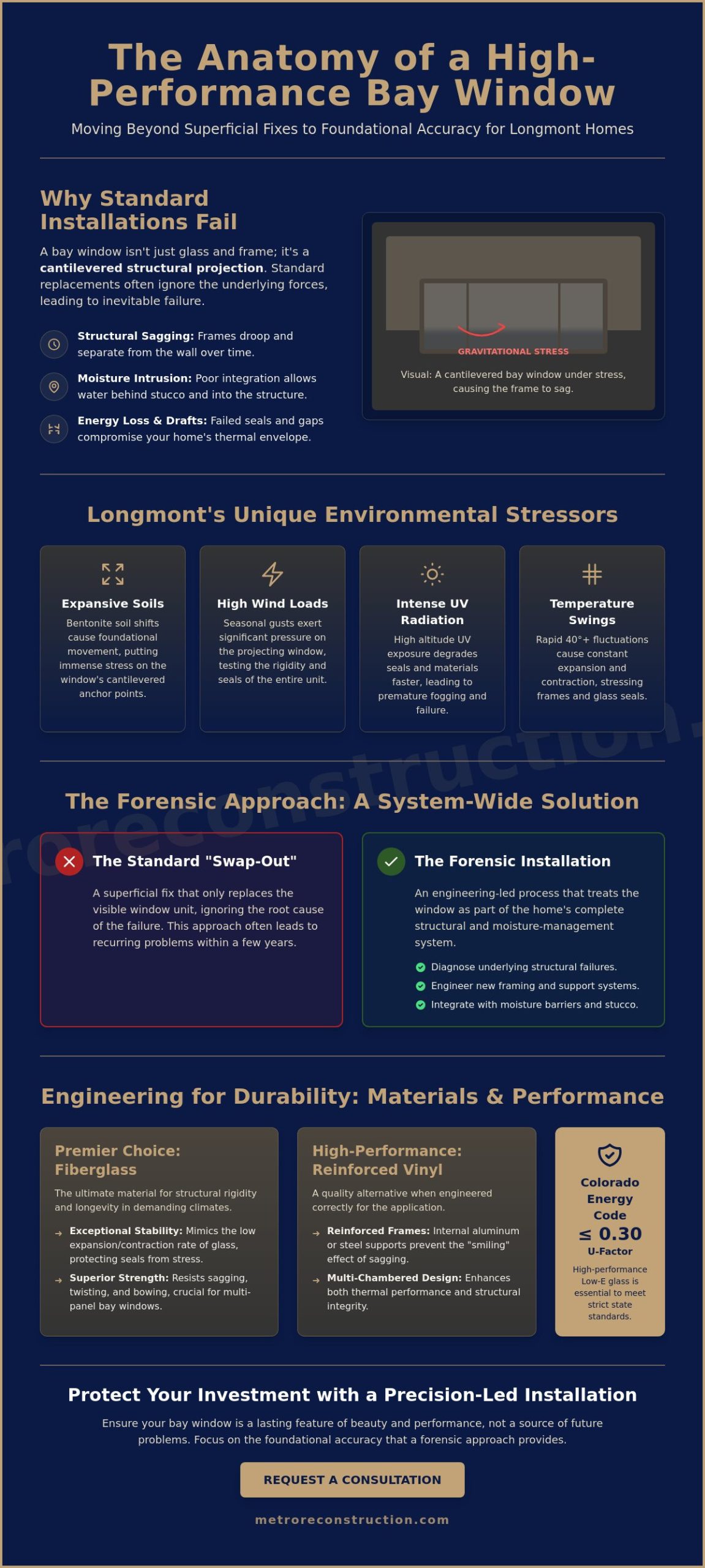
In Longmont, the combination of expansive bentonite soils and significant wind loads creates a demanding environment for these architectural projections. When the ground shifts due to soil expansion, the cantilevered window is frequently the first component to show signs of distress. This is why a professional bay window replacement Longmont must begin with a forensic diagnostic. We don’t simply swap out the glass; we investigate the underlying structural origins of the previous unit’s failure. By viewing the window as a critical part of the building’s complete outer system, we ensure that the moisture barrier, structural framing, and exterior finish work in unison to protect your investment.
Understanding the Cantilever Challenge
Because bay windows project outward, they distribute weight through a cantilevered system rather than direct vertical support. Most units are secured using either overhead support cables anchored to the house headers or structural knee braces installed beneath the unit. In many older homes across the Front Range, these supports have stretched or settled over time, leading to visible structural sagging. You might notice windows that stick, gaps appearing at the top of the unit, or hairline cracks in the surrounding stucco. Precision framing is required during a bay window replacement Longmont to ensure the rough opening is square and reinforced to handle these gravitational stresses.
Front Range Climate Stressors
The local environment in Boulder County is notoriously harsh on specialized building systems. Rapid temperature swings, which can see fluctuations of 40 degrees in a single afternoon, cause constant expansion and contraction in window frames. At our high altitude, intense UV radiation degrades window seals faster than in lower elevations, which often leads to premature seal failure and fogging. Additionally, Longmont’s seasonal wind gusts exert immense pressure on a projecting window. We prioritize airtight seals and rigid frame materials to combat these stressors, ensuring your new window functions as a high-performance component of your home’s protective building envelope.
Engineering the Perfect Bay Window: Materials and Design
The engineering of a bay window assembly is just as critical as the structural opening it occupies. Because these units are comprised of multiple panels joined at precise angles, the choice of frame material directly impacts the long-term rigidity of the entire system. A bay window replacement Longmont project requires materials that can withstand the physical stress of a cantilevered position while maintaining a tight thermal seal. Modern configurations typically utilize a combination of fixed center panes for unobstructed views and flanking casement or double-hung windows for ventilation. Balancing these elements requires an understanding of both the architectural intent and the Building Code Requirements regarding egress and safety glass in specific residential zones.
High-Performance Frame Selection
Fiberglass frames have emerged as a premier choice for bay windows due to their exceptional structural rigidity. Unlike standard vinyl, which can have a higher rate of expansion and contraction, fiberglass mimics the movement of the glass it holds, reducing the risk of seal failure. This stability is vital for bay units where multiple frames are mulled together. For homeowners preferring high-quality vinyl, it’s essential to select multi-chambered frames reinforced with internal aluminum or steel. These reinforcements prevent the “smiling” or sagging effect common in lower-grade installations. Darker frame profiles, which are currently trending in Boulder County, require specialized coatings to resist UV degradation and maintain color integrity under the intense Colorado sun.
Glass Packages for Colorado Altitudes
Longmont’s elevation necessitates a specific approach to glass engineering. Standard insulated glass units can bulge or collapse due to the pressure difference between the factory and our high-altitude environment. To prevent this, we prioritize windows equipped with capillary tubes, which allow the internal pressure to equalize without losing the protective argon or krypton gas fills. Starting in 2026, residential windows in Colorado must meet a U-factor of 0.30 or less. Achieving this standard often involves triple-pane glass or advanced Low-E coatings that reflect solar heat while protecting your interior finishes from UV damage. If you’re concerned about how these technical specifications apply to your home, discussing your options with Metro Reconstruction can help clarify the best path forward for your specific property.
Thermal performance is further enhanced by the use of warm-edge spacers and non-conductive materials between the glass layers. These components work together to eliminate the “drafty window” sensation often felt during Longmont’s winter months. By selecting a glass package tailored for the Front Range, you ensure that your bay window remains a source of comfort rather than a point of significant energy loss. This forensic level of detail in material selection is what distinguishes a permanent structural solution from a temporary aesthetic fix.
Integrating Bay Windows with Longmont’s Exterior Systems
A bay window replacement Longmont project is never just about the glass and the frame; it’s a critical intervention into your home’s building envelope. Because a bay window projects beyond the primary exterior wall, it creates multiple transition points where the window unit meets the siding, stucco, or masonry. These intersections are the most common points of failure in standard installations. If the transition between the window frame and the building’s moisture barrier isn’t handled with technical precision, the resulting water intrusion can lead to catastrophic structural decay that remains hidden for years.
Our forensic approach begins with a careful assessment of the existing “complete outer system” before the old unit is even removed. We look for subtle indicators of moisture distress, such as localized staining or soft spots in the surrounding wall. Identifying these underlying structural origins allows us to address root causes rather than simply covering up damage with a new unit. By ensuring the weather-resistive barrier (WRB) is properly integrated with the new window’s flashing, we create a continuous shield against the Front Range’s driving rains and heavy snowmelt.
Stucco and Masonry Considerations
In Longmont, many homes feature stucco or masonry exteriors that require specialized handling during a window upgrade. Stucco is a reservoir system, meaning it naturally absorbs and releases moisture. When we perform a bay window replacement Longmont, we must carefully “tie in” the new window flashing with the existing drainage plane behind the stucco. This process often involves surgical cuts to the exterior finish to ensure the head flashing directs water away from the opening. For larger conversions or homes with significant damage, our team provides comprehensive stucco restoration to ensure the entire wall system is restored to its original integrity. Precision is non-negotiable in these scenarios.
Moisture Mitigation and Drainage
Effective moisture management relies on a redundant drainage strategy. We utilize high-performance head flashes and integrated sill pans to ensure that any water reaching the window assembly is immediately channeled back to the exterior. Without these components, water can pool at the base of the cantilevered unit, eventually rotting the wooden subfloor or even impacting the foundation’s stability over time. We also prioritize the use of professional-grade, high-movement sealants that maintain their elasticity during Colorado’s extreme temperature shifts. This level of detail ensures that your building envelope remains airtight and watertight, protecting your property preservation efforts for decades to come.
The Forensic Installation Process: What to Expect
A successful bay window replacement Longmont project relies on a methodical execution that prioritizes structural integrity over speed. We begin with a forensic diagnostic to determine why the previous unit failed. If the existing window is sagging or leaking, it’s often due to insufficient reinforcement or a breach in the building’s complete outer system. By identifying these underlying structural origins, we can correct the framing before the new unit is ever lifted into place. This ensures that the rough opening is perfectly square and capable of supporting the cantilevered load of the new assembly.
Precision framing involves more than just fitting the window into a hole. We reinforce the header and the seat board to prevent the “smiling” effect that plagues poorly supported units. Once the frame is secure, we apply a dual-barrier weatherproofing system. The primary barrier prevents bulk water intrusion, while the secondary barrier manages any incidental moisture, directing it safely to the exterior. This process ensures that the building envelope remains uncompromised, even during the intense wind gusts common in Boulder County. Every step is designed to provide the peace of mind that comes from a permanent, engineering-led solution.
Pre-Installation Structural Assessment
Before we begin the physical replacement, we conduct a thorough assessment of the surrounding wall and foundation. In some cases, localized settling in Longmont’s expansive soils may have shifted the wall itself. If we detect significant shifting or large cracks in the masonry, we may recommend foundation repair services to stabilize the home before proceeding with window work. This step prevents the new window from binding or leaking due to future structural movement. We also verify local building codes, including the 2024 International Codes, to ensure all egress and support requirements are met.
The Day of Installation and Beyond
On the day of installation, our team manages the workspace with meticulous care to protect both your home’s interior and your exterior landscaping. The bay window components are often assembled on-site to ensure every joint is sealed with precision. Once the unit is secured, we integrate the new moisture barriers into the existing wall system. After the exterior finish is seamlessly matched, we perform post-installation testing for air-tightness and smooth operation. If you’re ready to ensure your home is protected by a high-performance installation, contact Metro Reconstruction to schedule your structural assessment.
Partnering with Metro Reconstruction for Your Longmont Project
Metro Reconstruction brings four decades of specialized experience to every project in Boulder County. As a family-owned firm, we’ve built our reputation on property preservation rather than the high-volume, low-margin model that often leads to compromised results. This distinction is critical when managing a complex bay window replacement Longmont homeowners trust us with, as these projects require a level of technical precision that goes beyond simple carpentry. We view ourselves as dedicated partners in protecting your home’s long-term value. Our commitment to high-quality craftsmanship ensures that every component of your building’s outer system functions as a cohesive unit. We don’t just install products; we engineer solutions.
Our authoritative professionalism is grounded in a deep understanding of structural mechanics. We recognize that a bay window is a significant investment, and our quiet confidence comes from knowing our forensic approach prevents the common failures associated with standard installations. By focusing on the interaction between specific building elements and environmental stressors, we guide you through the complexities of the restoration process. This deliberate methodology creates a narrative of reliability, ensuring that the final result is both aesthetically pleasing and structurally unassailable. It’s a premium, engineering-led solution designed for those who value substance over a temporary patch.
Beyond the Window: A Holistic Building Approach
We don’t believe in surface-level patches. Instead, we focus on identifying the structural origins of a failure to prevent its recurrence. This methodology is central to our broader exterior home repair philosophy. If your window failure has compromised the surrounding wall, we have the in-house expertise to perform stucco and masonry repairs that integrate perfectly with the new installation. To provide our clients with complete budget certainty, we utilize fixed-price reconstruction fees. This approach eliminates the stress of hidden costs and ensures that the focus remains entirely on the quality of the restoration. We prioritize transparency, providing you with the difficult truths about your home’s condition rather than offering a low-quality, short-term fix.
Getting Started with Your Custom Bay Window
The path to a structurally sound home begins with a comprehensive consultation. We move from an initial forensic diagnostic to a detailed design phase, ensuring your new window meets both your aesthetic preferences and the specific energy requirements of the Front Range. Timing is also a factor in Colorado. We help you schedule your project to take advantage of optimal weather windows in our unpredictable climate. By choosing a partner who understands the hidden mechanics of your home, you’re choosing long-term stability. Schedule your structural window consultation today to begin the process of reinforcing your home’s beauty and integrity with a team of seasoned experts.
Securing Your Home’s Structural Future
A bay window represents more than just a scenic view; it’s a complex structural extension that requires a forensic approach to maintain its long-term integrity. By identifying underlying structural origins and integrating a complete outer system, you prevent the common failures of sagging or moisture intrusion that often plague standard installations. Selecting high-performance materials specifically engineered for the Front Range ensures your investment withstands Colorado’s intense UV radiation and seasonal wind loads. When you commit to a technical bay window replacement Longmont homes remain protected against the environmental stressors unique to our region.
As specialists in structural moisture mitigation, Metro Reconstruction brings over 40 years of Boulder County expertise to every project. We’ve been family-owned and operated since 1982, opting for engineering-led solutions that prioritize property preservation over high-volume sales. If you’re ready to address the hidden mechanics of your home’s exterior with a dedicated partner, Request a Forensic Window Consultation from Metro Reconstruction. Your property is a significant investment, and we’re here to ensure it remains sound and beautiful for decades to come.
Frequently Asked Questions
How long does a bay window replacement typically take in Longmont?
A standard bay window replacement Longmont homeowners undergo typically takes between two and four days for the physical installation phase. This timeline accounts for the careful removal of the old unit, structural framing adjustments, and the precise integration of new moisture barriers. Projects requiring extensive masonry or stucco restoration may extend slightly longer to ensure the building envelope is perfectly sealed and the exterior finish is matched with technical precision.
Do I need a permit for bay window replacement in Boulder County?
Yes, a building permit is required in Longmont because window replacement is considered a structural alteration beyond simple cosmetic changes. The City of Longmont is adopting the 2024 International Codes, which mandate professional verification of structural headers and safety standards for projecting units. We manage the permitting process as part of our comprehensive service to ensure your project complies with all local regulations and safety protocols.
Can a bay window be installed if my home has a stucco exterior?
Bay windows can be installed in stucco homes, provided the installation includes a forensic tie-in to the existing moisture barrier. Because stucco acts as a reservoir system, the new flashing must be integrated behind the drainage plane to prevent water from pooling behind the wall. Our expertise in both window installation and stucco restoration ensures a seamless, watertight transition that protects the structural integrity of the building’s outer system.
What is the difference between a bay window and a bow window?
The primary difference lies in the number of panels and the resulting architectural shape. A bay window typically consists of three panels, featuring a large center fixed pane and two flanking windows set at 30 or 45-degree angles. A bow window uses four to six panels of equal size to create a gentler, more rounded curve. Both configurations project beyond the exterior wall and require specialized support systems to manage their weight.
How do I know if my bay window is structurally failing or just drafty?
Drafts are often the result of degraded seals or poor glass insulation, while structural failure presents as physical distortion of the frame. If your window is sticking, showing gaps at the top of the unit, or if you notice hairline cracks in the exterior stucco, the unit is likely sagging. We use forensic diagnostics to identify these structural origins, ensuring we fix the underlying framing rather than just replacing the glass.
Are bay windows energy efficient enough for Colorado winters?
Modern bay windows are highly energy-efficient, provided they meet the 2026 Colorado standard of a 0.30 U-factor or less. High-altitude glass packages featuring Low-E coatings and argon or krypton gas fills are essential for managing the intense solar gain and cold winters in Longmont. These components work together to maintain a stable interior climate, ensuring your home remains comfortable regardless of rapid Front Range temperature swings.
Can I change a flat window into a bay window during a remodel?
You can change a flat window into a bay window, but the process requires creating a new structural opening and installing a reinforced header. This conversion involves adding cantilevered supports, such as overhead cables or knee braces, to handle the weight of the projecting unit. We treat these remodels as custom engineering projects to ensure the new bay window integrates perfectly with your home’s existing structural system and moisture barrier.