
That hairline crack in your stucco isn’t just an eyesore; it’s a diagnostic symptom of a failing moisture management system. You’ve likely felt the frustration of paying for a quick patch only to see the same damage return after a single Colorado freeze-thaw cycle. With insurance premiums in Colorado rising 57.9 percent between 2018 and 2023, you can’t afford to guess whether your exterior home repair is actually fixing the problem.
This guide will show you how to move beyond surface level fixes by applying a forensic approach to your home’s exterior envelope, ensuring your property remains resilient against the Colorado Wildfire Resiliency Code requirements that went into effect April 1, 2026. We’ll examine the root causes of structural failure in stucco and masonry, and explain how a comprehensive strategy for window replacement and moisture protection secures your investment for the long term. By understanding the mechanical relationship between your home’s outer layers, you can transition from temporary band-aids to high-performance solutions built right the first time.
Key Takeaways
- Understand the concept of the integrated exterior envelope and how a failure in one component, such as improper flashing, compromises the entire structural system.
- Learn to prioritize exterior home repair based on structural risk, focusing on high-impact areas like stucco restoration and window integrity.
- Discover why a forensic reconstruction approach identifies and fixes the root cause of moisture damage rather than simply applying a temporary handyman patch.
- Utilize a localized annual maintenance checklist to spot early warning signs of failure before they escalate into expensive structural issues.
- Gain clarity on selecting a reconstruction specialist who provides fixed-price project fees for better transparency and long-term property preservation.
Understanding the Exterior Envelope: Why Boulder County Homes Require Specialized Care
A home is not merely a collection of isolated components like siding, windows, and a roof. It is an integrated system known as the building envelope, which acts as a sophisticated physical separator between the conditioned interior and the volatile Colorado environment. When one element of this system fails, the consequences are rarely contained. For instance, a small deficiency in window flashing can allow moisture to migrate deep into the wall assembly, compromising the structural integrity of the surrounding stucco or masonry. Effective exterior home repair requires more than a visual patch; it demands a forensic understanding of how these components work together to manage energy, air, and moisture flow.
Boulder County presents a unique set of environmental stressors that accelerate material degradation. With over 300 days of high-intensity UV exposure and rapid freeze-thaw cycles, building materials expand and contract with violent frequency. This constant movement creates stress fractures that allow water to enter the system. Once moisture is trapped behind the exterior skin, the semi-arid air often cannot reach it to dry the substrate, leading to silent rot. This is why we emphasize that every project must be built right the first time. A superficial fix ignores the underlying mechanical relationship between building parts, leading to repeated failures and mounting costs for the homeowner.
The Role of Moisture Mitigation in Colorado
Homeowners in our semi-arid climate often overlook water management, assuming that low humidity protects them from significant rot. This is a dangerous misconception. In Boulder County, moisture mitigation is a forensic process of identifying hidden leak paths before they reach the structural framing. Improper drainage or failing sealants often direct water toward expansive soils, which can cause foundation shifts and internal drywall cracking. For homeowners concerned about soil movement, professional foundation repair services in Boulder can identify whether shifting ground is the true root cause of your exterior damage. We focus on the root cause of water intrusion, ensuring that every repair revitalizes the home’s ability to shed water effectively rather than just hiding the damage behind a fresh coat of paint.
High-Altitude UV and Material Degradation
At an elevation of 5,000 feet and higher, the atmosphere provides significantly less protection from ultraviolet radiation. Standard paints and sealants that thrive in coastal or midwestern climates fail rapidly here, often becoming brittle and cracking within just a few seasons. This UV-driven thermal expansion is the primary root cause of premature stucco and siding failure in Front Range communities. Protecting your investment requires high-performance materials and specialized installation techniques designed to withstand the rigors of mountain environments. We prioritize durability over aesthetic shortcuts, ensuring your home remains resilient against the elements for decades.
A Roundup of Critical Exterior Home Repairs for 2026
Prioritizing exterior home repair requires a shift in perspective from aesthetic improvement to structural preservation. In the high-altitude environment of Boulder County, a hairline crack in your siding is rarely just a cosmetic blemish; it’s often a gateway for moisture that compromises the building’s internal framing. We utilize a forensic approach to distinguish between surface level wear and systemic failure. This methodology involves tracing cracks back to their origin to determine if they’re caused by natural settling or by a critical breakdown in the moisture management system. Identifying these root causes early prevents the need for repetitive, costly repairs that only mask the symptoms of a deeper problem.
Maintaining a rigorous annual maintenance checklist helps homeowners spot these issues before they escalate. However, when structural risks are identified, the solution must be comprehensive. If you suspect your home’s exterior is suffering from more than just surface wear, a professional evaluation of your building envelope can prevent minor issues from becoming catastrophic failures.
Stucco Restoration and EIFS Repair
Synthetic stucco, or Exterior Insulation and Finish Systems (EIFS), often fails when water becomes trapped behind the foam insulation layers. Signs of failure include soft spots, bulging, or dark discoloration near window corners. Simply patching these areas is a temporary fix that ignores the drainage plane behind the material. For long-term resilience, stucco restoration must involve a full-scale assessment of the weather-resistive barrier to ensure the system sheds water as intended. We focus on total stucco replacement when the substrate is compromised, ensuring the new system is built right the first time. Homeowners planning to expand their living space should also understand that stucco for home additions in Boulder demands the same forensic-level integration to prevent moisture failures at the critical junction where new and existing structures meet.
High-Performance Window Replacement
Windows are the most vulnerable points in your home’s exterior envelope. Improper window installation is a primary cause of hidden wall rot because water often enters through gaps in the flashing rather than the window itself. In our climate, fiberglass replacement windows offer superior thermal stability, resisting the warping that affects vinyl or wood during rapid temperature swings. Many homeowners assume a leak is a glass failure, but the true culprit often hides behind the stucco or masonry, which is why completing an exterior home inspection before window replacement in Boulder is essential to ensure you aren’t installing new windows into a structurally compromised wall. If you’re searching for a reliable window installation service near me that understands the technical relationship between fenestration and the entire exterior envelope, our 2026 buying guide outlines exactly what to look for in a qualified partner. We ensure that new windows are perfectly integrated with the surrounding moisture barrier to eliminate leak paths and improve energy efficiency.
Masonry and Stone Veneer Integrity
Boulder’s masonry often suffers from mortar deterioration and stone delamination due to the relentless freeze-thaw cycle. When mortar joints crumble, water reaches the substrate, leading to efflorescence or structural instability. Proper tuckpointing is essential to revitalize these surfaces and protect the home’s core. Specialized attention is required at transition points where stone meets stucco, as these areas require precision flashing to prevent moisture from bypassing the exterior skin. Our masonry work focuses on these critical junctions to ensure a high-performance, water-tight finish.
Forensic Reconstruction vs. Handyman Patches: Addressing the Root Cause
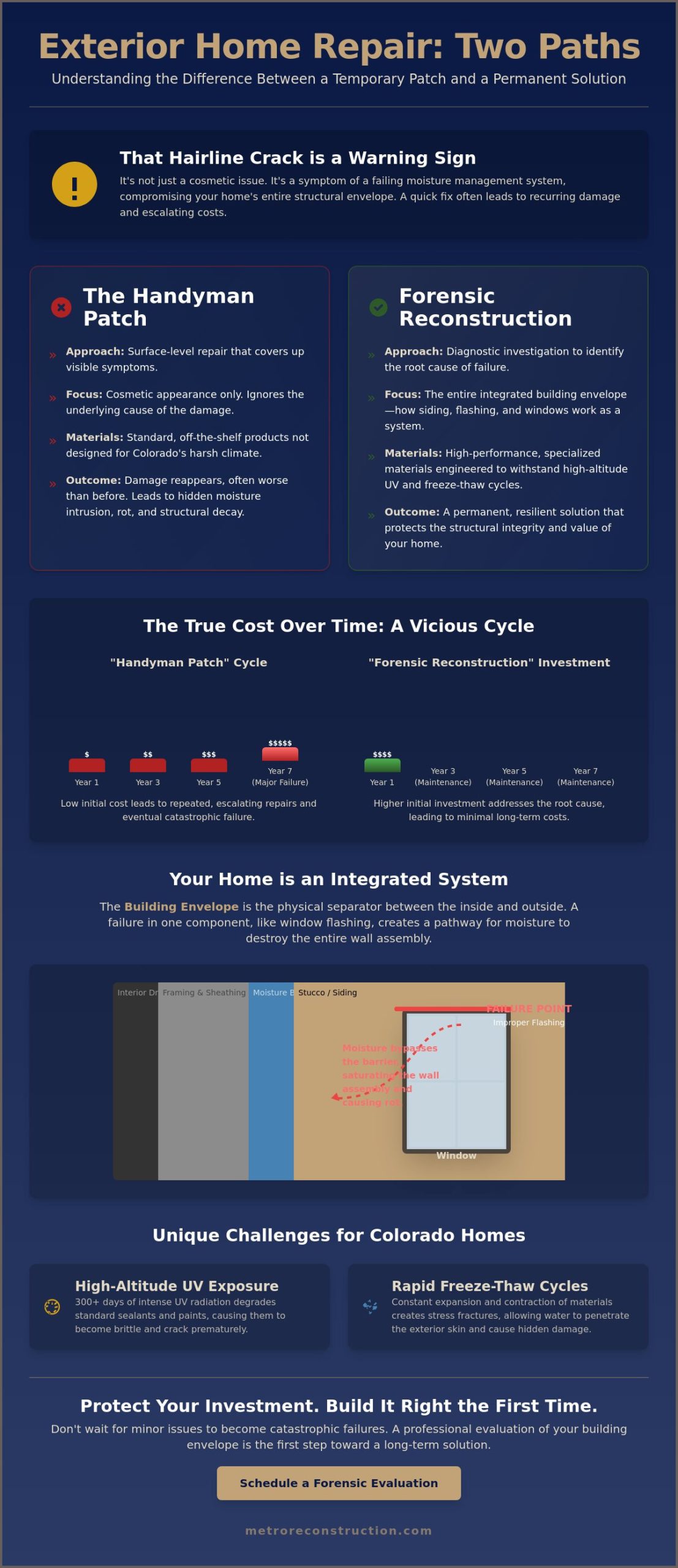
Homeowners often view exterior home repair as a series of aesthetic maintenance tasks, yet there’s a profound difference between a surface level patch and a forensic reconstruction. A handyman approach typically addresses symptoms; for example, painting over a water stain or applying caulk to a visible crack. While these fixes might improve appearances temporarily, they fail to investigate why the damage occurred in the first place. In contrast, forensic reconstruction utilizes an engineering-led methodology to identify the root cause of failure. It’s the difference between treating a cough and diagnosing the underlying infection. By the time a stain appears on your ceiling or a soft spot develops in your siding, the internal moisture management system has likely been compromised for months or years.
| Factor | Handyman Repairs | Forensic Reconstruction |
|---|---|---|
| Primary Focus | Surface Fixes and Symptoms | Root Cause Analysis |
| Material Selection | Standard Materials | High-Performance Materials |
| Warranty Scope | Limited Scope | Structural Warranty |
| Long-Term Goal | Temporary Patching | Engineering-Led Restoration |
Investing in a comprehensive solution offers a significantly higher return on investment than the cycle of annual patches. While a handyman might charge between $90 and $150 per hour for labor as of March 2026, those costs compound when the same exterior home repair issue returns every two seasons. A permanent fix protects your home’s valuation and prevents the exponential cost of structural framing replacement.
Why Small Repairs Can Mask Massive Problems
Small cracks in stucco or masonry are often the only external warning signs of significant wood rot within the wall assembly. When a non-specialist applies a patch over these cracks, they inadvertently trap moisture inside the envelope, accelerating the decay of your home’s structural skeleton. This is why it’s critical to consult a CSU Extension guide to hiring a contractor when dealing with moisture intrusion. You should stop “repairing” and start “reconstructing” the moment you identify recurring leaks, soft substrates, or signs of EIFS failure. These are indicators that the integrated system has failed and requires a specialist’s intervention.
The “Built Right the First Time” Philosophy
The commitment of Metro Reconstruction Services, Inc. to being built right the first time is more than a slogan; it’s an authoritative promise of durability. We approach every project with quiet confidence, knowing that our technical precision provides the peace of mind that a temporary fix never can. Complex exterior builds require professional project management to ensure that windows, flashing, and siding interact perfectly. This meticulous attention to detail ensures that your home isn’t just repaired, but revitalized to exceed modern performance standards, including the rigorous 2026 wildfire resiliency codes.
Boulder County Exterior Maintenance Checklist: What to Inspect Annually
Seasonal vigilance is the primary tool for preserving your home’s value in a climate as volatile as the Front Range. In Boulder County, the transition from winter to spring often reveals the heavy toll of the freeze-thaw cycle, making a biannual inspection a critical component of your exterior home repair strategy. You should focus your attention specifically on transition points where different materials meet, such as the junction between masonry and stucco. These areas are prone to differential movement, which can tear sealants and create direct paths for water intrusion. If you find that traditional materials require constant attention, consider fiber cement siding installation as a high-performance, low-maintenance alternative that resists the intense UV and moisture pressures of our mountain environment.
- Inspect for discoloration or soft spots at stucco-to-window junctions.
- Verify that kick-out flashing is present and unobstructed where rooflines meet vertical walls.
- Check for “fogging” between window panes, indicating a failed seal.
- Examine the ground slope near the foundation to ensure water moves away from the structure.
- Look for brittle or shrinking caulk around the entire exterior envelope.
Foundation and Soil Awareness
Expansive soils are a geological reality in Boulder and its surrounding communities. When these soils absorb moisture, they exert immense pressure on foundation walls, often resulting in a distinct stair-step cracking pattern in masonry mortar joints. It’s vital to maintain a proper grade where the soil slopes away at least 6 inches within the first 10 feet of the foundation. If you notice structural cracks or standing water near your walls, it’s time to call for a specialized assessment. While simple landscaping fixes might address minor drainage issues, recurring structural movement requires professional foundation repair services and a forensic reconstruction approach to prevent foundation failure.
The Envelope Inspection: Windows and Seals
At elevations of 5,000 feet and higher, the pressure differential between the inside of a double-pane window and the outside atmosphere can lead to premature seal failure. This isn’t just an aesthetic issue; it compromises your home’s thermal efficiency and creates a weakness in the moisture management system. Simultaneously, the 300-plus days of high-altitude UV exposure cause standard caulking to crack and pull away from window frames. You should also pay close attention to kick-out flashing at roof-to-wall intersections. If this component is missing or improperly installed, water will be funneled directly behind your siding or stucco, leading to silent rot in the structural framing. Understanding the technical requirements of a high-performance window installation service in Boulder County can help you identify whether your current windows meet the 2026 ENERGY STAR standards for the Northern Climate Zone. If your annual walk-through reveals signs of structural movement or moisture intrusion, contact us for a comprehensive building envelope assessment to prevent further degradation.
Selecting a Reconstruction Partner in Boulder County
Navigating the complexities of high-performance building systems requires a partner who understands the forensic nature of structural preservation. When vetting firms for your exterior home repair, you should look for specialists who move beyond the broad strokes of general contracting to address the specific mechanics of moisture management. One of the most significant advantages of choosing a dedicated reconstruction specialist is the implementation of Fixed-Price Reconstruction Project Fees. This pricing model provides total budget transparency and eliminates the financial uncertainty that often accompanies large scale restoration projects. By defining the scope with technical precision before the first tool is lifted, you ensure that your investment is protected from the unexpected change order culture prevalent in the broader construction industry.
The Metro Reconstruction Services, Inc. Difference
Our approach is defined by the persona of the Wise Craftsman; we’re a team that values substance over style and meticulous accuracy over high-pressure marketing. As a family-owned company established in 1982, Metro Reconstruction Services, Inc. has spent over four decades refining the techniques necessary to protect properties in the Front Range and Mountain communities. This longevity informs our commitment to protective care and professional integrity. Whether we’re revitalizing a custom residential estate or managing a specialized commercial remodel, our focus remains on providing a permanent structural solution that honors the original architecture while exceeding modern performance standards.
Next Steps: From Forensic Analysis to Restoration
The restoration process begins with an authoritative forensic analysis designed to uncover the hidden leak paths and structural weaknesses discussed throughout this guide. During this initial consultation, we provide a clear explanation of how your home’s components are interacting and where the envelope has failed. Following the diagnosis, our team transitions into personalized project management, ensuring that every detail of the reconstruction adheres to our strict quality benchmarks. This steady, logical flow from analysis to execution is what allows us to guarantee that every project is built right the first time. Protect your investment with Metro Reconstruction Services, Inc.’s expert exterior services.
Securing Your Home’s Structural Future
The transition from viewing your home as a collection of parts to an integrated exterior envelope is the first step toward true property preservation. As we’ve explored, exterior home repair in the Front Range is no longer about surface patches; it’s an engineering-led commitment to moisture management and structural integrity. By addressing the root causes of failure now, you prevent the high costs of repeated repairs and ensure your home meets the evolving resiliency standards of our unique mountain climate.
Metro Reconstruction Services, Inc. provides the deep expertise and forensic methodology required to revitalize your home with quiet confidence. With over 40 years of experience in Boulder County and the Front Range, our team specializes in moisture mitigation and the restoration of structural integrity. Our fixed-price project fees offer you total budget transparency, ensuring that your high-performance solution is delivered without financial surprises. Consult the Forensic Experts at Metro Reconstruction Services, Inc. to begin the journey toward a home that is truly built right the first time. Your investment deserves the protection of a partner dedicated to substance and durability.
Frequently Asked Questions
What are the signs that my Boulder home needs structural foundation repair?
Stair-step cracks in masonry or bowing basement walls indicate structural distress caused by Colorado’s expansive soils. You might also notice doors that stick or visible gaps where the wall meets the ceiling, signaling that the foundation is no longer providing uniform support. These symptoms suggest the soil is shifting under the weight of the home, requiring a professional assessment to prevent further movement.
Is stucco fireproof, and does it provide protection against Colorado wildfires?
Traditional stucco is non-combustible and provides a high level of fire resistance, making it an excellent material for meeting the Colorado Wildfire Resiliency Code adopted by April 1, 2026. While no material is entirely fireproof under extreme conditions, the cementitious nature of stucco acts as a significant barrier against ember ignition and radiant heat. This is a critical consideration for properties in the Wildland-Urban Interface affected by the 2021 Marshall Fire.
Why do windows fail more frequently in high-altitude areas like Boulder County?
Pressure differentials at elevations above 5,000 feet cause the seals in double-pane windows to expand and eventually rupture. This leads to the loss of insulating argon gas and the subsequent fogging between panes that many homeowners observe. Additionally, the 300 plus days of high-intensity UV exposure in the Front Range cause vinyl frames to warp and sealants to become brittle, compromising the entire exterior envelope.
How do expansive soils in Colorado affect my home’s exterior masonry?
Colorado’s bentonite-rich soils expand and contract with moisture changes, exerting thousands of pounds of pressure against masonry walls. This movement causes mortar joints to crack and stone veneers to delaminate from the substrate. Without proper moisture management and site grading, this cycle leads to permanent structural damage that requires professional masonry restoration to revitalize the building’s integrity and protect the substrate.
What is the difference between a handyman repair and forensic reconstruction?
A handyman repair focuses on surface level symptoms, whereas forensic reconstruction identifies the root cause of the failure. For example, a handyman might paint over a water stain, but a forensic approach involves deconstructing the wall assembly to fix the failing flashing that allowed the leak. This engineering-led methodology ensures your exterior home repair is built right the first time rather than requiring a repeat fix later.
How often should I have a professional roof and envelope inspection in the Front Range?
You should schedule a professional inspection of your roof and entire exterior envelope at least twice a year, specifically in the spring and fall. These biannual checks allow you to identify UV-induced sealant failure or damage from the 57.9 percent increase in hail-related claims seen between 2018 and 2023. Early detection prevents minor leaks from evolving into costly structural rot that compromises the home’s skeleton.
Can moisture intrusion be fixed without replacing the entire siding or stucco?
Targeted moisture mitigation is possible if the underlying structural framing hasn’t yet succumbed to rot. By utilizing forensic tools to trace the leak path, we can often replace specific sections of flashing or localized areas of stucco to restore the envelope’s integrity. However, if the water barrier has failed globally, a more comprehensive exterior home repair may be necessary to protect the home’s long-term value and structural safety.
What are the benefits of fiber cement siding for homes in Mountain communities?
Fiber cement siding is prized in mountain communities for its class A fire rating and its immunity to rot and wood-boring insects. Unlike natural wood, it doesn’t warp or crack under the intense thermal expansion caused by high-altitude UV rays. This material provides a durable, low-maintenance solution that aligns with the strict wildfire mitigation requirements enforced in Boulder County as of the April 2026 regulatory updates.