
What if the hairline fracture in your basement wall is actually a forensic map of the ground shifting beneath you? For many Boulder homeowners, the sight of a sticking door or a new crack triggers a deep anxiety about Colorado’s notorious expansive soils. You’re likely seeking foundation repair services because you want a permanent resolution, yet the sea of conflicting contractor advice only adds to the confusion. It’s frustrating to feel like you’re guessing when the structural integrity of your home is at stake.
We believe that protecting your property requires an analytical approach that treats your house as a complete exterior envelope. This guide will help you navigate the complexities of structural stabilization by explaining the engineering-led solutions necessary for our unique climate. We’ll preview the impact of the 2024 International Building Codes, discuss why local construction costs trend 8% higher than the national average, and show you how a forensic diagnosis leads to lasting peace of mind. You deserve a home that’s built right the first time, supported by a foundation that’s as rugged as the Front Range itself.
Key Takeaways
- Understand how Colorado’s expansive bentonite soils create a cycle of swelling and contraction that compromises structural integrity.
- Learn to distinguish between cosmetic flaws and structural red flags that necessitate professional foundation repair services, focusing on symptoms like stair-step masonry cracks and misaligned frames.
- Discover why helical and push piers provide the deep-soil stabilization required to secure a home against the unique geological pressures of the Front Range.
- Recognize the critical link between moisture management and foundation health to ensure your repair addresses the root cause rather than just the visible symptoms.
- Gain peace of mind by understanding how a forensic approach protects your property investment and ensures your home is built right the first time.
Understanding Foundation Failure in Colorado’s Front Range
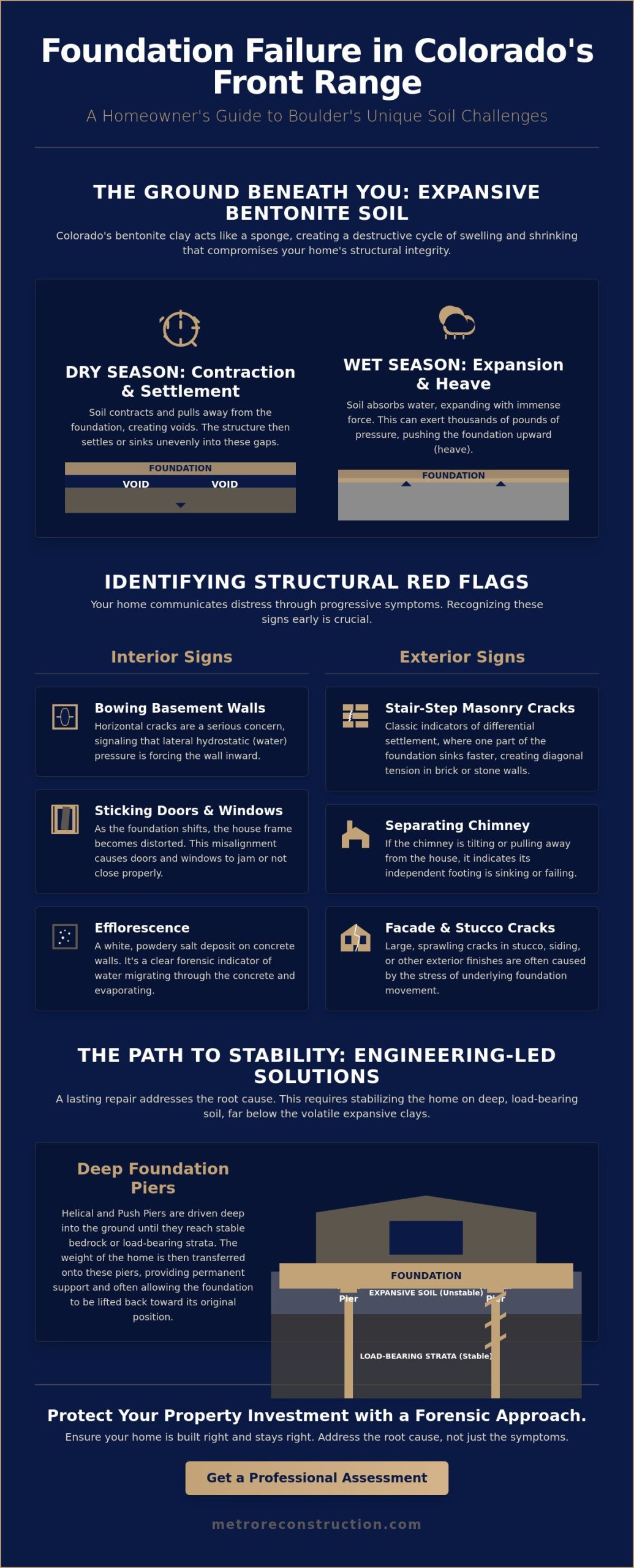
Boulder’s geography presents a unique set of challenges that standard construction methods often fail to anticipate. The geological profile of the Front Range is heavily influenced by bentonite, a type of clay mineral that acts like a sponge. Expansive soil is a primary driver of Colorado structural instability because it exerts immense pressure on a home’s footprint as moisture levels change. When these clays absorb water, they can expand significantly in volume, creating thousands of pounds of pressure per square foot against your concrete walls.
This cycle of swelling and shrinking is exacerbated by Boulder’s semi-arid climate and high-altitude conditions. During dry spells, the soil contracts and pulls away from the foundation, creating voids that allow the structure to settle or shift unevenly. When heavy spring rains or snowmelt arrive, water fills these gaps and triggers rapid expansion. This constant movement fatigues the building’s materials over time. Additionally, the frequent freeze-thaw cycles common in the mountains can cause moisture trapped within concrete pores or masonry joints to expand, leading to spalling and deep structural cracking that eventually requires professional foundation repair services.
The Science of Soil Heave vs. Settlement
Understanding the difference between heave and settlement is vital for a correct forensic diagnosis. Heave occurs when expansive soils push the foundation upward, while settlement happens when the soil beneath the footings fails to support the building’s weight. Many homes in the Front Range were built on uncompacted fill dirt that doesn’t adhere to strict Foundation engineering principles, leading to localized sinking. Our local precipitation patterns mean that one side of a house might be saturated while the other remains dry, causing the foundation to tilt or “rack” as the soil reacts inconsistently across the site.
Hydrostatic Pressure and the Exterior Envelope
Water accumulation against your home’s subterranean walls creates hydrostatic pressure, a lateral force that can push a basement wall inward. This bowing is a clear sign that the moisture management systems around your property have failed or were never properly installed. We view the foundation as the critical first line of defense for your entire exterior envelope. If the base of the structure is compromised, every other component, from your masonry work to your window installations, will eventually show signs of distress. Investing in comprehensive foundation repair services ensures that the root cause of these issues is neutralized, ensuring your home stays built right the first time.
Identifying Structural Red Flags: When to Seek Foundation Repair Services
A home communicates its distress through a series of progressive symptoms. While a single hairline crack might seem like a minor aesthetic nuisance, it often serves as a forensic indicator of significant movement within the soil profile. Recognizing these red flags early is the difference between a targeted intervention and a total structural failure. Identifying the specific moment to engage foundation repair services requires an understanding of how moisture and pressure interact with your home’s exterior envelope. Ignoring these signs doesn’t make them go away; it only increases the eventual cost of reconstruction.
Basement walls offer some of the most critical data points for a forensic analysis. Horizontal cracking is particularly concerning because it signals that lateral hydrostatic pressure is forcing the wall to bow inward. You might also notice efflorescence, which is a white, powdery salt deposit left behind when water evaporates after migrating through the concrete. These deposits aren’t just unsightly. They’re a clear signal that your moisture management system is failing and that the structural integrity of the concrete is being compromised from the outside in.
Exterior Signs: Brick, Stucco, and Masonry
The most visible warnings appear on the building’s facade. In Boulder County, stair-step cracks that follow the mortar joints of a brick or stone wall are classic indicators of differential settlement. This occurs when one portion of the foundation sinks faster than the rest, creating diagonal tension that the masonry cannot withstand. For homes with a cementitious finish, these movements often lead to the need for stucco restoration to seal the envelope against water intrusion. Vertical cracks can also occur, but diagonal patterns are more frequently tied to Colorado’s challenging soil conditions. You might also notice chimneys or porches beginning to pull away from the main structure, leaving gaps that invite pests and moisture. When recurring fissures appear in your home’s exterior cladding, a forensic approach to stucco and masonry repairs can identify whether the root cause is soil movement or moisture intrusion before the damage spreads further.
Interior and Functional Indicators
Structural movement eventually manifests inside the living space through functional failures. You might find that doors suddenly stick or refuse to latch properly. This happens because the door frame has been forced out of square by a shifting foundation. Similarly, gaps may appear between window frames and the surrounding drywall, or you might see nail pops where the drywall fasteners are pushed out as the underlying studs twist. Sloping floors are another decisive sign; even a slight pitch can indicate that the floor joists are no longer level. If these symptoms sound familiar, seeking a forensic structural evaluation can prevent these cosmetic issues from becoming a budget-breaking crisis.
Engineering-Led Solutions: Piers, Piles, and Stabilization Methods
Resolving structural failure requires moving beyond surface-level patches to address the actual mechanics of the building. High-performance foundation repair services utilize mechanical systems designed to bypass unstable upper soil layers and anchor the structure to competent material. This engineering-led approach ensures that once a home is stabilized, it remains so regardless of future moisture cycles. Selecting the correct piering system depends on a forensic evaluation of the building’s weight, the severity of the settlement, and the specific composition of the underlying earth. Effective foundation repair services aren’t just about lifting a floor; they’re about moisture management and long-term soil interaction.
Deep Foundation Stabilization Techniques
Steel piering systems have largely replaced older concrete cylinder methods in the Front Range because they offer superior durability and precision. Helical piers, which feature screw-like plates, are mechanically rotated into the ground. They’re particularly effective for residential builds because they handle both tension and compression loads, making them ideal for resisting the upward heave of expansive clays. In contrast, push piers utilize the weight of the building itself, using hydraulic equipment to drive steel sections deep into the earth until they reach load-bearing strata or bedrock. This distinction is critical because of Colorado’s unique geology, where shallow soils are often too volatile to support a heavy structure. For mountain community sites with limited access or complex rock layers, we often employ micropiles. These smaller-diameter piles are drilled and grouted, providing high-performance stability where traditional heavy machinery cannot operate.
Wall Bracing and Carbon Fiber Reinforcement
When lateral pressure from saturated soil causes basement walls to bow, the solution must reinforce the entire exterior envelope. Heavy-duty steel I-beams provide a decisive mechanical fix for severely inward-curving walls, effectively transferring the load from the failing masonry back to the floor and ceiling joists. For less severe cases where homeowners wish to maintain a finished basement appearance, carbon fiber straps offer a low-profile alternative. These high-tensile reinforcements are bonded directly to the wall, preventing further movement without the bulk of traditional steel. Integrating these stabilization methods into a broader plan for exterior home repair ensures that the structural core of the building is protected before aesthetic restorations begin. This comprehensive strategy is the only way to guarantee a project is built right the first time.
The Forensic Inspection: Why Root Cause Analysis Matters
A forensic inspection starts with a fundamental question: why is the structure moving? While many contractors simply sell a piering system, high-quality foundation repair services require a deep dive into the hidden mechanics of the building. We don’t just look at the crack in the basement; we look at the roofline, the grading, and even the window installation details. For instance, if a window was installed without proper flashing, water can migrate behind the siding and pool at the base of the foundation wall. This localized saturation softens the soil, leading to the differential settlement we’ve discussed. Treating the foundation without addressing these exterior envelope failures is like bailing water out of a sinking boat without plugging the hole.
We treat every project as a unique engineering puzzle. By evaluating the entire exterior envelope, we can identify how different systems are interacting to cause structural distress. This comprehensive view allows us to move beyond surface-level symptoms. It’s about understanding the relationship between moisture, soil chemistry, and structural load. When you address the root cause, you aren’t just performing a repair; you’re investing in the long-term preservation of your property. If you suspect your home’s exterior is contributing to structural issues, schedule a forensic inspection to identify the true source of the problem.
Moisture Mitigation and Drainage Strategy
Effective moisture management is the cornerstone of structural preservation. Gutters and downspouts must be more than present; they must be functional and extended far enough to discharge water away from the active soil zone. If the grading around your home has settled over the years, surface water will naturally flow toward the footing, increasing hydrostatic pressure and accelerating soil expansion. We emphasize that while waterproofing coatings are helpful for preventing dampness, they aren’t a substitute for structural stabilization. You must address the water’s path and the soil’s reaction to it simultaneously to achieve a permanent result.
The ‘Built Right’ Methodology
Our “Built Right” philosophy is rooted in technical precision and transparent communication. We provide a forensic scope of work that details the relationship between different building components, ensuring we solve the root cause rather than just masking symptoms. By offering a fixed-price scope based on engineering data, we protect your investment from the “hidden costs” that often plague less thorough contractors. This level of craftsmanship provides the peace of mind that comes from knowing your home is structurally sound from the ground up. It’s a commitment to doing the job right the first time, supported by over 40 years of local expertise.
Metro Reconstruction: Decisive Structural Mitigation for Boulder
Selecting a partner for structural stabilization is a significant decision that impacts your property’s value for decades. At Metro Reconstruction, we bring over 40 years of specialized experience to Boulder County and the Front Range, operating as a family-owned firm that prioritizes high-performance results over high-volume sales. We understand that homeowners facing structural distress are often overwhelmed by conflicting advice; this is why our approach is rooted in the persona of the Wise Craftsman. We’d rather explain the difficult truth of a structural failure than offer a cheap, temporary patch that will inevitably fail. Our goal is to ensure your home is built right the first time, protecting your investment through engineering-led foundation repair services that address the specific mechanics of your site.
Our analytical depth allows us to see the relationship between different building components that others might miss. We don’t view a sinking footing in isolation. Instead, we evaluate how soil movement, moisture management, and the condition of the entire exterior envelope contribute to the building’s current state. This holistic perspective ensures that the solutions we implement are both durable and comprehensive. By focusing on the root cause of the movement, we provide our clients with the quiet confidence that comes from knowing their home is anchored by a permanent, professional fix.
Serving the Front Range and Mountain Communities
Boulder’s rugged terrain and unique geographic features require a contractor who understands the local geology. We’ve spent decades navigating the challenges of high-altitude construction, from modified concrete mixes to the complexities of limited-access mountain project sites. Our technical proficiency extends across both custom residential restorations and complex commercial remodeling, allowing us to apply a sophisticated level of corporate polish to every job. Whether we’re performing masonry work on a historic property or stabilizing a modern mountain retreat, our commitment to reliability and personalized project management remains the cornerstone of our service.
Next Steps for Your Structural Preservation
The path to a stable, level home begins with a detailed forensic inspection. During this process, we document the symptoms of movement and use engineering data to identify the source of the distress. You can expect a transparent, straightforward consultation where we explain the “why” behind our recommendations. We provide a fixed-price scope of work that eliminates the uncertainty of hidden costs, ensuring you can invest in your home’s future with total peace of mind. If you’ve noticed stair-step cracks or sticking doors, don’t wait for the damage to progress. Contact Metro Reconstruction for a Professional Foundation Evaluation to secure the high-performance foundation repair services your property deserves.
Securing the Long-Term Stability of Your Property
Navigating the complexities of Front Range geology requires more than mechanical equipment; it demands a forensic understanding of how soil and structure interact. We’ve explored how expansive bentonite clays drive instability and why identifying the root cause within the entire exterior envelope is essential for a permanent fix. By choosing engineering-led solutions like helical or push piers, you ensure your home is anchored to stable strata, effectively neutralizing the seasonal cycles of heave and settlement. Investing in professional foundation repair services is about more than just leveling a floor; it’s about preserving the long-term value of your property.
Metro Reconstruction has been a dedicated partner in home preservation since 1982. As a family-owned and operated firm with over 40 years of Front Range expertise, we pride ourselves on a meticulous, engineering-led forensic approach that prioritizes durability over speed. We believe in providing the difficult truth about structural health so that your project is built right the first time. You don’t have to navigate these technical challenges alone. Secure Your Home’s Future with a Professional Foundation Assessment and gain the peace of mind that comes from a house built on a stable, scientifically sound foundation. Your home is your most significant investment; let’s ensure it stands strong for generations to come.
Frequently Asked Questions
What are the first signs that my Boulder home needs foundation repair services?
The earliest indicators often manifest as functional issues, such as doors that stick in their frames or windows that no longer latch properly. You may also notice stair-step cracks following the mortar joints in your exterior masonry or gaps appearing between the wall and the ceiling. These symptoms suggest the structure is racking due to soil movement, requiring professional foundation repair services to prevent further progression into catastrophic failure.
Is foundation repair covered by standard homeowners insurance in Colorado?
Standard homeowners insurance policies in Colorado typically exclude coverage for damage caused by earth movement, seepage, or expansive soils. Most providers categorize the swelling and shrinking of bentonite clays as a gradual geological process rather than a sudden, accidental peril. Coverage is generally only available if the structural failure results from a specific covered event, such as a sudden internal plumbing burst that saturates the footing area.
How long does a typical structural foundation repair project take to complete?
A typical residential stabilization project usually takes between three and ten days to complete, depending on the severity of the movement and the number of piers required. While minor crack injections might be finished in a single day, deep piering involves precise excavation and hydraulic lifting that requires a more deliberate pace. We prioritize a methodical execution to ensure every component is installed correctly, avoiding the long-term risks associated with rushed work.
Can I sell my home if it has a history of foundation repair?
You can certainly sell a home with a repair history, and in many cases, a professionally stabilized house is more attractive to informed buyers. Providing documentation of an engineering-led repair and a transferable warranty proves that the property’s structural integrity has been revitalized. Transparency regarding the root cause and the permanent solution offered by foundation repair services instills confidence, showing that the home was built right the first time.
What is the difference between a ‘crack repair’ and ‘structural stabilization’?
Crack repair is a localized treatment for a visible symptom, whereas structural stabilization addresses the underlying mechanics of the building’s movement. Filling a crack with epoxy or mortar is a temporary aesthetic fix that doesn’t stop the soil from shifting beneath the footing. Stabilization utilizes deep-foundation techniques, such as steel piers, to anchor the home to load-bearing strata, providing a permanent resolution to the root cause of the distress.
How do Colorado’s expansive soils specifically affect my home’s foundation?
Colorado’s soils contain high concentrations of bentonite, a mineral that expands significantly when wet and contracts during dry periods. This volume change exerts immense upward or lateral pressure against your concrete walls and footings, leading to heave or differential settlement. The constant cycling of these soils fatigues your home’s exterior envelope over time, eventually compromising the structural integrity of the entire building if moisture management isn’t strictly maintained.
What happens if I delay foundation repair for my residential property?
Delaying necessary repairs often leads to exponential increases in reconstruction costs as the damage spreads to other building components. What begins as a minor masonry crack can quickly evolve into bowed basement walls, misaligned rooflines, and failed window seals. Early intervention through a forensic assessment preserves your property investment and prevents the need for more invasive, expensive deep-soil stabilization methods that become necessary as the structural failure worsens.
Are the piers and piles used in foundation repair permanent?
High-performance steel piers and piles are considered permanent solutions because they bypass volatile upper soil layers to reach stable bedrock or load-bearing strata. Unlike concrete cylinders that can shift along with the surrounding clay, steel systems are designed to resist the Front Range’s aggressive moisture cycles. When installed using forensic engineering principles, these deep-foundation methods provide a lifetime of structural stability and the peace of mind that your home is finally secure.