
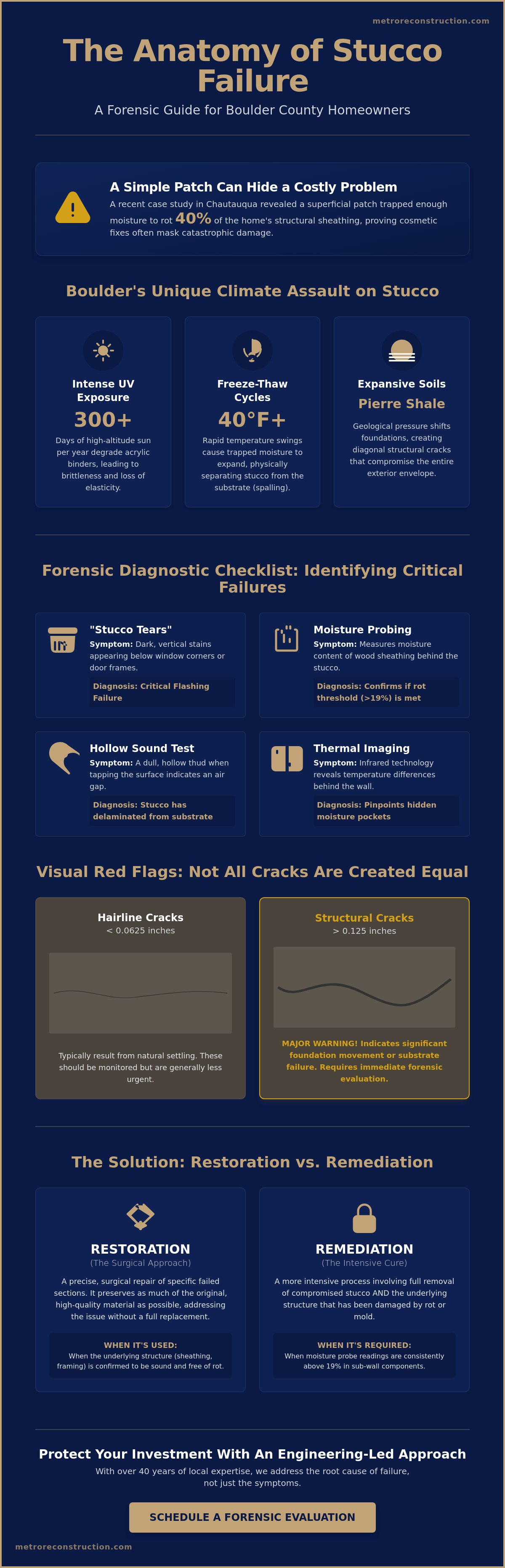
In June 2023, a homeowner in Chautauqua discovered that a superficial patch applied by a previous contractor had trapped enough moisture to rot 40 percent of their structural sheathing, proving that professional stucco restoration requires more than a bucket of cement. You likely suspect that the hairline cracks or dark staining on your exterior are more than just an aesthetic nuisance. It’s natural to worry about hidden mold or how Colorado’s expansive soils are shifting your foundation. We understand that your home is your most significant investment, and seeing it deteriorate feels like a breach of that security.
This article will teach you how to identify the signs of system failure and why a forensic approach is the only way to ensure long-term protection. We’ll examine the engineering-led techniques that address the root cause of moisture intrusion rather than just masking the symptoms. By the end, you’ll have a clear roadmap for a high-performance exterior envelope that preserves your home’s structural integrity and matches its original aesthetic perfectly.
Key Takeaways
- Learn to identify the root cause of moisture intrusion by recognizing critical symptoms like “stucco tears” that signal underlying flashing failures.
- Understand why professional stucco restoration requires a forensic, engineering-led approach to ensure the long-term preservation of your home’s exterior envelope.
- Discover the importance of treating your property as an integrated system where window replacements and masonry repairs are perfectly synchronized for maximum protection.
- Explore how forensic moisture mapping and surgical material removal provide a precise roadmap for resolving structural failures unique to the Boulder County climate.
- Gain the peace of mind that comes from applying over 40 years of local expertise to protect your investment from Colorado’s specific soil and environmental challenges.
Understanding Stucco Restoration in the Boulder County Climate
Professional stucco restoration represents a technical departure from standard home maintenance. It’s a comprehensive engineering process designed to identify and rectify failures within the exterior envelope rather than simply masking them. While a cosmetic patch might hide a hairline fracture for a season, true restoration addresses the moisture management systems and structural components hidden beneath the surface. To appreciate the necessity of this precision, homeowners often start by asking What is Stucco? and learning how its cementitious layers must work in harmony with the building’s drainage plane.
Boulder’s unique environment places extraordinary stress on these materials. The region experiences over 300 days of intense high-altitude sunshine annually. This high UV exposure accelerates the degradation of traditional acrylic binders, leading to brittleness and loss of elasticity. When the finish loses its ability to flex, the system becomes vulnerable to Colorado’s aggressive freeze-thaw cycles. During a typical winter, temperatures can swing 40 degrees in less than 12 hours. This rapid shift causes moisture trapped behind the lath to expand and contract violently, often resulting in delamination or “spalling” where the stucco physically separates from the substrate.
Why Traditional Stucco Fails in the Front Range
The geological makeup of Boulder County plays a significant role in exterior failures. Many local properties sit on expansive soils, such as the Pierre Shale formation, which can exert thousands of pounds of pressure on a foundation. This movement leads to structural shifting that manifests as diagonal cracking in the stucco. Additionally, Boulder’s elevation of 5,430 feet creates atmospheric pressure differentials that stress window-to-stucco transitions. We view surface cracks as symptoms rather than the disease. Our forensic approach identifies the root cause, usually a failure in the flashing or the weather-resistive barrier, ensuring the stucco restoration provides a permanent solution.
Restoration vs. Remediation: Which Do You Need?
Understanding the difference between restoration and remediation is vital for protecting your investment. Restoration involves the surgical repair of specific sections where the underlying structure remains sound. It’s a precise methodology that preserves as much of the original high-quality material as possible. Remediation is a more intensive process required when a forensic investigation reveals that the substrate, often the plywood sheathing or framing, has been compromised by rot or mold. We recommend a transition to full remediation if moisture testing reveals readings consistently above 19% in the sub-wall components. This data-driven decision ensures your home is built right the first time, preventing the need for repetitive, costly repairs. A successful stucco restoration isn’t just about the finish; it’s about the integrity of the entire building assembly.
The Forensic Approach: Identifying Signs of Stucco Failure
Effective stucco restoration begins with a forensic mindset. Rather than simply addressing aesthetic flaws, a professional evaluation examines the entire exterior envelope to understand how water interacts with the structure. This technical audit identifies where the system has been compromised and prevents further deterioration of the building’s underlying framing.
A comprehensive assessment typically includes the following diagnostic checklist:
- Stucco Tears: These dark, vertical stains beneath window corners or door frames signal a critical flashing failure.
- The Hollow Sound Test: Tapping on the surface can reveal delamination. A dull, hollow thud indicates the bond between the scratch coat and the substrate has failed.
- Thermal Imaging: We utilize infrared technology to detect temperature variances that suggest moisture pockets trapped behind the lath.
- Moisture Probing: This involves measuring the moisture content of the wood sheathing to determine if the levels exceed the 19% threshold where rot begins.
Visible Red Flags for Boulder Homeowners
Cracks are the most common symptom, yet their severity varies. Hairline cracks, often less than 0.0625 inches wide, might be the result of natural settling. However, structural cracks exceeding 0.125 inches often indicate significant movement or a failing substrate that requires immediate engineering attention. Beyond cracks, homeowners should watch for efflorescence. These white, powdery salt deposits appear when water moves through the stucco, dissolving minerals and depositing them on the surface as the moisture evaporates. If you notice bulging or bubbling in the finish, the system is likely experiencing advanced delamination. This occurs when moisture causes the wood sheathing to swell, pushing the stucco away from the wall. Colorado storms can also introduce impact damage that isn’t immediately obvious; understanding how to identify hail damage on stucco is an essential part of any thorough exterior assessment. If you spot these signs, scheduling an expert diagnostic assessment is the first step toward preserving your home’s value.
Hidden Dangers: Moisture Intrusion Behind the Lath
The most catastrophic damage often happens where you can’t see it. When moisture bypasses the weather-resistive barrier, it becomes trapped against the plywood or OSB sheathing. This creates a perfect environment for black mold and structural wood rot. It’s a sobering reality in our industry that visible damage represents only 10% of the actual moisture intrusion in a failing system. Many contractors offer localized patches, but these quick fixes are often futile. Without addressing the root cause, such as improper kick-out flashing or unsealed penetrations, localized repairs frequently lead to repeat failures within 24 months. We focus on high-performance moisture management to ensure the restoration protects the home for decades, not just seasons. We don’t believe in temporary patches; we believe in building it right the first time. For a broader understanding of how these failures connect to your home’s overall structural health, our guide to exterior home repair in Boulder County outlines the forensic approach needed to address every layer of the building envelope.
The Exterior Envelope: A Holistic Strategy for Lasting Repairs
At Metro Reconstruction, we don’t view a wall as an isolated surface. We treat your home as a single, integrated system known as the exterior envelope. When we perform stucco restoration, our focus extends beyond the visible finish to the underlying mechanics that protect your structural framing. Effective moisture management requires a deep understanding of how water moves across different materials. If one component fails, the entire system is compromised. We adhere to the mantra that every repair must be Built Right the First Time, ensuring that your investment remains protected against the unpredictable Boulder climate for decades.
This philosophy guides our forensic approach to reconstruction. We analyze why a previous system failed before we apply a single layer of new material. Often, the root cause isn’t the stucco itself but a failure in the flashing or the lack of a proper drainage plane. By addressing these hidden vulnerabilities, we provide homeowners with the peace of mind that comes from engineering-led solutions rather than surface-level patches.
Integrating Windows and Masonry
A significant portion of stucco failures, often as high as 90 percent, originate at the critical intersections where different materials meet. Window corners are particularly vulnerable because thermal expansion and contraction create micro-gaps in the seal. Our approach integrates professional window replacement with masonry work to create a unified barrier. By installing custom-fabricated pan flashing and ensuring seamless transitions between stone accents and stucco, we eliminate common pathways for water intrusion. This synergy ensures that the aesthetic beauty of your home’s facade is backed by rigorous engineering. We don’t just patch the area; we rebuild the interface to withstand 100-mile-per-hour wind-driven rain.
Advanced Moisture Mitigation Techniques
Modern standards for stucco restoration have evolved significantly since the 1990s. We often update older hard-coat systems by incorporating high-performance drainage planes and rainscreen technologies. These systems provide a dedicated space for moisture to escape before it reaches the wood sheathing. In the high-altitude environment of the Front Range, UV radiation and extreme temperature swings can cause standard caulking to fail within 24 months. We exclusively utilize high-altitude-rated sealants and integrated weep screeds to manage water shedding effectively. By addressing the root cause of moisture trapped behind the lath, we provide a permanent solution. Our systems include:
- Secondary weather-resistive barriers (WRB) for redundant protection against leaks.
- Stainless steel or heavy-gauge galvanized flashing to prevent long-term corrosion.
- Engineered weep screeds that allow the wall system to breathe and drain naturally.
By prioritizing the integrity of the exterior envelope, we ensure that every component works in harmony to repel moisture and preserve the structural health of your property.
The Restoration Process: Engineering-Led Steps to Success
A high-quality stucco restoration requires a forensic approach that goes beyond the surface. We view the home as a complete system where every layer must function in harmony to protect the interior. Our methodology follows a precise, five-step sequence designed to eliminate the root cause of failure. This isn’t just a repair; it’s a technical overhaul of the exterior envelope.
- Forensic Assessment: We begin with moisture mapping to identify hidden saturation levels. This data allows us to define the exact scope of damage before any demolition begins.
- Surgical Removal: Our team removes compromised material with precision. We inspect the underlying substrate and house wrap to identify exactly where the moisture management system failed.
- Structural Repairs: If water reached the framing, we stabilize the structure. This includes replacing rotted wood or addressing lath corrosion to ensure a solid foundation for the new materials.
- Three-Coat Application: We apply the scratch, brown, and finish coats. Each layer requires a minimum of 48 hours for proper curing to prevent the shrinkage cracks common in rushed projects.
- Protective Coating: The process concludes with a high-performance, UV-resistant coating. This adds a final layer of protection against Boulder’s high-altitude climate.
Texture Matching and Aesthetic Integrity
Matching an existing dash, sand, or float finish in Boulder requires a craftsman’s eye. Because Colorado’s intense sun alters the appearance of original stucco after 12 years of exposure, standard colors rarely match. We use professional color-matching technology and apply pH-balanced primers. These primers prevent efflorescence, the white salty deposits that often plague amateur repairs. Understanding the functional differences between stucco texture types is essential for selecting a finish that not only replicates the original appearance but also performs optimally in Colorado’s high-altitude climate. This ensures the stucco restoration is invisible to the naked eye.
Navigating Boulder County Regulations
Boulder County building codes are stringent regarding moisture barriers and structural integrity. For any restoration involving framing or foundation stabilization, permits are a legal requirement. We handle the documentation needed for insurance claims and future home appraisals. Having a licensed and insured contractor document the repair provides 100% transparency for future buyers. It proves the work was built right the first time. This documentation is vital for maintaining your property value during a sale.
Why Boulder Trusts Metro Reconstruction for Stucco and Masonry
Metro Reconstruction Services, Inc. has spent 42 years refining its approach to the building envelope across the Front Range and Colorado’s mountain communities. We aren’t just contractors. We’re a family-owned firm that deeply understands how Boulder’s expansive soils and shifting temperatures affect a structure’s stability over decades. This local depth allows us to provide a sense of security that national franchises can’t match. We know that the bentonite clay prevalent in this region can cause significant movement, often leading to the stress cracks that necessitate professional stucco restoration. We believe in transparency, which is why we utilize a ‘Fixed-Price’ approach. Once we define the project scope through our diagnostic process, the price stays firm. You won’t face hidden surprises or mid-project cost hikes that disrupt your financial planning.
The Wise Craftsman: Quality Over Speed
Quick patches are a temporary solution to a permanent problem. When a home suffers from moisture intrusion, simply covering a visible crack ignores the root cause within the wall assembly. Our team refuses to compromise on the integrity of your home’s exterior. We provide personalized project management for every residential build, ensuring that complex details like flashing, weep screeds, and drainage planes are executed perfectly. Stucco failure is frequently a symptom of deeper structural movement or poor moisture management. After a severe Colorado hailstorm, our forensic checklist for identifying hail damage on stucco can help you determine whether impact has compromised your exterior envelope before undertaking restoration work. If your home shows signs of settling, our foundation repair services work in tandem with stucco restoration to ensure the entire structure is stabilized. We focus on high-performance results because we believe in doing the job right the first time.
Get Started on Your Boulder Stucco Restoration
Protecting your property investment requires a scientific approach rather than a cosmetic one. You can schedule a professional consultation with our forensic team to identify exactly where your home’s defenses are failing. During the initial site visit, we perform a comprehensive assessment of the stucco system and surrounding masonry. We look for thermal bridging, moisture trap points, and improper sealant applications that lead to rot behind the surface. This isn’t a high-pressure sales pitch. It’s a technical evaluation designed to provide a clear roadmap for recovery. Our experts provide the data you need to make an informed decision about your home’s longevity. Secure your home’s future with a professional stucco evaluation today.
Protect Your Boulder County Investment Through Engineering-Led Precision
Preserving a home in the challenging Front Range climate requires more than a cosmetic touch-up; it demands a deep technical understanding of the entire exterior envelope. We’ve spent 40+ years refining a forensic approach that identifies the root cause of moisture intrusion rather than just treating visible symptoms. This commitment to engineering-led solutions ensures your stucco restoration project provides a permanent shield against the elements. Since 1982, our family-owned and operated team has specialized in forensic moisture mitigation to protect the structural integrity of local residences.
Choosing a specialist means you’re prioritizing long-term durability over a quick fix. We take pride in our history of high-performance results and transparent communication. By focusing on the mechanics of how your building breathes and sheds water, we deliver the peace of mind that comes from knowing the job’s done right the first time. Your home is likely your most significant asset, and it deserves a level of care that matches its value. To understand how stucco restoration fits within a comprehensive plan for structural preservation, explore our detailed overview of essential exterior home repair strategies for Boulder County properties.
Schedule your forensic stucco evaluation with Boulder’s restoration experts.
We look forward to helping you protect your investment for decades to come.
Frequently Asked Questions
Is stucco restoration covered by my homeowners’ insurance in Boulder?
Homeowners’ insurance typically covers stucco restoration only when damage results from a specific, sudden peril like a 2023 hail event or a fire. Most policies exclude maintenance issues or gradual water infiltration caused by aging sealant. We recommend reviewing your policy’s “Exclusions” section, as 90 percent of standard HO-3 policies don’t cover long term moisture damage. We focus on identifying the root cause to help you navigate these complex claims.
How long does a typical stucco restoration project take to complete?
A comprehensive stucco restoration project usually requires 14 to 28 days to complete depending on the home’s square footage and the extent of underlying moisture damage. This timeline accounts for the essential curing periods between the scratch, brown, and finish coats. Weather conditions in the Front Range can influence this schedule. We prioritize a meticulous process over speed to ensure your exterior envelope is built right the first time.
Can I just paint over small cracks in my stucco exterior?
Painting over cracks wider than 1/16th of an inch is a temporary aesthetic fix that fails to address potential structural issues. Standard exterior paint lacks the elastomeric properties needed to bridge moving fractures, which often leads to moisture being trapped behind the coating. This trapped water causes the substrate to rot and eventually leads to delamination. You must seal these gaps with professional grade materials to protect your home’s integrity.
What is the difference between EIFS and traditional hard-coat stucco?
Traditional hard-coat stucco consists of a sturdy 3-coat cementitious application over metal lath, while EIFS is a multi-layered synthetic system that includes integrated foam insulation. EIFS provides superior thermal resistance but requires precise moisture management systems to prevent water from becoming trapped against the sheathing. Understanding these differences is vital because each system demands a unique repair methodology. We evaluate your entire exterior envelope to determine the appropriate restoration approach.
How often should I have my stucco inspected in the Front Range?
You should schedule a professional stucco inspection every 12 to 24 months to account for the intense freeze-thaw cycles common in Boulder. The 300 days of annual sunshine in Colorado cause materials to expand and contract, which often creates new stress points in the finish. Catching these minor fissures early prevents them from becoming major restoration projects. Regular checks ensure your moisture barriers remain intact and functional throughout the year.
Will the new stucco match the color and texture of my existing walls?
We achieve a 95 percent or better match by utilizing custom color tinting and replicating the original application technique of your home. Stucco ages and fades due to UV exposure, so we don’t rely on original manufacturer codes alone. Our craftsmen create physical sample boards for your approval before we begin the full application. This meticulous approach ensures the repair is invisible and the aesthetic value of your property is preserved. For a deeper understanding of how different stucco texture types perform and age in Colorado’s high-altitude environment, our technical guide covers the functional and aesthetic distinctions between each finish.
Can stucco damage lead to foundation problems in Colorado?
Improperly managed stucco runoff can saturate the expansive soils found in Boulder, which leads to foundation movement. When water bypasses the flashing and drains directly into the soil at the base of your walls, it causes the clay to swell and exert pressure on the concrete. This process often results in structural cracking and basement seepage. Addressing the root cause of stucco failure protects the very base of your home.
What is the best time of year to perform stucco repairs in Boulder?
The optimal window for stucco work in Boulder spans from May through October when overnight temperatures consistently stay above 40 degrees Fahrenheit. Cementitious materials require these specific thermal conditions to cure properly and achieve their rated strength. While we can perform some repairs in winter using heated enclosures, the stable weather of the summer months provides the most reliable results. We plan our production schedule to maximize these ideal high performance windows.