
Could the specific pattern on your exterior walls be the primary factor in whether your home survives Colorado’s next hail season or a sudden freeze-thaw cycle? While many homeowners select stucco texture types based on curb appeal alone, these finishes are actually the first line of defense for your entire exterior envelope. We understand the frustration of seeing hairline cracks or feeling confused by conflicting names like “California” versus “Montalvo” finishes. It’s a valid concern; improper moisture management leads to structural failures that cost significantly more than the initial $6 to $12 per square foot installation price of traditional three-coat systems.
This guide provides the technical clarity you need to master both the aesthetic and functional differences between stucco textures. You’ll learn which finishes are easiest to maintain in our high-altitude environment and how to ensure your restoration meets the new Colorado Wildfire Resiliency Code (CWRC) standards taking effect in July 2026. We’ll examine the performance of smooth and lace finishes under ASTM C926 standards, giving you the confidence to choose a high-performance finish that protects your investment for the long term.
Key Takeaways
- Understand how aggregate size determines the technical performance and visual depth of your finish coat within the broader exterior envelope.
- Discover the structural realities and high labor intensity behind smooth steel-troweled finishes compared to traditional sand or dash textures.
- Learn why certain stucco texture types, such as Spanish Lace or Cat Face, provide a visual quality that naturally masks minor hairline cracks caused by thermal expansion.
- Identify the specific advantages of flexible acrylic finishes over traditional cement for resisting Colorado’s intense UV exposure and rapid freeze-thaw cycles.
- Gain the technical insight necessary to select a finish that balances artisanal Mediterranean aesthetics with the practical requirements of long-term moisture management.
Understanding Stucco Texture Types and the Exterior Envelope
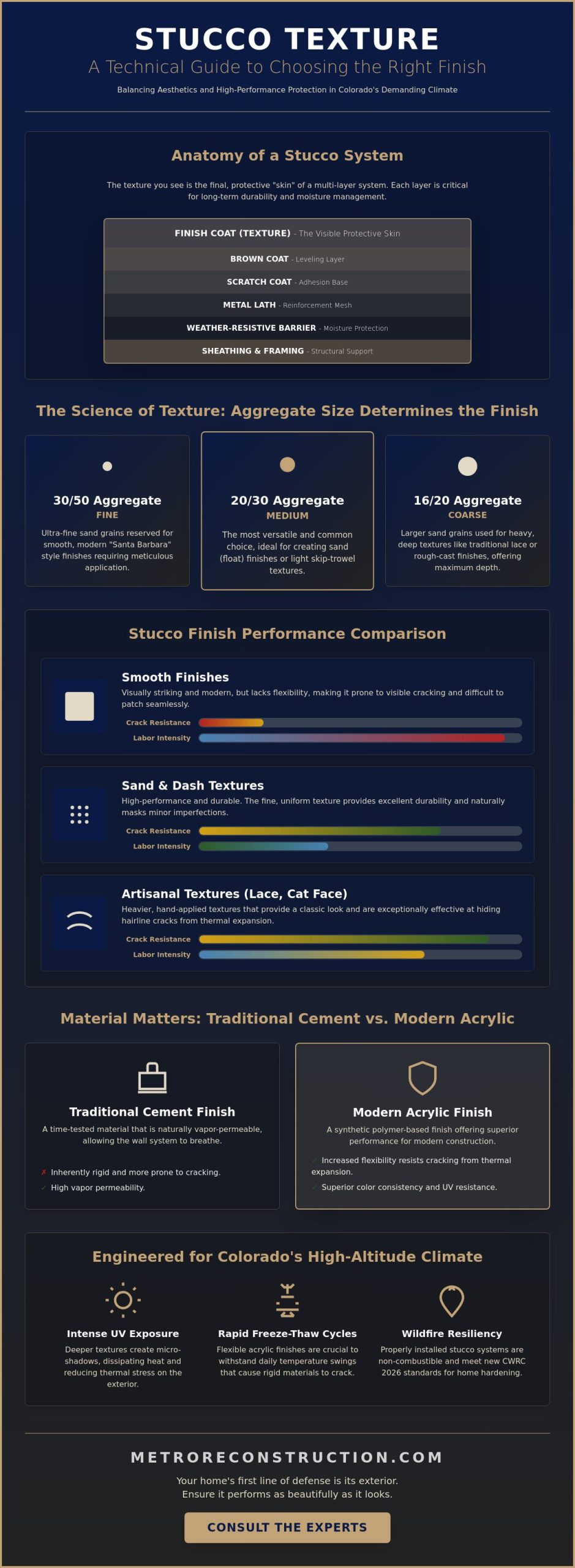
Stucco texture is more than a design choice; it is the final, visible layer of the Stucco finish coat. This layer, whether composed of cementitious materials or modern acrylic polymers, serves as the critical interface between your home and the elements. Selecting from various stucco texture types requires a balance of forensic understanding and aesthetic preference. It’s the outermost component of the exterior envelope, specifically designed to shed water and protect the underlying layers from moisture intrusion. When we evaluate a home’s performance, we view this texture as a functional skin that balances vapor permeability with aesthetic intent.
The “grit” or depth of a finish is dictated by aggregate size. Manufacturers typically categorize these by sieve size, and the choice significantly impacts the final look. Common aggregate standards include:
- 16/20 Aggregate: These larger sand grains are used for heavy lace or rough cast finishes, providing maximum depth.
- 20/30 Aggregate: These medium-sized grains are ideal for sand (float) or light skip-trowel textures.
- 30/50 Aggregate: These ultra-fine grains are reserved for smooth or modern “Santa Barbara” style finishes.
Traditional three-coat stucco relies on a cement-based finish, which is naturally vapor-permeable but inherently rigid. In contrast, synthetic options, often associated with EIFS (Exterior Insulation and Finish Systems), use acrylic resins. These synthetic finishes offer superior color consistency and increased flexibility, which helps the exterior envelope withstand the thermal expansion common in Colorado’s high-altitude climate. Understanding these differences is the first step toward a high-performance restoration. When a hairline crack appears in a synthetic finish, it is often the first visible symptom of a systemic issue that requires professional EIFS repair rather than a simple surface patch.
The Science of Aggregate and Application
The application method is just as vital as the material itself. A craftsman using a hawk and trowel can manipulate the aggregate to create “skip” or “lace” patterns, while a spray hopper produces a more uniform “dash” finish. We often find that the root cause of texture failure isn’t the finish coat itself, but rather inconsistencies in the base coat or “brown coat.” If the underlying layers aren’t level, the finish coat thickness will vary, leading to uneven drying and potential cracking. Precision in these early stages ensures the stucco texture types you choose are built right the first time.
Texture as a Protective Barrier
Heavier textures serve a practical purpose by masking minor structural settling that occurs naturally over time. In the Front Range, where UV exposure is significantly higher than at sea level, texture depth provides micro-shadows that help dissipate heat across the wall surface. This reduces the thermal stress on the entire exterior envelope. By choosing the right depth and aggregate, you invest in a high-performance finish that revitalizes the home’s appearance while ensuring long-term durability against intense sun and freeze-thaw cycles.
Smooth Stucco Finishes: Aesthetics vs. Structural Realities
Modern architecture frequently demands the clean, monolithic look of smooth finishes, yet these surfaces represent the most technically challenging stucco texture types to install and maintain. While a glass-like exterior is visually striking, it lacks the “give” that textured surfaces provide. This rigidity makes smooth stucco exceptionally prone to map cracking, a network of fine, spiderweb-like fissures that appear when the material shrinks during curing or expands during Colorado’s intense daily temperature swings. Because there is no aggregate depth to mask these movements, even the slightest shift in the home’s foundation or framing will telegraph directly to the surface.
The precision required for a true smooth finish often doubles the labor intensity compared to sprayed or floated textures. Applicators must work in small, controlled sections to ensure the Portland cement or acrylic finish is perfectly leveled before it sets. When damage occurs, stucco restoration for these finishes is notoriously difficult. Matching the exact sheen and trowel pressure of an existing smooth wall is nearly impossible without recoating the entire elevation, making the initial investment in a high-performance installation even more critical for long-term value.
Santa Barbara vs. Smooth Trowel
The Santa Barbara finish offers a compromise by utilizing a very fine sand aggregate to create an “imperfect” smooth look. It mimics the historic lime plasters of Mediterranean villas, providing a softer aesthetic that is slightly more forgiving than a steel-troweled true smooth finish. For homeowners seeking this look in 2026, we typically recommend synthetic acrylic finishes. These modern formulations offer the elasticity needed to bridge hairline cracks that would otherwise shatter a traditional, brittle cement-based smooth coat. This flexibility is vital for maintaining the home’s exterior envelope against the mechanical stresses of the Front Range.
The Forensic View on Smooth Surface Cracking
From a forensic perspective, smooth finishes require an over-engineered moisture management system. Without the drainage channels created by heavier textures, water can linger longer on the surface, making high-quality water-resistive barriers and ventilated air spaces, as mandated by the 2024 International Building Code, non-negotiable. In Boulder’s climate, intense UV exposure can accelerate the degradation of the finish coat. If you’re concerned about the integrity of your home’s facade, a comprehensive evaluation of your exterior envelope can determine if your smooth finish is performing as intended or hiding moisture-related root causes.
Sand and Dash Textures: High-Performance Durability
While smooth finishes offer a specific aesthetic, sand and dash finishes represent the high-performance standard for durability in the Front Range. These stucco texture types are favored not just for their appearance, but for their mechanical ability to withstand the rigors of our high-altitude environment. Unlike smooth surfaces, textured finishes possess a “self-healing” visual quality. The micro-shadows created by the aggregate depth naturally mask the hairline cracks that inevitably occur due to the 70-degree temperature swings common in Colorado. This makes them the primary choice for exterior home repair, as they allow for more seamless blending during restoration projects.
A popular hybrid often seen in modern residential communities is the “Knockdown” dash. This technique involves spraying a heavy dash layer and then lightly troweling the peaks while the material is still tacky. The result is a finish that provides the impact resistance of a textured surface with a flatter, more contemporary profile. It’s a pragmatic solution that addresses the root cause of many homeowner complaints: the desire for a modern look without the extreme maintenance and cracking risks associated with steel-troweled smooth coats.
Sand Float Finishes (Fine, Medium, Heavy)
The sand or “float” finish is achieved using a green sponge float moved in a consistent circular motion across the finish coat. This action draws the sand aggregate to the surface, creating a uniform, granular appearance. We categorize these by the grain size of the aggregate; a 16/20 sand creates a heavy, rugged look, while a 20/30 sand offers a refined, velvet-like texture. Because the applicator can control the “swirl” pattern, sand finishes are the most repair-friendly options available. When matching existing stucco, we meticulously analyze the original grain size to ensure the patch disappears into the surrounding wall, preserving the integrity of the exterior envelope.
Dash Finishes: The Sprayed Approach
Dash finishes are applied using a compressed air spray hopper, which flings the stucco material onto the wall in a consistent pattern of small “piles.” This method is exceptionally effective for achieving uniformity across large elevations where trowel marks might otherwise be visible. In areas prone to woodpecker damage or heavy hail, a “Heavy Dash” provides a sacrificial layer of protection that dissipates impact energy. Additionally, the increased surface area of a dash finish facilitates a superior mechanical bond for elastomeric coatings or high-performance paints. This ensures that any future aesthetic updates adhere correctly, protecting your investment for decades rather than years.
Artisanal Textures: Spanish Lace, Cat Face, and Worm Finishes
Artisanal stucco texture types represent the highest level of craftsmanship within the exterior envelope. Unlike standardized sand or dash finishes, these styles require a distinct “signature” from the applicator to ensure consistency across the entire elevation. A lack of uniformity often becomes the root cause of aesthetic failure during a restoration project, where a patch might stand out because the new trowel work doesn’t match the original rhythm. We approach these finishes with the eye of a Wise Craftsman, recognizing that every stroke must be deliberate to maintain the architectural integrity of the home. As the global stucco market is expected to reach $12.37 billion in 2026, the demand for these specialized, high-performance finishes continues to grow among homeowners who value substance over temporary, aesthetic patches.
The Complexity of Spanish Lace
Spanish Lace, frequently called a skip-trowel finish, has its roots in Mediterranean design and remains a favorite for its exceptional durability. The process involves two distinct steps: the application of a base finish coat followed by a second layer of “lace” that the applicator knocks down with a trowel while it’s still tacky. This creates a varied depth that is ideal for concealing minor imperfections in older masonry or uneven substrates. When we perform a restoration on a lace finish, the challenge lies in matching the specific frequency and pressure of the original application. Because every contractor has a different “hand,” achieving a seamless repair requires forensic attention to the existing height of the peaks and the flatness of the valleys to avoid visible seams.
Cat Face and Worm Finishes
The “Cat Face” or inclusion finish offers a sophisticated balance between smooth spans and rustic peeks. The applicator leaves small, irregular openings in the final coat, revealing the aggregate of the layer beneath. This style is increasingly popular for “Mountain Modern” aesthetics in Boulder and the surrounding Front Range, as it bridges the gap between contemporary minimalism and rugged, local character. By July 1, 2026, many Colorado jurisdictions will begin enforcing the Wildfire Resiliency Code (CWRC), and these noncombustible artisanal finishes provide a compliant solution that doesn’t sacrifice high-end design for safety.
A “Worm” or “Putz” finish uses large, round aggregates that the applicator “rolls” across the surface with a plastic float, creating distinct trails or grooves in the material. While visually unique, these grooves require precise moisture management; they must be applied with the correct downward slope to ensure water doesn’t pool within the texture. The same forensic principles that govern wall finishes apply equally to stucco retaining wall restoration, where improper drainage and moisture management can accelerate structural failure beneath the surface. If you’re planning a project that requires this level of technical detail, consult with our specialists to ensure your artisanal finish is restored with the technical precision your home deserves.
Choosing the Right Texture for Colorado’s High-Altitude Climate
Boulder’s intense UV exposure at 5,300 feet creates a punishing environment for the exterior envelope. Darker, smoother stucco texture types absorb significantly more thermal energy, which leads to rapid expansion and “chalking” as the binders in the finish coat degrade under solar radiation. This thermal stress is compounded by Colorado’s relentless freeze-thaw cycle, where moisture trapped in microscopic surface fissures expands as temperatures drop overnight. For these reasons, we often recommend flexible acrylic finishes over traditional Portland cement. Acrylic polymers possess the elasticity to stretch during these 40-degree temperature swings, preventing the brittle fractures that often plague rigid, cementitious surfaces.
Selecting a finish also involves preparing for the inevitable impact of extreme weather. When evaluating hail damage on stucco, homeowners with smooth finishes often face a difficult reality: every pockmark and dent is highlighted by the sun’s low angle. In contrast, heavier textures like sand or lace provide a degree of camouflage for minor surface abrasions. However, when a storm causes structural breach, the restoration must be handled with forensic precision. We don’t just patch the surface; we investigate the root cause of any moisture intrusion to ensure the repair preserves the home’s structural integrity for the next decade.
The UV and Altitude Factor
Smooth finishes lack the micro-shadows provided by aggregate, meaning they experience “chalking” and color fading up to 30% faster in high-altitude environments than textured counterparts. To mitigate this, we prioritize high-performance elastomeric coatings that act as a breathable, waterproof shield. These coatings fill the valleys of textured stucco, creating a revitalized surface that dissipates heat more effectively and reduces thermal shock. By choosing stucco texture types with moderate depth, you create a surface that protects the underlying substrate while maintaining a premium aesthetic.
The Metro Reconstruction Standard
Our “Built right the first time” philosophy dictates that the choice of texture is secondary to the health of the substrate. Before we apply a finish coat, we conduct a comprehensive inspection of the lath, flashing, and water-resistive barriers. This forensic approach ensures that your new texture isn’t just a cosmetic mask for underlying rot or moisture failure. We understand that matching an existing finish in Boulder County requires a Wise Craftsman’s touch, especially when dealing with aged masonry or custom skip-trowel patterns. If you’re ready to invest in a solution that balances architectural beauty with engineering-led durability, contact our team for a detailed consultation and custom texture match.
Preserving the Integrity of Your Exterior Envelope
Choosing between various stucco texture types is a decision that directly impacts the thermal performance and moisture management of your entire home. As we have explored, the depth of your aggregate and the flexibility of your finish coat determine how well your exterior skin withstands Colorado’s intense UV exposure and rapid freeze-thaw cycles. Ensuring your home meets the Colorado Wildfire Resiliency Code standards taking effect in July 2026 starts with selecting a finish that is both noncombustible and engineered for long-term durability.
At Metro Reconstruction, we bring over 40 years of experience in the Front Range to every project, specializing in moisture mitigation and comprehensive structural restoration. As a family-owned and operated firm, we prioritize high-performance craftsmanship that addresses the root cause of building failures rather than applying temporary, aesthetic patches. Whether you are restoring an artisanal Spanish Lace finish or upgrading to a modern smooth trowel, our forensic approach ensures your home is built right the first time. Protect your investment with a forensic stucco consultation from Metro Reconstruction. We look forward to helping you revitalize your home with a finish that is built to last.
Frequently Asked Questions
What is the most durable stucco texture for Colorado weather?
Sand and dash textures are the most durable options for Colorado’s climate because they effectively hide the hairline cracks caused by 40-degree daily temperature swings. These textured surfaces create micro-shadows that reduce UV degradation across the exterior envelope. Traditional three-coat systems or flexible acrylics in these textures offer the best long-term moisture management for high-altitude environments where freeze-thaw cycles are frequent.
Can I change my stucco texture from heavy to smooth?
You can transition from a heavy texture to a smooth finish, but it requires a comprehensive re-skimming of the entire wall surface. Because smooth finishes lack aggregate to hide substrate defects, the new base coat must be perfectly level to prevent telegraphing. This process is more labor-intensive than a standard recoat; it involves significant preparation to ensure the new finish coat bonds correctly to the existing material.
Why is smooth stucco more expensive than other finishes?
Smooth finishes are more expensive because they require a higher level of artisanal skill and significantly more labor hours to achieve a monolithic surface. Without sand aggregate to mask trowel marks, the applicator must work in smaller sections with higher precision. According to 2026 industry data, labor costs for specialty smooth finishes can reach $14 per square foot, reflecting the meticulous nature of the steel-troweling process.
How do I identify which stucco texture my house currently has?
Identify your current texture by examining the aggregate size and the physical pattern of the finish coat. Sand finishes look like uniform sandpaper, while Spanish Lace features flat, knocked-down peaks over a rougher base. Dash finishes appear as small, sprayed piles of material. If you see small, irregular grooves, you likely have a Worm or Putz finish, which was popular in specific 1990s residential developments.
Is it possible to perfectly match stucco texture during a repair?
Achieving a perfect match during a repair is technically challenging because every applicator has a unique signature or trowel rhythm. While we can match the specific aggregate size of various stucco texture types, factors like UV-induced fading and the age of the original cement impact the final sheen. We often recommend recoating the entire elevation to ensure a seamless look and maintain the continuity of the exterior envelope.
What is the difference between traditional stucco and EIFS textures?
Traditional stucco textures use Portland cement-based plaster, which is rigid and vapor-permeable, while EIFS (Exterior Insulation and Finish Systems) utilizes acrylic-based finishes. Acrylic textures are generally more flexible and crack-resistant, making them a high-performance choice for modern stucco texture types. If your property uses a synthetic system and you notice surface cracking, understanding the full scope of professional EIFS repair for synthetic stucco systems is essential to determining whether you need a targeted restoration or a full system replacement. EIFS also offers superior color consistency because the pigments are factory-blended into the synthetic resin rather than mixed on-site by a contractor.
Does the type of stucco texture affect my home’s fire resistance?
The specific texture does not significantly alter the fire resistance of the material; all stucco is inherently noncombustible. Under the Colorado Wildfire Resiliency Code (CWRC) enforced after July 1, 2026, stucco is an approved ignition-resistant material for homes in Wildland-Urban Interface zones. Whether you choose a smooth or heavy dash finish, the cementitious or acrylic layer provides a critical protective barrier against radiant heat and embers.
How often should I repaint or recoat my textured stucco?
You should expect to repaint or recoat your textured stucco every 10 to 15 years depending on the intensity of your home’s UV exposure. In Colorado’s high-altitude environment, sun damage can cause pigments to fade and binders to break down over time. Applying high-performance elastomeric coatings can bridge minor hairline cracks and revitalize the exterior envelope, extending the life of the finish and preventing moisture intrusion into the structural components.