
A hairline fracture on the surface of your stucco retaining wall is rarely just an aesthetic blemish; it is a diagnostic signal of a systemic failure occurring deep beneath the finish. You have likely watched these recurring cracks widen despite temporary patches, or perhaps you feel frustrated by the stubborn white efflorescence that persists no matter how often the surface is cleaned. It is natural to feel a sense of anxiety when a prominent landscape feature begins to show signs of structural distress. Your concern isn’t just about the peeling paint, but about the fundamental integrity of the masonry that protects your property investment.
True restoration requires looking beyond the surface to treat the building’s complete outer system as a holistic unit. This guide provides a clear understanding of the technical requirements and forensic restoration strategies necessary to ensure your landscape remains both structurally sound and visually pristine. We will examine the critical relationship between moisture management and substrate preparation, demonstrating how these hidden factors dictate the longevity of your wall. By identifying the underlying structural origins of failure, you can move toward a permanent solution that complements your home while resisting environmental stressors. Precision in the diagnostic phase is the only foundation for lasting peace of mind.
Key Takeaways
- Recognize that a resilient stucco retaining wall functions as an integrated system, requiring a dedicated drainage plane to mitigate hydrostatic pressure.
- Learn to diagnose common failure points by understanding how expansive soils and moisture intrusion cause the efflorescence and cracking seen on the surface.
- Discover the importance of a forensic assessment to identify the root cause of damage before removing compromised materials down to the original masonry.
- Understand why long-term structural longevity depends on treating the building’s complete outer system rather than applying superficial, temporary repairs.
Understanding the Role of Stucco Retaining Walls in Modern Landscapes
Many homeowners view a stucco retaining wall as a simple decorative feature, but this perspective overlooks the complex engineering required to manage lateral earth pressure. Fundamentally, retaining walls are structures designed to restrain soil to unnatural slopes, which means the stucco finish is merely the visible skin of a robust masonry system. By utilizing a solid masonry core protected by a high-performance cementitious finish, these structures provide a durable solution that bridges the gap between functional engineering and architectural elegance. Precision is mandatory. A failure to understand the relationship between the finish and the core often leads to superficial repairs that don’t address the underlying mechanics.
In regions like Boulder County, the decision to use stucco often stems from a need for superior fire resistance and long-term durability against extreme temperature fluctuations. Property owners frequently choose this material to create a visual harmony between their landscape and the home’s stucco exterior walls. This continuity ensures that the property’s complete outer system feels intentional and unified. However, it’s vital to distinguish between a low-height decorative garden wall and a true structural retaining system. The latter requires precise calculations regarding drainage and load-bearing capacity to prevent catastrophic failure. A garden wall might only hold back mulch, but a structural wall holds back the earth itself.
Substrate Options: Concrete vs. CMU
The stability of the finish depends entirely on the integrity of the substrate. Cast-in-place concrete offers exceptional density and strength. It provides a monolithic base that is highly resistant to moisture penetration, though it requires complex formwork. Consequently, Concrete Masonry Units (CMU) have become the standard for residential applications due to their versatility and the ease with which they can be reinforced with steel and grout. We must verify substrate compatibility before any stucco application begins. If the substrate is compromised by salt deposits or loose mortar, the new finish won’t bond effectively. Substrate integrity is everything.
Design Versatility in the Front Range
Stucco provides a level of design flexibility that rigid stone or timber cannot match. It allows for the creation of seamless curves and custom architectural shapes that follow the natural contours of a property. By integrating various stucco texture types, you can enhance curb appeal while ensuring the finish is thick enough to provide protective coverage. In the high-altitude environment of the Front Range, selecting finishes that withstand intense UV exposure is not just an aesthetic choice. It is a requirement for preventing premature color fading and surface degradation. Long-term value is built on these technical details.
The Anatomy of a High-Performance Stucco Retaining Wall System
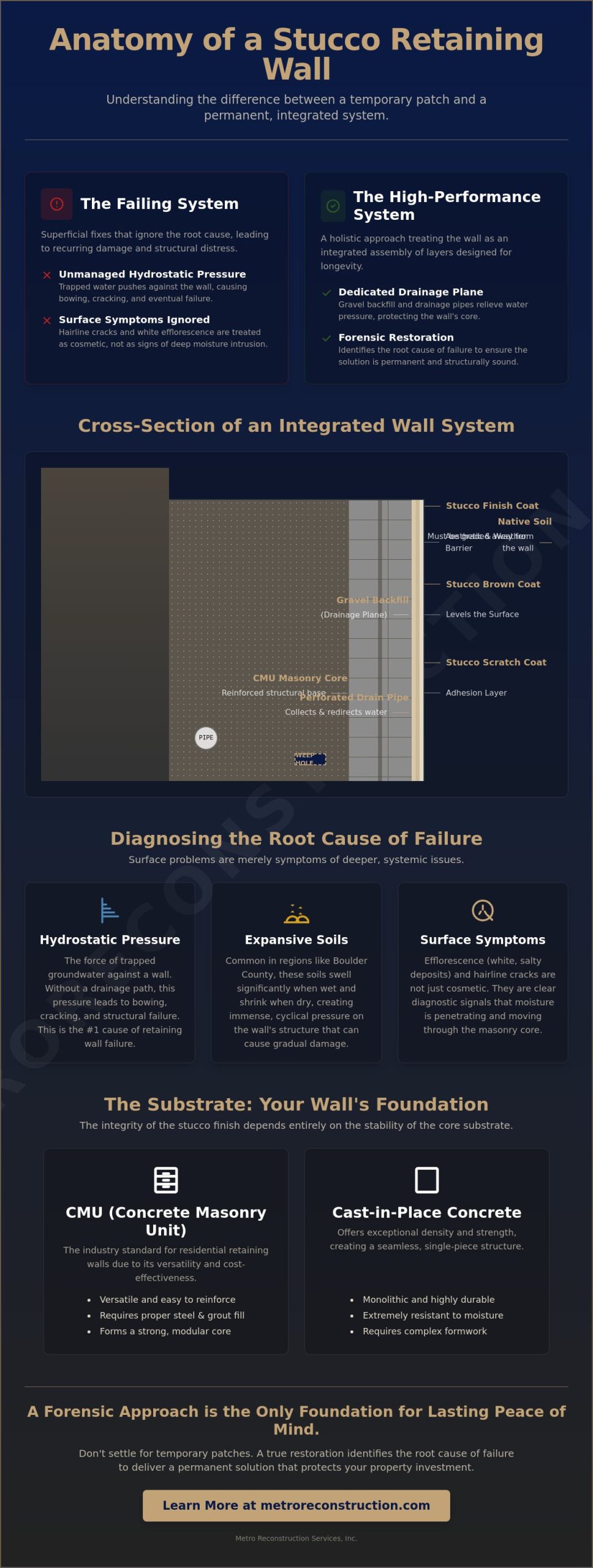
To achieve lasting results, we must view the stucco retaining wall as a complex assembly of interdependent layers rather than a singular masonry unit. A common industry oversight is treating the stucco finish as an isolated component. In reality, the complete outer system is a multi-layered barrier against environmental stress that integrates the substrate, moisture protection, and the final aesthetic finish. If any single layer fails to perform its specific role, the entire structure is compromised. Precision in the assembly of these layers is what distinguishes a professional restoration from a temporary patch.
The foundation of this system begins behind the masonry core. A dedicated drainage plane, typically consisting of clean gravel backfill and a perforated drainage pipe, is essential to prevent the buildup of hydrostatic pressure. Without this relief, water weight pushes against the wall, leading to structural bowing and finish failure. Weep holes must be installed at the base of the wall to allow trapped moisture to escape. These small openings are non-negotiable for structural integrity. When moisture is allowed to exit freely, the risk of internal rot or masonry degradation is significantly reduced. This proactive approach ensures the wall foundation remains stable while supporting the weight of the stucco layers above.
The application of the cementitious finish follows a strict three-coat process. The scratch coat provides the initial bond to the lath, while the brown coat creates a level surface that dictates the wall’s final plane. Finally, the finish coat provides the specialized UV and moisture resistance needed for long-term protection. If you are noticing signs of failure in these layers, a professional stucco restoration can identify exactly where the system has broken down.
Water Management and Vapor Permeability
A high-performance wall must be able to breathe. If moisture becomes trapped between the masonry core and the finish, the resulting vapor pressure will cause the stucco to separate from the substrate, a process known as delamination. Secondary moisture barriers protect the masonry core from absorbing excessive water while still allowing for necessary vapor transmission. In Colorado’s volatile climate, where freeze-thaw cycles are frequent, improper drainage leads to total system failure. The water expands as it freezes, literally tearing the finish away from the wall.
Lath and Reinforcement Requirements
The lath serves as the skeleton of the stucco finish. For retaining structures, we utilize a heavy-gauge galvanized metal lath to resist corrosion and provide a rigid matrix for the plaster. Proper overlapping of at least one inch at all joints is required to prevent “mapping” cracks, which are linear fractures that mirror the edges of the lath sheets beneath. Additionally, expansion joints and corner beads are strategically placed to manage thermal movement. These components allow the wall to expand and contract during temperature shifts without cracking the finish. Accuracy here is the foundation of our brand promise.
Common Failure Points: Moisture Intrusion and Expansive Soils
A failing stucco retaining wall often presents symptoms that many homeowners misinterpret as purely cosmetic. White, powdery staining known as efflorescence is frequently dismissed as a surface cleaning issue, yet it serves as a forensic indicator of water migrating through the masonry core. As moisture travels from the saturated soil behind the wall to the exterior face, it dissolves mineral salts within the concrete or mortar. When the water evaporates at the surface, these salts remain. This process signals that the internal moisture management system is compromised. Ignoring these deposits allows the salt crystals to grow within the pores of the stucco, eventually leading to internal pressure that shatters the bond between the finish and the substrate.
In Colorado, the structural integrity of these systems is further challenged by expansive soils. These clay-heavy soils swell significantly when they absorb moisture, exerting immense lateral pressure that most decorative finishes aren’t designed to withstand. While a standard patch might hide a crack for a season, it can’t stop the physical movement of the earth. Additionally, environmental stressors like hail damage on stucco create entry points for water. Even small impacts can breach the protective finish, allowing moisture to bypass the outer barrier and begin the cycle of degradation from within. We must distinguish between superficial hairline fissures caused by initial curing and deep structural cracks that indicate the wall is physically shifting.
The Impact of Hydrostatic Pressure
Trapped water is the primary enemy of any retaining structure. When drainage systems fail or were never properly installed, the weight of the water behind the wall, known as hydrostatic pressure, can become high enough to literally blow the stucco finish off the masonry. Signs of this failure include:
- Visible bulging or “pillowing” in the stucco surface.
- Wall sections that have begun to lean away from the slope.
- Persistent dampness at the base of the wall long after rain has stopped.
Surface-level patches fail because they don’t resolve the hydraulic force. Without addressing the backfill and drainage, the repair will simply pop off during the next heavy saturation event.
Freeze-Thaw Cycles in Boulder County
The high-altitude environment of Boulder County introduces a brutal freeze-thaw cycle that accelerates structural decay. When moisture becomes trapped in the masonry, it expands by approximately 9% as it turns to ice. This expansion creates internal stresses that cause spalling, where the face of the stucco or the masonry itself begins to flake away in layers. The forensic signature of this damage is unmistakable; it looks like the wall is shedding its skin. Proactive mitigation requires a holistic approach to the complete outer system, ensuring that every entry point is sealed and every drainage path is clear. Reliability is found in the details of the assembly.
Restoration Best Practices: Moving Beyond Superficial Fixes
Restoring a stucco retaining wall involves more than just masking surface cracks with a fresh coat of plaster. A professional restoration begins with a forensic assessment to determine the exact extent of moisture intrusion and substrate degradation. We don’t settle for superficial fixes. Instead, we remove all compromised material down to the sound masonry substrate to ensure the new system has a stable foundation. If the assessment reveals that the wall has physically shifted or tilted due to the expansive soil pressures discussed earlier, we must address the underlying foundation repair services before proceeding with the finish. Without a stable core, any new stucco application is destined to fail. Accuracy in this initial phase is our foundational promise.
Once structural integrity is confirmed, we apply modern, high-performance acrylic or mineral-based finishes. These materials offer superior elasticity and breathability compared to traditional cement-only mixes. They accommodate the subtle thermal movements common in our regional climate. Finally, establishing a proactive maintenance schedule is essential for preventing future structural degradation. Regular inspections allow for the early detection of hairline fissures before they evolve into systemic failures. Long-term value is only achieved through this meticulous, step-by-step methodology.
Surface Preparation and Cleaning
The longevity of the restoration depends on the quality of the bond between the substrate and the new stucco. We utilize low-pressure washing to remove surface contaminants, dirt, and organic growth without damaging the masonry underneath. If efflorescence is present, we neutralize the salts using specialized solutions before applying new base coats. Failing to neutralize these minerals will cause the new finish to delaminate. Additionally, we ensure a mechanical bond through proper substrate scarification. This process creates a textured surface that allows the new scratch coat to lock into the masonry core securely.
Texture and Color Matching
Restoration is as much an art as it is a science. Blending new work with existing landscape features requires a meticulous eye for detail to maintain the property’s visual continuity. We favor custom color tinting integrated directly into the finish coat rather than surface painting. Integrated pigments provide deeper color saturation and superior resistance to UV-induced fading at high altitudes. This method ensures a seamless transition between old and new sections of the stucco retaining wall. If your landscape features are showing signs of distress, contact the specialists at Metro Reconstruction Services, Inc. to begin a professional diagnostic evaluation.
Partnering with Forensic Experts for Lasting Property Preservation
Property owners often mistake a failing stucco retaining wall for a minor cosmetic issue that a local handyman can resolve with a bucket of premixed patch. This assumption frequently leads to a cycle of recurring repairs and wasted investment. A general handyman is ill-equipped for complex stucco and masonry repairs because they typically focus on covering symptoms rather than diagnosing systems. Without a deep understanding of hydrostatic pressure, soil expansion, and moisture migration, surface-level fixes will inevitably fail. We believe that true restoration requires a partner who views your wall as a critical structural component of the landscape. Properties with synthetic stucco cladding face similar systemic challenges, and homeowners should understand the distinctions involved in professional EIFS repair when evaluating the full scope of their building envelope.
The approach at Metro Reconstruction Services, Inc. is defined by a commitment to identifying the underlying origin of failure before any restoration work begins. We don’t guess; we analyze. By pinpointing the specific cause of distress, we can implement a solution that addresses the root problem, ensuring the repair is permanent rather than temporary. To provide total transparency and peace of mind, we utilize fixed-price project fees. This ensures that you understand the full scope of the investment upfront, with no hidden costs as the project progresses. Our team brings over 40 years of experience navigating the demanding Front Range environment to every project. This longevity is a testament to our precision and the reliability of our engineering-led solutions.
The Forensic Diagnostic Process
Our methodology relies on technical accuracy rather than visual estimation. We utilize specialized tools, including moisture meters and visual probes, to “see” behind the stucco finish and evaluate the condition of the masonry core. This data allows us to develop a tailored mitigation plan based on objective engineering facts rather than industry guesswork. Our goal is to ensure the complete outer system is restored to a better-than-new condition. We don’t just fix the damage; we harden the structure against the environmental stressors that caused the initial failure.
Investing in Structural Integrity
Choosing a professional restoration is a strategic investment in your total property value. A leaning or crumbling wall is a liability that can detract from your home’s equity and curb appeal. By doing the job correctly the first time, you secure a long-term ROI that far outweighs the cost of repeated, low-quality patches. Protecting your investment requires a dedicated partner who understands the hidden mechanics of property preservation. Don’t wait for a total system collapse to address visible warning signs. Schedule a forensic assessment of your stucco retaining wall today.
Securing Your Landscape with Engineering-Led Restoration
A resilient stucco retaining wall is the result of precise moisture management and a deep understanding of the lateral forces exerted by our regional soils. As we have examined, a wall is not merely a masonry core with a finish; it’s a complex, multi-layered system that requires a dedicated drainage plane to survive. By prioritizing a forensic approach, you ensure that every component works in harmony to resist the freeze-thaw cycles and UV exposure characteristic of the Front Range. Temporary patches only mask the underlying failures. True longevity requires identifying the origin of distress before applying a single coat of finish.
At Metro Reconstruction Services, Inc., our family-owned and operated team brings over 40 years of experience to every structural restoration. We specialize in the forensic diagnostic process, providing you with a permanent solution rather than a cosmetic fix. Precision in these details is what protects your property’s value and ensures your peace of mind. Contact Metro Reconstruction Services, Inc. for a Professional Stucco Assessment to begin securing your landscape today. Your property investment deserves the care of a seasoned expert.
Frequently Asked Questions
Can you put stucco on a concrete retaining wall?
Yes, you can apply stucco to a concrete retaining wall, provided the substrate is clean and structurally sound. To ensure a permanent bond, the concrete surface must be scarified or treated with a bonding agent to create a mechanical key. If the concrete is smooth or contaminated with form release agents, the stucco finish will eventually delaminate. A professional application ensures the finish adheres properly to the underlying masonry core.
Why is the stucco on my retaining wall bubbling or peeling?
Bubbling and peeling are primary indicators of trapped moisture or hydrostatic pressure migrating from the soil behind the wall. When water enters the masonry core and cannot escape through a dedicated drainage system, it pushes against the back of the finish. This vapor pressure eventually breaks the bond between the stucco retaining wall finish and the substrate. This type of failure signals a breakdown in the complete outer system.
How long should a stucco retaining wall last in Colorado?
A professionally installed wall can last 50 years or more if the underlying drainage and substrate are correctly engineered for the environment. However, without proper moisture management, the finish may show signs of distress within 5 to 10 years due to Colorado’s intense freeze-thaw cycles. Long-term durability depends entirely on the initial accuracy of the structural assembly and the quality of the cementitious materials used.
Does a stucco retaining wall need a waterproof backing?
The side of the wall in contact with the soil requires a robust waterproofing membrane and a drainage plane to prevent moisture from saturating the masonry. If the back of the wall isn’t sealed, water will naturally migrate toward the exterior face, carrying minerals that cause efflorescence. This internal saturation is a leading cause of systemic finish degradation and must be addressed during the initial construction or restoration phase.
What is the best way to clean a stucco retaining wall?
The most effective method is low-pressure washing combined with a mild detergent specifically formulated for masonry. High-pressure water can force moisture into hairline cracks or erode the finish coat, leading to premature failure. For stubborn mineral deposits or efflorescence, specialized neutralizing agents should be used to clean the surface without compromising the structural integrity of the stucco retaining wall. Avoid harsh chemicals that can degrade the cementitious bond.
How do you repair large cracks in a stucco retaining wall?
Large cracks require a forensic assessment to determine if they are structural or superficial. If the crack is caused by soil movement, the underlying substrate must be stabilized before the stucco can be restored. The repair process involves removing loose material, cleaning the crack, and applying a high-performance mineral-based patch or a new three-coat system. These modern materials better accommodate the thermal movement common in high-altitude environments. Homeowners with synthetic stucco finishes should also explore forensic EIFS repair techniques to understand how similar crack remediation principles apply to foam-backed cladding systems.
Is stucco a fireproof option for landscape walls in Boulder?
Stucco is an exceptionally fire-resistant material, making it a preferred choice for properties in Boulder’s wildland-urban interface. Because it’s composed of non-combustible cementitious materials, it provides a protective barrier against ember ignition and radiant heat. Utilizing stucco for landscape features helps harden the property’s complete outer system against wildfire threats. It offers a rugged, local solution that prioritizes both safety and aesthetic continuity.
How much does it cost to restore a stucco retaining wall?
The cost of restoration varies based on the extent of the structural damage and the specific drainage requirements of the site. Factors such as the height of the wall, the type of substrate, and the complexity of the texture matching will influence the final project fee. Homeowners should check with a specialist for a detailed forensic evaluation to understand the scope of work required for a permanent, long-term solution.