
A hairline crack in your synthetic finish is rarely just a cosmetic flaw; it is often the first visible symptom of a systemic failure in your building’s complete outer system. You might worry that these small signs point to hidden mold or rot trapped behind the foam, leading to an expensive and disruptive tear-off. It’s a valid concern, especially when the line between a superficial patch and a professional eifs repair is often misunderstood by general contractors. You deserve to know whether your property can be restored permanently or if you are facing a full system replacement.
We understand the anxiety that comes with maintaining a complex building envelope, but true restoration is possible through technical precision. This forensic guide will help you master the requirements of EIFS restoration to protect your property’s structural integrity and long-term value. We’ll explore how modern standards like ISO 17738-4:2026 and ASTM E2273 drainage efficiency requirements inform a high-quality project. We will detail the process of identifying underlying moisture origins and the precise methodology used to ensure your building envelope remains dry, thermally efficient, and aesthetically seamless.
Key Takeaways
- Contrast the fundamental differences between older barrier systems and modern water-managed designs to understand your building’s specific drainage requirements.
- Identify the forensic warning signs of moisture intrusion, such as bulging or staining, to address underlying issues before they compromise the structural framing.
- Execute a professional eifs repair by prioritizing the restoration of the hidden moisture barrier rather than settling for a superficial cosmetic patch.
- Target the critical transition points—including flashing, sealants, and terminations—where approximately 90% of synthetic stucco failures originate.
- Distinguish between high-risk “patch-and-paint” tactics and the forensic restoration methods required to maintain long-term property value in demanding regional climates.
Understanding EIFS Failures: Beyond the Synthetic Surface
An Exterior Insulation and Finish System (EIFS) is far more than a simple layer of synthetic stucco; it is a sophisticated, multi-layered building envelope designed to provide both aesthetic appeal and superior thermal resistance. While traditional stucco is a heavy, cementitious material, EIFS is a lightweight, engineered assembly that acts as a continuous insulation blanket for your property. Understanding the hidden mechanics of this system is the first step toward a successful eifs repair. When one component of this assembly fails, the entire protective barrier is compromised, necessitating a deep analytical look at the structure’s complete outer system.
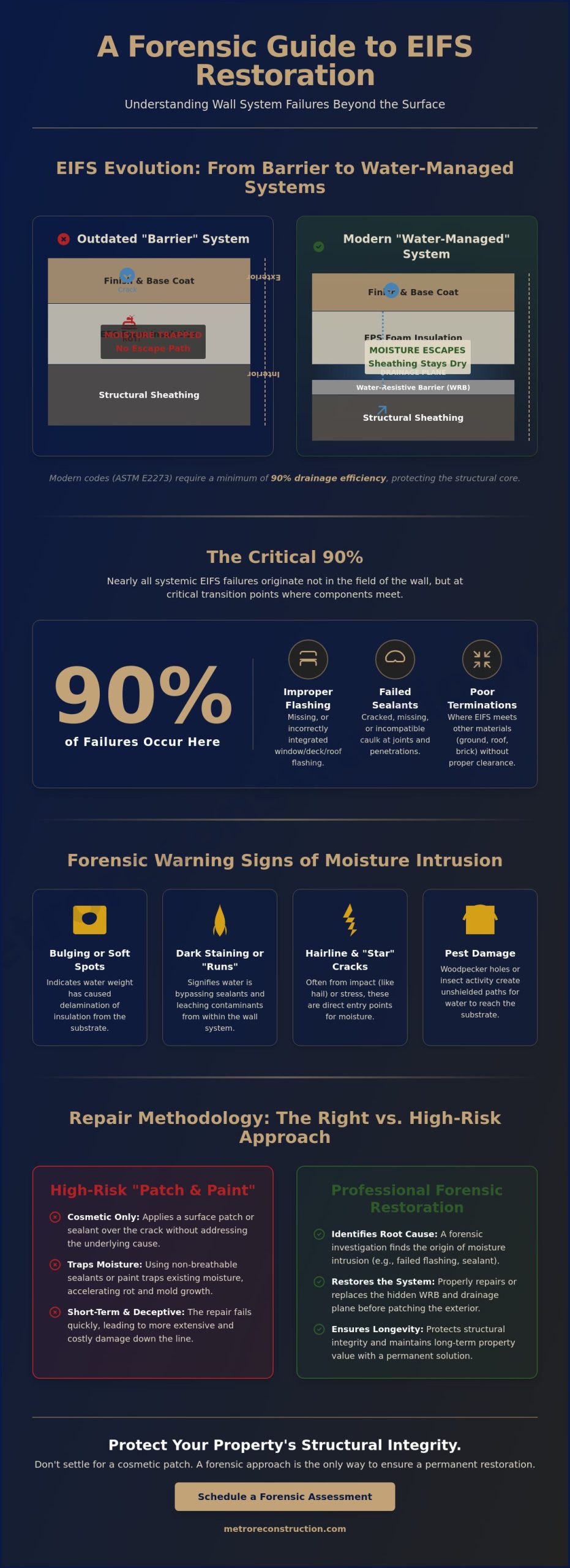
Historically, many EIFS applications were designed as “barrier” systems. These relied entirely on the outer acrylic skin to shed water. If a crack formed or a sealant joint failed, moisture entered the system but had no clear path to escape. Modern installations have evolved into “water-managed” systems, which are now required to achieve a minimum of 90% drainage efficiency under current standards. These newer designs include a dedicated drainage plane that allows moisture to exit the assembly before it reaches the structural sheathing. Most failures we diagnose today stem from moisture that becomes trapped behind the Expanded Polystyrene (EPS) insulation board. Once water is held against the substrate, it can quietly degrade the building’s core without showing immediate surface symptoms.
The Anatomy of an EIFS Wall System
The integrity of your building envelope depends on the synergy of several technical layers. It begins at the substrate, which must be protected by a high-performance Water-Resistive Barrier (WRB). This barrier serves as your home’s final line of defense against rot. Above this, the EPS insulation is secured with specialized adhesives, providing a significant thermal advantage of R-4 to R-6 per inch of insulation. The visible “face” of the system consists of a base coat reinforced with fiberglass mesh, followed by a breathable acrylic finish coat. Each layer must maintain its specific function; if the WRB is missing or the adhesive pattern blocks drainage, the system’s ability to protect the structure is lost.
Why EIFS Repair Requires a Forensic Methodology
A forensic approach is necessary because a surface hairline crack is often a symptom of a much larger structural origin. We distinguish between simple impact damage and structural delamination caused by hydrostatic pressure from trapped water. One of the most dangerous mistakes a non-specialist can make is applying a non-breathable sealant or heavy elastomeric paint over a damp EIFS wall. This effectively “traps” the moisture inside, which accelerates the growth of mold and the decay of wooden framing. We believe that initial accuracy in diagnosis is the only way to ensure the long-term value of your property. By identifying where the moisture management system has failed, we can implement a permanent restoration rather than a temporary, high-risk patch.
Identifying EIFS Damage: A Diagnostic Guide for Property Owners
Identifying early warning signs is the difference between a minor eifs repair and a total structural failure. While the synthetic finish is designed to be durable, it’s not invincible, especially when subjected to the harsh environmental stressors of the Front Range. Property owners should regularly scan their building’s complete outer system for visible red flags. Bulging in the wall surface often suggests that water weight has caused the insulation board to pull away from the substrate, while dark staining or “runs” near windows indicate that water is bypassing the sealants and leaching contaminants from within the system.
Regional factors play a significant role in system fatigue. Along the Front Range, hail damage on stucco is a frequent precursor to moisture intrusion. Large hailstones can create microscopic fractures or “star” cracks that are difficult to see from the ground but allow water to seep behind the protective base coat. Similarly, woodpecker holes are more than just an aesthetic nuisance; they create a direct, unshielded path for moisture to reach the sensitive wooden substrate. If you’ve noticed these signs, it’s wise to have a specialist perform a comprehensive system evaluation before moisture compromises your framing.
Our diagnostic process relies on objective data rather than guesswork. We utilize the “tap test,” where a seasoned expert listens for the hollow resonance that signals delamination between the insulation and the substrate. To confirm these findings, we use specialized moisture meters that can detect elevated humidity levels behind the foam without needing to tear into the wall. This forensic approach ensures that we identify the structural origin of the problem before any work begins.
Visible Indicators of System Fatigue
Stress points, such as the corners of windows and door frames, are the most common areas for cracking. These cracks often signal that the system isn’t properly handling the building’s natural movement or thermal expansion. You might also see efflorescence, a white, powdery mineral deposit that appears when water moves through the system and evaporates on the surface. If you press on the wall and feel “soft spots,” it’s a critical indicator that the underlying foam or substrate has begun to degrade, requiring immediate professional attention.
The Hidden Threat of Moisture Intrusion
Water rarely stays where it enters. According to Building Science Corporation’s analysis of EIFS, moisture can travel horizontally for several feet behind the insulation board, following the path of least resistance. This means a leak at a roofline might cause rot in a first-floor window header. Because the EPS board is such an effective insulator, it can also hide mold growth and structural decay for years. This is why high-quality stucco restoration must always include a meticulous inspection of the underlying sheathing to ensure the building’s skeleton remains sound.
The Professional EIFS Repair Process: A Step-by-Step Restoration
Executing a professional eifs repair requires a shift in perspective; we view the project as a forensic reconstruction of the moisture barrier rather than a cosmetic treatment of the synthetic finish. A common mistake in the industry is the “feathered patch,” where new material is simply smeared over old cracks. This approach lacks mechanical integrity and almost always fails within a few seasons. True restoration begins with clean, square-cut repair areas. By removing damaged sections in precise geometric shapes, we create the necessary surface area for new materials to bond effectively with the existing system, ensuring the building’s complete outer system remains a unified shield.
Before any new insulation is applied, we must validate the integrity of the Water-Resistive Barrier (WRB). If the underlying barrier is breached, the most beautiful finish in the world won’t prevent structural decay. We treat the exposed substrate as a diagnostic map, looking for evidence of previous moisture paths to ensure that the new installation corrects the original failure point. This level of precision is what separates a long-term solution from a temporary fix that merely hides a deeper problem.
Phase 1: Forensic Demolition and Preparation
The restoration begins by carefully removing the damaged EPS board to expose the substrate. It’s during this phase that we often find the “difficult truth” of a structural failure. We inspect the sheathing for rot or delamination, replacing any compromised framing to restore the home’s skeletal strength. Once the substrate is sound, we apply a high-performance moisture barrier and integrate new flashing at all transition points, creating a watertight foundation for the layers to follow.
Phase 2: Rebuilding the Core and Base Coat
Reinstalling the insulation requires more than just adhesive; it requires a specific “ribbon and dab” pattern that maintains the system’s drainage capabilities. We then embed a heavy-duty fiberglass mesh into a high-polymer base coat. This layer provides the impact resistance necessary to withstand regional environmental stressors. A critical signature of our work is “back-wrapping” the mesh at all termination points, such as window sills and door frames, which prevents moisture from wicking into the foam edges.
Phase 3: Aesthetic Integration and Finish
The final challenge is making the repair invisible. We prime the base coat to prevent “ghosting,” a phenomenon where the outline of the repair patch shows through the finish. Our craftsmen custom color-match the acrylic finish to your existing facade, accounting for natural UV fading. By meticulously matching specific stucco texture types, we ensure the restoration blends seamlessly with the original architectural style. The result is a dry, structurally sound envelope that looks as though the damage never occurred.
Critical Failure Points: Flashing, Sealants, and Terminations
While the field wall of an EIFS system is generally resilient, approximately 90% of system failures originate at the transition points where the cladding meets other building elements. These intersections, such as window perimeters, rooflines, and penetrations, are the true battlegrounds for moisture management. A professional eifs repair must prioritize these terminations, as they are the primary entry points for water that eventually leads to substrate rot. When moisture bypasses these critical junctions, it often travels undetected behind the insulation board, causing structural damage long before it becomes visible on the surface.
In our regional climate, where high-altitude UV exposure and extreme freeze-thaw cycles are common, standard flashing is often insufficient to protect the building envelope. We frequently identify moisture intrusion at roof-to-wall intersections caused by missing or improperly installed kick-out flashing. This specialized component is vital not just for residential walls but also for a stucco retaining wall, where it directs heavy runoff away from the system’s edge. Without these precise water-diversion tactics, water wicks behind the EPS board and compromises the entire assembly. If your property shows signs of staining at these junctions, you should contact our forensic specialists for an evaluation to prevent systemic failure.
Large commercial facades require even more specialized attention, particularly regarding expansion joints. These joints are not merely gaps; they are engineered components that allow the building to breathe and move during thermal shifts. Without them, the rigid acrylic finish will eventually buckle or crack under the stress of temperature swings. Ensuring these joints are properly restored is a foundational brand promise of our restoration process, as it prevents the mechanical stress that leads to secondary cracking in the field wall.
The Role of High-Performance Sealants
In the Front Range, silicone and polyurethane sealants are essential for surviving the rapid temperature changes that characterize our environment. We utilize a “two-stage” joint design for maximum moisture protection, which provides a secondary line of defense if the primary seal is breached. This methodology requires a deep understanding of material compatibility to ensure the sealant bonds chemically with the acrylic finish. We recommend checking sealant elasticity at five-year intervals to ensure the complete outer system remains watertight and resilient against environmental stressors.
Comparison: Professional Sealants vs. Generic Caulk
The choice of sealant is often where low-cost contractors cut corners, leading to secondary failures within 24 months. Professional-grade polyurethane offers up to 100% elongation, allowing the joint to expand and contract without tearing. In contrast, generic consumer-grade caulk lacks the UV resistance and elasticity required for high-altitude environments. To ensure a successful eifs repair, we always utilize “closed-cell” backer rods. These rods provide a stable backing for the sealant and prevent three-sided adhesion, which is the most common cause of premature sealant failure in synthetic stucco systems.
- Professional Silicone/Polyurethane: High UV resistance; 50% to 100% elasticity; 15 to 20-year lifespan.
- Consumer-Grade Caulk: Low UV resistance; 5% to 10% elasticity; fails within 18 to 24 months.
- Mechanical Bond: Professional sealants create a chemical link to the EIFS base coat; generic caulk relies on surface tension.
Selecting a Forensic EIFS Specialist in Boulder County
The “patch-and-paint” contractor myth remains one of the most significant threats to property longevity in Colorado. Many property owners are tempted by low-cost bids that promise a quick cosmetic fix, yet these surface-level treatments often ignore the moisture trapped behind the insulation board. Because eifs repair is a technical reconstruction of the building envelope, a cheap fix that fails to address the moisture barrier will lead to secondary failures that cost far more in the long run. You deserve a partner who understands that true restoration is an engineering-led process, not a painting project.
Metro Reconstruction provides fixed-price transparency for complex structural mitigations, ensuring you aren’t surprised by the hidden mechanics of a failure halfway through the project. Our family-owned firm brings 40 plus years of regional experience to every site, offering a level of reliability that only comes from decades of observing how different building systems interact with the Front Range environment. We don’t just offer a service; we act as a dedicated partner in property preservation, guiding you through the technical complexities toward a clear and professional conclusion.
Why Substance Over Style Matters in Restoration
There is a fundamental difference between a cosmetic painter and a reconstruction specialist. While a painter focuses on the final finish, a specialist identifies the underlying structural origins of a failure. We prioritize initial accuracy because a repair is only as good as the diagnostic work that preceded it. Our “Seasoned Expert” approach means we would rather explain the difficult truth of a structural breach than offer a temporary, high-quality patch that won’t stand the test of time. This commitment to precision is why our restorations remain dry and sound years after the work is completed.
Protecting Your Investment with Forensic Accuracy
Properly executed eifs repair is essential for preserving your property’s resale value and structural integrity. In the demanding Boulder County environment, local knowledge regarding the 2021 International Residential Code and specific moisture management requirements is vital. By choosing a specialist who understands the complete outer system, you’re investing in a long-term solution that protects your home from the inside out. If you’ve noticed the warning signs discussed in this guide, the next step is a professional evaluation. We invite you to secure your building’s future by scheduling a forensic diagnostic inspection with our team for your next exterior home repair project.
Securing Your Property’s Structural Future
Protecting a building with synthetic stucco requires moving beyond surface-level fixes to embrace a forensic understanding of the complete outer system. As we have detailed, a successful eifs repair is rooted in the precision of the moisture barrier and the technical accuracy of transition points like flashing and sealants. By addressing the structural origins of failure rather than just the visible symptoms, you ensure your property remains dry and thermally efficient for decades to come. This analytical approach transforms a stressful structural challenge into a controlled, long-term investment in your home’s preservation.
At Metro Reconstruction, we combine 40 plus years of Boulder County expertise with a commitment to fixed-price transparency and engineering-led solutions. Our family-owned firm specializes in complex moisture mitigation and structural restoration, providing the quiet confidence you need to protect your building’s integrity. Don’t leave your property’s health to chance or low-quality patches that only mask deeper issues. Schedule a Forensic EIFS Diagnostic with Metro Reconstruction Today to restore your peace of mind. Your property deserves the meticulous care and seasoned craftsmanship that only a dedicated partner in preservation can provide.
Frequently Asked Questions
Is EIFS repair different from traditional stucco repair?
Yes, the two systems are fundamentally different in composition and moisture management. Traditional stucco is a heavy, cement-based material applied over wire lath, whereas EIFS is a lightweight insulation system. An eifs repair involves managing layers of EPS foam and a dedicated drainage plane, while traditional stucco focuses on the integrity of the cementitious shell. Understanding these mechanical differences is vital for a successful restoration of your building’s complete outer system.
How do I know if the moisture barrier behind my EIFS is failing?
Visible signs include bulging in the wall surface or dark staining near the foundation and window corners. You might also notice a “hollow” resonance when tapping on the facade, which indicates the insulation has detached from the substrate. We use specialized moisture meters to detect humidity levels behind the foam, providing an accurate diagnosis without the need for immediate, invasive demolition of the wall system.
Can woodpecker holes in synthetic stucco cause structural rot?
Woodpecker holes are a significant threat because they create a direct breach in the building’s protective skin. These openings allow rain and snow to bypass the acrylic finish, saturating the EPS board and the wooden sheathing behind it. This localized moisture intrusion often leads to structural rot or mold growth if the holes aren’t sealed through a professional restoration process that addresses the underlying substrate.
What is the best sealant for EIFS joints in Colorado’s climate?
Colorado’s extreme temperature shifts require high-performance silicone or polyurethane sealants. These materials provide the necessary elongation to expand and contract during freeze-thaw cycles without tearing. Unlike generic caulking, professional-grade sealants offer superior UV resistance. This is critical for maintaining a watertight seal at high altitudes where solar radiation is more intense and damaging to building materials.
How much does EIFS repair typically cost for a residential home?
The cost of restoration depends on several technical factors, including the depth of moisture intrusion and whether the underlying sheathing requires replacement. While localized repairs are more affordable than a full system tear-off, the complexity of the project is often determined during the initial forensic diagnostic. Property owners should consult with a specialist to receive a detailed breakdown based on their building’s specific structural needs.
Can you match the color and texture of my existing EIFS finish?
We can achieve a seamless match by utilizing custom color-blending and texture replication techniques. Because the original finish often fades due to UV exposure, we match the current state of your facade rather than the original manufacturer’s color code. By meticulously replicating the specific grain and pattern of the existing synthetic stucco, we ensure that the repair area becomes invisible to the naked eye.
How long should a professional EIFS repair last?
A professional eifs repair is designed to be a permanent solution rather than a temporary patch. When the underlying cause of moisture intrusion is correctly identified and the drainage plane is restored, the repair should last the remaining life of the building envelope. Using high-quality polymers and reinforced mesh ensures that the restored area maintains the same durability and impact resistance as the rest of the system.
Do I need to replace the entire wall if I see a small crack?
A small crack does not always necessitate a full wall replacement, but it does require a forensic inspection. If the crack is merely a surface-level stress fracture, a localized repair is often sufficient to restore the system’s integrity. However, if the crack is a symptom of widespread delamination or substrate rot, a larger intervention may be necessary to protect the building’s core from further environmental damage.