
A successful home addition isn’t measured by how well the paint matches, but by how effectively the new building envelope functions as a single, unified system. You likely worry that your new expansion will look like a tacked-on afterthought or, worse, develop moisture leaks where the new and old structures meet. These anxieties are well founded, as the transition point between existing masonry and new framing is often the primary origin of structural failure. When planning stucco for home additions Boulder, the goal must shift from simple aesthetics to forensic-level integration.
We understand that you want a cohesive exterior that doesn’t just look right but performs reliably under environmental stress. This guide will teach you how to integrate stucco into your addition for a seamless, weather-resilient finish that protects your home for the long term. We’ll explore the technical nuances between traditional systems and EIFS, navigate the 2024 Boulder Energy Conservation Code (COBECC) requirements, and explain how the city’s 2026 permit fee structures, including the new affordable housing fee for additions over 500 square feet, impact your project. By focusing on the complete outer system rather than superficial fixes, you can proceed with the quiet confidence that your investment is secure.
Key Takeaways
- Learn how to manage the critical transition point between new and old structures when installing stucco for home additions Boulder to prevent moisture intrusion and stress cracks.
- Discover the forensic matching process for analyzing age, grit, and application techniques to ensure your addition’s texture is indistinguishable from the original home.
- Understand the role of expansion joints and specialized building systems in mitigating the impact of Boulder’s extreme freeze-thaw cycles and high-wind debris.
- Identify why treating your exterior as a complete outer system rather than a surface fix is essential for the structural preservation of your property.
- Gain clarity on how modern stucco and siding combinations can enhance thermal performance while complying with the 2024 Energy Conservation Code.
Planning Your Boulder Home Addition: Why Stucco is a Premier Exterior Choice
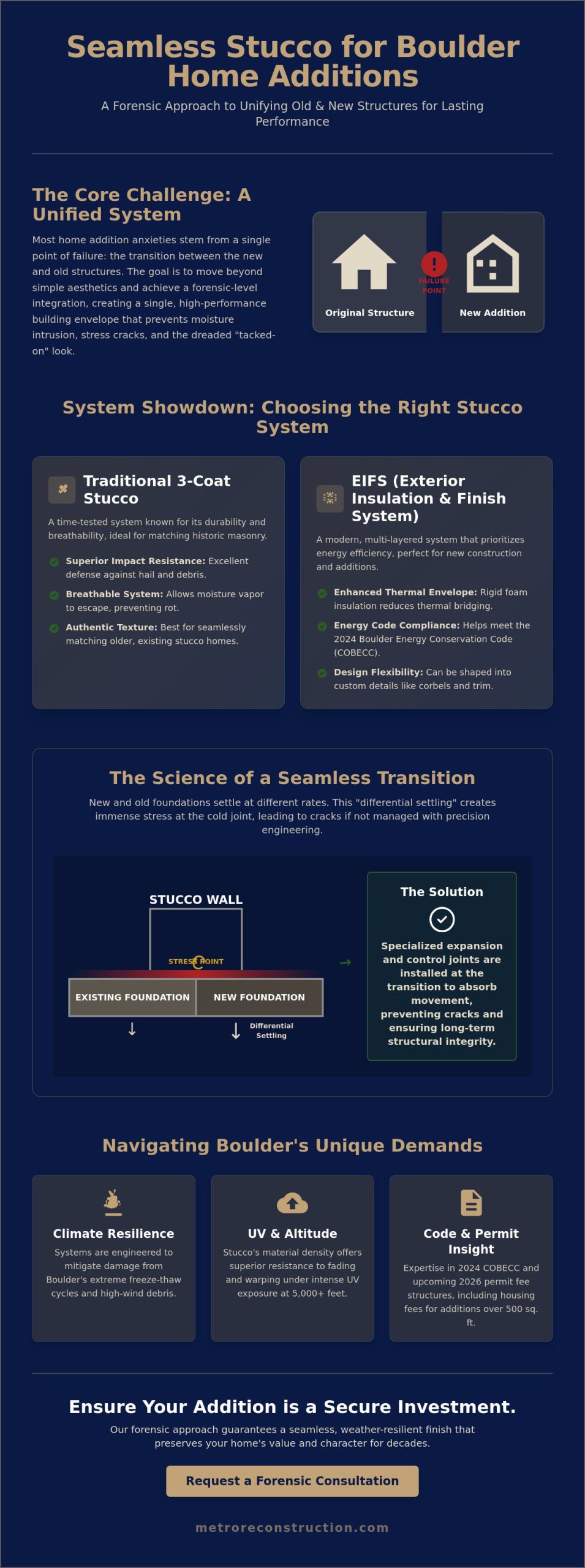
Boulder’s high-altitude environment places unique demands on a building’s exterior. Choosing stucco for home additions Boulder is a strategic decision that addresses these environmental stressors through material density and thermal mass. Unlike wood or vinyl, which often degrade under intense UV exposure at 5,000 feet, stucco offers a durable shield that resists fading and warping. This resilience ensures that the new addition maintains its structural integrity and visual appeal for decades, directly contributing to a higher long-term resale value for the property. Because stucco acts as a monolithic barrier, it provides a level of protection against the region’s seasonal hail and high-wind debris that thinner siding materials simply cannot match.
Traditional Stucco vs. EIFS for New Additions
The choice between traditional three-coat stucco and Exterior Insulation and Finish Systems (EIFS) depends largely on the performance requirements of the new space. Traditional stucco provides superior impact resistance and breathability, making it ideal for additions that must match older masonry structures. However, modern EIFS is frequently preferred for new additions because it incorporates a layer of rigid foam insulation, which significantly enhances the thermal envelope. This added insulation helps homeowners comply with the 2024 City of Boulder Energy Conservation Code (COBECC) by reducing thermal bridging. We evaluate the existing structure’s original exterior system to determine which material combination will provide the most stable transition. Precision here is vital; we focus on the underlying structural origins to ensure the new system doesn’t just look right but functions as a logical extension of the home’s thermal defense.
The Aesthetic Advantage of a Seamless Finish
One of the most common fears when expanding a home is the “tacked-on” look, where the new structure fails to harmonize with the original architecture. Stucco provides a continuous exterior envelope that can be manipulated to match any texture, from a smooth Santa Barbara finish to a heavy lace texture. This versatility allows for the integration of custom details such as corbels and integrated window trim, which unify the two structures into a single, cohesive design. By applying exterior home repair principles to the entire building, we ensure the new addition feels like an intentional part of the original footprint rather than a secondary attachment. We prioritize the building’s complete outer system to eliminate the visual seams that often appear when different materials are forced together. This holistic approach creates a professional finish that preserves the home’s character while modernizing its performance.
The Structural Science of Seamless Stucco Integration
The “transition point” represents the critical juncture where the new addition meets the original structure. For homeowners investing in stucco for home additions Boulder, this seam is the most vulnerable area for potential water intrusion and aesthetic failure. We approach this transition not as a simple material overlap, but as a complex engineering challenge that requires a deep understanding of structural mechanics. Before any lath is applied, we conduct forensic diagnostics on the existing substrate to ensure it can support the new load and that no hidden moisture issues will be trapped behind the new system. Adherence to Boulder’s building codes is only the baseline; our standard is the long-term preservation of the building’s complete outer system.
Managing the Cold Joint Between Structures
New foundations and existing foundations settle at different rates, a phenomenon known as differential settling. This movement creates immense stress at the cold joint between the two structures, which often leads to unsightly cracks if not managed correctly. To mitigate this risk, we utilize specialized expansion joints and control joints that allow for micro-movements without compromising the stucco shell. Proper structural reinforcement involves precise lath and mesh overlap at the transition. By creating a flexible yet durable bridge, we prevent the hairline fractures that typically plague low-quality additions. This technical precision ensures the exterior remains airtight and visually unified even as the new structure stabilizes over time.
Flashing and Drainage Systems
Moisture mitigation is the cornerstone of our methodology, as even minor leaks at the seam can lead to catastrophic rot within the wall cavity. We ensure the weather-resistive barrier (WRB) is continuous across both structures, creating a seamless drainage plane that directs water away from the substrate. Kick-out flashing is a mandatory requirement where new rooflines intersect with existing walls; this component redirects heavy runoff into gutters rather than allowing it to saturate the stucco. This level of detail is especially vital when developing a stucco restoration plan that incorporates new window openings. Every window in the addition must be integrated into the drainage system to prevent capillary action from drawing water into the framing. Before installing new windows in your addition, conducting an exterior home inspection before window replacement Boulder can identify hidden moisture damage in the surrounding substrate that would otherwise be sealed behind the new frames. If you suspect your current exterior has underlying moisture issues, a forensic building envelope assessment can identify the root cause before you break ground on your new addition.
Achieving an Invisible Transition: Texture Matching and Siding Combinations
Achieving an invisible transition requires more than a standard color wheel. We utilize a “Forensic Match” process that analyzes the specific grit profile, aggregate size, and application technique of the existing structure. Because the original finish has undergone years of oxidation and UV exposure, a fresh batch of the original product will rarely match. We must account for the way sunlight interacts with the aged surface to ensure the new application doesn’t create a jarring visual break. When applying stucco for home additions Boulder, we consider the building’s complete outer system, ensuring that the transition is physically sound and visually undetectable. This analytical depth allows us to address the underlying structural origins of the home’s aesthetic character while protecting your long-term investment.
Mastering Stucco Texture Types
Dash, Lace, or Sand finishes each possess a unique physical signature. A heavy lace texture on a 1980s home has a different rhythm than a modern smooth finish. Our artisans focus on the specific pressure and angle of the trowel to blend the new material into the weathered surface. This level of precision is necessary because any variation in texture will catch shadows differently, revealing the seam even if the color is perfect. We often perform multiple mock-ups to verify that the light reflection on the new addition mimics the existing walls under various times of day. Professional craftsmanship isn’t just about the finish; it’s about the technical accuracy of the application.
Integrating Siding and Stucco
Many modern Boulder additions successfully combine cladding materials to mask the cold joint where the new structure meets the old. Utilizing fiber cement siding installation on bump-outs or upper levels provides a natural break that eliminates the need for a perfect stucco-to-stucco match. This strategy isn’t just about style; it’s about smart engineering. This approach requires sophisticated moisture management in stucco systems, as the transition between siding and stucco must be properly flashed with Z-bars or starter tracks to prevent water from entering the substrate. When planning stucco for home additions Boulder, varying the materials allows us to create visual interest while maintaining absolute structural continuity. This method effectively bypasses the anxiety of texture matching while providing a weather-resilient exterior that protects the addition for decades.
Boulder Climate Considerations: Weatherproofing Your New Addition
High-altitude environments present a distinct set of challenges for the building envelope that standard construction practices often overlook. When installing stucco for home additions Boulder, we must account for the atmospheric pressure and intense solar radiation that accelerate material degradation. It’s not enough to match the aesthetic profile; the chemical composition of the finish must be UV-stable to prevent the premature fading common in the Colorado sun. We focus on the building’s complete outer system to ensure the new addition remains resilient against seasonal hail storms and high-wind debris. Precision in material selection is a foundational promise of our methodology. We don’t just apply a finish; we engineer a shield.
The Freeze-Thaw Cycle in the Front Range
The Front Range is notorious for rapid temperature fluctuations where the thermometer can drop 40 degrees in a few hours. This cycle causes trapped moisture within the substrate to expand during the freeze, which ultimately leads to the catastrophic failure of the stucco bond. We utilize vapor-permeable finishes that allow the wall assembly to breathe, ensuring that internal moisture can escape rather than freezing behind the finish coat. Proper curing times are equally critical in our arid environment. If the stucco dries too quickly, it loses its structural density and becomes prone to brittle failure. We manage this process meticulously to ensure the addition’s exterior achieves its full chemical strength.
Expansive Soils and Structural Flex
Boulder’s geological profile often includes bentonite clay, which expands and contracts significantly based on its moisture content. This soil movement frequently causes additions to shift independently of the original home, placing immense stress on the exterior cladding at the transition point. We analyze the underlying structural origins of any existing cracks before proceeding with new work. Our approach often involves linking stucco performance to specialized foundation repair services when the soil conditions are particularly volatile. By using high-performance elastomeric coatings, we provide the stucco with the necessary elasticity to bridge minor structural movement without fracturing. This proactive measure prevents water from entering the building envelope during periods of soil expansion.
A resilient exterior starts with an accurate diagnosis of your site’s specific environmental risks. Contact us for a comprehensive exterior envelope consultation to ensure your new addition is built to last for decades.
The Forensic Approach to Addition Longevity: Beyond Surface Aesthetics
We view every project not as a simple construction task, but as a rigorous structural preservation effort. When homeowners invest in stucco for home additions Boulder, they are often unaware that the integrity of the new wall depends entirely on the health of the existing substrate. Metro Reconstruction Services, Inc. analyzes the complete outer system to ensure that the integration doesn’t create hidden pockets for moisture or air leakage. This forensic mindset allows us to identify potential failures before they manifest as visible cracks or rot. Precision during the initial installation is the only way to avoid the cycle of temporary patches and expensive restoration work that plagues many properties in the Front Range. By prioritizing long-term reliability over superficial fixes, we protect the significant financial investment you’ve made in your home’s expansion.
Pre-Construction Diagnostics
Before any lath is attached or mortar is mixed, we perform a series of diagnostic tests to verify the health of the original building envelope. We test moisture levels within the existing walls to ensure we aren’t sealing in pre-existing dampness that could lead to mold or structural decay. Identifying the underlying structural origins of existing cracks on the main house is essential; if the original structure is still settling or shifting, the new addition must be engineered to accommodate that movement. This phase of the project ensures that the new addition doesn’t compromise the original home’s integrity. We don’t guess at the condition of your substrate. We verify it through analytical depth and technical precision.
The Metro Commitment to Quality
With over 40 years of experience in Boulder County custom builds, Metro Reconstruction Services, Inc. has developed a deep understanding of how regional environmental stressors interact with complex building systems. Our project management style is characterized by authoritative professionalism and a quiet confidence that comes from decades of successful problem-solving. We maintain a high level of corporate polish while delivering the rugged, local expertise required for Colorado’s demanding climate. Our final inspection protocols cover the entire exterior envelope, not just the new stucco surfaces. We examine the interaction between your new windows, masonry work, and drainage planes to ensure every component functions as a unified shield. This holistic focus is what distinguishes a professional installation from a standard contractor’s work. We don’t just build additions; we preserve the future of your property through meticulous craftsmanship and transparent communication.
Securing Your Home’s Structural Future
Integrating a new addition requires an analytical understanding of how disparate building elements interact under constant environmental stress. Throughout this guide, we’ve explored how technical precision at the transition point and forensic texture matching prevent the visual and structural failures that often compromise expanded properties. By prioritizing the complete outer system, you ensure that your investment in stucco for home additions Boulder remains resilient against the region’s intense UV rays and aggressive freeze-thaw cycles. Accuracy at the outset is the foundational promise of our methodology. We don’t just apply a finish; we preserve a legacy.
Metro Reconstruction Services, Inc. brings over 40 years of Boulder County expertise to every project. As specialists in structural mitigation, we operate with the quiet confidence and integrity of a family-owned and operated business that values permanent solutions over superficial fixes. Our methodology identifies the underlying origins of structural issues before they can threaten your property’s long-term value. Precision is not optional; it’s essential. Consult with our forensic experts on your Boulder home addition to ensure your exterior envelope is engineered for decades of reliable protection. Your home deserves a partner dedicated to its preservation.
Frequently Asked Questions
How do you match the color of new stucco to my existing 20-year-old home?
Matching the color of aged stucco requires a forensic evaluation of the existing finish’s oxidation and UV degradation. Because the original pigment has faded over two decades, a fresh batch of the original product will create a visible patch. We utilize custom-tinted finish coats and multiple on-site mock-ups to account for how light reflects off the weathered surface. This process ensures the new material mimics the current state of the original home rather than its brand-new condition.
Is stucco or siding better for a home addition in Boulder’s climate?
Stucco is generally superior for Boulder’s climate due to its high thermal mass and exceptional resistance to intense high-altitude UV radiation. While fiber cement siding is a durable alternative, stucco provides a monolithic barrier that better protects against seasonal hail and extreme temperature swings. Choosing stucco for home additions Boulder often results in a more energy-efficient envelope that aligns with the city’s strict energy conservation standards while offering superior long-term structural preservation.
What is the most common cause of stucco failure on home additions?
The primary cause of failure is moisture intrusion at the transition point where the new addition meets the original structure. If the weather-resistive barrier and drainage plane aren’t perfectly continuous across this seam, water can penetrate the substrate and cause rot. This often happens because contractors treat the two structures as isolated components rather than an integrated building system. This oversight leads to catastrophic failure behind the surface finish that is often expensive to remediate.
Can I apply new stucco directly over my existing exterior material?
Applying new stucco directly over existing materials like wood or vinyl is not a recommended practice as it prevents proper bonding and moisture drainage. For a successful integration, the existing cladding must typically be removed to expose the original substrate. This allows for the installation of a new, continuous weather-resistive barrier and lath system. This ensures the addition is structurally tied to the main house and that the complete building envelope remains watertight and secure.
How long does it take for stucco to cure on a new home addition?
Stucco typically requires 48 hours of curing time between the scratch and brown coats, followed by a minimum of 10 to 14 days before the final finish coat is applied. In Boulder’s dry, arid environment, we often utilize misting techniques to prevent the material from drying too quickly, which can lead to brittle failure. A full chemical cure usually takes approximately 28 days. During this period, the material reaches its maximum structural density and durability.
What maintenance does a stucco addition require in Colorado?
A stucco addition in Colorado requires annual inspections to identify hairline fractures or breaches in the sealant around windows and doors. Because of the intense freeze-thaw cycles in the Front Range, addressing minor cracks immediately prevents water from entering the wall cavity and freezing. Periodic cleaning with a low-pressure garden hose helps remove dirt and salts that can degrade the finish over time. This proactive care preserves both the aesthetic and functional integrity of the system.
Do I need to worry about my addition settling and cracking the stucco?
Differential settling between an established foundation and a new addition is a common occurrence that can cause structural cracking if not managed. We mitigate this risk by installing specialized expansion joints at the transition point, which allow the two structures to move independently without fracturing the stucco shell. This technical foresight ensures that the inevitable micro-movements of a new build don’t compromise the aesthetic continuity of the exterior. It’s a foundational step in our preservation process.
How much does it cost to stucco a home addition in Boulder?
The cost of an addition project in Boulder is influenced by several variables, including the total project valuation and the city’s 2026 fee schedule. For additions over 500 square feet, the new affordable housing fee significantly impacts the overall budget. Because every project requires a unique forensic analysis of the existing substrate and custom texture matching, we provide comprehensive evaluations to determine the specific requirements for a long-term, weather-resilient installation. We focus on providing accurate assessments rather than superficial estimates.
Is stucco a fire-resistant material for homes in Boulder’s wildfire zone?
For homeowners in Boulder’s Wildland-Urban Interface, understanding whether stucco is fireproof and how its fire resistance rating performs under extreme thermal stress is a critical consideration when selecting exterior materials for any addition. Cementitious stucco can achieve a one-hour fire rating, but that performance depends entirely on the integrity of the installation and the absence of cracks that could compromise the system.