
With Boulder facing a wildfire risk higher than 97% of all U.S. communities, homeowners are rightfully scrutinizing every layer of their property’s defense. You likely chose your home’s exterior for its aesthetic durability, yet as the Colorado Wildfire Resiliency Code moves into full enforcement by July 2026, you may be asking: is stucco fireproof or just a temporary delay against the heat? It’s a valid concern for anyone living in the Wildland-Urban Interface who wants to move beyond marketing terms toward genuine structural resilience.
You deserve to know the technical reality of how your home responds to extreme thermal stress. We’ll clarify the critical distinction between fireproof materials and fire-resistant systems, demonstrating how a one-hour fire rating depends entirely on the integrity of the installation. This guide examines the ASTM E119 standards for cementitious stucco, the dangers that existing cracks pose to your safety, and why a holistic approach to your building’s complete outer system is the only way to achieve true structural hardening. By understanding the relationship between material science and proactive maintenance, you can ensure your property remains a secure sanctuary.
Key Takeaways
- Distinguish between marketing jargon and technical reality to understand why asking is stucco fireproof leads to the more accurate measurement of a one-hour fire resistance rating.
- Learn how the mineral density of traditional three-coat stucco systems provides a superior thermal barrier compared to thinner, superficial applications.
- Identify the critical connection between your stucco, window installations, and roof lines to ensure your complete outer system remains sealed against environmental stressors.
- Evaluate the performance differences between cement-based stucco and synthetic EIFS to determine which material best supports your home’s structural hardening goals.
- Discover how proactive restoration of surface cracks prevents minor flaws from becoming dangerous gateways for moisture and fire intrusion.
Defining Fireproof vs. Fire-Resistant Stucco
When homeowners ask is stucco fireproof, they’re often seeking a level of absolute certainty that rarely exists in residential engineering. In the professional world of structural protection, we focus on measurable resistance rather than absolute immunity. Defining Fireproof vs. Fire-Resistant Stucco involves recognizing that while cement-based systems do not burn, they are designed to manage and delay the transfer of thermal energy. This distinction is vital for Boulder residents, as the goal of structural hardening is to provide a window of safety that can save both lives and property.
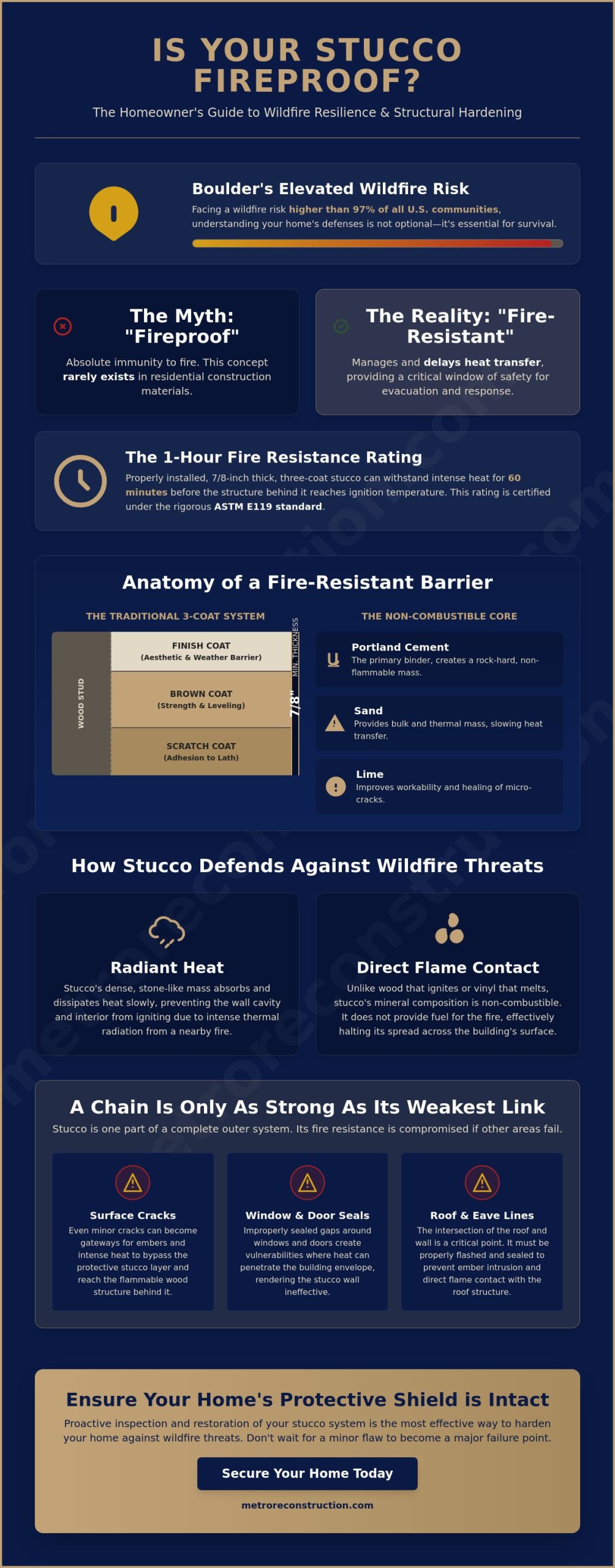
A traditional 7/8-inch three-coat stucco application earns its reputation by offering a one-hour fire resistance rating. This rating indicates that the material can endure intense heat for sixty minutes before the structural elements behind it reach a critical ignition temperature. By acting as a dense thermal barrier, the Portland cement layer reflects radiant energy away from the home’s skeleton, providing a level of reliability that flammable siding options simply cannot match. Understanding whether is stucco fireproof or fire-resistant helps you move past marketing terms and toward a factual assessment of your home’s long-term preservation.
The Science of Non-Combustibility
The protective capacity of stucco is rooted in its mineral composition, primarily consisting of Portland cement, sand, and lime. These components are inherently non-combustible, meaning they do not provide fuel for a fire or contribute to its spread across the building’s surface. According to the ASTM E119 standard, a one-hour fire rating represents the duration an assembly can successfully prevent fire penetration and limit temperature rise on the protected side during a controlled test. This mineral density creates a stable exterior that maintains its structural integrity even when subjected to the rapid temperature spikes common in wildfire scenarios.
Radiant Heat vs. Direct Flame Contact
Many homes are lost to wildfires because of radiant heat transfer, where the intense energy of a nearby fire ignites the interior of a wall without the siding ever catching fire. Stucco is exceptionally effective at mitigating this risk, as its stone-like properties absorb and dissipate heat much more slowly than wood or synthetic alternatives. While vinyl siding may melt at relatively low temperatures and wood siding can ignite from airborne embers, stucco remains a steadfast barrier against direct flame contact. It’s important to recognize that this protection isn’t infinite; during prolonged high-intensity events, the heat will eventually penetrate the envelope. This is why we emphasize the importance of a complete outer system, ensuring that every component of your home’s exterior works in unison to resist thermal intrusion.
The Mineral Composition of Fire-Resistant Stucco
The effectiveness of stucco as a thermal barrier isn’t accidental; it’s a direct result of its mineral chemistry. Portland cement, sand, and lime are the primary ingredients that transform from a wet paste into a rock-like substrate through a chemical process called hydration. This curing process creates a dense, non-combustible surface that doesn’t melt, smoke, or contribute fuel to a fire. When homeowners ask, is stucco fireproof, they are really asking about the limits of this mineral shield. The answer lies in its density, which allows the material to withstand the extreme temperatures of a Colorado wildfire without losing structural integrity.
The National Fire Protection Association (NFPA) emphasizes the importance of non-combustible siding in wildfire-prone areas like Boulder. For residential applications, a 7/8-inch thickness is the industry benchmark for traditional three-coat systems. This specific depth provides the necessary thermal mass to achieve a one-hour fire rating. Thinner, superficial applications often lack the density required to prevent heat from transferring to the underlying wood studs. Precision in the mix is vital. When evaluating if is stucco fireproof, it’s the thickness and mineral consistency of this shield that dictates the level of protection for your property.
The Traditional 3-Coat System Breakdown
A reliable thermal barrier is built in stages, each contributing to the building’s complete outer system. The process begins with the scratch coat, which establishes the foundational bond to the metal lath and provides the first layer of non-combustible protection. Following this, the brown coat is applied to add the bulk of the system’s mass. This second layer is critical for fire safety, as it provides the majority of the 7/8-inch thickness required to slow heat transfer. Finally, the finish coat adds the desired aesthetic texture while maintaining the mineral integrity of the entire assembly. This layered approach ensures that the home is wrapped in a consistent, stone-like envelope.
Material Additives and Their Fire Impact
Modern advancements have introduced specialized additives to improve the longevity of stucco systems. Glass or alkali-resistant fibers are frequently incorporated into the mix to enhance tensile strength and reduce the likelihood of surface cracking. These fibers are designed to be non-combustible, ensuring that the fire-resistant properties of the Portland cement remain uncompromised. However, the danger of DIY repairs often lies in the use of improper, combustible additives or incorrect mixing ratios that can create weak points in the thermal shield. Ensuring your home benefits from high-quality, professional masonry work is the only way to guarantee that the chemical composition of your exterior meets rigorous safety standards. Consistency in the substrate is the difference between a superficial fix and a lasting protective barrier.
Stucco as Part of a Complete Fire-Resistant Outer System
A building’s exterior functions as a unified defense mechanism, where the failure of a single joint can compromise the entire assembly. While the question of is stucco fireproof focuses on the material itself, the reality is that stucco only provides safety if the building envelope remains hermetically sealed. We refer to this as the “weak link” theory. If embers bypass the stucco at a window frame or roof line, the non-combustible nature of the cement becomes irrelevant. Achieving true protection requires looking at the home through a forensic lens to ensure every transition point is secure.
Moisture intrusion is a silent enemy of fire resistance. When water seeps behind the substrate due to poor flashing, it causes the underlying wood structure to decay. This rot creates internal voids and dry timber that can ignite rapidly if heat penetrates the exterior. By maintaining the integrity of the substrate, you aren’t just preventing water damage; you’re ensuring the thermal barrier remains backed by solid mass. Precision in these details is a foundational brand promise for any high-quality restoration, as we focus on identifying underlying structural origins rather than superficial issues.
Critical Transition Points and Flashing
Window replacement in Boulder requires more than just fitting glass into an opening. It demands a meticulous integration with the surrounding stucco to prevent air gaps. The Stucco Manufacturers Association provides specific technical details for these junctions, emphasizing that metal flashing must be layered to direct heat and moisture away from the sheathing. For homeowners considering upgrades, an exterior home inspection before window replacement Boulder is a critical step in verifying that the envelope’s safety hasn’t been compromised by previous structural shifts.
The Role of Soffits and Eaves in Fire Protection
Overhangs and eaves are often the most vulnerable parts of a home during a wildfire, as they can trap rising heat and embers. Extending a stucco wrap-around technique into these areas can significantly harden the structure against ignition. We ensure the building’s complete outer system is resilient by identifying specific areas where air currents might carry embers into the attic space. This forensic approach ensures that every square inch of the exterior, from the foundation to the roof line, contributes to a collective defense against environmental stressors. It’s this level of accuracy that transforms a simple wall covering into a comprehensive protective system.
Evaluating 3-Coat Stucco vs. Synthetic EIFS for Fire Safety
Choosing between traditional cementitious systems and modern synthetic alternatives requires a deep understanding of how different materials react to extreme thermal stress. While both systems are often categorized under the same umbrella, their chemical compositions lead to vastly different outcomes when homeowners ask, is stucco fireproof. Traditional three-coat stucco is a mineral-based assembly that relies on the density of Portland cement to absorb heat. In contrast, Exterior Insulation and Finish Systems (EIFS) are acrylic-based and utilize Expanded Polystyrene (EPS) foam for insulation. While EIFS meets modern building codes through the addition of fire-retardant chemicals, its performance during a high-intensity wildfire event differs significantly from its stone-like predecessor.
In high-risk Boulder County zones, traditional masonry is often the preferred choice for structural hardening. This preference stems from the inherent non-combustibility of the scratch and brown coats, which provide a thick, heat-dissipating shield. The structural differences are not just about surface protection; they involve the entire relationship between the exterior cladding and the home’s framing. For those expanding their property, using stucco for home additions Boulder ensures that new construction matches the safety standards of existing fire-resistant envelopes.
Traditional Stucco: The Heavyweight Defender
The primary advantage of the three-coat system lies in its thermal mass. Because it’s applied at a thickness of 7/8-inch, it acts as a heavyweight defender against radiant heat. This mass requires a longer curing time and adds significant weight to the structure, but these factors are a necessary trade-off for long-term structural integrity. This system won’t melt or pull away from the wall when exposed to high temperatures. It remains a reliable component of the building’s complete outer system, providing consistent protection that lighter materials struggle to replicate. Precision in the initial application is what guarantees this durability.
Synthetic Stucco (EIFS): Insulation vs. Ignition
EIFS provides exceptional energy efficiency, yet its reliance on EPS foam creates unique challenges during a fire. If the system’s fire-stop detailing is compromised, the foam can melt away behind the acrylic finish; this potentially creates a “chimney effect” that draws flames upward through the wall cavity. This vulnerability makes professional installation and diagnostic accuracy non-negotiable. When comparing the resilience of different materials, some owners look toward fiber cement siding installation as a middle ground, but neither can match the raw density of traditional masonry. To ensure your home is protected against these hidden mechanics, you should invest in professional stucco installation that prioritizes technical precision over low-cost shortcuts.
Maintaining Your Stucco’s Protective Integrity in Wildfire-Prone Areas
A home’s fire resistance isn’t a static feature that remains unchanged after the initial application. Even the most robust three-coat system requires diligent oversight to ensure its protective capacity hasn’t been compromised by environmental stressors. When residents ask is stucco fireproof, they must consider that any physical breach in the substrate acts as a gateway for wind-driven embers. During a wildfire, these embers can be forced into microscopic openings, bypassing the non-combustible exterior to ignite the flammable wood framing within. Maintaining the continuity of your building’s complete outer system is the only way to ensure the one-hour fire rating remains a functional reality rather than a theoretical specification.
Structural preservation and fire safety are deeply intertwined. In Boulder County, the freeze-thaw cycle frequently causes the ground to shift, which often leads to stress fractures in the cementitious layer. While these might appear cosmetic, they often signal underlying structural origins that require forensic-level diagnostics. We recommend that homeowners conduct a thorough visual assessment at least once a year, specifically looking for the following indicators of vulnerability:
- Separation at transition points where stucco meets window frames or door casings.
- Vertical or diagonal cracks wider than a credit card, which may indicate foundation movement.
- Spalling or flaking of the finish coat, suggesting that moisture has weakened the bond.
- Discoloration or staining that points to internal water intrusion and potential rot in the sheathing.
Identifying and Repairing Stucco Cracks
It’s vital to distinguish between superficial hairline cracks and significant structural failures. Hairline cracks often result from the natural curing process or minor thermal expansion, but larger gaps suggest a deeper issue that compromises the thermal barrier. Many homeowners attempt to resolve these issues with hardware-store caulk, but this approach fails to restore the assembly’s fire resistance. Most consumer-grade sealants are combustible and don’t provide the mineral density required to stop heat transfer. Engaging in professional stucco restoration ensures that repairs are made with compatible, non-combustible materials that maintain the integrity of the original shield.
The Importance of Professional Masonry Work
When an exterior system fails, the solution must address the root cause rather than simply covering the symptom. Our methodology focuses on identifying why a failure occurred, whether it was due to improper flashing, moisture trapping, or structural settling. High-quality stucco and masonry repairs ensure the building remains a cohesive unit capable of resisting both water and fire. Metro Reconstruction Services, Inc. focuses on the structural origins of exterior damage to provide long-term reliability. Protecting your investment in Boulder’s demanding environment requires a commitment to precision and a proactive approach to exterior maintenance. When evaluating if is stucco fireproof, remember that the answer is only as strong as your most recent inspection.
Securing Your Home’s Future Against Wildfire
Understanding the technical limitations of building materials is the first step toward true structural hardening. While the question of is stucco fireproof is often met with nuanced technical ratings, real protection comes from the meticulous maintenance of your home’s complete outer system. By ensuring that transition points remain sealed and the mineral density of your 3-coat system is uncompromised by stress fractures, you create a formidable barrier against environmental stressors. This proactive approach ensures that your property remains a secure sanctuary in Boulder’s demanding landscape.
Metro Reconstruction Services brings over 40 years of Boulder County expertise to every project, utilizing a forensic approach to identify the underlying structural origins of exterior damage. We specialize in complete outer system restoration, ensuring that your property is not just superficially repaired but fundamentally resilient. Ensure your home’s exterior is wildfire-ready with a forensic stucco inspection from Metro Reconstruction Services. Investing in the initial accuracy of your home’s defense today provides the reliability you need for the years ahead. Your property is a significant investment; we are here to help you preserve it for the long term.
Frequently Asked Questions
Is stucco more fire-resistant than brick or stone?
Stucco provides a comparable level of fire resistance to brick or stone; however, the specific performance depends on the density of the entire wall assembly. While brick and stone are naturally thicker and offer high thermal mass, a standard 7/8-inch stucco system is engineered to meet the same non-combustible standards. Both materials effectively prevent the spread of flames across the exterior envelope when installed correctly.
Can stucco melt during a house fire or wildfire?
Traditional Portland cement stucco does not melt because it is a mineral-based masonry product. It can withstand extreme heat until it eventually cracks or calcifies under prolonged exposure. In contrast, synthetic EIFS contains acrylic polymers and foam insulation that can melt or deform when subjected to high temperatures. This is a critical distinction for homeowners evaluating if is stucco fireproof or merely heat-resistant.
Does painting stucco affect its fireproof properties?
Standard acrylic paints are technically combustible; however, the thinness of the application usually prevents them from compromising the underlying stucco’s fire rating. For superior protection, homeowners should consider mineral-based silicate paints or specialized fire-retardant coatings. These options bond chemically with the substrate and don’t provide a fuel source for wind-driven embers during a wildfire event.
What is the difference between traditional stucco and EIFS regarding fire safety?
The primary difference lies in the core materials: traditional stucco is a dense cementitious mix, while EIFS utilizes expanded polystyrene (EPS) foam boards. Traditional systems offer superior resistance to direct flame contact and radiant heat due to their mineral mass. EIFS requires specific fire-stop detailing and chemical retardants to meet building codes, as the internal foam can melt if the outer acrylic layer is breached.
How thick should stucco be to provide the best fire protection?
An industry standard thickness of 7/8-inch is required for a traditional three-coat system to achieve a certified one-hour fire resistance rating. This depth provides the necessary thermal mass to slow the transfer of heat to the home’s wooden framing. Thinner applications, often found in one-coat systems, may not offer the same duration of protection during intense wildfire events where radiant heat is high.
Can embers get behind stucco and ignite the house?
Embers can bypass the stucco layer if there are cracks in the substrate or gaps around window and door transitions. This is why we emphasize the building’s complete outer system rather than just the material itself. Even if the stucco remains intact, a single unsealed joint or stress fracture allows wind-driven embers to reach the flammable sheathing and framing behind the non-combustible exterior.
Does insurance offer discounts for stucco homes in fire zones?
Many insurance providers offer premium adjustments for homes that utilize non-combustible exterior materials like cementitious stucco in Wildland-Urban Interface zones. Because stucco is listed as a compliant material under the Colorado Wildfire Resiliency Code, it reduces the risk of total loss. You should consult with your specific carrier to see if your 2026 resiliency upgrades meet their criteria for a fire-safety discount.
How often should I inspect my stucco for fire-safety vulnerabilities?
You should conduct a comprehensive visual inspection of your stucco at least once a year, preferably before the peak wildfire season. Look for new stress fractures, separation at window seals, or signs of moisture intrusion. Identifying these underlying structural origins early allows for professional restoration that preserves the thermal integrity and safety of your home’s exterior envelope.