
A standard siding replacement is often sold as a cosmetic upgrade, but for a home in the Front Range, treating it as anything less than a forensic reconstruction is a dangerous oversight. You’ve likely seen the frustration of recurring moisture damage or felt the weight of new wildfire mitigation requirements that now cover both the forested mountains and the eastern grasslands of Zone 2. It’s natural to want a permanent fix rather than a temporary patch that ignores the underlying health of your home.
Discover how a high-performance fiber cement siding installation serves as the foundation for a resilient exterior envelope that exceeds the 2021 International Codes adopted in Boulder County on March 31, 2025. We’ll show you why a “built right the first time” approach, focusing on technical precision and ignition-resistant materials, is the only way to secure a Class A fire rating and long-term structural integrity. This article provides a detailed look at our methodology for identifying the root cause of failure and implementing a solution that protects your investment for decades.
Key Takeaways
- Understand why non-combustible materials are now essential for Boulder County homes and how fiber cement provides a Class A fire rating against wildfire risks.
- Learn how a professional fiber cement siding installation goes beyond the surface to address the root causes of moisture intrusion within the exterior envelope.
- Identify the technical flashing requirements and overlap rules necessary to protect your home’s structural sheathing from wind-driven rain and intense UV exposure.
- Discover why choosing a forensic reconstruction specialist over a general contractor ensures your home is built right the first time with long-term resilience in mind.
Why Boulder County Homeowners Prioritize Fiber Cement Siding Installation for Wildfire and Weather Resilience
Boulder County presents a unique set of architectural challenges that traditional materials simply weren’t designed to withstand. Between the intense UV radiation at high altitudes and the rapid temperature fluctuations that characterize the Front Range, homeowners are moving away from aesthetic-only upgrades in favor of high-performance solutions. A professional fiber cement siding installation represents more than a visual refresh; it’s a strategic investment in the long-term preservation of the exterior envelope. By choosing materials engineered for resilience, you’re addressing the root causes of building degradation before they lead to structural failure.
Wildfire Mitigation and Non-Combustible Materials
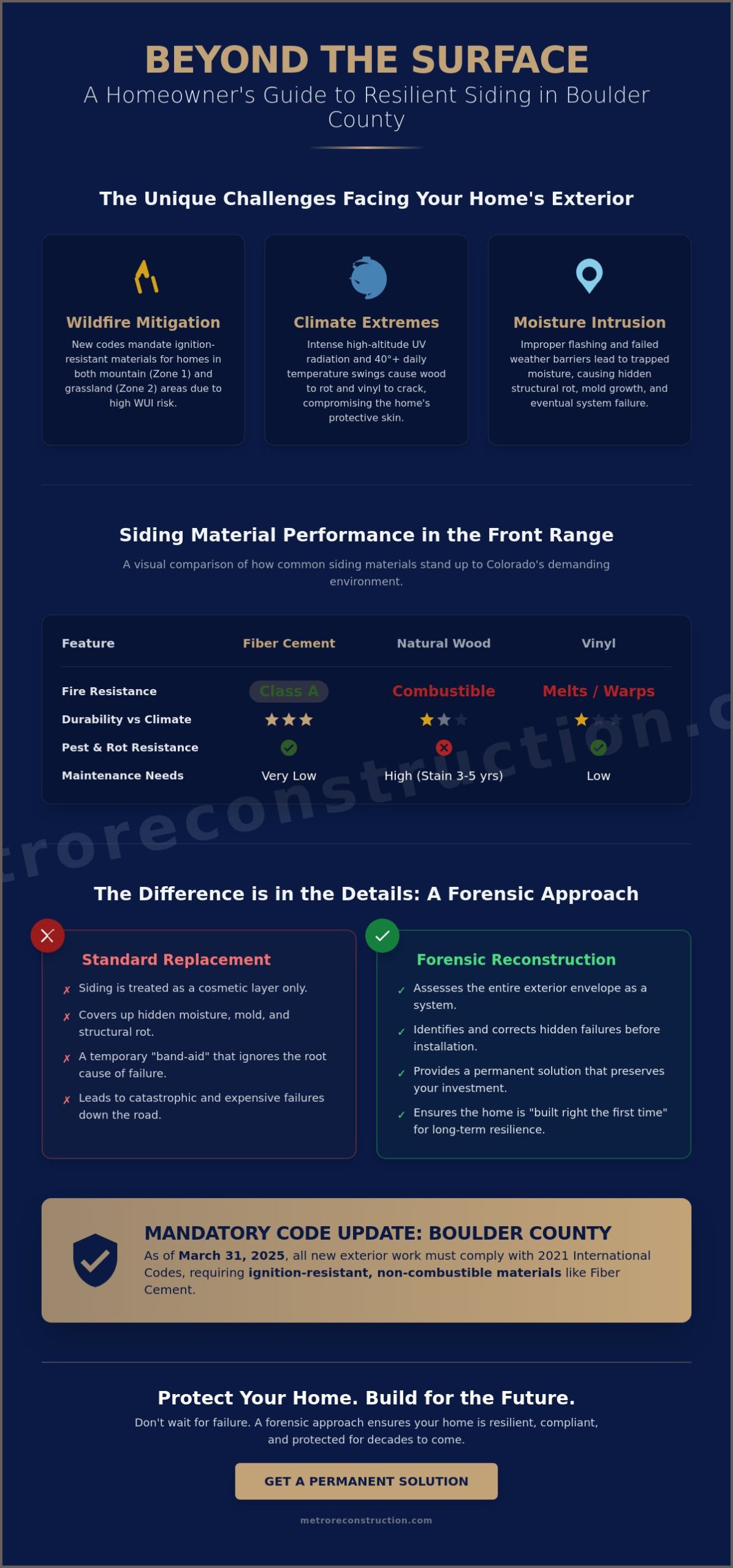
The reality of living in the Wildland-Urban Interface (WUI) means that fire safety is no longer optional. As of March 31, 2025, Boulder County’s adoption of the 2021 International Codes mandates ignition-resistant construction for all new exterior work in both the mountainous Zone 1 and the grassland areas of Zone 2. Fiber cement siding is composed of a mixture of portland cement, sand, and cellulose fibers, earning it a Class A fire rating. This means the material won’t ignite when exposed to direct flame or intense heat. It creates a critical defensive buffer that can prevent wind-blown embers from penetrating your home’s structural core during a wildfire event, a factor that’s increasingly reflected in local insurance premiums and building requirements.
Durability Against Front Range Climate Extremes
Colorado’s climate is notoriously hard on a building’s skin. It’s common to see 40-degree temperature swings within a 24-hour period. This rapid cycle causes wood to warp and vinyl to become brittle over time. While traditional stucco often develops spiderweb cracks under these freeze-thaw stresses, fiber cement remains dimensionally stable. It doesn’t expand and contract with the same volatility, which protects the integrity of your caulking and weather barriers. This stability is essential for maintaining a moisture-tight seal around windows and doors.
Beyond temperature, the high-altitude sun is a constant threat. Natural cedar or redwood siding requires staining every 3 to 5 years to prevent rot and UV degradation, whereas fiber cement holds its finish significantly longer. It also solves the localized issue of woodpecker damage and pest infestation. These are common problems in Boulder’s wooded communities that frequently plague natural wood exteriors. Investing in a comprehensive fiber cement siding installation ensures that your home’s first line of defense remains impenetrable, regardless of what the Colorado sky delivers.
The Forensic Approach: Assessing the Entire Exterior Envelope Before Installation
The exterior envelope is an integrated system of components working in concert to protect your home’s structural core. Many contractors approach a fiber cement siding installation as a purely cosmetic task, focusing only on the final appearance of the boards. At Metro Reconstruction Services, Inc., we recognize that the siding is merely the visible layer of a complex assembly. If the underlying flashing or weather barriers are compromised, even the most expensive siding will eventually fail. Our process begins with a forensic assessment of the entire system to ensure we aren’t just covering up a deeper structural issue.
Siding over existing rot or moisture damage is a common shortcut that leads to catastrophic failures. When water is trapped behind new siding, it creates an environment where mold and wood rot thrive in the dark. This “band-aid” fix might look good for a season, but it ignores the root cause of the problem. Our goal is to provide a permanent solution that preserves your investment. By identifying and correcting these hidden failures during the discovery phase, we ensure your home is truly built right the first time. Understanding the full scope of exterior home repair in Boulder County is essential to recognizing why a forensic approach protects your investment far better than surface-level patches.
Identifying the Root Cause of Siding Failure
Visible symptoms like peeling paint or cracked boards are often just the tip of the iceberg. In older stucco or EIFS systems, failures frequently occur at the intersections of different materials, such as where a roofline meets a wall. We use technical diagnostic tools, including thermal imaging and moisture meters, to detect water saturation that isn’t visible to the naked eye. If our inspection reveals that the underlying substrate has been compromised by long-term leaks, we may suggest professional stucco restoration to repair the damage before proceeding. This forensic depth is what distinguishes a specialist from a general siding crew.
The Role of High-Performance Weather Barriers
While the siding sheds the majority of rain and snow, the weather-resistive barrier (WRB) serves as the home’s secondary line of defense. A high-performance WRB must have the correct level of permeability, which allows moisture vapor to escape from the wall cavity while blocking liquid water from entering. We often utilize rain screen technology to create a dedicated drainage plane. This air gap between the siding and the house wrap ensures that any water that manages to penetrate the outer layer can drain away or evaporate. This system prevents the trapped moisture that causes sheathing to rot over time. If you’re concerned about the health of your home’s exterior, requesting a forensic evaluation from Metro Reconstruction Services, Inc. is the first step toward a lasting solution.
Case Study: Restoring Structural Integrity to a Boulder County Residence with Fiber Cement Siding
A 1990s residence nestled in the Boulder foothills recently served as a perfect example of why surface-level remodeling fails in the Front Range. From the driveway, the original cedar siding appeared merely weathered; however, our forensic assessment revealed a failing exterior envelope that was actively compromising the home’s structure. Upon removing the first few courses of wood, we discovered significant rot in the OSB sheathing, particularly concentrated behind the chimney and above several window headers. This moisture intrusion was the direct result of missing kick-out flashing and degraded weather barriers that had been improperly installed decades ago.
Restoring this home required a comprehensive reconstruction rather than a simple overlay. We stripped the building back to its studs in the affected areas, replaced the rotted structural components, and installed a high-performance drainage plane. This set the stage for a precision fiber cement siding installation using James Hardie products. By the end of the project, the homeowner moved from a state of constant maintenance anxiety to the peace of mind that comes with a 100% moisture seal and a 30-year warranted exterior.
Project Challenges: High-Altitude Wind and Exposure
The site’s specific orientation toward the Continental Divide meant the western elevation faced punishing wind loads and extreme UV exposure. Because standard nailing patterns often prove insufficient for high-altitude gusts, we utilized specialized, corrosion-resistant fasteners and a reinforced attachment schedule to ensure the boards remain secure during 100-mph wind events. The aesthetic goal was equally important. We selected a palette that honored the “mountain modern” architecture of Boulder, using deep earth tones and a mix of lap and vertical textures to provide a rugged, sophisticated finish that blends with the natural landscape.
Technical Execution: Beyond the Manufacturer’s Minimum
Our team at Metro Reconstruction Services, Inc. believes that meeting the building code is merely the starting point. For this project, we exceeded standard requirements by integrating custom-fabricated metal flashing at every transition between the siding and the existing stone masonry. These transitions are where most “budget” contractors fail, leading to the very moisture issues we were hired to fix. We applied high-grade, color-matched sealants that maintain flexibility during the intense freeze-thaw cycles described earlier. This level of technical precision ensures the entire exterior envelope functions as a single, impenetrable unit. We don’t just hang boards; we engineer a long-term defense for your home.
Best Practices for Fiber Cement Siding Installation: Moisture Management and Flashing
The technical success of a fiber cement siding installation depends entirely on the geometry of water shed. While the boards themselves are impervious to rot, the way they are integrated into the exterior envelope determines whether the underlying structure remains dry. Precision in the hidden details, such as flashing and clearances, is what separates a high-performance system from a failure-prone assembly. At Metro Reconstruction Services, Inc., we treat every joint and intersection as a potential point of entry for moisture, applying engineering-led solutions to ensure your home is built right the first time.
Proper clearance is the first line of defense against moisture wicking. To prevent the absorption of water into the substrate, we maintain a strict 6-inch clearance from the finished grade and a 2-inch gap from roof surfaces. Every lap board must maintain a minimum 1.25-inch overlap to prevent wind-driven rain from being forced upward behind the siding. Achieving clean, accurate results requires specialized equipment; we utilize PCD (Polycrystalline Diamond) tipped blades to ensure crisp cuts that don’t compromise the material’s factory-sealed edges.
Critical Flashing and Sealant Points
Kick-out flashing is a non-negotiable component at every roof-to-wall intersection. This specialized piece of metal diverts the concentrated flow of water away from the siding and into the gutter system, preventing the saturated sheathing common in older Boulder homes. We utilize Z-flashing for all horizontal transitions between siding and trim, creating a physical barrier that gravity cannot overcome. A capillary break is a small air gap designed to interrupt the surface tension of water, preventing it from being sucked into tight spaces between building materials. Budget contractors often rely on “caulk-only” solutions, but because sealants eventually shrink and crack in the Colorado sun, they should never be the primary defense against water intrusion. To ensure your home’s defenses are properly engineered, you can schedule a technical consultation with the team at Metro Reconstruction Services, Inc.
Fastening Patterns and Structural Stability
The method of attachment is critical for both aesthetics and wind resistance. Blind nailing involves driving fasteners through the top of the board so they are hidden by the subsequent course, protecting the nail head from UV exposure and moisture. However, in Boulder County’s high-wind zones, we often supplement this with specific face-nailing patterns to meet local uplift requirements. Every fastener must hit a structural stud rather than just the sheathing to provide the necessary pull-out resistance. We exclusively use hot-dipped galvanized or stainless steel nails to prevent the corrosion and bleeding that often occurs with standard fasteners in the Front Range’s variable climate.
Built Right the First Time: Selecting Your Boulder County Siding Specialist
Selecting the right partner for a fiber cement siding installation is the most critical decision a homeowner will make regarding their property’s longevity. While many contractors can hang a board, few understand the complex mechanics of the entire exterior envelope. A general siding crew often lacks the structural knowledge to identify failing sheathing or improper window integration before the new material goes up. By choosing a forensic reconstruction firm, you’re investing in a team that views your home as a high-performance system rather than a series of cosmetic surfaces. This holistic perspective is the only way to ensure that hidden moisture issues don’t continue to degrade your home from the inside out. A comprehensive strategy for structural exterior home repair addresses these interconnected vulnerabilities as a unified system rather than isolated problems.
Metro Reconstruction has spent the last 40 years serving Boulder County, building a reputation for technical excellence and quiet confidence. We don’t rely on high-pressure sales tactics because our work speaks for itself. We understand the difficult truths of structural failure and would rather explain the necessity of a proper repair than offer a cheap, temporary patch. This commitment to integrity ensures that every project we touch is truly built right the first time, protecting your investment against the specific wildfire and weather risks of the Front Range.
The Value of a Multi-Service Reconstruction Firm
Complex exterior issues rarely exist in a vacuum. A failure in the siding often points to issues with windows or masonry transitions. Because we are a multi-service firm, we handle these components as a single cohesive project. This approach eliminates the communication gaps that occur when multiple contractors are involved. You won’t have to worry about a siding crew blaming a window installer for a leak. We provide a fixed-price reconstruction project fee, giving you financial clarity and the peace of mind that comes from knowing the job will be done correctly without hidden costs. Our status as a local, family-owned business means we’re deeply invested in the resilience of our community. Homeowners planning an expansion should also understand how stucco for home additions in Boulder requires the same forensic-level integration at transition points to prevent moisture intrusion where new and existing structures meet.
Next Steps: Your Forensic Exterior Evaluation
The path to a resilient home begins with a comprehensive assessment. During an initial consultation, our specialists perform a detailed walkthrough to identify visible symptoms and hidden vulnerabilities. We prioritize transparency, providing you with a clear explanation of the root causes affecting your exterior envelope. You can expect a professional, engineering-led discussion rather than a standard sales pitch. We invite you to protect your investment and revitalize your home’s safety with a solution designed for the next 30 years. Contact Metro Reconstruction today to schedule your forensic exterior evaluation and experience the difference that four decades of local expertise makes.
Secure Your Home’s Future with a Resilient Exterior
Protecting your home in the Front Range requires a transition from cosmetic thinking to forensic engineering. A high-performance fiber cement siding installation is the most effective way to meet Boulder County’s ignition-resistant codes while managing the intense freeze-thaw cycles of our local climate. By addressing the root cause of moisture intrusion and prioritizing the health of the entire exterior envelope, you ensure that your home remains a safe, durable sanctuary for decades to come. It’s about moving beyond surface-level fixes toward a permanent standard of quality.
Metro Reconstruction has been a dedicated partner in home preservation since 1982. As a family-owned and operated firm with over 40 years of Boulder County expertise, we specialize in the complex moisture mitigation and structural integrity issues that general contractors often overlook. We don’t believe in temporary patches; we believe in solutions that are built right the first time. This commitment to technical precision is why homeowners trust us to revitalize their most significant investments.
Don’t wait for visible damage to become a structural crisis. Request a Forensic Exterior Evaluation from Metro Reconstruction today to gain a clear, professional understanding of your home’s current health. Our team is ready to help you invest in the long-term resilience your property deserves.
Frequently Asked Questions
Is fiber cement siding better than stucco for Boulder County homes?
Fiber cement offers superior resilience compared to traditional stucco in our local climate. While stucco often develops hairline cracks during 40-degree temperature swings, fiber cement remains dimensionally stable. This stability prevents moisture from entering the wall cavity and compromising your home’s structural integrity.
How much does professional fiber cement siding installation cost in Colorado?
A professional fiber cement siding installation typically costs between $7 and $18 per square foot based on March 2026 national averages. In Boulder County, local estimates for a full replacement often range from $7,000 to $15,000 depending on the project’s complexity. These figures include both the high-performance materials and the specialized labor required for a forensic-level application.
Can fiber cement siding help with wildfire insurance in Boulder?
Installing fire-resistant siding is a significant factor in mitigating wildfire risk and can influence insurance considerations. Since March 31, 2025, Boulder County requires ignition-resistant construction in both Wildfire Zones 1 and 2. Because fiber cement has a Class A fire rating, it serves as a critical defensive buffer that many insurance providers recognize as a proactive safety measure.
What is the life expectancy of fiber cement siding in a high-altitude climate?
You can expect a life expectancy of 30 to 50 years for fiber cement siding even at high altitudes. Its composition of portland cement and cellulose fibers makes it resistant to the intense UV radiation and rapid freeze-thaw cycles common in the Front Range. Unlike wood, it doesn’t rot or warp, provided the exterior envelope is managed correctly during the initial setup.
Do I need to replace my windows when I install new siding?
Replacing windows during a siding project isn’t mandatory, but it’s the ideal time for optimal moisture management. Because both components are part of the same exterior envelope, installing them together allows for a seamless integration of flashing and weather barriers. This approach eliminates the risk of water intrusion at the critical junctions where windows meet the siding.
What is the difference between James Hardie and other fiber cement brands?
The primary difference lies in James Hardie’s climate-specific engineering, such as their HZ5 product line designed for Colorado. Their boards are specifically formulated for the extreme temperature variations and snow exposure found in our region. While other brands offer generic boards, Hardie provides a thicker profile and proprietary finishes that resist fading more effectively over long periods.
How do I maintain fiber cement siding after it is installed?
Maintenance is minimal and generally limited to periodic visual inspections. We recommend washing the siding with a garden hose once a year to remove dust and checking the sealant at joints every few years. It’s a much simpler process than maintaining natural cedar, which requires restaining every 3 to 5 years to prevent rot.
What happens if there is rot found under my old siding during installation?
If we discover rot during a fiber cement siding installation, we transition into a forensic reconstruction phase. We identify the root cause of the moisture intrusion, replace the compromised sheathing or framing, and install new flashing to prevent a recurrence. We never “side over” damage because our commitment is to ensure your home is built right the first time.