
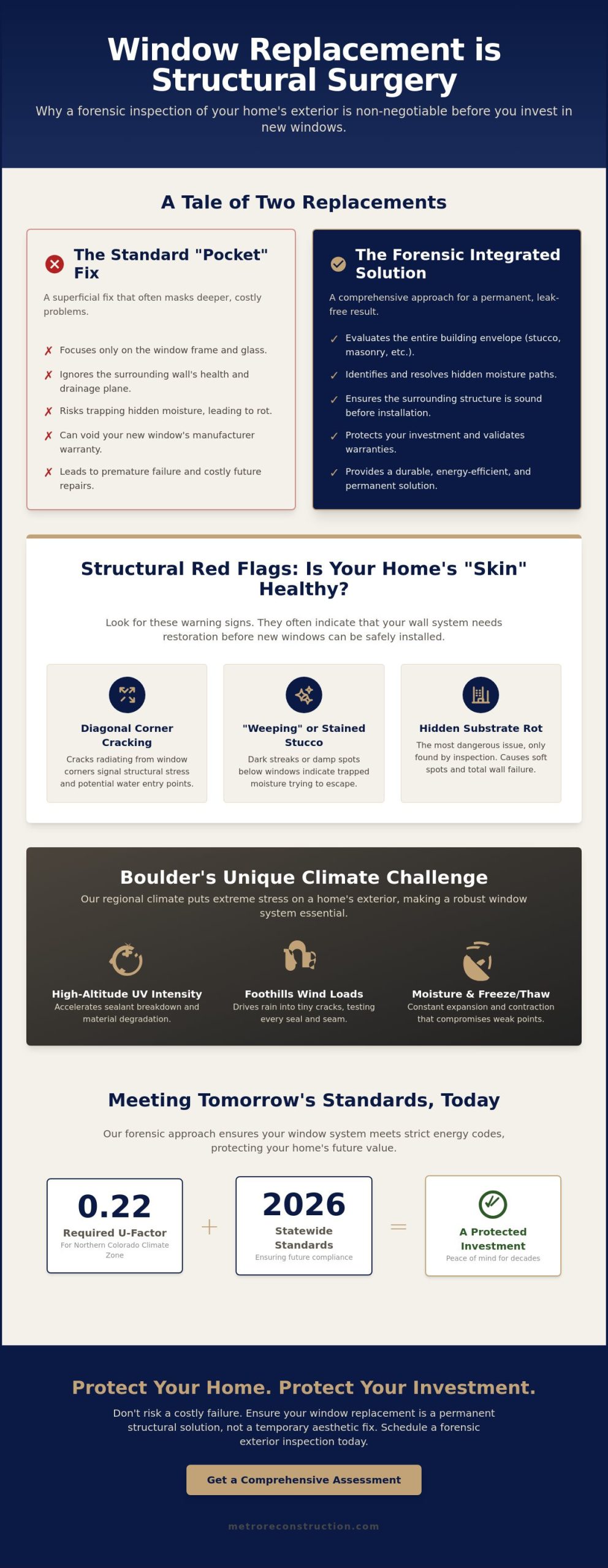
The most expensive window in the world will still fail if the wall surrounding it is structurally compromised. While it’s tempting to view a window swap as a simple product upgrade, it’s actually a form of structural surgery that requires a healthy “skin” to succeed. Many homeowners assume a leak is a glass failure, but the true culprit often hides behind the stucco or masonry. Investing in a forensic exterior home inspection before window replacement Boulder ensures that you aren’t just masking a deeper moisture problem. By identifying the underlying structural origins of potential leaks, you protect your investment from the high-altitude wind and intense UV exposure that define our regional climate.
We understand the anxiety of discovering hidden rot after the old frames are pulled. You want the peace of mind that comes from a leak-free home and a window system that meets the strict 2026 statewide standards, including the 0.22 U-Factor requirement for our northern climate. This guide will show you how a comprehensive diagnostic approach prevents premature failure and ensures compliance with the 2024 City of Boulder Energy Conservation Code. We’ll explore the critical relationship between your home’s complete outer system and its new openings, providing a clear path to a durable, energy-efficient restoration.
Key Takeaways
- Understand why viewing your home as a complete outer system is essential for preventing new windows from failing due to existing moisture paths within your stucco or masonry.
- Learn why a forensic exterior home inspection before window replacement Boulder is the only definitive way to uncover hidden substrate rot that standard installers often overlook.
- Identify critical structural red flags, such as diagonal corner cracking and weeping stucco, which signal that your wall system needs restoration before new glass is installed.
- Discover how Boulder’s high-altitude UV intensity and foothills wind loads dictate the specific performance ratings and sealant types required for a durable installation.
- See how a forensic diagnostic approach ensures your window replacement serves as a permanent structural solution rather than a temporary aesthetic fix.
The Critical Role of an Exterior Inspection Before Window Replacement
An exterior home inspection before window replacement Boulder isn’t a cursory glance at the trim; it’s a forensic evaluation of the entire building envelope to identify hidden moisture paths. This process acknowledges that windows are integral components of a complex system designed to shed water and manage thermal loads. When a window fails, the evidence often manifests as a leak at the sill or a draft near the frame, yet the underlying structural origin may be far removed from the glass itself. By conducting a thorough diagnostic before any materials are ordered, we ensure that the surrounding substrate is capable of supporting new installations without succumbing to latent rot.
Standard assessments often fail because they focus exclusively on the product being sold rather than the environment where it will live. If a new unit is installed into a wall where the drainage plane has already been compromised, the moisture will continue to accumulate behind the cladding. This leads to a cycle of structural decay that eventually voids the manufacturer’s warranty. Most high-end window brands require a sound, weather-tight opening for their performance guarantees to remain valid. Precision at this stage prevents the catastrophic expense of removing newly installed windows to fix a rotted header that should have been addressed initially.
Why ‘Standard’ Window Quotes Aren’t Enough
Typical window sales representatives are trained to evaluate the frame and the glass, but they rarely possess the technical depth to diagnose cladding failures. They may offer a quote for a “pocket” replacement that leaves the original, potentially compromised flashing in place. Our commitment to initial accuracy means we distinguish between a simple seal failure and a systemic breakdown of the stucco or masonry. Identifying these difficult truths early is the only way to avoid the superficial fixes that lead to long-term property damage. We believe that identifying the structural origin of a problem is the only path to a permanent solution.
The Peace of Mind Factor for Boulder Homeowners
Boulder residents often invest in premium fiberglass or wood windows to combat our region’s intense UV and wind loads. Protecting this significant investment requires more than just high-quality glass; it demands a validated surrounding structure. A forensic inspection reduces the risk of post-installation litigation and emergency repairs, ensuring your home remains a high-value asset in the competitive Boulder County market. We act as your dedicated partner in property preservation, prioritizing structural integrity over high-pressure sales tactics. This grounded approach ensures that your new windows perform as intended for decades, not just until the next heavy storm cycles through the foothills.
Evaluating the Building Envelope: Beyond the Glass and Frame
Viewing a home as a complete outer system is the only way to ensure structural longevity during a renovation. When we analyze a property, we look past the aesthetic appeal of new energy-efficient windows to understand how the building envelope manages moisture. The transition zone, where the window frame meets the exterior cladding, represents the most common point of failure in modern construction. Water doesn’t always announce its presence through interior drywall stains; instead, it often migrates behind the surface, causing “blind” moisture intrusion that rots the structural sheathing while leaving the interior looking pristine. This hidden decay is exactly why a forensic exterior home inspection before window replacement Boulder is a mandatory step for any responsible property preservation project.
Moisture mitigation is a science of paths and pressures. Water naturally follows the path of least resistance, which frequently leads it into the gaps between dissimilar materials. In Boulder, where wind-driven rain can hit with significant force, the window-to-wall interface must be engineered to redirect this energy effectively. A forensic inspection identifies whether your existing system relies on a barrier method or a drainage plane, a distinction that dictates how your new windows should be flashed and sealed. Neglecting this technical detail often results in moisture being trapped against the studs, leading to structural origins of rot that are far more expensive to fix than the windows themselves.
Stucco and EIFS Integration Challenges
Synthetic stucco systems, or EIFS, require specific detailing to prevent water from becoming trapped against the wood substrate. Replacing windows in these homes without a forensic plan often leads to catastrophic envelope failure because the original drainage plane is easily disrupted during the removal process. This phase provides a natural opportunity for stucco restoration, ensuring that the new window seals are chemically and mechanically compatible with the existing wall system to prevent future delamination.
Masonry and Stone Veneer Considerations
Stone and brick exteriors present unique challenges, particularly regarding the placement of weep holes and internal drainage paths. Before cutting into masonry or installing new units, it’s vital to assess the structural integrity of the stone veneer to ensure it can support the weight and movement of the new frames. Ensuring that necessary stucco and masonry repairs are completed prior to the window phase prevents future movement that could crack the new glass or compromise the perimeter seals. If you’re concerned about the state of your cladding, a professional review by the experts at Metro Reconstruction can clarify your home’s actual condition before work begins.
Common Structural Red Flags in Boulder County Residences
Identifying the structural origins of building failure requires a trained eye that looks beyond superficial aesthetic issues. While many homeowners focus on the clarity of the glass, an exterior home inspection before window replacement Boulder acts as a diagnostic safeguard against future system collapse. We look for specific patterns of distress that signal the building’s complete outer system is under duress. These indicators are rarely isolated; they are the visible results of complex interactions between gravity, moisture, and material fatigue.
- Diagonal cracking at window corners: These stress fractures often indicate header deflection or significant movement in the surrounding wall assembly.
- ‘Weeping’ stucco below the sill: Dark staining or persistent dampness suggests that the internal flashing has failed, allowing water to bypass the window frame.
- Efflorescence on masonry: White, powdery mineral deposits on brick or stone are not merely cosmetic. They prove that chronic moisture is migrating through the wall and leaching salts from the mortar.
- Sealant bead separation: A gap between the window frame and the cladding is a primary entry point for foothills wind and rain.
- Soft spots near the frame: Any ‘give’ in the exterior skin usually points to advanced decay in the underlying wood substrate.
A failed sealant bead or a minor crack might seem like a simple maintenance task, but in our demanding climate, these are often the first signs of a larger forensic challenge. Accuracy in this initial phase is our foundational promise. We don’t just see the crack; we analyze why it formed and what it means for the longevity of your new window installation.
Expansive Soils and Frame Distortion
Boulder’s geological profile includes high concentrations of expansive soils that exert immense pressure on residential structures. This movement can distort window openings, causing frames to go out of square and making operation difficult. It’s vital to determine if a sticking sash is a product defect or a symptom of a larger foundation repair issue. We use a cause-and-effect framework to link these exterior envelope cracks to the hidden mechanics of soil shift, ensuring the solution addresses the root cause rather than the symptom.
The Hidden Danger of Mold and Substrate Rot
Stucco is remarkably resilient, which can be a disadvantage when it hides black mold on the OSB or plywood substrate. Even if the exterior appears dry, moisture may be trapped in the wall cavity, quietly compromising the home’s structural integrity. We utilize moisture probes and forensic diagnostics to see behind the exterior skin before new glass is installed. Addressing these findings early is a core component of essential exterior home repair, preventing the need for invasive and costly remediation after the project is finished.
Boulder-Specific Environmental Stressors: UV, Wind, and Moisture
Boulder’s geography creates a set of environmental stressors that are statistically more aggressive than those found in lower elevations. At an elevation exceeding 5,000 feet, the solar radiation is significantly more intense, which accelerates the degradation of standard sealants and vinyl frames. This high-altitude UV exposure causes materials to become brittle, leading to hairline fractures in the window-to-wall interface. When these microscopic cracks meet the high-velocity foothills wind loads common in neighborhoods like Table Mesa, moisture is driven deep into the building envelope. An exterior home inspection before window replacement Boulder is critical because it identifies where these environmental forces have already compromised the structural integrity of your home’s skin.
The Front Range is also defined by rapid freeze-thaw cycles, where temperature swings of 50 degrees within a single day are not uncommon. These fluctuations cause stucco and masonry to expand and contract at different rates than the window frames they surround. This differential movement places immense stress on the perimeter beads, often leading to a total failure of the moisture barrier. On north-facing elevations, snow loading and slow melt cycles further exacerbate the risk, as water can sit against the sill for weeks, seeking out any vulnerability in the flashing or the drainage plane.
Neighborhood Micro-Climates in Boulder
West Boulder and Foothills neighborhoods like Pine Brook Hills face the brunt of extreme wind and steep-grade drainage challenges. In these locations, the hydrostatic pressure against the foundation and lower-level windows requires specialized management. Conversely, North Boulder (NoBo) often presents failures in builder-grade materials used in newer developments that weren’t engineered for long-term durability. In historic districts like Mapleton or Chautauqua, preservation is the priority. When homeowners require stucco for home additions, the integration must be forensically sound to avoid creating new moisture paths between the old and new sections of the building.
Selecting Materials for the Front Range
Choosing the right product is only half the battle; the other half is ensuring the installation can withstand the climate. Fiberglass is often the preferred choice for its thermal stability, as it expands and contracts at a rate similar to glass, reducing stress on the seals. It’s also essential to use “low-E” coatings that reflect heat without trapping it against the stucco, which can lead to delamination or “stucco burn.” Verifying that your window installation service near me understands the 2024 City of Boulder Energy Conservation Code is non-negotiable for long-term compliance. Boulder’s position in the Wildland-Urban Interface also means homeowners should understand whether stucco is fireproof or simply fire-resistant, as the integrity of your cladding system plays a direct role in how your home performs under extreme thermal stress. If you’re ready to protect your home with a forensically-backed solution, contact the experts at Metro Reconstruction to schedule your diagnostic review.
Metro Reconstruction’s Forensic Approach to Window Integration
Metro Reconstruction Services, Inc. brings a 40-year legacy of property preservation to Boulder County, positioning us as a dedicated partner for homeowners facing complex structural challenges. We approach every project through the lens of a forensic expert, seeking to identify the difficult truths that general contractors often overlook. This deep expertise is why a comprehensive exterior home inspection before window replacement Boulder is the cornerstone of our methodology. We understand that a window is only as reliable as the wall system supporting it. By diagnosing the structural origins of failure before the first frame is removed, we ensure that your investment is protected by a sound, weather-tight assembly.
One of the primary anxieties in any renovation is the discovery of “surprise” rot or hidden damage that leads to escalating costs. We address this through a cause-and-effect framework that prioritizes transparency and precision. Our fixed-price reconstruction fees are designed to eliminate the uncertainty of hidden repairs, providing you with a grounded and reassuring path forward. This model allows for a seamless transition from the initial diagnostic phase to specialized mitigation, ensuring that every component of the complete outer system is restored to its peak performance without the stress of open-ended billing.
The Integrated Solution: Stucco + Windows
The safest path to a leak-free home is hiring a specialist who understands how windows and cladding interact as a single unit. Our methodology focuses on creating a 100% waterproof window-to-envelope seal, a process that requires the technical depth of a stucco and masonry expert. Whether your home features traditional lime-based stucco or modern synthetic systems, our team ensures the drainage plane remains intact. We have successfully applied these forensic principles across various materials, as seen in our work with fiber cement siding installation, where envelope resilience is paramount. This holistic approach prevents moisture from ever reaching the sensitive wood substrate of your home.
Ready to Protect Your Investment?
Choosing a partner who understands the hidden mechanics of your home’s structure is the difference between a temporary patch and a long-term solution. Our quiet confidence comes from decades of managing Boulder’s most demanding residential projects with integrity and protective care. We invite you to experience the peace of mind that comes from a forensically-backed installation. To secure your home’s future and ensure compliance with the latest regional energy standards, contact Metro Reconstruction Services, Inc. for a Professional Diagnostic Consultation today. Let us provide the accuracy and reliability your property deserves.
Securing Your Home’s Structural Integrity for the Long Term
Choosing a path of precision ensures your home remains resilient against the foothills’ demanding weather patterns. Throughout this guide, we’ve explored how identifying structural origins and evaluating the building envelope are the only ways to prevent premature window failure. An exterior home inspection before window replacement Boulder acts as your final safeguard, validating that the surrounding masonry or stucco is prepared for a high-performance upgrade. This proactive stance transforms a standard renovation into a long-term preservation strategy.
Metro Reconstruction Services, Inc. remains committed to the meticulous standards we established in 1982. As a family-owned and operated firm, we bring four decades of specialized experience in moisture mitigation and stucco restoration to every project. We’d rather explain the difficult truth of a structural vulnerability now than offer a superficial fix that fails later. Schedule Your Forensic Exterior Diagnostic with Metro Reconstruction Services, Inc. to secure your home’s future with a partner who values substance over style. We’re ready to help you navigate these technical complexities toward a clear, professional result.
Frequently Asked Questions
Is an exterior inspection required by Boulder building codes?
The 2024 City of Boulder Energy Conservation Code doesn’t explicitly mandate a forensic evaluation, but it does require strict adherence to performance standards and permits. For properties 50 years of age or older, a Historic Preservation Demolition Review may be necessary before window replacement can proceed. A professional diagnostic ensures your project complies with these evolving regulations while protecting your structural investment.
Can I replace windows if my stucco is currently cracking?
Installing new units into a cracking substrate isn’t recommended because those fissures often signal underlying structural origins of movement or moisture. If the cracks aren’t addressed first, the stress will likely transfer to your new window frames, leading to seal failure or glass distortion. We prioritize identifying the cause of the cracking during the diagnostic phase to ensure a stable environment for your new windows.
How long does a forensic exterior home inspection take?
A comprehensive review of the building’s complete outer system typically requires two to four hours on-site. This duration allows our specialists to perform a meticulous analysis of the transition zones, drainage planes, and sealant integrity across the entire structure. The complexity of your home’s architecture and the total number of openings will ultimately dictate the specific timeframe needed for an accurate assessment.
Will a window inspection find hidden mold behind my siding?
Yes, a forensic exterior home inspection before window replacement Boulder utilizes moisture probes and thermal imaging to detect elevated moisture levels indicative of mold. These tools allow us to see through the exterior skin and identify substrate rot that isn’t yet visible on interior surfaces. Catching these issues early prevents the mistake of sealing active mold behind a new, high-performance window installation.
What is the most common reason window installations fail in Boulder?
The primary cause of failure is improper integration into the home’s drainage plane, where installers rely on superficial sealant rather than mechanical flashing. In our climate, intense high-altitude UV degrades these exposed seals, while foothills wind loads drive moisture into the resulting gaps. Without a forensically sound transition between the window and the wall, water eventually migrates into the structural sheathing.
Does Metro Reconstruction Services, Inc. handle both the inspection and the window installation?
Metro Reconstruction Services, Inc. provides a fully integrated solution that encompasses the initial forensic diagnostic and the subsequent window installation or stucco restoration. This continuity ensures that the technical findings from your inspection are directly translated into the construction phase without the communication gaps common when using multiple contractors. By managing the complete outer system, we maintain accountability for the long-term performance of your home’s envelope.
How much does a typical exterior envelope inspection cost before renovation?
Professional home inspections in the Boulder metro area typically range from $400 to $700 according to regional market data. A forensic envelope evaluation is a more specialized, engineering-led service that focuses specifically on moisture mitigation and structural preservation rather than a general maintenance overview. You should check with a local specialist to determine the specific diagnostic depth required for your property’s unique challenges.
Can high winds in the Boulder Foothills actually blow out a window seal?
Extreme wind loads in areas like Table Mesa create significant pressure differentials that can physically fatigue a window’s perimeter seals. These forces cause the frame and glass to flex, which eventually breaks the bond of standard builder-grade sealants. This is why we emphasize high Design Pressure (DP) ratings and forensic-grade sealants that are specifically engineered to withstand the unique environmental stressors of the Front Range. For homeowners in wildfire-prone areas, it’s equally important to understand the fire resistance ratings of stucco cladding systems and how existing cracks can compromise your home’s defense against extreme heat.