
A single hairline crack on your home’s exterior is rarely just a cosmetic issue; it’s often the first warning sign of a failing system. When you notice these small gaps or damage from local woodpeckers, it’s natural to feel uneasy about what might be happening out of sight. Most homeowners worry that moisture is already trapped behind the walls, leading to hidden mold or wood rot. This uncertainty makes it difficult to decide between a simple repair and a full replacement. Determining the scope of stucco restoration Boulder homes require means looking past the surface to evaluate how the entire outer system interacts with our demanding climate.
We believe that your home deserves care that prioritizes long-term stability over temporary patches. In this article, you’ll discover how to identify, repair, and protect your exterior using professional forensic restoration techniques. We’ll provide a step-by-step plan to address Colorado’s intense weather and aggressive wildlife. By focusing on the mechanics of moisture mitigation and precise restoration, you can move forward with the confidence that your property is secure for years to come.
Key Takeaways
- Learn how Boulder’s high-altitude UV rays and intense freeze-thaw cycles impact the longevity of your home’s exterior system.
- Understand the forensic approach to stucco restoration Boulder homeowners use to identify hidden moisture issues before they cause structural damage.
- Discover the specific indicators that help you decide between a targeted restoration and a full exterior replacement to protect your investment.
- Gain a clear overview of the professional restoration process, from initial evaluation to the thorough inspection of the underlying substrate.
- See why over 40 years of local experience ensures your home meets modern building codes while surviving the unique environmental stressors of the Front Range.
Understanding Stucco Restoration in Boulder’s Challenging Climate
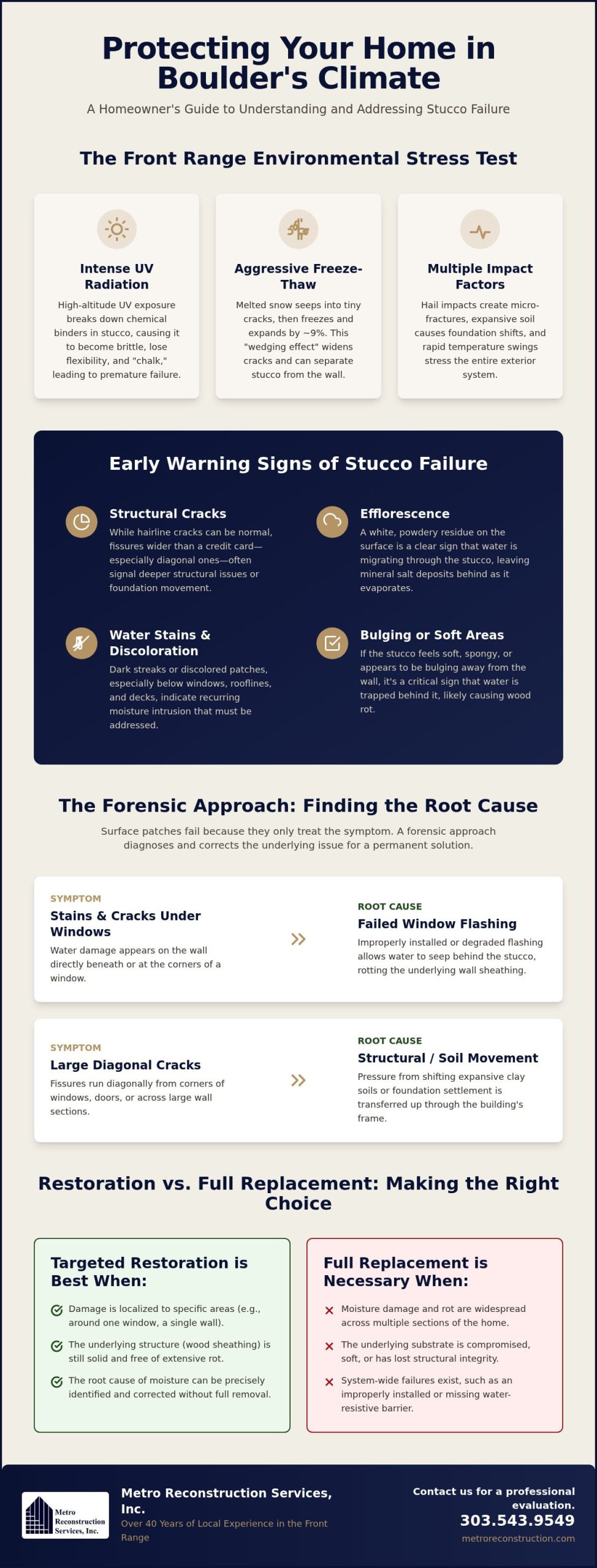
Boulder’s environment acts as a relentless laboratory for building materials. At our elevation, the atmosphere is thinner, which allows high-intensity ultraviolet (UV) radiation to strike your home’s exterior with greater force than at sea level. This constant exposure slowly breaks down the chemical binders in traditional finishes, causing the material to become brittle and prone to “chalking.” When the surface loses its flexibility, it can no longer accommodate the natural movements of the home, leading to the initial stage of failure. To understand the history and composition of these materials, one can look at what is stucco in a traditional sense compared to the modern systems we use today.
The freeze-thaw cycle is perhaps the most aggressive force in the Front Range. During a typical Boulder winter, snow melts during the day and seeps into microscopic pores or hairline cracks. As temperatures drop at night, this water expands by approximately 9% as it turns to ice. This internal pressure creates a wedging effect that widens cracks and can eventually delaminate the stucco from the underlying substrate. When moisture becomes trapped behind the exterior walls, it creates a hidden environment for rot that often goes undetected until the damage is extensive.
Hail damage is another factor that homeowners often underestimate. While a storm might only leave small indentations, these impacts can micro-fracture the cementitious layers. These fractures compromise the water-resistive barrier, allowing moisture to bypass the outer defense. Additionally, Boulder’s expansive clay soils frequently shift, putting immense pressure on foundations. This movement often manifests as diagonal structural cracking in the stucco, indicating that the origin of the failure is deep within the building’s complete outer system.
The Front Range Environmental Stress Test
Rapid temperature swings are a hallmark of our local weather, sometimes shifting 50 degrees in a single afternoon. These fluctuations cause significant material expansion and contraction, placing immense stress on your property. For homeowners in the wildland-urban interface, this system must also prioritize fire-resistant materials to meet local safety standards. We view the exterior not just as a decorative layer, but as a protective envelope where every component must work in harmony to prevent structural degradation.
Signs of Stucco Failure Homeowners Often Miss
Identifying the early warning signs is critical for effective stucco restoration Boulder. While tiny hairline cracks are common, structural fissures that are wider than a credit card often indicate deeper issues. Another common sign is efflorescence, a white, powdery substance that appears on the surface. This is a signal that water is moving through the material and carrying mineral salts with it. For a baseline on maintaining your property’s integrity, you can review our guide on essential exterior home repair. If you suspect your home’s exterior is compromised, contact our experts at 303.543.9549 or visit our contact page to discuss a long-term solution.
The Forensic Approach: Identifying the Origin of Stucco Failure
Forensic restoration isn’t just about covering up a crack; it’s a diagnostic process that uncovers why the damage happened in the first place. Many homeowners find that surface-level patches fail within just a few seasons because they only address the symptom. If the underlying cause, such as a failing drainage plane or poor window flashing, isn’t corrected, the moisture will continue to degrade the system from the inside out. For those dealing with older properties, understanding historic stucco preservation and repair can provide valuable context on how these materials were intended to function and why they eventually fail.
Window flashing is a common culprit in structural degradation. When the seals around windows are improperly installed or have aged past their effectiveness, they allow water to bypass the protective outer layer. This moisture then travels along the internal framing, often showing up as damage far away from the original leak. Similarly, structural movement in the foundation doesn’t stay localized. It travels upward through the wall system, manifesting as diagonal fissures in the stucco finish. A forensic approach analyzes these patterns to determine if the issue is a material failure or a sign of shifting soil.
Moisture Mitigation and Forensic Diagnostics
Moisture mitigation is the proactive prevention of water-driven rot and mold. In the context of stucco restoration Boulder projects, this involves identifying every possible water entry point, specifically behind the stucco lath. We often find that the drainage plane, which is the space designed to let water escape, has been compromised or was never installed correctly. Without a clear path for water to exit, the moisture sits against the wood framing, leading to structural rot that is invisible from the street. Identifying these structural origins is the only way to ensure a long-term solution rather than a temporary fix.
Woodpecker Damage and Structural Vulnerability
Boulder’s local wildlife, particularly woodpeckers, can cause surprising amounts of damage to a home’s exterior. These birds often target specific areas of stucco or EIFS because the hollow sound behind the finish suggests a nesting site or the presence of insects. Leaving these holes unsealed is a significant risk; they act as direct funnels for rainwater to enter the wall cavity. Integrating specialized woodpecker prevention into your restoration plan ensures that your home isn’t just repaired, but protected against future avian attacks. If you’re seeing signs of wear or bird damage, it’s best to consult a specialist who understands the complete outer system. You can reach our experts at 303.543.9549 or visit our contact page for a detailed evaluation.
Restoration vs. Replacement: Choosing the Right Path for Your Home
Deciding between a repair and a full overhaul is a significant financial consideration for any property owner. For many, stucco restoration Boulder services offer a way to salvage the existing system while addressing the root causes of failure. Restoration is typically the most cost-effective path when the damage is caught early and hasn’t yet compromised the structural sheathing behind the finish. However, a “point of no return” exists. If moisture has sat behind the walls for years, leading to widespread rot or mold in the framing, a full replacement is the only way to ensure the home remains safe and structurally sound.
The type of material also dictates the strategy. Traditional cement stucco is known for its ruggedness, but it lacks the flexibility of synthetic systems like EIFS. While synthetic finishes offer superior insulation, they require a flawless drainage plane to prevent water entrapment. Restoring these systems correctly doesn’t just improve the look; it protects your property’s resale value. Potential buyers in Boulder are increasingly savvy about moisture issues, and having a professionally restored exterior provides the transparency they need to feel confident in their investment.
Evaluating the Scope of Work
Determining the extent of the project requires a thorough look at whether the issues are isolated or systemic. Isolated damage, like a single cracked corner or woodpecker holes on one side of the house, can often be resolved through targeted stucco and masonry repairs. Systemic failure, conversely, suggests the entire installation process was flawed from the start. We find that a “fixed-price” approach to these complex projects is essential for our clients. It eliminates the stress of unexpected costs and ensures that the focus remains on the quality of the preservation rather than the clock.
Long-Term Value and Structural Integrity
Restoration acts as a critical layer of “home hardening” against Boulder’s unique environmental risks. By sealing the envelope and ensuring water flows away from the structure, you’re effectively preventing future foundation issues caused by soil saturation. This proactive stance is a hallmark of the stucco restoration pillar of home maintenance. If you’re unsure which path is right for your property, call us at 303.543.9549 or reach out through our contact page to schedule a professional evaluation. Our goal is to provide the clarity you need to make an informed decision about your home’s future.
The Professional Stucco Restoration Process
A high-quality stucco restoration Boulder project follows a steady, logical path that prioritizes structural integrity over superficial aesthetics. The process begins with a forensic evaluation to map out every failure point across the building’s complete outer system. This isn’t a surface-level scan; it’s a deep dive into the underlying structural origins of damage. Once we identify the compromised areas, we remove the failed material to inspect the substrate for hidden rot or moisture. Any damaged wood is replaced, ensuring the foundation for the new stucco is secure. We then address the critical junctions by installing advanced moisture barriers and flashing to prevent water from ever reaching the interior framing again.
Application involves layering new material using either traditional cementitious methods or modern synthetic techniques. During this stage, we also integrate specialized materials to address local issues like woodpecker damage. By using reinforced mesh and high-density backer, we make the exterior far less attractive to nesting birds. This engineering-led approach ensures that the repair isn’t just a patch, but a long-term solution for property preservation.
Precision in Texture and Color Matching
Matching a new repair to a finish that has weathered for twenty years is a delicate task. We analyze the existing aggregate and pigment to create a seamless transition that respects the home’s original aesthetic. In Colorado’s dry air, managing curing times is essential; we carefully monitor the moisture levels in the material to prevent premature drying and shrinkage cracks. Whether your home features a smooth modern finish or a heavy traditional texture, we ensure the new application mirrors the surrounding surface perfectly.
Caulking and Sealing the Outer System
The transitions between different materials, such as where the stucco meets window frames or door trim, are the most vulnerable points of any home. We use professional-grade sealants that maintain their elasticity through Boulder’s extreme temperature swings. Standard hardware store products often fail within a year because they can’t handle the material expansion and contraction common in the Front Range. The seal at the complete outer system acts as the final line of defense against moisture intrusion. If you want to ensure your home is protected by expert stucco restoration services, contact us at 303.543.9549 or visit our contact page today.
Trusting Your Property to a Seasoned Boulder Expert
When you face complex exterior challenges, the value of local history cannot be overstated. We’ve been a family-owned firm since 1982, providing over four decades of industry expertise specifically along the Front Range. This deep-rooted history allows us to approach every project with a sense of quiet confidence. We don’t rely on high-pressure tactics; instead, we let our technical precision and long-term results speak for themselves. Understanding the specific evolution of Boulder’s building codes, including the most recent updates to energy and fire safety standards, is essential for a successful stucco restoration Boulder project. We recognize that your home is likely your most significant investment, and our role is to act as a protective partner in its long-term preservation.
Choosing a dedicated partner in property preservation saves you money over the life of your home. By identifying the underlying structural origins of failure rather than applying a superficial patch, we prevent the cycle of repetitive, low-quality repairs. Our commitment to integrity means we’d rather explain the difficult truth of a structural issue than offer a temporary fix that will fail in a few seasons. This meticulous attention to detail is what distinguishes a Wise Craftsman from a standard contractor. We focus on initial accuracy as a foundational promise, ensuring that the complete outer system is restored to a standard that exceeds original construction.
A Holistic Approach to Home Construction
Many exterior problems are symptoms of larger architectural issues. By integrating our design-build services, we manage complex structural mitigation alongside cosmetic restoration. This holistic approach ensures that your exterior remodel isn’t just a face-lift but a fundamental improvement to the building’s envelope. Whether we’re addressing moisture behind the walls or updating the aesthetic of an older home, our team functions as a Seasoned Expert who understands how every technical component interacts. This broad expertise allows us to maintain a high level of corporate polish while delivering rugged, local solutions tailored to the Colorado environment.
Take the Next Step for Your Boulder Home
Proactive maintenance is the most effective way to prevent catastrophic structural failure. A forensic evaluation of your home’s exterior provides the clarity needed to protect your investment for the long term. If you’ve noticed hairline cracks, efflorescence, or bird damage, it’s time to move toward a permanent solution. Our methodology ensures that we solve the problem at its source, providing you with the peace of mind that comes from a secure and healthy home. To protect your investment, contact the experts at Metro Reconstruction or call us directly at 303.543.9549. We look forward to partnering with you on your next stucco restoration Boulder project.
Securing Your Home’s Future with Expert Care
Preserving a home in the Front Range requires more than just aesthetic updates; it demands a deep understanding of how environmental stressors impact the complete outer system. By adopting a forensic approach to identify the underlying structural origins of failure, you can address moisture intrusion and woodpecker damage at their source. This method ensures that your investment remains secure against Boulder’s intense UV exposure and rapid freeze-thaw cycles. Choosing professional stucco restoration Boulder services allows you to resolve these issues before they escalate into costly structural repairs.
Our family-owned firm has spent over 40 years mastering the nuances of property preservation in Colorado. We prioritize long-term stability and precision, providing you with the peace of mind that your home’s envelope is truly protected. Proactive care is the most effective strategy for maintaining structural integrity and resale value over time. Protect your home’s structural integrity. Schedule your forensic stucco evaluation with Metro Reconstruction today. You can also reach our team directly at 303.543.9549 to discuss your project. We look forward to helping you preserve your home for the next generation.
Frequently Asked Questions
How much does stucco restoration cost in Boulder?
Every project is unique because the scope is determined by the specific structural origins of the failure. Factors that influence the total investment include the size of the home, the extent of moisture intrusion behind the walls, and whether underlying wood rot requires replacement. Since we utilize a fixed-price model for our stucco restoration Boulder projects, you’ll receive a clear, comprehensive breakdown once the forensic evaluation is complete. This provides the transparency needed for complex structural work.
Can you repair woodpecker holes in stucco so they don’t come back?
Yes, we utilize specialized woodpecker prevention techniques that go beyond simple patching. By reinforcing the vulnerable areas with high-density materials and impact-resistant mesh, we make the surface significantly less attractive to birds looking for nesting sites. This approach addresses the structural vulnerability of the exterior system rather than just the cosmetic hole. It’s part of a long-term strategy to ensure these aggressive local birds don’t cause recurring damage to your property.
How long does a typical stucco restoration project take?
A typical project can span several weeks depending on the complexity of the repairs and the local weather conditions. Proper curing times are non-negotiable in Colorado’s dry climate to prevent shrinkage cracks in the new material. We provide a detailed schedule during the initial project management phase. This ensures that every layer of the complete outer system is allowed to set correctly, providing the structural integrity your home deserves and protecting your long-term investment.
Is stucco fireproof enough for Boulder’s wildfire prevention standards?
Stucco is highly regarded for its ignition-resistant properties and is a core component of home hardening services. In Boulder’s wildland-urban interface, using fire-resistant materials is essential for meeting local safety standards and wildfire prevention construction goals. While no material is entirely fireproof, a correctly installed stucco system provides a significant defensive barrier. This helps protect the underlying structure from radiant heat and embers during a wildfire event, offering essential peace of mind.
What is the difference between traditional stucco and EIFS?
Traditional stucco is a cement-based material known for its rugged, breathable nature and long-term durability. Synthetic stucco, or EIFS, offers superior insulation properties but relies heavily on a perfectly executed drainage plane to manage moisture. Both systems require a forensic understanding of water mitigation to function correctly in the Front Range. We specialize in identifying EIFS problems and restoring both types of systems to ensure they protect your home’s structural integrity and aesthetic appeal.
How often should I have my stucco exterior inspected?
We recommend a professional evaluation of your home’s exterior at least once a year or after significant weather events like hail storms. Early detection of hairline cracks or efflorescence allows for targeted stucco restoration Boulder before moisture reaches the internal framing. Proactive inspections are the most effective way to prevent hidden rot and avoid the high costs of full-scale replacement. Regular monitoring ensures your property preservation remains on track for decades to come.
Can you match the texture of my existing stucco during a repair?
Precision in texture matching is a hallmark of our craftsmanship. We analyze the existing aggregate and application style of your current finish to create a seamless transition between the old and new sections. Whether your home features a smooth, modern aesthetic or a heavy traditional lace texture, our team has the technical expertise to mirror it exactly. This meticulous attention to detail ensures that the repair is invisible to the naked eye and maintains your home’s value.
Does stucco restoration require a building permit in Boulder?
In the City of Boulder and unincorporated Boulder County, a building permit is required for any work that involves the water-resistive barrier or structural components. This includes removing stucco down to the lath or addressing moisture mitigation issues behind the cladding. We manage the permitting process as part of our comprehensive project management. This ensures your restoration meets all current 2021 International Codes and local energy conservation requirements for long-term compliance and structural safety.