
Could the very structure meant for your family’s summer gatherings be hiding a dangerous secret beneath its surface? For many homeowners in Parker, the sight of a splintering board or a bit of fading wood leads to a difficult question: is this a simple weekend fix or a sign of an impending structural failure? Understanding how to know when to replace your deck is about more than just checking for surface-level wear. It requires a forensic look at how your outdoor living space interacts with Colorado’s intense sun and freeze-thaw cycles.
We understand the uncertainty that comes with evaluating a major part of your home’s complete outer system. You want to ensure your investment is protected and your family stays safe. This guide provides the technical clarity needed to identify hidden structural failures and moisture intrusion. You’ll learn to distinguish between manageable repairs and the necessity of a full professional replacement under the 2024 International Residential Code. By examining the underlying mechanics of your deck, you can move forward with the confidence that your property is preserved for the long term.
Key Takeaways
- Differentiate between surface-level wear and deep-seated structural rot that requires immediate attention for safety.
- Discover how to know when to replace your deck by performing a forensic assessment of the underlying frame and foundation.
- Apply the 50% rule to determine if repair costs are high enough to justify a more reliable, full-scale replacement.
- Identify how local factors like high-altitude sun and seasonal temperature swings specifically stress your deck’s fasteners and wood fibers.
- Secure your property’s value by contacting our team at 303.543.9549 or through our contact page.
Identifying Visible Signs of Deck Deterioration and Safety Risks
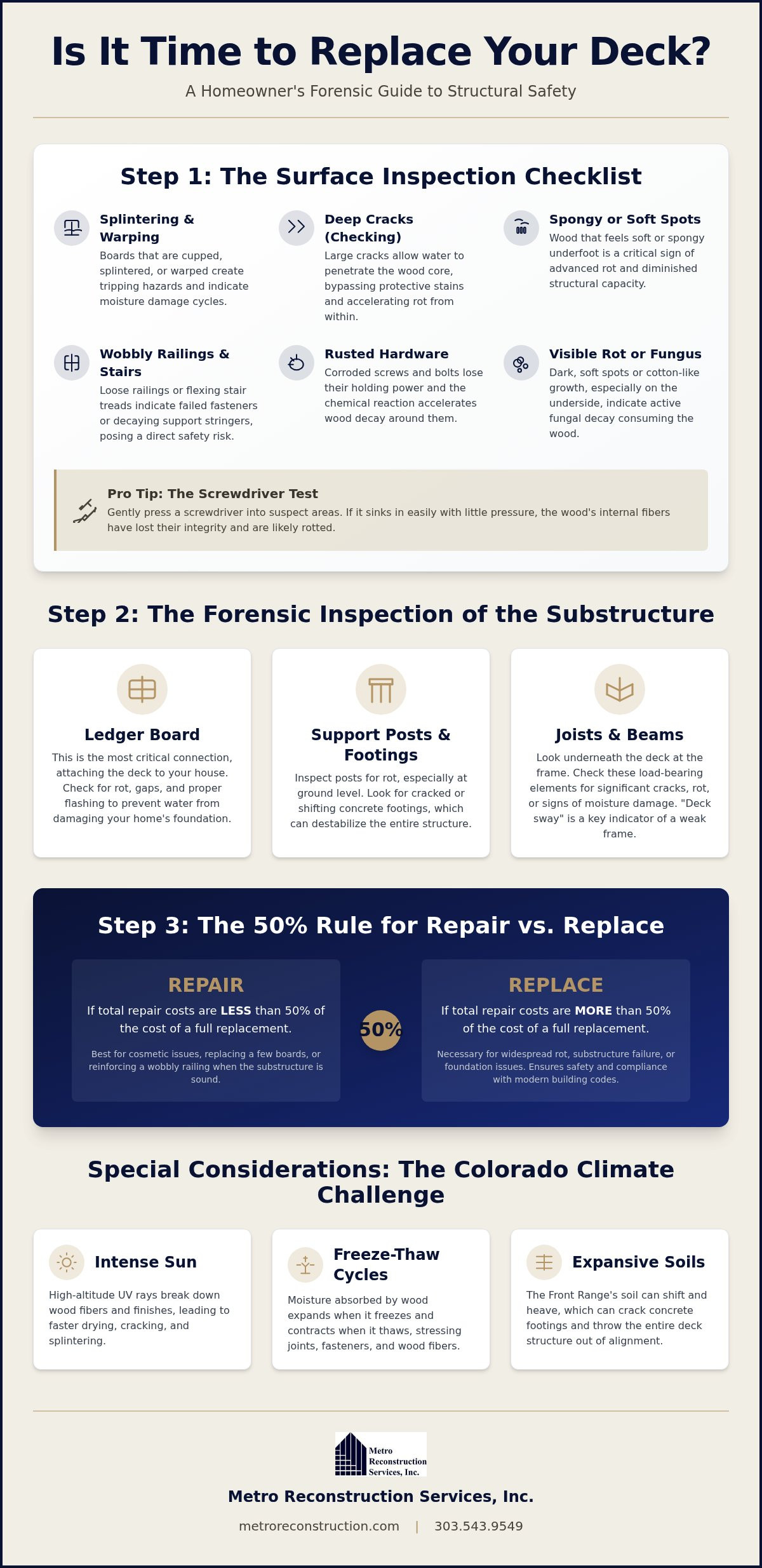
A deck that has weathered a decade of Colorado winters will naturally show its age, but there is a vital distinction between a silvered patina and a structural failure. Understanding how to know when to replace your deck begins with a systematic inspection of the wood’s density and the stability of its connections. While surface weathering is often a cosmetic issue that can be addressed with staining, deep-seated rot represents a compromise in the material’s ability to hold weight. You can perform a preliminary check using the screwdriver test; press a flat-head screwdriver into areas where moisture tends to collect, such as the ends of boards or near the home’s foundation. If the tool sinks easily into the wood without much pressure, the internal fibers have lost their integrity.
Safety risks often manifest first in the deck’s transition points. You should pay close attention to railings and stairs, as these are the components most likely to cause injury if they fail. A railing that wobbles when leaned upon or stair treads that deflect under your weight are not merely nuisances; they are indicators that the fasteners have lost their grip or the underlying stringers have begun to decay. Identifying these issues early allows you to determine if a targeted restoration service is possible or if the damage has progressed too far for a simple patch.
Surface Damage: When Cosmetic Issues Become Safety Concerns
Deep cracks, also known as checking, occur when the wood dries out and shrinks, creating pathways for water to bypass the protective surface and reach the core of the beam. This moisture cycle leads to excessive splintering and warping, which can eventually pull fasteners out of their holes. When hardware like screws or bolts becomes rusted, the chemical reaction often accelerates the breakdown of the surrounding wood. If your deck surface feels spongy or if you notice uneven gaps between boards, the structural capacity of the platform is likely diminished. These visible warnings suggest that the complete outer system of your home may be at risk of further moisture intrusion.
Visible Rot and Decay: The Telltale Signs of Moisture Intrusion
Persistent dampness creates an environment for fungal wood decay, a biological process that consumes the cellulose that gives wood its strength. This decay often appears as dark, soft spots or as a white, cotton-like growth on the underside of the structure. Many homeowners attempt to hide these areas with a fresh coat of paint, but this is a temporary fix that actually accelerates internal decay by trapping moisture inside the wood. If you find persistent mold growth or wood that crumbles when touched, the decay has likely reached the structural origins of the deck. For a professional assessment of your deck’s health, contact Metro Reconstruction Services at 303.543.9549 or visit our contact page.
The Forensic Inspection: Assessing the Deck Substructure and Foundation
While surface-level wear is easily observed, the true health of a structure lies within its skeleton. A deck’s frame is far more critical than the boards you walk on; it’s the primary system responsible for load distribution and stability. When we take a forensic approach to an inspection, we look for the underlying structural origins of failure rather than just surface decay. If you notice a “deck sway” or lateral movement when people move across the platform, it often indicates that the connection points or support posts have been compromised. This instability is a primary factor in deciding how to know when to replace your deck, as it suggests the original engineering can no longer guarantee safety.
The interaction between your deck and the local Colorado soil is another vital diagnostic point. The Front Range is known for expansive soils that can shift and heave, potentially lifting or cracking concrete footings. If a footing has failed or a post has begun to rot at the ground level, the entire structure’s alignment is at risk. Ensuring your deck meets modern deck building codes is essential for long-term reliability, especially in the Town of Parker where permits are required for all deck work. If you suspect your foundation is shifting, a professional structural assessment can provide the clarity you need.
The Ledger Board: The Most Critical Point of Failure
The ledger board is the horizontal beam that attaches the deck directly to your home’s structural frame. This connection is the most common site of catastrophic failure, often caused by improper flashing that allows water to seep behind the board. For homes with stucco or masonry exteriors, this moisture intrusion can silently rot the house’s rim joist, leading to expensive repairs that extend far beyond the deck itself. We often see cases where professional stucco restoration in Boulder County becomes necessary because a deck was not properly integrated into the building’s complete outer system. Proper moisture mitigation at this junction is the only way to prevent long-term structural decay.
Joists, Beams, and Posts: The Skeleton of Your Deck
Below the surface, we look for signs of previous “band-aid” fixes. “Sistering,” or bolting a new piece of wood next to a rotten one, is a frequent tactic that often masks a larger beam failure without solving the root cause of the moisture intrusion. We also examine the posts for rot, particularly where they meet the ground or concrete footings. In our region, the freeze-thaw cycle can trap water against the wood, accelerating the breakdown of fibers. When these vertical supports fail, the deck loses its ability to resist gravity. These issues often mirror the same structural challenges found in foundation repair services in Boulder, where soil pressure and water management dictate the longevity of the entire property.
Repair vs. Replace: A Cost-Benefit Analysis for Homeowners
Deciding how to know when to replace your deck often comes down to a simple financial calculation known as the 50% rule. If the estimated cost of repairing structural components and replacing damaged boards exceeds half the value of a new installation, a full replacement is typically the more responsible path. This approach ensures that you aren’t pouring capital into an aging system that will require further interventions in just a few years. While a repair might address immediate safety concerns, it does not reset the clock on the wood’s natural lifespan or the integrity of the fasteners. By choosing a full replacement, you invest in a modern solution that utilizes advanced moisture mitigation and structural techniques that were not available when older decks were built.
The Town of Parker recently adopted the 2024 edition of the International Residential Code, which sets rigorous standards for lateral load connectors and structural attachments. Older structures often fail to meet these modern safety requirements, meaning that even a significant repair might not bring the deck up to current legal standards. Because a permit is required for all deck work in Parker, an inspector may require you to upgrade the entire structure if you attempt a major repair. We focus on these technical realities to help you avoid the hidden costs of non-compliance. In many cases, the long-term return on investment for a new, low-maintenance composite deck far outweighs the recurring maintenance costs of an aging wood structure.
When a Simple Repair is Sufficient
If your forensic inspection revealed a substructure that is entirely sound, dry, and properly flashed, you may be a candidate for resurfacing or targeted repairs. This process involves replacing isolated deck boards that show surface wear while keeping the original frame intact. You can often achieve a significant safety upgrade by simply tightening loose hardware, replacing rusted fasteners, and stabilizing wobbly railings. These restoration services are ideal for decks that are less than ten years old and have been consistently maintained. Keeping the frame while upgrading the surface can extend the life of your outdoor space without the cost of a full demolition.
When Full Replacement is the Only Safe Option
There are scenarios where pervasive rot in the substructure makes a patch job both impossible and dangerous. When fungal decay has reached the ledger board or the primary support beams, the structural integrity of the platform is lost. In these instances, a full design-build replacement is the only way to guarantee the safety of your family and the preservation of your home’s exterior. A new installation allows for the correct integration of the deck with your home’s stucco or masonry, ensuring the complete outer system remains watertight. For a professional evaluation of your deck’s health, contact our experts at 303.543.9549 or reach out through our contact page.
Regional Factors: How the Colorado Climate Affects Your Deck
Colorado’s high-altitude environment presents a unique set of stressors that aren’t found in lower elevations. Understanding how to know when to replace your deck requires recognizing that local structures face a dual assault from intense solar radiation and extreme moisture cycles. At 5,000 feet and above, the atmosphere provides less protection from ultraviolet rays, which penetrate deep into wood fibers and break down the lignin that holds them together. This process doesn’t just fade the color; it fundamentally weakens the material’s ability to resist the weight of heavy snow or the tension of structural fasteners. When wood becomes brittle from UV exposure, it’s more prone to splitting when subjected to the Front Range’s recurring freeze-thaw cycles.
Water management is equally critical in our arid but snow-heavy climate. During the spring, snow melts during the day and seeps into the smallest cracks in your deck’s joists and beams. When temperatures drop at night, this water freezes and expands with immense force, effectively prying the wood fibers apart and loosening the grip of your screws and bolts. This cycle is a primary cause of the lateral instability we look for during a forensic inspection. If your deck wasn’t designed to handle these specific regional pressures, it can quickly become a liability for your property’s complete outer system. Ensuring your home is protected requires a strategy for essential exterior home repair in Boulder County that accounts for these environmental realities.
UV Exposure and High-Altitude Protection
Decks in mountain communities like Evergreen or high-plains areas like Parker age significantly faster than those at sea level. The sun effectively “bleaches” the structural integrity out of the wood, leaving it grey, cracked, and susceptible to dry rot. This isn’t a cosmetic issue you can simply stain over once the damage has reached the core. We recommend specialized, high-solids stains designed specifically for high-desert and mountain climates to provide a genuine UV barrier. If your boards have begun to “cup” or turn upward at the edges, the sun has likely caused irreversible cell collapse within the wood fibers.
Snow Loads and Moisture Mitigation
A heavy Colorado snowstorm can place thousands of pounds of pressure on your deck in a matter of hours. On an older structure where the beams have already been weakened by moisture or UV damage, this weight can lead to catastrophic sagging or total collapse. Proper drainage is essential to ensure that melting snow moves away from your home’s foundation and doesn’t sit against your stucco or masonry. When water is allowed to pool near the ledger board, it creates a direct path for rot to enter your home’s interior framing. If you’re concerned about how last winter’s snow affected your structure, contact our team at 303.543.9549 to schedule a professional assessment through our contact page before the next season begins.
Choosing a Professional Partner for Your Deck Replacement
Once you have gathered the evidence of structural decay or outdated building methods, the final step in understanding how to know when to replace your deck is selecting a partner who can execute a long-term solution. A simple carpenter might only focus on the wood, but a professional reconstruction specialist looks at the relationship between your deck and your home’s complete outer system. This holistic view is essential because a deck is not an isolated structure; it’s a component that must be perfectly integrated with your stucco, siding, and foundation to prevent future moisture intrusion. For homeowners who also require specialized accessibility features, HomeSafe Living Solutions provides expertise in aging-in-place home modifications that can be integrated into the new design. You should prioritize contractors who are fully licensed and insured, but also those who can demonstrate a forensic understanding of how regional stressors affect building materials over decades.
Choosing a design-build approach ensures that there is no disconnect between the structural engineering and the final aesthetic result. This methodology allows for a seamless transition from the initial diagnostic phase to the completed project, providing a level of harmony that separate design and construction firms often struggle to achieve. When a single team manages the entire lifecycle of the project, accountability is clear, and the precision of the installation is guaranteed. This process moves through a logical progression from fundamental diagnostics to a finished structure that is both beautiful and resilient.
While exterior structural integrity is paramount, many homeowners also choose to update interior utility spaces; for those projects, Superior Construction provides expert laundry room remodeling services throughout the Denver Metro Area.
The Metro Reconstruction Difference
Metro Reconstruction Services, Inc. is a family-owned firm that has served the Front Range and mountain communities since 1982. With over four decades of industry expertise, we have developed a specialized approach to structural integrity and moisture mitigation. Our design-build services are built on a foundation of transparency, utilizing fixed-price project fees to eliminate the uncertainty often associated with complex restoration work. We don’t just replace boards; we ensure that your new deck is properly integrated with your home’s stucco or masonry, preserving the value of your entire property investment.
Next Steps for Your Home
If you are still weighing the evidence and wondering how to know when to replace your deck, the most reliable path forward is a professional structural evaluation. A superficial fix might provide temporary relief, but it often masks deeper failures that will eventually require more expensive interventions. We invite you to partner with a team that values substance over style and integrity over high-pressure sales. Contact the experts at Metro Reconstruction Services today at 303.543.9549 or visit our contact page to schedule your comprehensive assessment and gain the peace of mind that comes from a permanent structural solution.
Securing the Longevity of Your Outdoor Living Space
Determining the true health of your deck requires looking beyond silvered boards to the structural origins of the frame. Deciding how to know when to replace your deck involves a careful balance between the immediate cost of repairs and the long-term reliability of a code-compliant installation. By identifying hidden moisture intrusion and accounting for the specific high-altitude stressors of the Front Range, you take a proactive step in protecting your family and your home’s complete outer system.
Metro Reconstruction Services has been family-owned since 1982. We bring over four decades of industry expertise to our clients, specializing in structural moisture mitigation and forensic building diagnostics. Initial accuracy is our foundational promise. This commitment to precision ensures you receive a permanent solution rather than a temporary patch. Contact Metro Reconstruction for a professional deck evaluation or call our specialists at 303.543.9549. We’re ready to help you secure the safety of your home.
Frequently Asked Questions
How long does a typical wood deck last in Colorado before needing replacement?
In the demanding Colorado climate, a traditional wood deck typically maintains its structural integrity for 10 to 15 years. The combination of intense high-altitude UV radiation and rapid freeze-thaw cycles causes wood fibers to expand and contract aggressively. This environmental stress eventually leads to deep cracks and internal rot. Without consistent maintenance and specialized sealants, the wood’s ability to resist the weight of heavy snow loads diminishes significantly over time.
Can I just replace the deck boards and keep the old frame?
You can replace surface boards only if a forensic inspection confirms the underlying frame is entirely sound and meets current safety standards. Determining how to know when to replace your deck involves checking if the original joists can support the weight of new materials, especially heavier composite options. If the frame is over a decade old or shows signs of moisture intrusion at the ledger board, a full replacement is the only way to ensure long-term safety.
How much does it cost to replace a deck in the Boulder area?
The investment required for a deck replacement depends on the structure’s square footage, the complexity of the design, and the choice of materials. Factors such as soil stability in the Front Range and the need for specialized moisture mitigation also influence the total project scope. We provide detailed, fixed-price project fees after a thorough assessment to ensure you understand the full value of your property preservation project without hidden costs.
What are the signs that my deck ledger board is failing?
A failing ledger board often manifests as a visible gap between the deck and the home’s exterior siding. You might also notice rusted fasteners or water stains on the interior rim joist inside your basement or crawlspace. Because this component connects the deck to your home’s structural frame, any sign of soft wood or loose bolts indicates a critical failure. This situation requires immediate professional attention to prevent the deck from pulling away from the house.
Is it better to use wood or composite materials for a new deck in high-altitude areas?
Composite materials are often the superior choice for high-altitude environments like Parker and Evergreen due to their resistance to solar degradation. Unlike natural wood, modern composites don’t warp, splinter, or fade under intense UV exposure. They also provide a watertight surface that protects the underlying frame from snowmelt. While wood offers a traditional aesthetic, composite systems deliver long-term value by eliminating the need for recurring staining and intensive structural repairs.
Does a new deck require a building permit in Boulder County?
Yes, most jurisdictions along the Front Range require formal permits for deck construction to ensure compliance with modern safety codes. In the Town of Parker, a permit is required for all decks, regardless of their height or size. This process involves a review of the structural plans and multiple inspections of the footings and framing. Following these legal requirements is essential for maintaining your home’s insurance coverage and future resale value.
What is the best time of year to replace a deck in the Front Range?
Late fall and winter are often the most advantageous times to begin a deck replacement project in Colorado. The lower humidity levels during these months allow for more stable curing of concrete footings and minimize the expansion of new wood materials. Starting your project during the off-season also ensures that your new outdoor living space is fully completed and ready for use before the peak summer season arrives.
How can I tell if my deck posts are rotting below the ground?
Identifying rot in buried posts requires checking for lateral movement or “sway” when pressure is applied to the deck. You can use a screwdriver to probe the wood at the ground line where moisture tends to settle and cause fungal decay. If the wood feels soft or crumbles easily, the post’s structural capacity is compromised. Understanding how to know when to replace your deck includes evaluating these foundation points to prevent a total structural collapse.