
A single bead of sealant is often the only thing standing between your home’s structural integrity and the unforgiving climate of the Colorado Front Range. You’ve likely experienced the frustration of patched cracks that simply open up again after a single season of intense sun and freezing nights. It’s a common cycle that leaves many homeowners questioning why their previous repairs failed to stop the moisture. We understand that recurring water damage is more than an eyesore; it’s a serious threat to your property that demands a more reliable solution.
This guide explains how professional-grade exterior caulking for water leaks serves as a critical protective component rather than a superficial fix. By using a detailed approach to moisture mitigation, we can identify the underlying structural origins of a leak instead of just masking the symptoms. You’ll learn how to choose materials that survive our 2026 climate realities, such as rapid freeze-thaw cycles and the high-altitude sun. We will examine the building’s complete outer system to ensure your home stays dry and your repairs last through extreme temperature swings. Initial accuracy is the only way to ensure long-term property preservation.
Key Takeaways
- Learn how to evaluate your home as a complete system so that every joint and transition point works together to keep moisture out.
- Discover why specialized exterior caulking for water leaks is essential for resisting the intense UV radiation and rapid temperature changes common in Colorado.
- Understand the necessity of using professional-grade sealants that offer superior elasticity and the ability to be painted for a seamless finish.
- Find out how a forensic approach uncovers the hidden origins of water intrusion, preventing you from wasting money on fixes that don’t address the root cause.
- Contact our experienced team at 303.543.9549 or through our contact page for a precision-led preservation strategy.
The Role of Exterior Caulking in Professional Moisture Mitigation
Exterior caulking for water leaks is the primary flexible barrier that protects your home at its most vulnerable points. It functions as a critical part of the complete outer system, bridging the gaps between diverse materials like stucco, stone, and wood trim. Without this flexible seal, the natural movement of your home would quickly create paths for water to enter. We see caulking as a foundational element of moisture mitigation, acting as a proactive shield against the elements that preserves the integrity of your structure.
Maintaining a continuous seal is the only way to prevent hidden rot from taking hold within your walls. When water finds a way behind the exterior skin, it often stays trapped, leading to structural decay that is expensive to repair. We prioritize initial accuracy to ensure that your home remains a dry, healthy environment. By treating the exterior as a unified system, we can address potential failures before they require major restoration work.
Why Water Leaks Occur at Material Transitions
Joints where different materials meet are naturally weak points in any building envelope. For example, the transition from stucco to wood trim is a high-risk area because these materials absorb moisture and heat differently. This difference creates physical stress on the sealant. Hydrostatic pressure from wind-driven rain can then force water into even the smallest openings. Minor sealant gaps that look harmless on the surface often lead to significant internal moisture damage over time, compromising the underlying wall assembly.
The Long-Term Value of Professional Sealant Application
Professional sealing is a far cry from a quick DIY patch. It requires an understanding of What Are Building Sealants? and how they interact with specific substrates. A professional approach involves meticulous preparation to ensure a deep-bond seal that won’t fail after one winter. This prep work is what prevents premature delamination, ensuring the sealant stays attached even as the building moves through intense temperature swings.
Implementing high-quality exterior caulking for water leaks is a key part of Essential Exterior Home Repair in Boulder County. This level of precision provides the peace of mind that comes from a long-term solution rather than a temporary fix. If you are concerned about moisture intrusion, call us at 303.543.9549 or visit our contact page to discuss a diagnostic evaluation for your property preservation needs.
Climate Stressors: Why Front Range Homes Face Unique Leak Risks
Living along the Colorado Front Range means your home’s exterior is under constant attack from environmental forces that don’t exist in milder climates. High-altitude living brings specific challenges that can quickly compromise the building’s complete outer system. Professional-grade exterior caulking for water leaks must be engineered specifically for these conditions to provide lasting protection. When sealants aren’t designed for our thin air and intense sun, they often fail long before their rated lifespan, leaving your structure vulnerable to moisture intrusion.
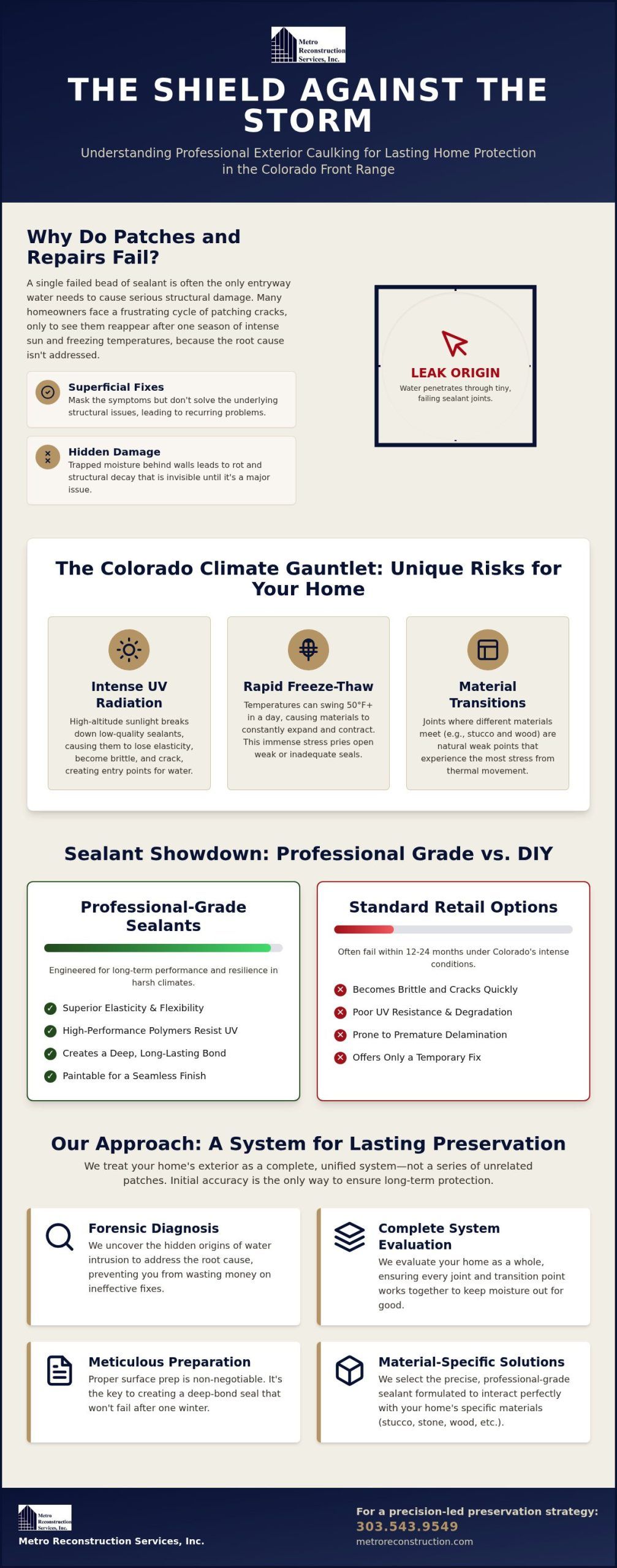
Standard retail products often fail within 12 to 24 months in areas like Parker, Boulder, and Evergreen. These products aren’t built to handle the rapid freeze-thaw cycles where temperatures can swing 50 degrees in a single afternoon. This volatility puts immense pressure on every joint in your home. Maintaining a reliable seal requires a forensic understanding of how these stressors interact with your specific siding and window materials.
UV Degradation and Sealant Brittleness
Sunlight at our elevation contains significantly more UV radiation than at sea level. This intensity accelerates the chemical breakdown of low-quality sealants, causing them to lose their essential elasticity. When these chemical bonds fail, the material becomes brittle and begins to crack or turn into a chalky substance. These signs of UV failure mean the sealant can no longer bridge the gaps between materials. We recommend using high-performance polymers that are specifically formulated for high-altitude exposure to ensure your moisture mitigation strategy remains effective for years rather than months.
Addressing Movement in Mountain and Front Range Structures
Thermal expansion and contraction cause buildings to effectively “breathe” or shift throughout the day. Different materials, such as stucco and wood, expand at different rates when heated by the sun. In the Denver metro area, this movement is often compounded by expansive soils that cause subtle, ongoing structural shifts. A sealant must have high movement capability to remain bonded during these changes. If the material is too rigid, it will simply pull away from the substrate, creating a direct path for water to enter.
If you’ve noticed recurring gaps in your siding or around your windows, it’s likely a sign of climate-driven failure. Our team at Metro Reconstruction specializes in these regional challenges, focusing on initial accuracy to prevent future damage. You can reach us at 303.543.9549 or through our contact page to discuss a long-term preservation plan for your home.
Sealant Selection: Professional-Grade vs. DIY Retail Options
Choosing the right material is just as important as the application technique itself. Many homeowners reach for the first tube they see at a big-box store, but Professional-Grade vs. DIY Retail Options vary significantly in their chemical makeup and longevity. Industrial-grade bulk sealants offer superior performance compared to off-the-shelf tubes because they are designed for specific structural demands. Using the correct exterior caulking for water leaks ensures that the bond remains intact even when subjected to the harsh Colorado environment we discussed earlier.
Professional-grade sealants are typically sourced in bulk rather than the individual tubes found at a local hardware store. These industrial materials offer a different chemical consistency that allows for better smoothing into the joint. This process ensures there are no air pockets where moisture could hide. When we select exterior caulking for water leaks, we prioritize these high-performance options because they provide the reliability our clients expect for their property preservation. We also utilize adhesion promoters and primers during the application process to ensure the sealant integrates deeply with the surface material.
Polyurethane Sealants: The Professional Standard for Siding
Polyurethane sealants are widely considered the professional standard for siding and masonry. Their primary advantage lies in their incredible durability and their ability to form a permanent bond with surfaces like wood and stone. This makes them ideal for joints that are subject to heavy wear or significant structural movement. While polyurethane requires a longer cure time and more technical precision during application, it offers a level of protection that retail alternatives simply cannot match. It’s also fully paintable, allowing the repair to blend perfectly with your home’s existing aesthetic while adding another layer of defense.
The Limitations of Standard Silicone in Structural Repair
While silicone is often marketed as a universal solution, it has serious limitations in structural repair. The biggest drawback is the residue it leaves behind; once applied, the surface becomes chemically resistant to almost everything else. This means you can’t paint over it, and future sealants will struggle to adhere to the same spot. Silicone is appropriate for glass-to-glass transitions, but it often fails on stucco and other porous materials. For these areas, we typically recommend advanced hybrid sealants. These hybrids combine the elasticity of silicone with the paintability and adhesion of polyurethane, providing a versatile solution for the building’s complete outer system.
When Recaulking Isn’t Enough: Addressing Structural Origins
While exterior caulking for water leaks is a vital defense, it cannot fix a compromised structural system. We utilize a Forensic Approach to determine if a leak is simply a sealant failure or a symptom of a deeper issue. Simply applying more material over a failing joint can actually trap moisture inside the wall assembly. This trapped water leads to structural decay that remains hidden until the damage is extensive. Identifying the underlying structural origins of a leak is the only way to ensure your home remains protected for the long term.
Ignoring minor cracks in your stucco or masonry is a risk that often leads to high costs later. When water bypasses the sealant and enters the building envelope, it begins to degrade the very foundation of your home’s exterior. We believe in providing the difficult truth of a structural failure rather than offering a low-quality patch that will eventually fail. Understanding when a repair has transitioned from a simple sealing task to a structural necessity is key to property preservation. For homeowners facing these deeper issues, professional remediation from experts like Dryrite Restoration is essential to ensure mold and rot are fully addressed.
If you suspect a leak, you can perform a simple “soft spot” test on the wood framing around your windows or doors. If the material feels spongy or gives way under light pressure, the substrate has already begun to rot. New sealant will not adhere to damp or decaying surfaces. In cases where persistent leaks are caused by structural shifting, you may need to look at Foundation Repair Services in Boulder to address the underlying movement before any new caulking is applied.
Stucco Restoration and Moisture Intrusion
Stucco and EIFS exteriors have unique moisture mitigation needs that go beyond simple sealant application. These systems rely on integrated flashing working in tandem with precision caulking to shed water effectively. When flashing is improperly installed or the stucco itself is saturated, even the best exterior caulking for water leaks will not stop the damage. For a deeper look at how to preserve these complex systems, our Professional Stucco Restoration guide provides a detailed analysis of our specialized methodology.
Don’t settle for a temporary patch that masks a larger problem. Call our team of experts at 303.543.9549 or visit our contact page for a diagnostic evaluation of your home’s complete outer system. We are here to partner with you in the long-term preservation of your property.
The Metro Reconstruction Approach to Exterior Preservation
Since 1982, our family-owned firm has provided specialized structural repairs throughout the Front Range and into our high-altitude mountain communities. We’ve spent over 40 years refining a methodology that prioritizes the long-term health of your property over the superficial fixes common in the industry. Our approach to exterior caulking for water leaks is rooted in technical precision and a deep understanding of how different building components interact under stress. We don’t just apply sealant; we partner with you to preserve your investment through engineering-led solutions.
Our process is steady and logical, mirroring the meticulous nature of a high-quality restoration project. It begins with a comprehensive diagnostic evaluation to identify exactly where the building envelope has been compromised. Once the origin of the moisture is found, we move into rigorous substrate preparation. This step is vital because even the best sealant will fail if the surface isn’t properly cleaned and primed. Finally, we perform precision sealing to restore the building’s complete outer system, ensuring a dry and leak-free home for years to come.
Forensic Diagnostics and Custom Solutions
Every property faces a unique set of environmental stressors, from the intense UV radiation in Boulder to the heavy snow loads in Evergreen. We use forensic diagnostics to understand these specific variables before proposing a solution. For complex restoration projects that require more than just a fresh bead of sealant, our Design-Build Services offer a seamless way to address structural failures. This integrated approach provides you with the peace of mind that comes from a professional, fixed-price project fee and a clear plan for preservation.
Protect Your Investment Today
Maintaining structural integrity requires a comprehensive approach to property care. For those seeking expert general contracting services, Prestige Operations offers professional oversight for residential and commercial projects, ensuring that every component of the building system is properly managed.
It’s vital to act before minor leaks transition into major structural failures that require expensive restoration. By addressing gaps in your exterior caulking for water leaks early, you prevent the hidden rot and decay that often follow moisture intrusion. Whether you manage a residential property or a commercial building, we offer a full range of Metro Reconstruction Services tailored to the demanding Colorado climate. Our goal is to provide a grounded, reassuring solution that stands the test of time.
If you’re ready to secure your home’s exterior, we invite you to reach out for a professional consultation. You can contact our team at 303.543.9549 or visit our contact page to begin the process. We look forward to helping you maintain the integrity of your property.
Securing Your Home’s Future Against the Elements
Preserving your property requires moving beyond temporary patches toward a comprehensive understanding of your building’s complete outer system. We’ve explored how specialized exterior caulking for water leaks serves as a critical barrier, provided it’s engineered to withstand the intense UV radiation and rapid temperature shifts of the Front Range. By utilizing a forensic approach, you can distinguish between simple maintenance needs and underlying structural origins that require deeper restoration. Accuracy in your initial repair strategy is the only way to ensure long-term reliability and peace of mind.
Since 1982, our family-owned firm has applied over 40 years of expertise to solve complex moisture intrusion challenges for our neighbors. We’re dedicated partners in property preservation, offering the quiet confidence that comes from specialized forensic moisture mitigation. Protect your home with a professional moisture evaluation today. Contact Metro Reconstruction Services or call us at 303.543.9549 to discuss your project. We look forward to helping you maintain a dry, secure, and lasting structure.
Frequently Asked Questions
How do I know if my exterior caulking needs to be replaced?
You can identify failing sealant by looking for visible gaps, cracking, or material that has pulled away from the substrate. If the caulk feels brittle or turns into a chalky powder when touched, it has lost its essential elasticity due to UV exposure. These openings allow moisture to bypass your home’s outer system, leading to hidden rot. Regular inspections are vital for proactive property preservation, especially after the intense temperature swings common along the Front Range.
Can I apply new caulk over old, cracked sealant?
No, applying new material over old sealant is a temporary fix that almost always fails because the new layer cannot form a proper bond. For effective exterior caulking for water leaks, the old material must be completely removed and the surface thoroughly cleaned. This preparation ensures the new sealant integrates deeply with the substrate. Skipping this step often traps moisture behind the new bead, which accelerates structural decay within the wall assembly.
What is the best temperature for applying exterior caulking in Colorado?
Most professional-grade sealants should be applied when temperatures are between 40 and 90 degrees Fahrenheit. In Colorado, we must be mindful of rapid temperature drops that can occur during the curing process. Applying sealant in extreme cold can prevent proper adhesion, while intense midday sun can cause the material to skin over too quickly. We prioritize initial accuracy by timing applications to ensure the material cures correctly under stable environmental conditions.
Is silicone or polyurethane better for sealing around windows?
Polyurethane is typically the superior choice for sealing window perimeters because it offers better adhesion to wood, masonry, and stucco. Unlike standard silicone, polyurethane is paintable, allowing it to blend seamlessly with your home’s exterior while providing a durable, structural bond. Silicone is effective for glass-to-glass joints but often leaves a residue that prevents future repairs. We select materials based on their ability to handle the specific movement of your home’s complete outer system.
How long should professional exterior caulking last?
High-quality professional sealant applications generally last between five and ten years, though our high-altitude UV radiation can shorten this lifespan. Factors like the direction your home faces and the specific materials used will influence durability. While retail products might fail in just 12 to 24 months, our specialized methodology and use of industrial-grade polymers ensure a much longer period of protection. Regular maintenance evaluations help catch minor issues before they become major structural failures.
Why is water still leaking into my home after I recaulked the windows?
Persistent leaks after recaulking often indicate that the water is entering through a different part of the building envelope, such as failing flashing or saturated stucco. If the exterior caulking for water leaks was applied over a damp or rotting surface, it won’t create a waterproof seal. We use a forensic approach to identify these hidden structural origins. Simply adding more caulk cannot fix a system where the underlying components have already been compromised.
Do I need a professional to fix a small leak near my stucco siding?
Yes, because leaks near stucco are rarely as simple as they appear on the surface. Stucco and EIFS systems require integrated moisture mitigation strategies to prevent water from becoming trapped behind the finish. A professional can determine if the leak is a minor sealant gap or a sign of substrate failure. Our team has over 40 years of experience identifying these complex issues. Call us at 303.543.9549 or visit our contact page.