
A window isn’t merely a piece of glass held in a frame; it’s a complex thermal bridge that must be forensically integrated into your home’s building envelope to prevent structural failure. In Boulder County, where extreme temperature swings and high-altitude winds test every seam, a standard window installation often fails because it ignores the critical relationship between the aperture and the surrounding stucco or masonry. When these systems aren’t synchronized, the result is inevitable: persistent drafts, rising energy costs, and the silent creep of moisture that rots framing from the inside out.
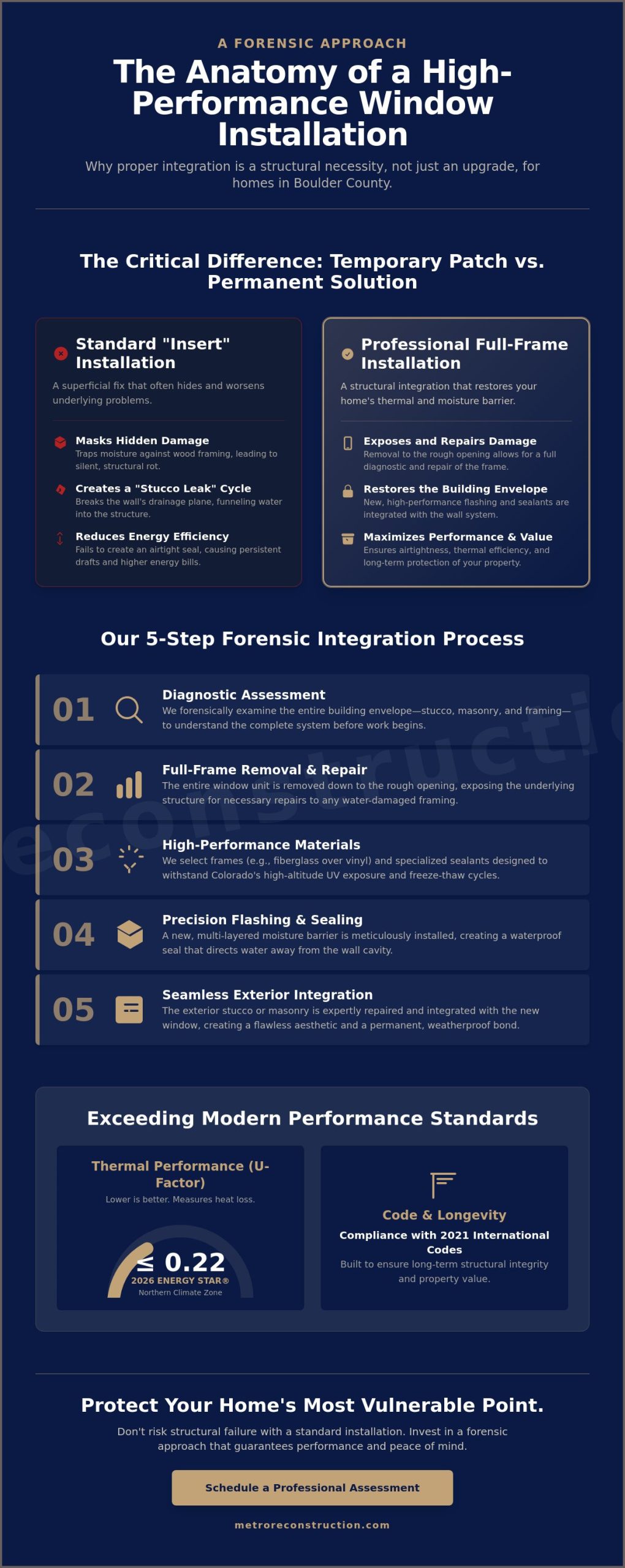
It’s understandable to feel concerned when you see water marks around your casings or notice your HVAC system struggling to maintain a consistent temperature. You deserve the peace of mind that comes from a permanent solution rather than a temporary patch. This article explores how professional precision preserves your property’s integrity by meeting the 2021 International Codes and the rigorous 2026 ENERGY STAR standards, which require a U-Factor of 0.22 or less for the Northern Climate Zone. We’ll walk through the technical methodology of moisture-proofing and seamless exterior integration to ensure your home remains a high-performance sanctuary.
Key Takeaways
- Understand why a full-frame window installation is a structural necessity for restoring your home’s thermal envelope and moisture barrier.
- Learn the forensic methods used to integrate new units with stucco and masonry to prevent moisture intrusion and structural decay.
- Discover how high-altitude environments and intense UV radiation influence the longevity of vinyl versus fiberglass frames.
- Identify the steps of a precision installation process that begins with a diagnostic assessment of the building’s complete outer system.
- Explore the critical questions to ask a contractor regarding moisture mitigation and the preservation of your property’s long-term value.
Defining Professional Window Installation as a Structural Necessity
Windows are often viewed as simple aesthetic choices, yet they represent the most significant breach in a home’s protective shell. In the high-altitude environment of the Front Range, a window installation must be treated as a forensic structural integration rather than a simple product swap. If the interface between the frame and the wall fails, the thermal efficiency and structural integrity of the entire property are compromised. This is why we view windows as the most vulnerable point in a building’s envelope, requiring a holistic understanding of how different materials interact under environmental stress.
A building’s envelope relies on the seamless management of air pressure and water shedding. Windows are dynamic components; they must resist intense wind loads while simultaneously allowing for the natural expansion and contraction caused by Colorado’s dramatic temperature fluctuations. For those seeking a comprehensive overview of window types and their components, it’s clear that the frame and glazing are only as effective as the flashing system that surrounds them. Without precise flashing, water is funneled into the wall cavity rather than away from it, leading to the silent decay of structural studs and the eventual failure of the building’s complete outer system.
The Role of Windows in the Building Envelope
Precision in the building envelope is paramount because even a minor gap can lead to significant energy loss and moisture intrusion. Proper fenestration ensures that the window unit works in harmony with the home’s drainage plane. In Boulder County, the 2021 International Codes mandate specific performance standards that go beyond mere glass quality. It’s about how the entire assembly manages the transition from the exterior finish to the interior living space. When this transition is handled with technical depth, the result is a home that maintains its thermal comfort regardless of the season.
Insert vs. Full-Frame: Which Does Your Home Require?
Many homeowners are tempted by “pocket” or insert replacements because they preserve existing interior trim and offer a faster turnaround. This method involves placing a new unit into the existing frame. While this works for relatively new structures with intact moisture barriers, it’s often a superficial fix for older Boulder County homes. A full-frame window installation, by contrast, involves removing the entire unit down to the rough opening. This allows for a fundamental diagnostic of the underlying structure. It’s the only way to identify hidden rot or previous water damage that an insert would simply mask, ensuring a long-term solution that protects your investment.
The Forensic Integration: Windows, Stucco, and Masonry
Integrating new units through a professional window installation requires a level of technical precision that goes beyond simple carpentry. Many general contractors treat the exterior finish as a static obstacle, often breaking the bond between the window frame and the moisture resistant barrier during removal. This oversight creates a path for water to bypass the drainage plane, leading to the structural decay discussed in the previous section. Because we approach each project through the lens of stucco restoration, we understand that the window is a critical component of the building’s complete outer system.
A successful window installation in Boulder County must account for the specific physics of stucco systems. Stucco is porous; it’s designed to manage moisture through a drainage plane and weep holes that allow trapped water to escape. When a window is swapped without expert integration, these drainage paths are often obstructed by improper flashing or low grade sealants. We prioritize high performance, specialized sealants that maintain flexibility during Colorado’s freeze thaw cycles, unlike standard hardware store caulk which tends to brittle and fail within a few seasons.
Moisture Mitigation at the Window-Wall Interface
The “stucco-leak” cycle is a common failure where water enters around the window casing, saturates the substrate, and causes the stucco to delaminate. Precision flashing is the only defense against this structural threat. By carefully Evaluating Window Materials for High-Altitude Performance, homeowners can select units that withstand UV stress, but those materials only perform if the interface is airtight. We ensure that every transition is mechanically sound and chemically bonded to prevent moisture from finding its way into the wall cavity.
Preserving Masonry Integrity During Installation
Masonry walls present a different set of forensic challenges. Removing an old unit from brick or stone requires surgical accuracy to avoid fracturing the surrounding material or damaging the lintel. Once the new unit is secured, the surrounding area often requires stucco and masonry repairs to restore the home’s aesthetic character and structural seal. Our team focuses on matching original mortar textures and colors so that the upgrade looks like it was part of the original design. If you’re concerned about how new units will integrate with your existing facade, consulting a specialist at Metro Reconstruction Services, Inc. who understands both fenestration and masonry is the most reliable way to protect your investment. You can contact our team for a structural evaluation to ensure your exterior remains impenetrable.
Evaluating Window Materials for High-Altitude Performance
Selecting materials for a window installation in Boulder County requires an analytical approach that accounts for environmental stressors unique to the Front Range. High altitude environments present two primary threats: atmospheric pressure differentials and extreme ultraviolet (UV) radiation. At 5,000 feet and above, the air pressure is significantly lower than at sea level. If a dual-pane window is manufactured at a lower elevation without capillary tubes, the internal pressure can cause the glass to bow outward, eventually compromising the seal and allowing insulating argon gas to escape. We prioritize units engineered with pressure-equalization technology to ensure long-term thermal performance.
The intensity of UV radiation at high elevations also accelerates the degradation of common building materials. While vinyl is a frequent choice for its lower initial cost, it’s often inadequate for the rugged Colorado climate. Intense sun exposure causes standard vinyl frames to become brittle and lose their structural rigidity over time. We often recommend fiberglass as a superior alternative because it expands and contracts at nearly the same rate as the glass it holds. This material harmony reduces stress on the seals and ensures the window remains a functional part of the building’s complete outer system for decades.
Fiberglass vs. Vinyl vs. Wood: The Front Range Perspective
Fiberglass replacement windows offer the highest level of thermal stability for Boulder homeowners. Unlike wood, which requires intensive maintenance to prevent rot in our semi-arid environment, fiberglass is impervious to moisture and won’t warp under the sun’s heat. Wood remains a necessary choice for specific historic preservation projects where aesthetic authenticity is paramount, but it must be meticulously finished to survive the elements. Vinyl may be appropriate for budget-conscious projects in shaded areas, yet it frequently fails to meet the long-term durability standards we set for property preservation.
Glass Technology: U-Factor and SHGC for Colorado
Optimizing your home’s energy profile involves balancing winter heat retention with summer solar gain. In our region, Low-E coatings are essential for reflecting infrared light while allowing visible light to pass through. The U-Factor measures the rate of non-solar heat loss through a window assembly, and under the 2026 Boulder County energy codes, new installations must achieve a rating of 0.22 or lower to ensure compliance. Additionally, we look for a Solar Heat Gain Coefficient (SHGC) that prevents your home from overheating during the intense afternoon sun. This technical precision ensures your window installation provides a measurable return on investment through reduced energy loads and improved interior comfort.
The Professional Window Installation Process: A Step-by-Step Overview
A professional window installation is not a race against the clock; it’s a methodical restoration of your home’s defensive barrier. While retail installers often prioritize speed, our approach is rooted in technical depth and the identification of underlying structural origins. By analyzing why a previous unit failed, we ensure the new installation is not just a replacement but a permanent improvement to the building’s complete outer system. This forensic mindset allows us to address hidden issues before they are sealed behind new finishes.
Precision is non-negotiable. Our process begins with a comprehensive evaluation of the rough opening to ensure it’s level, plumb, and square. If a window frame is significantly distorted, it often signals shifting in the building’s skeleton. In such cases, we determine if your home needs foundation repair services before the new units are secured. Addressing these structural fundamentals prevents the premature seal failure and operational sticking that plague lower-quality installs.
Diagnostic Assessment and Preparation
Once the initial assessment is complete, we move to surgical removal. We take proactive measures to protect your interior finishes and exterior masonry from dust and debris. Each opening is measured with extreme accuracy to ensure a tight fit, which minimizes the reliance on expandable foam. This is a critical distinction; foam should provide insulation, not structural support. During this phase, we also monitor local weather patterns to ensure your home’s interior is never unnecessarily exposed to Colorado’s sudden afternoon storms.
The Technical Installation and Sealing Phase
The core of a durable window installation lies in the integration of the moisture barrier. We utilize a “complete system” approach, which includes the application of high-performance pan flashing and weather-resistant membranes. These components create a redundant drainage plane that directs water away from the wall cavity. After the unit is mechanically fastened, we perform back-bedding and perimeter sealing using specialized, high-flexibility sealants. The final step involves a rigorous calibration of all moving parts to ensure an airtight seal and effortless operation. If you are ready for a solution that prioritizes long-term property preservation, schedule a diagnostic assessment for your window installation with our team of specialists.
Selecting a Specialized Window Installation Service in Boulder
Choosing a partner for your window installation is the final and most critical decision in the property preservation process. In a landscape filled with high-pressure sales tactics and superficial “quick-fix” promises, the value of a specialized firm becomes clear through their technical depth. A window is only as reliable as the contractor’s understanding of the entire building assembly. For complex exterior home repair projects, family-owned expertise provides a level of accountability and detail that large-scale retail installers simply cannot match.
Before committing to a project, it’s vital to vet your contractor with questions that go beyond price points. Ask about their specific methodology for moisture mitigation at the window-to-stucco interface. Inquire how they handle warrantied labor and whether they perform a diagnostic check of the rough opening before the new unit is secured. A professional should be able to explain the relationship between the window frame and the home’s structural stability with clarity. If a contractor focuses solely on the glass and ignores the surrounding masonry or drainage plane, they’re offering a product swap rather than a long-term solution.
The Metro Difference: A Holistic Approach
At Metro Reconstruction Services, Inc., we move beyond the “product-only” mindset that dominates the industry. Our structure-first philosophy is rooted in over 40 years of experience navigating the unique challenges of the Front Range. We don’t just replace units; we identify underlying structural origins of failure to ensure that your new windows perform exactly as engineered. This analytical depth allows us to provide personalized project management for both residential and commercial properties, ensuring that every detail of the building’s complete outer system is respected and reinforced.
Securing Your Investment in Property Preservation
A high-quality window installation pays for itself through reduced maintenance requirements and significant energy savings. By meeting the stringent 2026 energy standards and ensuring an airtight seal, you’re protecting your home from the silent creep of moisture and the financial drain of thermal loss. Choosing a local firm with deep roots in Boulder County ensures that your partner understands the local climate and building codes intimately. The next step in preserving your property’s integrity is scheduling a forensic assessment to evaluate the current state of your building’s envelope and determine the most effective path toward restoration.
Protecting Your Property Investment through Structural Integration
Preserving the integrity of a Boulder County home requires more than just high-quality glazing; it demands a forensic approach to how those units interface with the building’s complete outer system. As we’ve explored, the successful window installation hinges on accurate moisture mitigation and a deep understanding of Colorado’s high-altitude stressors. By addressing the underlying structural origins of failure rather than applying superficial patches, you ensure your home remains thermally efficient and structurally sound for decades.
Metro Reconstruction Services, Inc. has been family-owned and operated since 1982, bringing over 40 years of industry expertise to every project. As specialists in moisture mitigation and stucco integration, we provide the quiet confidence that comes from a permanent solution. Schedule a Forensic Assessment for Your Window Installation Project to begin the process of restoring your home’s thermal and moisture barriers. Your property deserves the meticulous care and technical precision that only a seasoned craftsman can provide.
Frequently Asked Questions
How do I know if I need a window repair or a full window installation?
You need a full window installation when the frame’s structural integrity is compromised or the thermal seal has failed permanently. While minor hardware issues can often be repaired, persistent moisture intrusion or frame rot indicates that the unit can no longer protect the building’s complete outer system. A forensic assessment identifies whether the failure is localized or symptomatic of a larger structural issue within the wall cavity.
Does window installation typically include repair to the surrounding stucco or siding?
Standard retail services often ignore the surrounding facade, but a specialized window installation should include the precise integration of stucco or masonry. Because windows are the most vulnerable point in your home’s moisture barrier, failing to restore the surrounding stucco leads to future leaks. We treat the window and the wall as a single, synchronized system to ensure total moisture protection and a seamless aesthetic finish.
Why is high-altitude window installation different from sea-level installation?
High-altitude environments require windows equipped with capillary tubes to equalize internal pressure with the thin mountain air. Without these tubes, the pressure differential between sea-level manufacturing sites and Boulder’s elevation can cause glass to bow or seals to rupture. This specialized engineering prevents the loss of insulating argon gas and maintains the unit’s thermal efficiency against Colorado’s extreme atmospheric conditions.
How long does a professional window installation service near me usually take?
A professional installation typically spans one to three days depending on the number of units and the complexity of the exterior finish. While speed is a common marketing claim, a methodical approach that includes substrate preparation and forensic diagnostics ensures a long-term solution. You should prioritize technical accuracy over a fast, superficial swap to prevent future structural failures and ensure the new units are perfectly plumb.
Can new windows help with the structural integrity of my home?
New windows improve structural integrity by preventing moisture from reaching the load-bearing studs within your walls. When a window installation is performed correctly, it seals the building envelope and stops the cycle of wood rot that weakens a home’s skeleton. This proactive maintenance preserves the fundamental mechanics of the structure and prevents the hidden decay often found in older Front Range properties.
What are the signs of a poor window installation?
Signs of a poor installation include persistent drafts, condensation trapped between glass panes, and visible gaps in the exterior sealant. If a window is difficult to open or doesn’t sit square in the frame, it often indicates the installer failed to properly level the rough opening. These issues suggest that the window is not functioning as part of a complete outer system, leading to energy loss.
Are fiberglass replacement windows worth the extra cost in Boulder County?
Fiberglass units are highly recommended in Boulder County because their expansion rate closely matches that of the glass panes. This material harmony prevents the seal failure common with vinyl frames, which often become brittle under intense high-altitude UV radiation. While the initial investment is higher, the long-term value is found in superior thermal stability and a significantly longer lifespan compared to lower-cost alternatives.
What kind of warranty should I expect for professional window installation?
You should expect two distinct layers of protection: a manufacturer’s warranty on the product and a labor warranty from the installer. Since specific terms vary between companies, it’s essential to verify that your contractor covers moisture mitigation and structural integration. A reputable partner stands behind their precision and the long-term performance of the building’s envelope rather than just the window unit itself.