
What if the sticking sash on your casement window isn’t just a nuisance, but a symptom of a failing structural envelope? For many homeowners, a difficult handle or a persistent draft feels like a minor maintenance task, yet these issues often signal deeper complications within your home’s exterior system. When you consider casement window replacement in Lafayette, you’re not just buying glass; you’re addressing the critical intersection of energy efficiency and moisture protection. We understand that Colorado’s extreme temperature swings and high-altitude UV exposure place immense stress on window seals and frame integrity. It’s frustrating to watch your energy bills climb while hidden wood rot potentially compromises the stucco surrounding your window frames.
You deserve a home that remains airtight and structurally sound regardless of the season. This guide will show you how to choose and install casement windows that meet the 2026 ENERGY STAR Northern Climate Zone standards while ensuring a water-tight seal against the elements. We’ll examine the forensic details of proper installation, from navigating Lafayette’s specific permitting requirements to selecting glass that won’t degrade under our intense sun. By the end, you’ll have a clear path toward long-term property preservation and the peace of mind that comes from a precisely engineered solution.
Key Takeaways
- Learn how Colorado’s intense high-altitude UV rays and extreme temperature swings cause standard window seals to fail and frames to warp.
- Compare the thermal stability of fiberglass, wood-clad, and vinyl to select materials that maintain a consistent seal against your home’s exterior.
- Discover why a forensic approach to casement window replacement Lafayette is essential for protecting the delicate interface between your windows and stucco or masonry.
- Understand the science behind high-altitude glass performance and how to ensure your new windows meet the 2026 ENERGY STAR standards for Colorado.
- Identify the importance of a complete structural diagnosis to prevent hidden moisture damage and ensure the long-term preservation of your building envelope.
Understanding Casement Window Failure in Colorado’s Climate
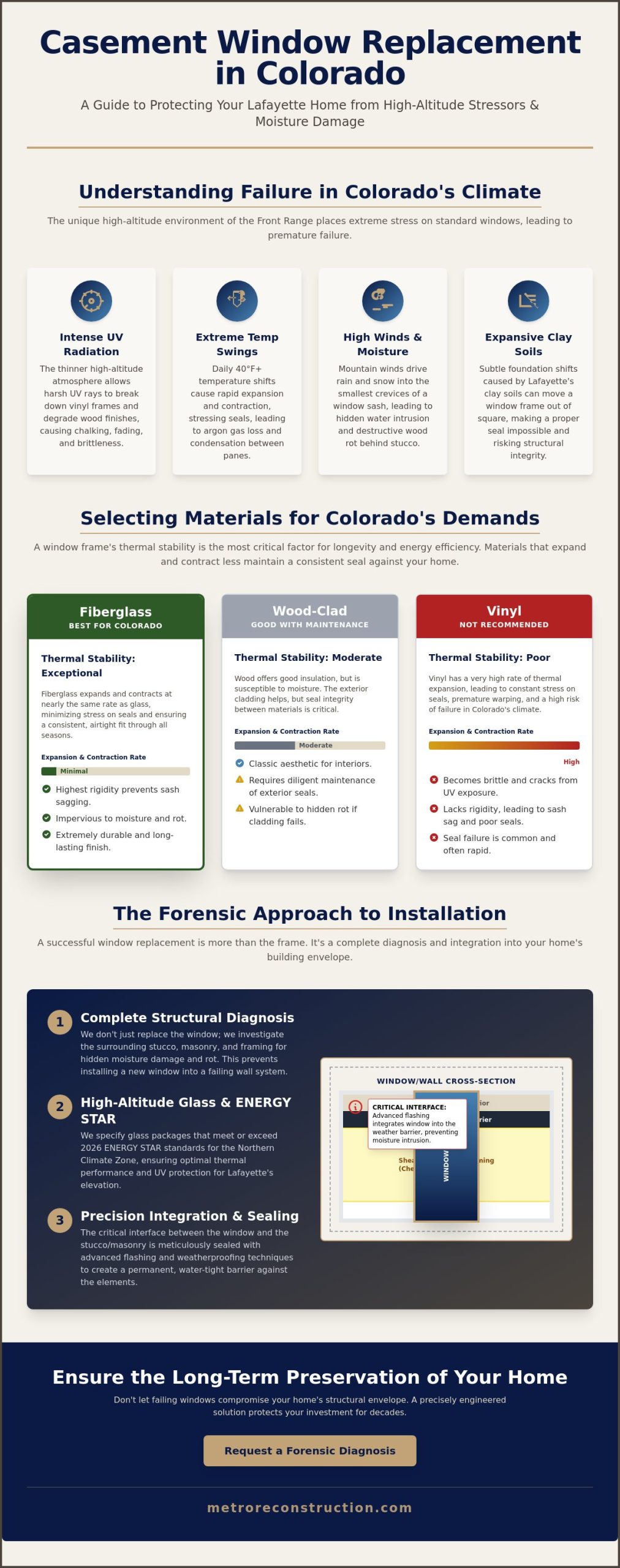
In the high-altitude environment of the Front Range, a window is more than a view; it’s a critical component of your home’s thermal and structural defense. Residents seeking Understanding Casement Windows often find that their units fail prematurely due to the unique atmospheric conditions of Lafayette, Colorado. Unlike lower elevations, our thinner atmosphere provides less protection against intense ultraviolet (UV) radiation. This constant bombardment breaks down the chemical bonds in vinyl frames and degrades the protective finishes on wood-clad units. This leads to chalking, fading, and eventually, brittle material failure that compromises the entire building envelope.
When homeowners consider casement window replacement in Lafayette, they often cite drafty sashes or difficult operation as the primary drivers. These symptoms are frequently caused by extreme diurnal temperature swings. It’s common for Lafayette to experience a 40-degree temperature shift in a single afternoon. This volatility causes rapid expansion and contraction of the window materials, leading to material fatigue. Over time, the seals between the glass and the frame lose their elasticity. Once the seal fails, argon gas escapes and moisture enters, resulting in the characteristic fogging of the glass and a total loss of insulating value.
The mechanical hardware of a casement window is particularly susceptible to these stressors. We often observe a “crank failure” cycle in older units. It begins when a warped sash or a frame shifted by environmental pressure creates resistance. The homeowner must apply more force to the crank to close the window, which strips the internal gears or bends the linkage. Eventually, the window can no longer achieve a tight compression seal. This leaves the home vulnerable to wind-driven rain and snow, which can seep behind the casing and cause hidden wood rot that remains invisible until the damage is extensive.
Why Casement Windows Fail Faster in Boulder County
Boulder County presents specific challenges that accelerate the degradation of the building envelope. High wind speeds coming off the mountains drive moisture into the smallest crevices of a casement sash. Additionally, the expansive clay soils common in Lafayette can cause subtle shifts in a home’s foundation. These shifts move the window frame out of square, making it nearly impossible for the sash to seat correctly. This misalignment isn’t just an operational issue; it’s a structural risk that can lead to moisture intrusion behind stucco or masonry exteriors.
The Aesthetic Advantage of Casements for Lafayette Homes
Despite these climatic challenges, casement windows remain a premier choice for local properties. They offer superior air-tightness compared to sliding options because the sash locks firmly against the frame when closed. This design is ideal for maximizing ventilation during those cool Colorado evening breezes. Their wide-opening design provides unobstructed views of the Front Range and nearby open spaces. When installed with a forensic focus on precision, they provide a functional and beautiful investment that preserves the integrity of your home for decades.
Evaluating Replacement Materials for Durability and Performance
Selecting a frame material is a decision that dictates the longevity of your home’s structural envelope. In our region, the choice between fiberglass, wood-clad, and vinyl isn’t merely aesthetic; it’s a matter of engineering. Because casement windows project outward and hang from a side-mounted hinge system, the sash must maintain exceptional rigidity to prevent sagging. Without this structural stiffness, the locking points will eventually misalign, leading to the air leaks and mechanical strain that often necessitate window replacement earlier than expected.
Thermal stability is the most critical factor for energy-efficient windows in Boulder County. Every material expands and contracts when heated, but they do so at different rates. When a window frame expands significantly more than the glass it holds, or the wall it’s anchored to, the perimeter seals are under constant stress. Over time, this movement creates micro-gaps in the caulking and weatherstripping. This is why we prioritize materials with low expansion coefficients for every casement window replacement in Lafayette, ensuring the window-to-wall seal remains intact through every season.
Fiberglass vs. Vinyl: The Expansion-Contraction Debate
Fiberglass is often the superior choice for our climate because its base material is essentially glass fibers. This composition means the frame and the glass panes expand and contract at nearly identical rates, preserving the integrity of the seals during 40-degree temperature shifts. While budget vinyl is often marketed for its low cost, its high expansion rate can lead to “frame creep” in high-heat-gain environments. High-quality fiberglass also offers superior color retention, resisting the chalking and fading that often plagues darker vinyl frames under the intense Colorado sun.
The Longevity of Professional Wood-Clad Systems
Wood-clad systems offer the timeless interior warmth homeowners desire, protected by a durable aluminum or fiberglass exterior shell. Modern designs incorporate sophisticated drainage planes that allow moisture to escape rather than becoming trapped against the wood. In our semi-arid climate, protecting the interior wood from “dry rot” is essential. This occurs when wood fibers lose their natural oils and become brittle, often due to poor moisture management at the frame’s edge. A professional installation ensures these units are integrated into the building’s moisture barrier correctly. If you’re concerned about how these materials will interface with your specific exterior, a consultation with Metro Reconstruction can clarify the best path forward for your property.
Maintenance requirements also vary significantly between these options. While fiberglass and high-end vinyl are virtually maintenance-free, wood-clad units require periodic inspection of the exterior cladding joints to ensure no water is bypassing the protective shield. For larger casement sashes, the inherent strength of fiberglass or aluminum-clad wood prevents the frame from twisting under its own weight, ensuring smooth operation for decades.
The Critical Interface: Integrating Windows with Stucco and Masonry
Many contractors treat window installation as a simple swap, often referred to as “pop and drop.” This approach is dangerous in Colorado’s climate, especially for homes with stucco or masonry exteriors. A window is a hole in your building’s protective skin. If the interface between the new frame and the existing wall isn’t perfectly managed, water will find its way in. For a successful casement window replacement Lafayette project, we must look beyond the window itself and examine the entire wall system for signs of underlying compromise.
Proper flashing is the most overlooked step in the process. Without a seamless connection between the window’s nail fin and the home’s weather-resistive barrier, gravity and wind-driven rain will eventually pull moisture into the wall cavity. This isn’t just about a leak you can see; it’s about the slow, silent degradation of your home’s framing. When integrating windows with masonry, we often have to address the structural headers and sills to ensure they shed water away from the opening rather than trapping it against the new frame. Achieving precision window installation requires a deep understanding of how different materials expand and contract against one another.
Preventing Moisture Intrusion at the Sash and Frame
A successful installation relies on a secondary drainage plane. This system acts as a backup, ensuring that any moisture bypassing the primary seal is safely channeled back to the exterior. Because stucco is a reservoir cladding, meaning it absorbs and holds water, the transition between the window frame and the stucco must be handled with extreme care. In many cases, professional stucco restoration is required to repair previous damage and create a watertight bond with the new casement unit.
Managing the Building Envelope for Long-Term Value
We view every window project as a critical part of exterior home repair. If a window seal fails, the resulting moisture can migrate downward, potentially causing foundation issues or mold growth within the wall. Our forensic diagnostic process identifies existing wall cavity damage before the new window is set. By identifying underlying structural origins rather than just fixing superficial issues, we ensure that your casement window replacement Lafayette investment is protected for the life of the home. We don’t just replace parts; we restore the integrity of the complete outer system to provide lasting peace of mind.
Optimizing Energy Efficiency for Lafayette’s Elevation
At an elevation of approximately 5,200 feet, Lafayette homeowners face atmospheric pressures and solar intensities that differ significantly from sea-level environments. When executing a casement window replacement Lafayette project, we must account for the physics of pressure equalization. Standard Insulating Glass Units (IGUs) manufactured at lower altitudes can bow or even burst when installed in the Front Range due to the internal pressure being higher than the surrounding thin air. This structural stress often leads to the premature failure of the primary seal, rendering the window’s insulating properties useless long before its expected lifespan.
Casement windows are uniquely suited for our windy climate because of their compression seal technology. Unlike sliding or double-hung windows that rely on brush-like weatherstripping, a casement sash pulls tight against a continuous bulb seal when locked. This creates a gasket-like closure that effectively blocks the persistent westerly winds coming off the mountains. For homes located near high-traffic corridors like Highway 287 or South Boulder Road, this airtight seal also provides a significant secondary benefit: acoustic dampening. By eliminating the air gaps found in other window styles, casements drastically reduce the transmission of low-frequency road noise into your living space.
Low-E Glass and Argon Fill: High-Altitude Specifications
To maintain glass integrity at our elevation, we utilize capillary tubes. These small stainless steel tubes are inserted into the spacer bar to allow the internal and external pressures to equalize during transit and installation. While some argue this leads to argon gas loss, modern manufacturing techniques allow us to maintain high thermal performance while ensuring the glass remains flat and functional. Selecting the correct Low-E coating is equally vital. For south-facing rooms that endure intense afternoon heat, a triple-silver coating can reflect up to 70% of solar heat gain. Conversely, north-facing windows may benefit from coatings that allow for passive solar heating during our cold January freezes. Eliminating thermal bridging within the frame itself ensures that heat doesn’t bypass the glass, keeping your interior surfaces warm to the touch.
The Impact of New Windows on Home ROI in Lafayette
Investing in precision-engineered windows provides a measurable return through reduced HVAC loads and increased property value. As of January 1, 2026, Colorado House Bill 23-1161 requires all replacement windows to meet strict ENERGY STAR Northern Climate Zone standards, necessitating a U-Factor of 0.22 or less. Adhering to these regulations isn’t just about compliance; it’s about protecting your investment in a competitive Boulder County real estate market. High-performance casements improve curb appeal while signaling to future buyers that the home’s building envelope has been professionally maintained. If you are ready to upgrade your home’s thermal defense, contact us for a forensic window installation assessment to ensure your project meets these rigorous 2026 standards.
The Metro Reconstruction Approach to Precision Installation
At Metro Reconstruction, we don’t view a project as a simple product swap; we see it as a surgical restoration of your home’s first line of defense. When you choose us for casement window replacement Lafayette, you’re partnering with specialists who look beneath the surface to understand the hidden mechanics of your structure. We believe that a window is only as good as the wall system that supports it. Our methodology is designed to instill immediate trust by addressing the complex structural challenges that generic installers often overlook.
Our process relies on a holistic approach to the building’s complete outer system. This means our technicians don’t just pull out an old frame and nail in a new one. Instead, we coordinate specialized teams across window, stucco, and masonry disciplines to ensure every interface is watertight. Because we understand the relationship between different building elements and environmental stressors, we can guarantee that your new casement windows will operate smoothly while protecting your home’s structural envelope from the inside out.
Forensic Diagnosis of Existing Window Failures
Before any installation begins, we perform a meticulous forensic diagnostic of your current failures. We aren’t satisfied with just seeing a warped sash; we want to know why it warped. We investigate whether the failure stemmed from the high-altitude UV degradation discussed earlier or if a shifting structural foundation has compromised the frame’s alignment. By identifying these underlying structural origins, we can correct the root cause of the issue. This commitment to initial accuracy is our foundational brand promise, ensuring the job is done right the first time.
Fixed-Price Transparency and Project Management
We understand that homeowners face significant anxiety regarding “change orders” and hidden costs once a project starts. Our approach eliminates this uncertainty through comprehensive initial diagnostics and a fixed-price project management model. We leverage over 40 years of local experience to provide an honest, straightforward assessment of what your home requires for total preservation. We’ve built our reputation on substance over style, directing our window installation service toward the long-term health of your property rather than superficial fixes. This engineering-led perspective provides the peace of mind that comes from knowing your investment is protected by seasoned experts who value integrity above all else.
Long-term structural preservation remains our primary goal. By integrating your new casement windows into a perfectly managed drainage plane and weather-resistive barrier, we prevent the “dry rot” and moisture intrusion that plague so many Boulder County homes. We don’t just sell windows; we provide a dedicated partnership in property preservation, ensuring your Lafayette home remains a sanctuary against the demanding Colorado climate for decades to come.
Securing Your Home’s Structural Future
A window project’s success isn’t defined on the day of installation; it’s proven through decades of performance against Colorado’s demanding elements. By prioritizing high-altitude glass specifications and understanding the critical relationship between your sashes and exterior cladding, you protect your home’s fundamental integrity. This forensic perspective ensures that your casement window replacement Lafayette project does more than just lower energy bills. It preserves the building envelope, prevents structural moisture intrusion, and provides a permanent solution to the material fatigue caused by our extreme climate.
Our team brings over 40 years of Boulder County expertise to every diagnostic assessment, specializing in the complex integration of stucco and masonry systems. We offer a fixed-price project guarantee because we believe that initial accuracy is the foundation of professional trust. You’re not just hiring a contractor; you’re partnering with seasoned experts dedicated to your home’s total preservation. We invite you to Schedule a Forensic Window Consultation with Metro Reconstruction to receive a meticulous evaluation of your property. Take the first step toward a more resilient home with the peace of mind that comes from engineering-led precision.
Frequently Asked Questions
Do I need to repair my stucco when replacing casement windows?
Stucco repair is often a necessary component of a professional installation to ensure the new unit is perfectly integrated into the building’s moisture barrier. Because stucco acts as a reservoir cladding, any breach made during the removal of the old window can lead to water intrusion if not expertly sealed. We perform a forensic assessment to determine if the surrounding material has suffered from hidden rot, ensuring the new installation creates a watertight bond with the existing wall system.
What is the best window material for the Colorado climate?
Fiberglass is generally the superior material for Colorado’s high-altitude environment due to its exceptional thermal stability. Since fiberglass expands and contracts at nearly the same rate as glass, it maintains the integrity of the seals during Lafayette’s extreme diurnal temperature shifts. This prevents the frame creep and seal failure common in budget vinyl units, providing a significantly longer lifespan for your casement window replacement Lafayette project.
Why are casement windows more expensive than double-hung windows?
Casement windows require more complex mechanical hardware and precision engineering to support a sash that projects outward from the frame. The heavy-duty hinges, crank mechanisms, and multi-point locking systems required for smooth operation increase manufacturing costs. Additionally, the continuous bulb seal design provides a superior airtight gasket, which offers better energy performance and sound dampening than the brush weatherstripping found in standard double-hung or sliding options.
How long does a typical window replacement project take in Lafayette?
A standard residential project typically spans several days, though the exact duration depends on the complexity of the structural integration required. Beyond the physical installation, the timeline must account for the City of Lafayette’s permitting process and the mandatory inspections required under the 2021 International I-Codes. Our fixed-price project management ensures that every stage, from the initial forensic diagnosis to the final stucco touch-up, is coordinated to minimize disruption to your schedule.
Can I replace just the glass sash or do I need a full-frame replacement?
While sash-only replacement is possible for minor glass damage, we usually recommend a full-frame replacement to address underlying structural issues. In older Lafayette homes, the original frame has often shifted or suffered from moisture degradation hidden behind the casing. A full-frame approach allows us to inspect the wall cavity, replace failing flashing, and ensure the entire window system meets the 2026 ENERGY STAR Northern Climate Zone standards for maximum efficiency.
Will new windows help with the noise from the nearby highway?
New windows provide significant sound mitigation for homes located near Highway 287 or South Boulder Road. The compression seal technology in a casement design creates an airtight closure that blocks the air gaps where sound waves typically penetrate. When combined with varied glass thicknesses or laminated panes, these units effectively dampen low-frequency road noise, restoring a sense of quiet and privacy to your interior living spaces.
What is the difference between a “pop and drop” and a forensic installation?
A “pop and drop” installation is a superficial swap that ignores the condition of the surrounding wall, while a forensic installation treats the window as part of a complete outer system. We begin by identifying the underlying structural origins of previous failures, such as wood rot or foundation settling. This ensures that the new casement window replacement Lafayette is perfectly integrated with the home’s drainage plane and moisture barriers for long-term structural preservation.
Are there specific energy rebates for Lafayette homeowners in 2026?
Homeowners may be eligible for federal tax credits under the Inflation Reduction Act for windows that meet the 2026 ENERGY STAR Northern Climate Zone standards. These standards require a U-Factor of 0.22 or less, which is now mandatory for all new installations in Colorado under House Bill 23-1161. We recommend verifying current local incentives through the City of Lafayette or Boulder County’s EnergySmart program to maximize the financial return on your high-efficiency investment.