
What if the very layer designed to protect your Denver home was actually masking a slow-moving structural crisis? For many homeowners along the Front Range, the discovery of soft spots or woodpecker holes in synthetic siding is just the visible tip of a much deeper issue. You likely invested in your property with the expectation of lasting security, yet the reality of hidden moisture can be a constant source of anxiety. Understanding why replacing your EIFS with Traditional Stucco is Better for your Home is the first step toward reclaiming your peace of mind and protecting your largest investment.
We recognize that your home’s exterior is a complete outer system that must withstand intense UV rays and heavy hail. Traditional stucco offers a level of durability and breathability that synthetic layers simply cannot match in our unique climate. It’s about more than curb appeal; it’s about preservation. In this guide, you’ll discover why transitioning to a time-tested material is the most critical investment you can make for your property’s structural integrity. We’ll walk through the benefits of a permanent moisture solution, the impact on your home insurance eligibility, and how a professional restoration increases your overall property value.
Key Takeaways
- Learn the fundamental differences between synthetic foam layers and the durable Portland cement used in traditional stucco systems.
- Discover how a more rigid exterior provides a permanent shield against Colorado’s heavy hail and destructive woodpecker activity.
- Understand why replacing your EIFS with Traditional Stucco is Better for your Home by addressing hidden moisture and protecting the wood structure underneath.
- Explore how a forensic restoration process identifies existing rot and secures your property’s long-term insurance eligibility and market value.
- Take the first step toward a permanent solution by calling 303.543.9549 or visiting our contact page for an expert evaluation.
EIFS vs. Traditional Stucco: Understanding the Core Differences
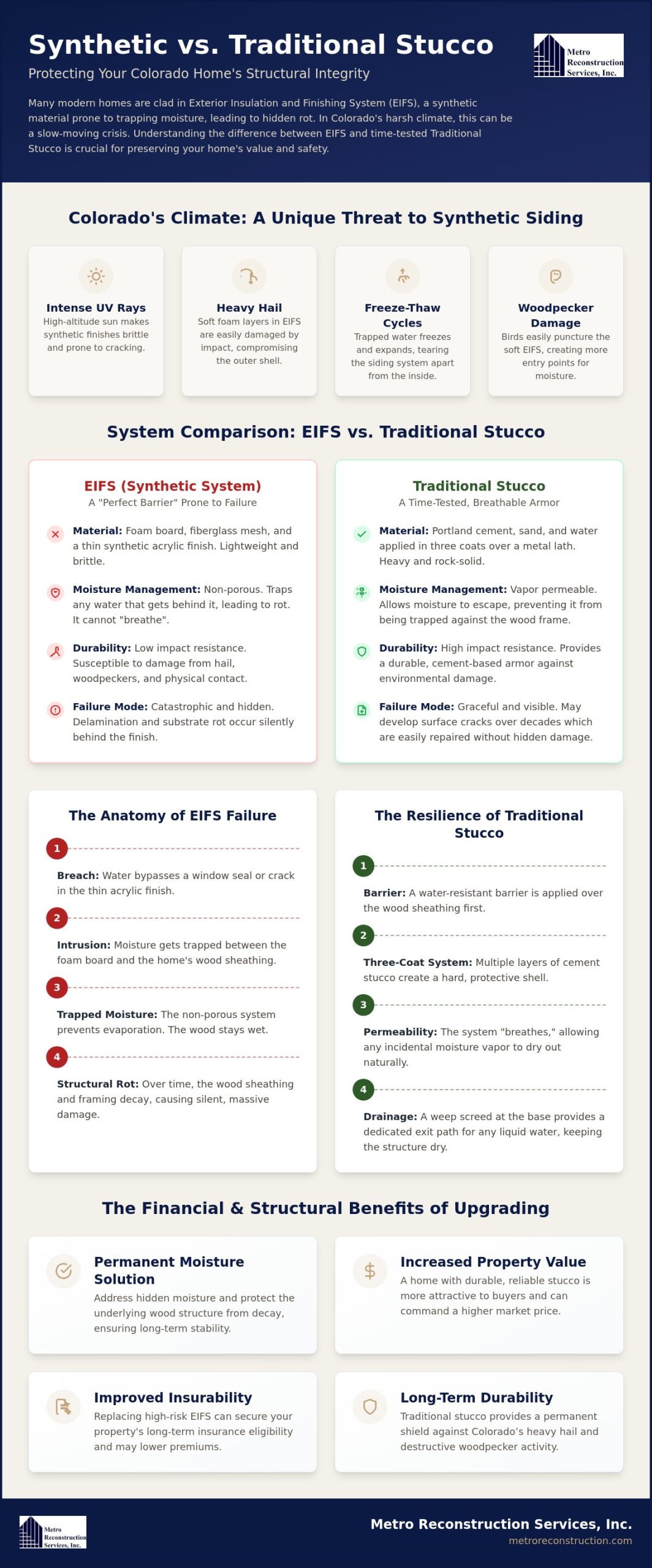
Many homeowners use the terms interchangeably, but these materials represent fundamentally different engineering philosophies. The Exterior Insulation and Finishing System (EIFS) is a multi-layered cladding that relies on a synthetic finish to act as a water barrier. In contrast, traditional stucco is a mineral-based material that has protected structures for centuries. One is a lightweight synthetic shell; the other is a heavy, cement-based armor. While EIFS provides high insulation, its design often ignores the reality of moisture movement in Colorado’s fluctuating climate.
How Synthetic EIFS Functions (and Fails)
During the building boom of the late 20th century, EIFS became popular for its design flexibility. It consists of foam insulation boards glued to the home, covered with a thin fiberglass mesh and a synthetic acrylic finish. This creates what professionals call a “perfect barrier.” While it sounds ideal, the lack of an internal drainage cavity means that if water breaches a window seal or a roof line, it remains trapped against the wood sheathing. Because the synthetic layers are non-porous, the moisture cannot evaporate. Over time, this leads to delamination, where the synthetic layers pull away from the foam, and eventually, the underlying wood begins to rot. It’s a silent failure that often goes unnoticed until the damage is extensive.
The Time-Tested Durability of Traditional Stucco
Traditional stucco uses a heavy-duty approach that prioritizes long-term resilience. It’s applied in a three-coat process over a water-resistant barrier and a metal lath. This includes a scratch coat for strength, a brown coat for leveling, and a final finish coat. Unlike synthetic options, this system is vapor permeable. This means it allows the building to “breathe,” letting internal moisture escape rather than trapping it against the frame. Understanding why replacing your EIFS with Traditional Stucco is Better for your Home often comes down to this fundamental ability to manage moisture. Modern installations also include a weep screed at the base of the wall. This component provides a dedicated exit path for any moisture that finds its way behind the system, ensuring the skeleton of your home stays dry.
At Metro Reconstruction Services, Inc., we look at your building’s complete outer system to ensure every component works together. Our forensic approach helps identify exactly where the synthetic barrier failed so we can restore the structural integrity of your property. If you’re concerned about soft spots or moisture behind your walls, reach out to us at 303.543.9549 or visit our contact page. You can also explore our full range of restoration services to see how we help homeowners across the Front Range preserve their investments.
The Hidden Dangers of EIFS in Colorado’s Extreme Climate
Colorado’s high-altitude environment is uniquely hostile to synthetic building materials. In communities like Golden and Niwot, the sun’s intensity is amplified by the elevation, which causes synthetic acrylic finishes to lose their elasticity over time. When these coatings become brittle, they lose their ability to expand and contract during the Front Range’s rapid temperature swings. This physical stress creates micro-cracks that invite moisture into the system. Unlike a breathable material, the fundamental flaws of face-sealed EIFS mean that once water enters, it has no way to evaporate.
During our harsh winters, this trapped water undergoes a destructive freeze-thaw cycle. As the water turns to ice, it expands, putting immense pressure on the foam boards and the wood substrate underneath. This repetitive cycle literally pulls the home’s exterior apart from the inside out. It’s a primary reason why replacing your EIFS with Traditional Stucco is Better for your Home, as traditional cement-based systems are designed to handle these environmental stressors without trapping moisture.
Moisture Intrusion: The Silent Home Destroyer
Water rarely enters through the center of a wall. Instead, it finds its way through window seals, improper kick-out flashing, or around light fixtures. Because the synthetic foam is so thick, it can hide massive amounts of substrate rot for years. You won’t see a leak in your living room, but the wood sheathing behind the foam is slowly turning to mulch. Our forensic inspections often reveal that by the time a homeowner notices a small crack, the structural damage is already advanced. Addressing these underlying issues is a core part of our restoration services.
The Insurance and Resale Hurdle
The financial risks extend beyond repair costs. Many insurance carriers in Colorado now refuse to issue new policies on homes with synthetic EIFS due to the high risk of hidden claims. This has created a significant stigma in the real estate market. Potential buyers are often wary, and lenders may hesitate to approve mortgages without a clean moisture report. Transitioning to a traditional system removes this barrier, providing immediate peace of mind for both current owners and future buyers. It’s a strategic move that protects your equity while securing your home’s future.
If you’re concerned about the integrity of your home’s exterior, we recommend a professional evaluation of your complete outer system. To speak with an expert about your property, call us at 303.543.9549 or reach out through our contact page.
The Structural and Financial Benefits of Traditional Stucco Replacement
Investing in a high-quality exterior is about more than just aesthetics; it’s a fundamental decision to harden your property against the unique environmental threats of the Front Range. While synthetic systems focus on surface-level insulation, they often leave the home’s skeleton vulnerable to external forces. Understanding why replacing your EIFS with Traditional Stucco is Better for your Home requires looking at the physical durability of Portland cement compared to synthetic foam. Traditional stucco provides a rigid, impact-resistant shield that withstands the heavy hail storms common in Denver and Boulder, whereas synthetic layers often crack or puncture under the same pressure.
The financial advantage of this transition is found in the reduction of recurring maintenance costs. Synthetic systems require constant monitoring of expansion joints and frequent recaulking to prevent moisture intrusion. Because some building scientists consider certain face-sealed synthetic systems to be inherently defective and unfit for use in high-moisture environments, the cycle of patching and repair becomes a never-ending expense. Switching to a mineral-based system eliminates these superficial fixes and builds long-term equity through structural reliability.
Hardening Your Home Against Wildfires
Fire safety is a critical concern for Colorado homeowners, especially those in mountain-transition zones. Traditional stucco is a non-combustible material that provides an excellent fire rating, acting as a protective barrier for the wood framing beneath. In contrast, the foam used in EIFS can melt or contribute to fire spread if the synthetic finish is breached. By choosing a cement-based restoration, you align your property with modern safety standards and regional requirements. You can learn more about local compliance and protection strategies on our Fire Mitigation and Prevention Services page.
Woodpecker Resistance and Exterior Hardness
Local wildlife presents a surprising but costly challenge for synthetic exteriors. Woodpeckers are drawn to the hollow, drum-like sound produced when they peck at the foam boards behind EIFS finishes. Once they breach the synthetic layer, they often create large nesting holes that lead to immediate water damage. This durability is a key reason why replacing your EIFS with Traditional Stucco is Better for your Home. Traditional stucco solves this problem through sheer density. The multi-layered application of scratch and brown coats creates a solid, rock-hard surface that birds cannot penetrate. This eliminates the need for unsightly deterrents and saves thousands of dollars in annual repairs. It’s a permanent solution that respects the local environment while protecting your investment.
If you’re ready to move away from temporary patches and toward a permanent structural solution, our team is here to help. You can reach us at 303.543.9549 or visit our contact page to schedule a diagnostic evaluation of your home’s complete outer system.
The Forensic Approach to EIFS Replacement and Substrate Restoration
When we address a failing exterior, we don’t simply swap one material for another. Our methodology is rooted in a forensic understanding of how moisture interacts with your home’s skeleton. This systematic process is exactly why replacing your EIFS with Traditional Stucco is Better for your Home; it allows us to identify and resolve the underlying structural origins of damage rather than just covering them up. By looking behind the surface, we ensure that the restoration is a permanent solution rather than a temporary mask.
The restoration moves through four critical phases designed to secure the building’s complete outer system:
- Phase 1: Controlled demolition. We carefully remove the synthetic layers, ensuring that the removal process doesn’t cause further stress to the structural frame.
- Phase 2: Forensic inspection. Our experts examine the underlying OSB or plywood sheathing for signs of moisture intrusion, rot, or mold that the foam layers previously hid.
- Phase 3: Structural mitigation. We replace any compromised wood or moldy insulation, restoring the physical strength of the wall cavity.
- Phase 4: Modern drainage plane installation. We apply a high-quality moisture barrier and create a dedicated path for water to exit the system, preventing future saturation.
Why ‘Just Patching’ EIFS is a Temporary Fix
Applying a new synthetic patch over an existing crack is often a recipe for disaster. This approach frequently traps existing moisture within the wall cavity, which accelerates the decay of your home’s framing. Metro Reconstruction Services, Inc. believes in a forensic approach to home preservation because it identifies why the system failed in the first place. Whether the issue originated from poor roof flashing or a failed window seal, we fix the source. A superficial patch ignores the hidden mechanics of the structure, leading to more expensive repairs later.
Integrating New Windows and Flashing
A building’s exterior is a complete outer system where every component must work in harmony to prevent moisture intrusion. The removal of the old EIFS barrier provides the perfect opportunity for high-performance window installation. By integrating windows during the stucco restoration, we can ensure that stainless steel or copper flashing is perfectly lapped with the new moisture barrier. This level of precision creates a seamless seal that protects your foundation and interior for decades. It’s an investment in accuracy that pays dividends in property value and peace of mind.
Don’t settle for a superficial fix that ignores the health of your home’s structure. Contact the expert team at Metro Reconstruction Services, Inc. today to schedule your stucco restoration evaluation at 303.543.9549 or visit our contact page.
Choosing a Dedicated Partner for Your Stucco Restoration Project
Metro Reconstruction Services, Inc. has operated as a family-owned firm since 1982. This history matters because we’ve watched how various building materials perform over decades in Colorado’s high-altitude environment. We don’t just see a project; we see a property that needs preservation. Our team brings quiet confidence and deep expertise to every site, ensuring that we identify the root cause of failures rather than applying superficial fixes. This long-term perspective is exactly why replacing your EIFS with Traditional Stucco is Better for your Home. It turns a liability into a permanent, structural asset.
One of the biggest anxieties for homeowners is the fear of discovery costs, which are the hidden rot or structural issues found once a wall is opened. We address this directly through our fixed-price project model. By providing analytical depth during our initial diagnostics, we offer a grounded and reassuring financial path forward. We serve the entire Front Range, providing rugged, local expertise to communities from Parker to Breckenridge. Our reputation is built on the peace of mind that comes from long-term solutions rather than low-quality patches.
The Metro Reconstruction Services, Inc. Difference
Our firm prioritizes structural integrity over simple aesthetics. While other companies might focus on a fresh coat of paint, we look at the building’s complete outer system. This forensic mindset ensures that the underlying mechanics of your home are sound before the first coat of Portland cement is ever applied. Whether you’re managing a complex residential restoration or a commercial build, our personalized project management provides the oversight needed for precision. You can review our full suite of restoration and construction services to see how we handle everything from window integration to moisture mitigation.
Take the Next Step Toward Property Preservation
Securing your home’s future starts with an accurate assessment. When you schedule a forensic evaluation, the experts at Metro Reconstruction Services, Inc. conduct a thorough investigation to determine the current health of your substrate. During a professional stucco consultation, we explain the relationship between your existing EIFS and any environmental stressors we identify. We provide the difficult truth of a structural failure rather than offering a temporary, low-quality patch. This transparency is a foundational brand promise that ensures your investment is protected for years to come.
If you’re ready to protect your investment with a dedicated partner, reach out to our team today. Call us at 303.543.9549 or visit our contact page to begin your restoration. Understanding why replacing your EIFS with Traditional Stucco is Better for your Home is the first step toward a more durable, valuable property.
Investing in Long-Term Structural Reliability
Your property is more than a building; it’s a significant investment that deserves a complete outer system designed for the Front Range’s specific demands. By moving away from synthetic layers that trap moisture and invite pests, you’re choosing a path of resilience. This transition clarifies why replacing your EIFS with Traditional Stucco is Better for your Home, as it replaces a failing barrier with a time-tested, breathable shield. Our forensic approach ensures that we don’t just cover up problems but restore the underlying health of your home’s skeleton.
At Metro Reconstruction, we’ve spent 40+ years in Boulder County refining our expertise in moisture mitigation and structural diagnostics. As a family-owned firm operated since 1982, we take a dedicated partner approach to every property preservation project. You can trust our team to provide the analytical depth and quiet confidence needed to handle your most complex structural challenges. Protect your home’s structural integrity today with a forensic evaluation from our seasoned experts, or call us directly at 303.543.9549. We look forward to helping you achieve lasting peace of mind.
Frequently Asked Questions
How can I tell if my home has EIFS or traditional stucco?
You can identify the material by performing a simple tap test on the exterior wall. If the surface sounds hollow or feels like a drum, it’s likely EIFS because of the foam insulation board behind the finish. Traditional stucco sounds solid like a rock and has no “give” when you press on it with your thumb.
Is it possible to install traditional stucco directly over existing EIFS?
No, we don’t recommend this approach because it’s a temporary fix that creates significant structural risk. Adding the heavy weight of a cement system over synthetic foam can cause the entire exterior to pull away from the house. A full removal is necessary to inspect the wood substrate for hidden rot and ensure a proper moisture barrier is in place.
Why is EIFS replacement so much more expensive than a simple paint job?
Replacement is a complete forensic restoration of your home’s skeleton, not a cosmetic update. While paint only covers the surface, a full replacement involves controlled demolition, structural mitigation of rotted wood, and the installation of a modern drainage plane. This process addresses the underlying mechanics of the structure to provide a permanent solution for your property.
How long does a full EIFS to traditional stucco replacement take?
Most residential restoration projects require three to five weeks to complete properly. This timeline allows our craftsmen to carefully remove the old barrier, perform necessary substrate repairs, and follow the specific curing times required for the three-coat cement process. We prioritize accuracy over speed to ensure the long-term reliability of your building’s complete outer system.
Will replacing my EIFS lower my home insurance premiums in Colorado?
Many Colorado insurance carriers now categorize EIFS as a high-risk building material, which can lead to higher premiums or a refusal to offer coverage. While we don’t control insurance rates, transitioning to a traditional system often makes a property eligible for standard policies. This change provides immediate peace of mind and can significantly improve your home’s resale value.
Can woodpeckers damage traditional stucco like they do EIFS?
No, woodpeckers are physically unable to drum through the rock-hard layers of Portland cement used in traditional systems. They target synthetic siding because the hollow foam sound mimics the resonance of a decaying tree. By choosing a denser material, you create an impenetrable shield that eliminates the need for constant woodpecker repairs and deterrents.
What are the signs of moisture intrusion hidden behind synthetic stucco?
Visible signs often include dark staining around window corners, bulging in the finish, or cracking along the foundation line. These indicators highlight why replacing your EIFS with Traditional Stucco is Better for your Home, as they suggest that the synthetic barrier is trapping water against your wood framing. If you notice these issues, a forensic evaluation is the most reliable way to identify the origin of the failure, and resources like Mold Pros Phoenix can help you estimate potential remediation costs if mold is detected.
Do I need to replace my windows when I replace my EIFS?
It isn’t mandatory, but the replacement process is the most strategic time for window installation. Since the exterior cladding is already removed, we can ensure that the new flashing and moisture barriers are perfectly integrated with the window frames. This holistic approach creates a seamless seal that protects your home’s interior from the Front Range’s extreme weather shifts.
If you’re concerned about the integrity of your home’s exterior, don’t wait for a small crack to become a major structural failure. Contact the experts at Metro Reconstruction today for a thorough assessment of your property. You can reach us at 303.543.9549 or visit our contact page to schedule your evaluation.