
What if the subtle granules in your gutters or a small water spot on the ceiling are actually early warnings of a failing structural system? For many Denver homeowners, the uncertainty of knowing exactly when to replace your roof can lead to significant stress, especially after a typical Front Range hailstorm. It’s natural to feel concerned that a contractor might be pushing for a full replacement when a repair could suffice, or to worry that a hidden leak is quietly compromising your home’s interior.
We believe that your home deserves a forensic approach to preservation rather than a temporary fix. This article provides the technical clarity you need to evaluate your property’s health, covering the five critical warning signs and the specific lifespans of various roofing materials. You’ll discover how local factors, such as the 2026 Colorado Wildfire Resiliency Code and our unique climate, dictate the necessity of a new installation. We’ll guide you through a professional checklist designed to restore your peace of mind and protect your long-term investment.
Key Takeaways
- Learn to spot visual indicators like buckling shingles and excessive granule loss that signal your home’s outer system is reaching the end of its functional life.
- Understand the specific lifespans of asphalt and metal materials in high-altitude environments to help you determine exactly when to replace your roof before leaks occur.
- Evaluate how Colorado’s unique climate, including frequent hail and intense UV radiation, accelerates the degradation of structural components and protective layers.
- Use the 25% rule and a thorough inspection of the underlying roof decking to make an informed, economical decision between a minor repair and a full replacement.
- Gain confidence by adopting a forensic approach to property preservation that focuses on identifying the root causes of structural failure rather than applying temporary patches.
Recognizing the Warning Signs of a Failing Roof System
A roof is more than a simple covering; it’s the anchor of your home’s complete outer system. When homeowners try to determine when to replace your roof, they often wait for a visible leak before taking action. This reactive stance can lead to deeper structural failures that affect the foundation and interior health. A proactive approach involves identifying subtle changes in the roof’s physical state before moisture reaches the living space. By understanding how different components interact, you can protect your property from the cumulative effects of weather and age.
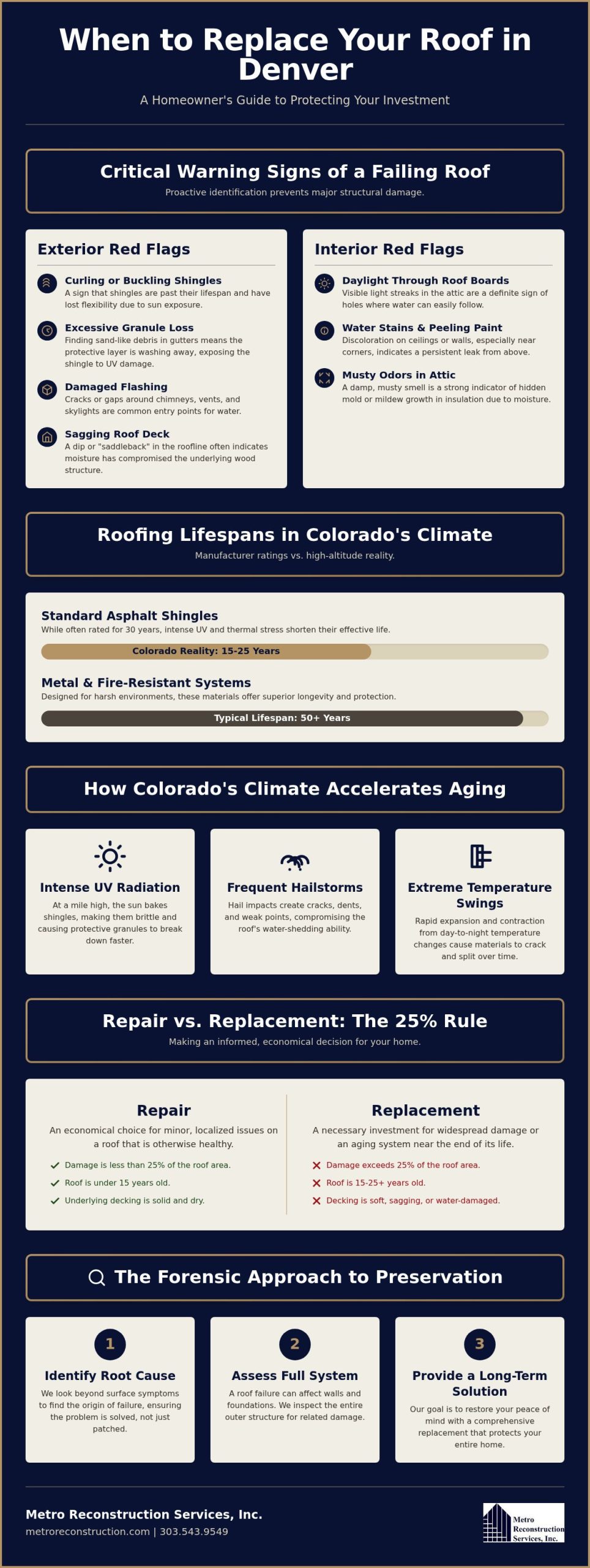
Visual indicators such as curling or buckling shingles are clear signals that the material’s structural integrity is failing. In our high-altitude environment, Denver’s intense sun and rapid temperature swings bake the shingle until it loses its flexibility. This process is often accompanied by significant granule loss. If you find sand-like debris accumulating in your gutters, the protective layer of your roof is washing away. This exposure drastically shortens the Asphalt shingle lifespan, as the sun bakes the underlying surface until it becomes brittle and prone to cracking.
Our team at Metro Reconstruction Services, Inc. frequently identifies how roof failures lead to moisture intrusion in stucco and masonry walls. Water that bypasses a degraded roof edge often migrates behind the exterior finish. This creates hidden wood rot that remains invisible until the damage is extensive. We take a forensic approach to these issues. We look for the underlying structural origins rather than just the surface-level symptoms. This thoroughness ensures that any replacement addresses the root cause of the problem.
Visual Cues on the Roof Surface
A thorough ground-level inspection can reveal “balding” shingles where the protective granules are entirely missing. You should also look for cracked or damaged flashing around chimneys and vents, as these metal transitions are common points of failure. Most importantly, note any sagging areas along the ridgeline or roof planes. A sag typically indicates that the underlying wood decking has been compromised by long-term moisture exposure and requires immediate professional attention.
Interior Red Flags to Watch For
Your attic often tells the most honest story about your roof’s condition. During the day, turn off the lights and look for streaks of light coming through the roof boards. If light can get in, water will follow. You should also be alert for persistent musty odors, which suggest hidden mold growth within the insulation. On your living floors, monitor for peeling paint or wallpaper near the top of exterior walls. These interior signs often signal that water is traveling down the wall studs from a failure point high above.
If you’ve identified any of these warning signs, it’s time for a professional diagnostic evaluation to protect your investment. Contact Metro Reconstruction Services, Inc. today at 303.543.9549 or visit our contact page to discuss a long-term solution for your home.
Typical Lifespans for Common Colorado Roofing Materials
While visual damage is a clear indicator of distress, the chronological age of your home’s outer system remains the most reliable predictor for when to replace your roof. National manufacturers often advertise a 30-year life for asphalt products, but Denver’s environment is far more demanding. Intense UV exposure at a mile high and extreme temperature swings between day and night create constant thermal stress. In our experience across the Front Range, standard asphalt materials typically reach their functional limit between 15 and 25 years. Beyond this window, the risk of structural failure increases regardless of how the surface appears from the street.
A roof’s lifespan isn’t just about the top layer; it’s about how the entire assembly handles environmental pressure. For mountain properties or homes in the foothills, the implementation of the Colorado Wildfire Resiliency Code on July 1, 2026, has shifted the focus toward more durable, fire-resistant materials. These advanced systems offer superior protection but require a higher level of technical precision during installation to ensure they reach their full potential.
Shingle and Composite Material Expectations
Standard 3-tab shingles are increasingly rare in our region because they lack the weight and wind resistance required for Colorado storms. Architectural shingles provide better durability through multiple layers, yet they’re still susceptible to the rapid expansion and contraction common in Boulder and Denver. Proper attic ventilation is critical here. Without adequate airflow, heat trapped beneath the decking effectively cooks the shingles from the inside out, causing them to become brittle years before their time.
Premium Materials and Long-Term Value
For homeowners seeking a permanent solution, metal and clay tile offer exceptional longevity. A standing seam metal roof provides excellent hail resilience and can last twice as long as asphalt alternatives. Clay tile and slate have a 50-year potential, though they carry significant weight that must be accounted for during the planning phase. These high-quality materials require a specialized design-build approach to confirm that the underlying structural supports are sufficient for the load. If you’re considering a transition to these heavier materials, our team can provide a forensic evaluation of your home’s current capacity. You can reach us at 303.543.9549 to discuss your project’s specific requirements.
Understanding the age and material of your roof is the first step in proactive property preservation. If your system is approaching the 20-year mark, it may be time to consider a long-term replacement strategy. Visit our contact page to schedule a professional diagnostic assessment of your roof’s integrity.
The Impact of Colorado Climates on Roof Integrity
Colorado’s geography creates a unique set of challenges for any building’s complete outer system. While national standards might offer general guidelines, the specific intersection of high-altitude UV rays and volatile storm patterns determines when to replace your roof on the Front Range. At 5,280 feet and above, the atmosphere provides less protection from solar radiation. This intense UV exposure acts as a constant catalyst for chemical degradation in asphalt-based adhesives and sealants. Over time, the materials that once kept your shingles bonded together lose their elasticity, leaving the system vulnerable to wind uplift during our notorious spring gusts.
Beyond the sun, wildfire resiliency has become a primary concern for property preservation. Integrating your reconstruction project with fire mitigation and prevention services is no longer an optional upgrade but a structural necessity. Following the implementation of the Colorado Wildfire Resiliency Code, selecting materials that resist ember ignition is a critical part of maintaining your home’s long-term safety and insurance eligibility. This holistic approach ensures that your new roof isn’t just a weather shield but a fortified component of a hardened exterior.
Hail Damage: The Silent Roof Killer
Denver sits in the heart of “Hail Alley,” where frequent strikes cause cumulative damage that often goes unnoticed by the untrained eye. Much like how Five Star Dent Removal specializes in restoring vehicle surfaces after a storm, it’s essential for homeowners to distinguish between cosmetic hail scuffs and structural bruising on their roof. When a large hailstone strikes, it can fracture the fiberglass mat within a shingle without leaving a visible hole on the surface. These hidden fractures allow moisture to seep into the wood decking over several seasons, requiring a forensic inspection to identify underlying structural origins before they lead to expensive internal failures.
Winter Weather and Ice Damming
Winter presents its own set of stresses, particularly through the phenomenon of ice damming. When heat escapes from poorly insulated attics, it melts snow on the upper roof planes. This water then refreezes at the colder eaves, creating a physical dam that forces liquid water upward and under the shingles. Without proper ventilation or the strategic use of heat tape, this cycle causes massive gutter failures and forces moisture into your wall cavities. Addressing these issues requires a partner who understands the relationship between insulation, ventilation, and structural integrity.
If you suspect your roof has sustained weather-related damage, don’t wait for a leak to confirm your fears. Contact Metro Reconstruction Services, Inc. today at 303.543.9549 or visit our contact page for a professional evaluation of your home’s exterior integrity.
Repair vs. Replacement: Making the Economical Decision
Choosing between a localized patch and a full system overhaul is one of the most significant financial decisions you’ll make for your property. While some contractors push for total replacement at the first sign of a leak, we advocate for a more analytical approach based on the 25% rule. If the necessary repairs exceed 25% of the total surface area, or if the damage is distributed across multiple roof planes, the labor costs for patchwork often outweigh the long-term value of a new installation. Determining when to replace your roof requires evaluating whether a repair is a sustainable solution or merely a temporary delay of an inevitable structural failure.
The health of the underlying decking and structural supports is the true deciding factor. A surface might look salvageable, but if moisture has compromised the plywood or rafters beneath, a simple shingle replacement won’t solve the core issue. Modern, energy-efficient roofing systems offer a long-term cost-benefit that goes beyond simple leak prevention. These systems improve thermal regulation, potentially lowering utility costs while ensuring your property meets the latest building codes. Documenting these improvements as part of your essential exterior home repair strategy is vital for maintaining and increasing your home’s market value.
When a Professional Repair is Sufficient
There are specific scenarios where a targeted repair is the most logical choice. If your roof is relatively new and has suffered isolated damage from a fallen tree limb or a minor wind event, a professional repair can restore the system’s integrity. Replacing damaged flashing around chimneys or installing new rubber boots around vent pipes are routine maintenance tasks that extend the life of the larger system. However, even these minor interventions must be performed by structural experts who understand how these components interact with your home’s complete outer system.
The Hidden Costs of Delaying Replacement
Ignoring a failing roof creates a cascade of expensive problems that extend far beyond the shingles. Persistent leaks often lead to soil saturation around your home’s perimeter, which can eventually necessitate foundation repair services to correct structural shifting. In Colorado, a compromised roof is also at high risk for catastrophic failure during a heavy spring snowstorm when the added weight of wet snow exceeds the capacity of weakened wood. Delaying action can also result in increased insurance premiums or the total loss of coverage if the carrier deems the roof has exceeded its functional lifespan.
Don’t let a minor leak turn into a major structural failure. Our team at Metro Reconstruction Services, Inc. can provide a forensic evaluation to help you make the right choice for your home. Contact us today at 303.543.9549 or visit our contact page to schedule a professional assessment.
The Forensic Approach to Structural Roof Replacement
A successful reconstruction project begins long before the first shingle is removed. While many contractors focus on a rapid installation, we prioritize a forensic diagnostic process to ensure the long-term health of your property. Identifying when to replace your roof is only the first step; understanding why the previous system failed is what prevents future issues. Our commitment to precision means we look for the underlying structural origins of every leak or material failure, ensuring that your new roof is a permanent solution rather than a superficial patch. By evaluating the complete outer system, we protect the integrity of your entire home.
Precision in diagnostics allows us to identify hidden complications, such as compromised rafters or inadequate ventilation, that a standard roofing company might overlook. We treat your home as a complex building envelope where every component must work in harmony. This analytical depth is why Metro Reconstruction has been a trusted partner in property preservation for over 40 years. We believe in providing the difficult truth about a structure’s condition rather than offering a low-quality fix that will fail within a few seasons. Your investment deserves the protection that only a seasoned expert can provide.
Beyond the Shingles: A Holistic Evaluation
Our team examines how the roof line interacts with other critical elements, such as siding, windows, and masonry. For homes with specialized exteriors, we often find that roof failures are closely linked to stucco restoration needs. Water that isn’t properly diverted by the roof can saturate wall cavities, leading to hidden rot and structural degradation. By assessing the integrity of the complete building envelope, we ensure that your new roof provides a seamless seal that protects every facet of your home’s exterior.
Starting Your Project with Confidence
Choosing a family-owned firm with four decades of local history means you’re working with partners who understand the unique demands of the Colorado climate. During a professional structural evaluation, you can expect a transparent and detailed breakdown of your home’s current condition and a clear path toward restoration. We don’t use high-pressure tactics; we use data and expertise to guide your decision. If you’re ready to secure your home’s future, call Metro Reconstruction at 303.543.9549 or visit our contact page to discuss your property’s specific needs.
Trust the experts who understand the hidden mechanics of your home. We’re here to provide the peace of mind that comes from a long-term structural solution. Reach out today to start your project with the confidence of professional guidance.
Securing Your Home’s Structural Future
Protecting your property requires moving beyond surface-level observations to understand the health of your complete outer system. We’ve explored how identifying early warning signs, such as granule loss and internal moisture signals, can prevent a localized issue from becoming a catastrophic failure. Recognizing when to replace your roof is a vital part of property preservation, especially when considering the 15 to 25-year lifespan of standard materials in our demanding high-altitude climate. Decisions regarding your home shouldn’t be based on guesswork or high-pressure sales tactics.
Since 1982, our family-owned firm has provided the Front Range with deep expertise in forensic structural diagnostics. We don’t just look at shingles; we analyze the relationship between your roof, siding, and masonry to ensure a long-term solution. With over 40 years of local history, we’re dedicated to helping you make an informed, economical decision that restores your peace of mind and protects your investment. You deserve a partner who prioritizes structural accuracy and technical precision.
If you’re ready for a precise evaluation of your home’s integrity, contact our structural experts today or call us at 303.543.9549 to discuss your specific property needs. We look forward to helping you navigate your restoration project with confidence and clarity.
Frequently Asked Questions
How many years does a typical roof last in Colorado?
A typical asphalt shingle roof in Colorado usually lasts between 15 and 25 years before environmental stressors compromise its integrity. While manufacturers often suggest longer lifespans, our high-altitude UV radiation and rapid temperature cycling accelerate material degradation. Understanding this timeline helps you plan when to replace your roof before structural failure occurs.
Can I install a new roof over my existing shingles?
We strongly advise against installing a new roof over existing shingles because it prevents a thorough inspection of the underlying roof deck. Adding a second layer traps heat, which shortens the lifespan of the new shingles, and adds significant weight to the structural supports. A complete tear-off is the only way to identify hidden rot and ensure the new system is bonded correctly to the building’s complete outer system.
How do I know if my roof has hail damage if it isn’t leaking?
A roof can have significant damage without leaking yet, often presenting as structural bruising or significant granule loss that weakens the shingle’s water-shedding capabilities. These impact points fracture the internal fiberglass mat, allowing moisture to seep into the underlying wood surface over time. A professional evaluation is necessary to distinguish between cosmetic scuffs and deep structural damage that will eventually lead to internal rot if left unaddressed.
What is the best time of year to replace a roof in the Front Range?
The ideal window for roof replacement in the Front Range typically spans from late spring through early autumn when temperatures are consistently warm enough for shingle adhesives to seal properly. However, professional crews can perform installations year-round provided the weather remains dry. We recommend scheduling work outside of the peak spring hail season to avoid the high demand and material shortages that often follow major storm events.
Will homeowners insurance cover the cost of my roof replacement?
Homeowners insurance generally covers roof replacement if the damage results from a sudden, accidental event like a hailstorm or high wind occurrence. Policies typically don’t cover replacement for standard wear and tear or material aging. It’s important to realize that many Colorado insurers now offer premium discounts for homes that utilize Class 4 impact-resistant shingles, which is a factor to consider when to replace your roof.
What happens if I ignore a small roof leak for a few months?
Ignoring a minor leak allows moisture to accumulate in your attic and wall cavities, which triggers rapid mold growth and compromises structural wood. Over time, this water migration can saturate the soil around your perimeter, potentially leading to foundation shifting. What begins as a simple shingle issue can quickly evolve into a complex reconstruction project involving multiple building systems if you don’t address the problem immediately.
How does a failing roof affect my home’s stucco or siding?
A failing roof edge often allows water to migrate behind your home’s stucco or siding, leading to peeling or separation and hidden rot within the wall assembly. This moisture intrusion is particularly damaging to exterior finishes that rely on a tight seal at the roofline. By evaluating the complete building envelope, we can identify how a roof failure is quietly degrading your exterior walls and provide a holistic restoration solution.
For more specific answers regarding your property’s health, contact Metro Reconstruction Services, Inc. today at 303.543.9549 or visit our contact page to schedule a professional evaluation.