
What if the fog clouding your mountain views isn’t just a sign of age, but a symptom of a failing outer system that compromises your home’s structural health? Many homeowners assume that condensation between glass layers is a simple aesthetic nuisance. In reality, it signals a pressurized seal failure often caused by our unique high-altitude climate. When you consider double pane window replacement Boulder residents often find that the problem goes deeper than the glass itself. It’s a matter of maintaining the protective barrier of your entire property.
It’s frustrating to watch your energy bills climb while UV rays slowly damage your interior furnishings through compromised seals. You deserve a home that remains efficient and secure against the elements. In this forensic guide, you’ll learn how to identify the root causes of window failure and choose a high-altitude replacement strategy that restores your home’s structural integrity. We’ll explore the technical requirements of the 2024 City of Boulder Energy Conservation Code and explain how a precise, system-wide approach provides the long-term reliability your investment requires.
Key Takeaways
- Understand how Boulder’s high elevation creates internal gas pressure imbalances that lead to premature Insulated Glass Unit (IGU) failure.
- Learn to distinguish between simple seal failure and more complex structural shifts that compromise your home’s complete outer system.
- Evaluate the long-term ROI of glass-only repairs versus a comprehensive double pane window replacement Boulder strategy to ensure lasting thermal protection.
- Identify which high-performance materials, such as fiberglass or wood-clad units, best withstand Colorado’s intense UV exposure and temperature swings.
- Discover the necessity of forensic installation techniques to maintain the structural integrity of your property and maximize energy efficiency.
Why Double Pane Windows Fail in Boulder’s Unique Climate
An Insulated Glass Unit (IGU) serves as the heart of your home’s thermal envelope. It consists of two panes of glass separated by a spacer, creating a hermetically sealed chamber filled with insulating gas. Understanding how insulated glass works is vital because this assembly is what keeps the biting Colorado wind out and your conditioned air in. When the seal fails, the window loses its ability to resist heat transfer. This leads to the common foggy appearance that indicates moisture has infiltrated the unit, signaling a total failure of the thermal system.
Living at 5,430 feet presents a unique set of challenges for these seals. The atmosphere here is thinner and the UV radiation is significantly more intense than in coastal regions. These factors work together to attack the structural integrity of your windows from both the inside and the outside. High-intensity solar gain cooks the sealants, while the altitude creates a pressure imbalance that few standard windows are designed to handle. For a successful double pane window replacement Boulder homes require a specialized approach that accounts for these environmental stressors before they compromise the building’s outer system.
The Altitude Factor: Pressure and Capillary Tubes
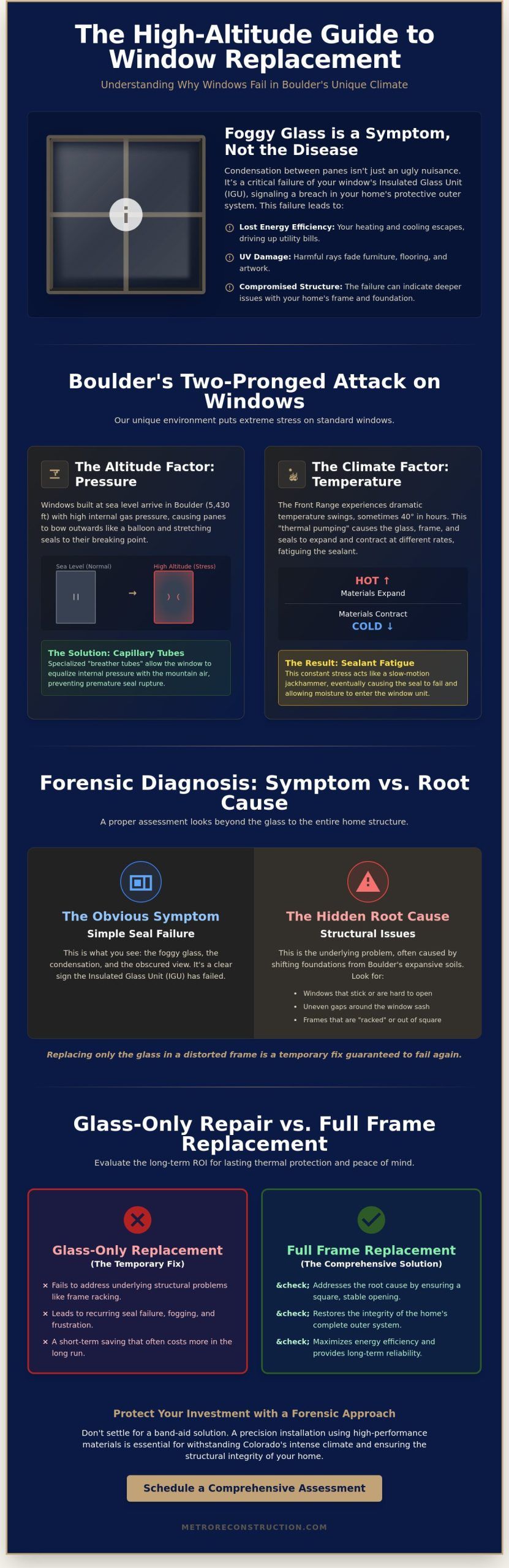
Windows manufactured at sea level arrive in the mountains under immense internal pressure. Because the air inside the glass is denser than the thin mountain air, the panes bow outward like a balloon. This constant outward force stretches the sealant to its breaking point. To solve this, we look for units equipped with capillary tubes; these are tiny, stainless steel breather tubes that allow the IGU to equalize its internal pressure with the surrounding atmosphere. This simple mechanical addition ensures that internal and external pressures remain balanced, which prevents the premature seal rupture that plagues so many standard replacements in our area.
Thermal Stress and Expansion in the Front Range
Our local climate is famous for dramatic temperature shifts, sometimes swinging 40 degrees in a few hours. These fluctuations cause the glass, the spacer, and the frame to expand and contract at different rates. This thermal pumping action acts like a slow-motion jackhammer on the window’s seals. Eventually, the sealant fatigues and fails, allowing moisture to enter. This failure isn’t just about a lost view; it’s a breach in the building’s complete outer system that can lead to hidden moisture damage within the wall structure if not addressed during a double pane window replacement Boulder homeowners can trust.
The Forensic Approach: Seal Failure vs. Structural Issues
A window failure is rarely an isolated event. While we previously discussed how altitude affects internal gas pressure, a forensic assessment must also consider the physical aperture holding the unit. When considering double pane window replacement Boulder homeowners often discover that foggy glass is merely a symptom of a larger structural shift. If a window becomes difficult to operate or exhibits uneven gaps between the sash and the frame, the issue likely originates in the building’s foundation rather than the glass itself. We prioritize identifying these structural origins before recommending a specific product.
We view every home as a complete outer system. This means the window, the flashing, the weather-resistant barrier, and the exterior cladding must work in perfect unison to protect your investment. In Boulder County, our geology is characterized by expansive soils that exert significant pressure on a home’s footprint. These soil movements lead to frame distortion, where the window opening is pulled out of its original square alignment. Replacing glass in a racked frame is a temporary fix that leads to recurring seal failure and frustration.
Identifying Frame Distortion and Racking
Racking occurs when the vertical and horizontal components of a window frame are no longer perpendicular. This distortion is a clear indicator of foundation movement. It creates stress points that crack even high-quality seals and allow air to bypass the weatherstripping. If your windows are sticking or showing daylight around the edges, it’s necessary to investigate our foundation repair services to stabilize the opening before installing new units. Accuracy at this stage is essential for long-term reliability.
Moisture Intrusion and the Building Envelope
The intersection between a window and the wall is the most vulnerable point in the building envelope. When flashing fails, water migrates behind the stucco or masonry, leading to rot and structural degradation that remains hidden for years. While the National Fenestration Rating Council provides essential data on how well a window resists heat, no rating can account for a poor interface with the surrounding wall. A window is only as good as its integration with the wall system. Ensuring this transition is watertight remains a core component of our methodology. If you suspect your window failure has deeper origins, a thorough diagnostic assessment of your complete outer system is the first step toward a permanent solution.
Glass Replacement vs. Full Frame Replacement
Deciding between a glass-only repair and a full unit replacement requires a cold, analytical look at the window’s underlying components. While a simple IGU swap addresses the immediate visual nuisance of fogged glass, it does nothing to improve a frame that has lost its thermal efficiency or structural squareness. For a comprehensive double pane window replacement Boulder residents must weigh the immediate savings of a glass-only fix against the long-term ROI of a modern, energy-efficient system. A window is a complex assembly; treating only one part of that assembly often leads to recurring issues.
One common objection to full replacement is the higher initial investment. However, the limitation of glass-only fixes is their inability to improve the overall U-factor of the opening. An old, uninsulated frame acts as a thermal bridge, allowing heat to bypass even the most advanced new glass. Over a ten-year horizon, the energy savings and the prevention of moisture-related wall rot usually make the more thorough approach the more fiscally responsible choice. We aim to provide the difficult truth about a window’s condition rather than offering a temporary patch that will fail again in a few seasons.
When Glass-Only Replacement Suffices
Glass-only replacement remains a viable path when the surrounding frame and sashes are structurally sound and the original flashing remains uncompromised. This process involves carefully removing the failed IGU and installing a new, high-altitude-rated unit while preserving the existing architectural millwork. This is particularly relevant in Boulder’s historic districts, where preserving the original character of the home is often a regulatory mandate. In these specific scenarios, we focus on restoring the hermetic seal without disturbing the historical integrity of the building’s facade, provided the wood or metal frames remain rot-free and square.
The Case for Full-Frame Replacement
A full-frame replacement is often the more responsible choice for modernizing a home’s performance and protecting its structural health. At our elevation, older vinyl or wood frames often warp under intense UV exposure, creating air leaks that new glass simply cannot fix. Upgrading to fiberglass or composite frames offers superior stability during the Front Range’s extreme temperature swings. This method also allows us to correct original installation errors, such as missing sill pans or improper flashing techniques. By integrating new windows with professional stucco restoration, we ensure a seamless, watertight seal that protects the entire wall system from the inside out. This forensic approach ensures that your double pane window replacement Boulder project delivers the peace of mind that comes from a permanent, engineering-led solution.
Selecting High-Performance Materials for Boulder Homes
Choosing the right material for a double pane window replacement Boulder project is a decision that impacts your home’s structural integrity for decades. The 2024 City of Boulder Energy Conservation Code (COBECC) has established rigorous standards for thermal performance; looking ahead, all residential windows must achieve a U-factor of 0.30 or lower by January 1, 2026. Meeting these requirements requires more than just picking a brand name. It involves a technical analysis of how different materials behave under the stress of our high-altitude environment. While vinyl is a common choice due to its lower initial cost, it often lacks the rigidity needed to maintain a hermetic seal against the Front Range’s intense UV radiation and wind loads.
Thermal bridging is another critical factor to consider during selection. This occurs when heat travels through the window frame itself, bypassing the glass entirely. To combat this, we evaluate the Solar Heat Gain Coefficient (SHGC) alongside the U-factor. A lower SHGC is vital for south-facing windows in Boulder to prevent overheating during our 300 days of sunshine, while high-density gas fills like Argon or Krypton provide the necessary insulation for our sub-zero winter nights. These gases are denser than air and significantly reduce convective heat transfer within the IGU. Selecting the right combination of these technologies is what qualifies a project for the 30% federal tax credit available for Energy Star certified windows.
Fiberglass: The High-Altitude Standard
Pultruded fiberglass has emerged as the premier material for mountain environments because its thermal expansion coefficient is nearly identical to that of glass. This means the frame and the glass move together as temperatures fluctuate, which drastically reduces the mechanical stress placed on the spacers and sealants. Unlike vinyl, which can become brittle after years of high-altitude sun exposure, fiberglass remains dimensionally stable and won’t warp. It also offers superior resistance to the heavy hail and high-velocity wind events common in Boulder County. Investing in fiberglass ensures that the precision of the initial installation is maintained over the long term.
Glass Coatings and Solar Control
Modern Low-E3 coatings are essential for protecting your home’s interior from UV damage while managing solar energy. These microscopically thin metallic layers reflect long-wave infrared energy back to its source, keeping your home cooler in the summer and warmer in the winter. We also prioritize the use of warm-edge spacers, which are made of low-conductivity materials rather than traditional aluminum. These spacers keep the edges of the glass warmer, which effectively prevents the perimeter condensation that can lead to mold growth and damage to the surrounding wall system. If you’re ready to upgrade your home’s thermal envelope, our team provides expert window replacement services designed for lasting performance.
The Metro Methodology: Precision Window Installation
Our approach to double pane window replacement Boulder homes require begins with a commitment to initial accuracy. We recognize that even the most advanced high-altitude unit is only as effective as the precision of its installation. While high-pressure marketing tactics often prioritize volume, we operate from a position of quiet confidence and technical depth. We treat every window opening as a vital component of the building’s complete outer system. This methodology ensures that the structural integrity of your property is preserved for decades rather than just a few seasons. We aren’t just replacing glass; we are restoring a critical barrier against the demanding Colorado environment.
Reliability comes from understanding the hidden mechanics of a structure. By focusing on long-term solutions, we distance ourselves from low-cost alternatives that rely on superficial fixes. Our team acts as a dedicated partner in property preservation, guiding you through the technical complexities of modern building codes and environmental stressors. This engineering-led approach is designed to instill immediate trust through transparent communication and meticulous craftsmanship.
Forensic Evaluation and Specification
Before any materials are ordered, we perform a thorough diagnostic of the existing opening and its structural surrounds. This phase is essential because it identifies underlying issues like frame racking or foundation shifts that could compromise a new installation. We customize window specifications based on your home’s specific orientation and altitude, ensuring the internal pressure of the IGU is perfectly balanced for Boulder’s 5,000-foot elevation. Every specification we develop meets or exceeds the 2024 City of Boulder Energy Conservation Code (COBECC). This level of initial accuracy prevents the premature seal failure that often plagues standard replacements in the Front Range.
Seamless Integration and Protection
The intersection between a window frame and your home’s exterior cladding is where moisture protection succeeds or fails. Our installation process utilizes specialized flashing and moisture mitigation techniques that ensure a watertight transition to your existing stucco or masonry. We prioritize the building’s complete outer system by verifying that the new unit integrates perfectly with the weather-resistant barrier. During the final quality assurance phase, we verify the thermal and structural seal to guarantee long-term performance. This forensic focus on detail provides the peace of mind that only comes from a professional, system-wide restoration. If you suspect your windows are failing, you can Schedule a forensic window evaluation with Metro Reconstruction to protect your investment.
Securing Your Home’s Structural Envelope
Protecting the long-term value of your property requires viewing windows as critical components of a complete outer system rather than isolated pieces of glass. The unique environmental stressors of the Front Range demand a specialized response that accounts for both high-altitude pressure and potential structural shifts. By prioritizing high-performance materials and precise installation techniques, you effectively shield your home from moisture intrusion and thermal loss. A successful double pane window replacement Boulder project relies on this foundational accuracy to ensure lasting results.
Our family-owned firm brings over 40 years of local expertise to every project. We specialize in building envelope protection and utilize a forensic approach to identify underlying structural origins before proposing a solution. This focus on engineering-led restoration provides the peace of mind that comes from a permanent fix. If you suspect your home’s thermal barrier is compromised, Contact Metro Reconstruction for a Professional Window Consultation. We are ready to help you preserve the integrity and comfort of your home for years to come.
Frequently Asked Questions
How much does double pane window replacement cost in Boulder?
The total investment for double pane window replacement Boulder homeowners encounter is influenced by rigorous local energy standards and specific permitting requirements. While we avoid flat-rate estimates due to the forensic nature of our work, project costs typically include Boulder County permit fees ranging from $50 to $200 and specialized disposal fees. High-performance units that meet the 2024 City of Boulder Energy Conservation Code represent a significant commitment to your home’s structural integrity and long-term thermal efficiency.
Can I replace just the glass if my window is foggy?
You can replace just the glass assembly, known as the Insulated Glass Unit (IGU), provided the surrounding frame and flashing remain structurally sound. This approach is often necessary for historic preservation where maintaining the original architectural millwork is a priority. However, if our diagnostic reveals that the fogging resulted from frame distortion or foundation movement, a glass-only fix will likely fail again. We evaluate the complete outer system to determine if a more comprehensive solution is required.
Why do windows in Boulder fail more often than in other climates?
Boulder’s 5,430-foot elevation creates a persistent pressure imbalance between the factory-sealed gas inside the window and our thin mountain air. Without specialized capillary tubes to equalize this pressure, the hermetic seals are under constant mechanical stress. This issue is compounded by intense UV radiation and rapid 40-degree temperature swings common in the Front Range. These environmental stressors fatigue sealants and spacers much faster than in more stable, sea-level environments.
What is the best window frame material for the Colorado Front Range?
Fiberglass is the premier choice for our regional climate because its thermal expansion rate nearly mirrors that of the glass itself. This synergy ensures that the frame and glass move together during extreme temperature fluctuations, which protects the integrity of the seals. Unlike vinyl, which can warp or become brittle under Colorado’s high-intensity solar gain, fiberglass remains dimensionally stable. It provides the rugged durability needed to withstand high-velocity winds and frequent hail events.
How long does it take to replace double pane windows?
A typical installation project requires one to three days, though the timeline depends on the number of units and the complexity of the building’s exterior cladding. Our methodology prioritizes initial accuracy, which includes a forensic diagnostic phase to ensure perfect integration with your home’s stucco or masonry. We take the necessary time to install specialized flashing and verify the structural seal. This meticulous pace ensures a permanent result that protects your property’s long-term value.
Do new windows require a building permit in Boulder County?
Yes, replacing windows in Boulder requires a building permit to verify compliance with strict energy and safety regulations. This process ensures that new installations meet the 2024 City of Boulder Energy Conservation Code (COBECC) standards for U-factors and solar heat gain. Permits also ensure that safety glazing is installed in hazardous locations as required by the 2021 International Residential Code. We manage the technical documentation and inspections necessary to meet these rigorous municipal standards.
Will replacing my windows stop the drafts in my home?
Replacing failing units will significantly reduce air infiltration, but only if the installation addresses the entire building envelope. Drafts often bypass the window itself, leaking through gaps between the frame and the wall or through warped sashes caused by frame racking. Our forensic approach identifies these underlying structural origins to ensure the new double pane window replacement Boulder project creates a seamless seal. We focus on restoring the thermal integrity of the building’s complete outer system.
What is the difference between a glass-only repair and a full-frame replacement?
A glass-only repair involves replacing the failed IGU while leaving the existing frame and sashes undisturbed, which works well for sound frames. A full-frame replacement involves removing the entire assembly down to the rough opening to allow for a total system upgrade. This more thorough method is essential if the original frames are warped, rotted, or misaligned due to foundation shifts. It allows us to install modern moisture mitigation and high-performance materials that provide superior long-term reliability.