
What if damaged siding or stucco is only a symptom of a problem elsewhere in the exterior system? On Colorado’s Front Range, moisture, sun, wind, and temperature changes affect materials and the places where they meet. Choosing an exterior restoration contractor Front Range property owners can trust means looking beyond visible damage to understand what may have caused it.
It’s reasonable to want a clear explanation of whether weather exposure, moisture, or failing materials are involved. Repairs also need to work together. Restoring one surface without addressing vulnerable connections can leave other parts of the building envelope exposed.
A complete exterior assessment can help define the restoration scope, compare project approaches, and plan for long-term durability. Metro Reconstruction Services, Inc. brings over 40 years of experience to exterior restoration, considering how the roof, siding, windows, stucco, and other components interact. This guide explains how to plan around your property’s conditions and Front Range exposure, so the next step addresses the cause of the damage, not only its appearance.
Key Takeaways
- Visible damage can point to a problem at a nearby roof, window, door, or siding connection. Check where materials meet, not only where the damage appears.
- Front Range exposure to moisture, hail, wind, snow, and wildfire makes it useful to consider material durability and moisture management together.
- Compare restoration scopes by how they address evaluation, connected exterior components, project coordination, and durability, not appearance alone.
- Before discussing a project, note the affected locations and materials and when you first noticed a change. These details help define the scope.
- Use this evaluation framework when choosing an exterior restoration contractor Front Range property owners can work with. Contact Metro Reconstruction or call 303.543.9549 to discuss your project.
Why Front Range properties need an exterior restoration contractor who sees the whole structure
A crack in stucco, loose siding, or staining near a window may be visible in one spot while the source involves a nearby connection. Water entering behind cladding, for example, can travel from a roof edge or opening before appearing on an interior surface. Repairing only the visible area may leave the route for moisture unchanged.
The building envelope is a property’s complete exterior protective system, including the roof, walls, windows, doors, and the connections between them. Each part helps manage water and weather exposure. A useful evaluation considers how components meet, not just the most noticeable surface. The building envelope concept explains why exterior components need to be considered as a connected system.
How Colorado weather can affect exterior materials
Front Range properties face changing exposure to moisture, hail, wind, snow, and wildfire. Rain and melting snow test roofing, flashing, and wall connections. If water is not directed away, it can reach siding, stucco, or the materials behind them. Wind can drive precipitation toward openings and cladding joints. Hail can damage exposed surfaces, while snow and ice add moisture and weight to exterior assemblies.
Temperature changes affect materials differently. Wood decks weather with exposure to sun and moisture. Stucco and masonry can develop cracks that need evaluation to determine whether movement or water is involved. In areas with wildfire exposure, exterior material choices can form part of a home-hardening plan. No single material suits every property. Selection depends on existing construction, exposure, adjoining components, and project goals.
What an exterior restoration scope should clarify
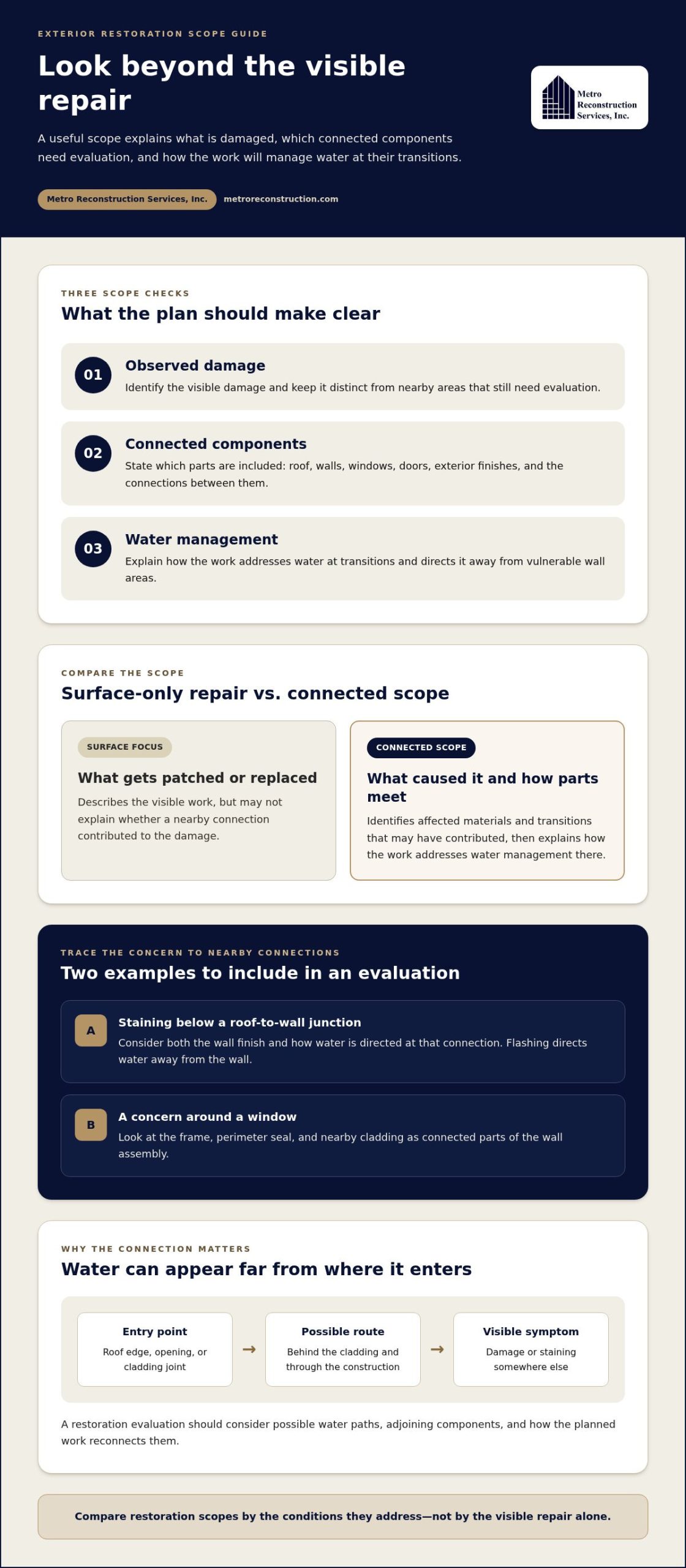
A surface repair describes what will be patched or replaced. A connected scope also identifies affected materials and transitions that may have contributed to the damage. Staining below a roof-to-wall junction, for example, calls for attention to the wall finish and how water is directed at that connection. A window concern may involve the frame, perimeter seal, and nearby cladding.
Before work begins, the scope should separate observed damage from related areas that need evaluation. It should state which exterior components are included and how the work addresses water management at their transitions. Metro Reconstruction considers these interacting components when planning exterior restoration services. This makes it easier to compare scopes by the conditions they address, rather than by the visible repair alone.
How a building-envelope approach connects exterior restoration work
A building envelope is the connected assembly of roof, walls, windows, doors, and exterior finishes that helps manage water and weather. These components meet at joints and edges, so a weakness at one transition can affect nearby materials. A useful restoration scope looks at the visible finish as well as the layers and connections behind it.
Exterior restoration should account for connected assemblies because water can enter at one point, move through the construction, and become visible somewhere else. That principle helps you assess a scope by how the parts work together, rather than by the appearance of one surface.
Where water management depends on connected components
At roof-to-wall transitions, flashing directs water away from the wall. Kick-out flashing is one example: it directs water away where a roof edge meets a wall. The appropriate detail depends on the specific roof and wall configuration, so it should be considered in relation to the assembly rather than applied as a generic specification.
Windows and doors interrupt the wall surface. Their frames, perimeter joints, flashing, and nearby cladding need to work together to direct water outward rather than into the wall. Behind the finish, a weather‑resistant barrier is a protective membrane that helps limit water intrusion into the underlying construction. Building paper is one type of moisture-resistant layer installed behind some exterior finishes. Neither layer replaces careful detailing at openings and transitions. Each is part of a larger system.
If water reaches materials behind cladding, the visible symptom may be far from the entry point. A restoration evaluation should consider where water could travel, the condition of adjoining components, and how the planned work reconnects them.
How material choices shape a restoration plan
Stucco, EIFS, fiber cement siding, masonry, and windows interact differently with a wall assembly. The right choice depends on the existing construction, project goals, and exposure. A replacement finish should be considered alongside the layers behind it and the way water drains at edges, openings, and roof junctions. Changing the material alone does not resolve a transition detail.
For stucco work, the condition of the finish and surrounding assembly can help determine whether restoration or replacement is appropriate. Metro Reconstruction’s stucco restoration guide discusses evaluating stucco as part of the property’s exterior system.
Metro Reconstruction plans exterior work with attention to how components connect, including moisture management around openings and wall finishes. Consider these connections when identifying the questions your restoration scope needs to answer.
How to compare exterior restoration contractor scopes without focusing only on appearance
A clear proposal explains what work is included and why it belongs in the project. Two scopes may describe the same visible repair but differ in how they evaluate related materials, water-management details, and coordination needs. When reviewing an exterior restoration contractor Front Range project scope, look for a clear connection between observed conditions and proposed work, not just a list of finishes to replace.
What a well-defined exterior project scope addresses
A useful scope identifies affected components, describes how they relate to the repair, and states what work is included. If a concern appears near a window, for example, the scope might account for adjacent siding or stucco and the joint around the opening. Flashing, a weather-resistant barrier, or moisture mitigation may be relevant, depending on the assembly and observed conditions. These details should respond to the project, not appear as generic specifications.
Use this comparison framework to distinguish surface-focused work from a scope that considers connected parts:
Diagnosis
A surface-focused scope: Names the visible defect and describes the finish repair.
A connected scope: Relates the visible condition to affected materials and identifies connections that may need evaluation.
Connected components
A surface-focused scope: Centers on the damaged siding, stucco, or other finish.
A connected scope: Considers adjoining areas such as openings, flashing, and the layers behind the exterior finish where relevant.
Coordination
A surface-focused scope: Describes the immediate construction task.
A connected scope: Clarifies how design, permitting, inspections, and construction fit together when needed.
Durability
A surface-focused scope: Describes the new or repaired appearance.
A connected scope: Explains how material choices and water-management details relate to the existing assembly and exposure.
The goal is not to make every restoration project larger. It is to make the boundaries of the work clear, including what the proposed work addresses and which related components are part of the plan.
When restoration may involve more than one exterior service
Some conditions involve more than one type of work. Stucco restoration alongside window work can involve the finish, the window perimeter, and how those elements meet. Siding replacement with moisture mitigation may require attention to materials behind the siding and the path water takes around openings. These examples show how related services can be coordinated. They do not mean every project needs each task.
Metro Reconstruction coordinates design, permitting, inspections, and construction for exterior projects, with the scope shaped around the property’s conditions. Consider how related work fits together when defining your project needs.
How to prepare for exterior restoration in Boulder, Denver, and nearby Front Range communities
A focused project discussion starts with useful observations, not a homeowner’s diagnosis. Before speaking with an exterior restoration contractor Front Range property owners can work with, record what you see and where it appears. Clear notes help identify the relevant parts of the property while leaving the cause of hidden damage to a proper evaluation.
Information to gather before discussing the project
Use this sequence to organize what you know before a project discussion:
- Mark the location. Note which side of the property is affected and where you see a change, such as a wall below a roof edge or around a window.
- Name the visible material. Record whether the affected surface appears to be stucco, siding, masonry, a window, a deck, or another exterior component. If you are unsure, describe what you can see instead of guessing.
- Record when you first noticed it. Note an approximate date or season and whether the condition has changed. Do not assume a weather event caused it unless you know that connection.
- Gather helpful records. Collect available project documents, permits, product information, or photographs. Older images may help show how the condition has changed.
Keep your notes factual. A crack, stain, loose finish, or draft is an observation, not proof of a particular hidden failure. Avoid probing or removing materials to investigate on your own. Share what you have noticed so the project evaluation can determine whether related areas need closer review.
Planning around local requirements and property conditions
Building requirements can vary by city or county, and applicable rules depend on the property’s location and project scope. Boulder, Denver, and nearby communities may follow different code editions or local amendments. Do not assume that a requirement for one municipality applies in another, or that the same rules govern every type of exterior work.
Metro Reconstruction coordinates design, permitting, inspections, and construction as part of a project. Planning around the property’s location helps identify the local requirements and review steps to consider, while coordination among project participants keeps the planned work aligned. For Boulder-area projects, Boulder construction services are relevant to restoration planning in the community.
Bring your notes and records to the conversation. They provide a practical starting point without presuming what is behind the exterior finish. Metro Reconstruction serves communities including Parker, Morrison, Boulder, Longmont, Niwot, Evergreen, Cherry Creek, Cherry Hills Village, Golden, Genesee, Littleton, Broomfield, Denver, Silverthorn, Breckenridge, Vail, and Larkspur, as well as Colorado mountain communities.
Plan your Front Range exterior restoration project with Metro Reconstruction
Choosing an exterior restoration contractor Front Range property owners can rely on means finding a team that can relate observed damage to the proposed work. Metro Reconstruction is a family-owned Colorado contractor with over 40 years of experience and family ownership spanning four generations. Its project approach considers how exterior materials and their connections work together, so restoration planning can respond to the property rather than treat each surface as an isolated task.
A coordinated approach to exterior remodeling and restoration
Stucco or EIFS installation, replacement, and repair; masonry work; window and door installation or replacement; siding; deck construction and hardening; and moisture mitigation may involve different parts of a property. Where work meets at a window opening, roof edge, or wall transition, the scope should account for those connections when relevant. Coordination helps keep material choices and water-management details aligned with the existing assembly and project goals.
Metro Reconstruction can coordinate design, permitting, inspections, and construction as project stages. The specific scope depends on the property and planned work. A stucco project, for instance, may need to account for adjoining windows and wall details, while siding work may relate to moisture conditions behind the finish. Each property needs its own evaluation; one example does not mean every project needs the same combination of services.
Metro Reconstruction’s exterior remodeling and restoration work includes stucco and EIFS, masonry, windows and doors, siding, decks, moisture mitigation, and waterproofing. Coordinating related work can clarify what is included, which components meet, and how repairs fit together. The scope should reflect the property’s actual conditions, rather than assume one material or repair approach suits every building.
Discuss your property’s restoration needs
Before starting a project conversation, gather your observations: where changes appear, which materials are affected, and when you first noticed them. Existing photographs or project documents can provide useful context. These details help focus the discussion while keeping diagnosis separate from what is visible at the surface.
Metro Reconstruction serves Front Range and Colorado mountain communities. Whether your property is in Denver, Boulder, or a nearby community, a project discussion can help organize the exterior concerns and planning steps. Bring the locations and materials you have noted, along with questions about how related work may fit into the restoration scope.
Ready to discuss your property? Contact Metro Reconstruction or call 303.543.9549.
Take the next step toward a well-planned restoration
A durable restoration plan starts with a clear project discussion. Consider what you want the work to address, how the affected areas relate to the rest of the exterior, and what you need to understand before moving forward. This gives your exterior restoration contractor Front Range project a practical starting point: a defined concern, a thoughtful evaluation, and a scope shaped around the property.
Metro Reconstruction brings a building-envelope perspective to exterior restoration across the Colorado Front Range and mountain communities. The aim is to identify work that fits the property’s conditions and plan with connected components in mind. You do not need to resolve every technical question before beginning. Start with what you have observed and what you want to protect.
Take the next step. Contact Metro Reconstruction to discuss your Front Range exterior restoration project, or call 303.543.9549.
Frequently Asked Questions
What does an exterior restoration contractor do?
An exterior restoration contractor evaluates and plans work on a property’s outer materials and features. Depending on the project, that work can include stucco or EIFS, masonry, siding, windows and doors, decks, and moisture mitigation. The contractor you choose should define the work around observed conditions and the connections between affected components, rather than assume every issue has the same repair.
How do I know whether exterior damage involves more than one building component?
A broader evaluation may be useful if a concern appears in several areas, returns after a repair, or occurs near a transition between materials. Peeling finish near a deck connection, for example, may call for looking at the adjoining wall as well as the deck surface. These signs do not prove a hidden defect. Record what you observe and where, then have the assembly evaluated before settling on a repair scope.
Can stucco, siding, and window work be coordinated in one restoration project?
Yes. A project can coordinate stucco, siding, and window work when the property’s conditions and planned scope call for them together. Replacing a window beside stucco, for example, may involve planning how the new frame meets the surrounding finish. The scope should state which materials are included and how their edges will be addressed. Combining services is a project-planning choice, not a requirement for every restoration.
Does an exterior restoration project need permits in Colorado?
Permit requirements depend on the project and jurisdiction. Colorado cities and counties have their own building requirements, so the review needed can differ between Boulder, Denver, and nearby communities. The work’s scope may also affect which approvals and inspections apply. Project planning should account for the requirements relevant to the property and proposed work.
What happens if a contractor finds additional exterior damage during restoration?
Newly exposed conditions can affect what work is appropriate, particularly if underlying materials are damaged. The condition should be documented and explained, including how it relates to the original scope. Before additional work proceeds, clarify what has changed, which components are involved, and whether the revised plan affects coordination or required approvals. That gives you a clear basis for deciding how to address the newly visible condition.
Can exterior restoration include wildfire-resistant upgrades?
Yes. Exterior restoration can be planned alongside wildfire prevention construction or home-hardening work when it fits the property and project goals. Options include fire-resistant siding systems and deck hardening. Appropriate measures depend on the building, its location, and the project scope. If your home is in an area with wildfire exposure, include that concern in the project discussion so it can inform the work plan.
Does Metro Reconstruction serve communities outside Boulder?
Yes. Metro Reconstruction serves Front Range and Colorado mountain communities beyond Boulder. Communities served include Denver, Parker, Longmont, Golden, Evergreen, and Littleton, as well as mountain locations such as Breckenridge, Silverthorne, and Vail. The company also serves Parker, Morrison, Niwot, Cherry Creek, Cherry Hills Village, Genesee, Broomfield, Silverthorn, and Larkspur. You can start a restoration discussion by sharing your property’s location and the exterior concern.
How can I start an exterior restoration project with Metro Reconstruction?
Share the property location, the exterior areas you are concerned about, and what you have observed. Photos or existing project documents can add useful context, but you do not need to diagnose the cause before reaching out. Contact Metro Reconstruction or call 303.543.9549 to discuss a practical next step for your property.