
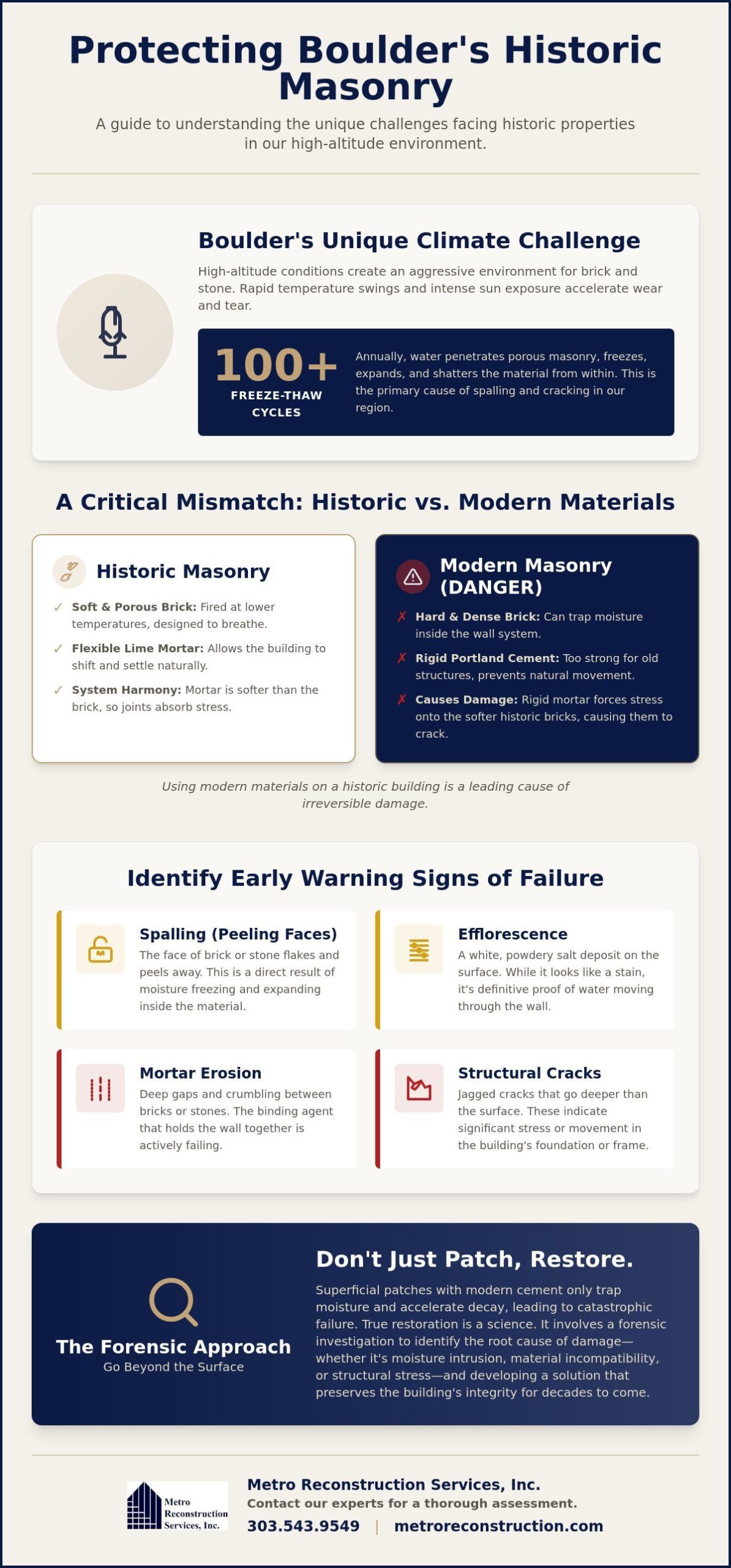
Did you know that Boulder’s unique high-altitude climate subjects your home to over 100 freeze-thaw cycles every single year? This constant environmental stress puts immense pressure on aging brick and stone, often leading to structural cracks that go much deeper than the surface. If you own one of the 1,300 designated historic properties in our community, you already know that historic masonry restoration Boulder requires a level of precision that goes beyond simple cosmetic repairs.
It’s natural to feel concerned when you notice crumbling mortar or shifting stones, especially when conflicting advice makes it hard to know which path to take. You want to preserve the historical value of your property while ensuring it stays safe and stable for decades to come. We understand this need for certainty and the desire to protect your significant investment by addressing the root cause of damage rather than just covering it up.
This article will show you how to identify specific signs of failure and apply professional forensic techniques tailored for the Boulder environment. We’ll also explore how the 2026 changes to historic preservation tax credits, including the new 12-month lookback period and expanded eligibility for buildings at least 30 years old, can help you achieve a beautiful, lasting restoration.
Key Takeaways
- Learn to recognize early warning signs of masonry failure, such as peeling brick faces or white salt deposits, which often point to underlying moisture movement.
- Discover why a forensic approach to historic masonry restoration Boulder is vital for identifying the root causes of structural damage rather than relying on temporary patches.
- Understand the relationship between your masonry and the building’s complete outer system, ensuring that elements like windows and foundations work together to protect your home.
- Navigate the 2026 updates to preservation tax credits and Boulder-specific regulations to ensure your project is both compliant and cost-effective.
- Protect your property investment by contacting our experts at 303.543.9549 or visiting our contact page for a thorough assessment.
What is Historic Masonry Restoration and Why Does it Matter?
Restoration is a specialized discipline that bridges the gap between past craftsmanship and future durability. In Boulder, this process ensures that our 1,300 designated landmarks remain structurally sound. Unlike a standard repair that might only address surface-level cracks, historic masonry restoration Boulder focuses on returning a structure to its original state while integrating modern stability enhancements. This approach protects the architectural heritage of our community, ensuring that the unique character of our historic districts isn’t lost to time or neglect.
Success in this field relies on understanding the principles of historic restoration, specifically the chemical and physical compatibility of materials. When we analyze a wall, we look at the breathability of the brick and the compression strength of the mortar. If a repair uses materials that are too dense or chemically reactive, it can trap moisture or cause the original masonry to crumble under pressure. Proactive restoration prevents these minor issues from evolving into catastrophic structural failures that threaten the building’s complete outer system.
Why Boulder’s Climate is Tough on Old Brick and Stone
Boulder’s environment is uniquely aggressive. We experience rapid temperature swings that force brick and stone to expand and contract multiple times in a single day. This movement stresses every joint. The local freeze-thaw cycle is particularly dangerous because it traps moisture inside porous bricks, where it expands as ice and shatters the material from within. High-altitude sun exposure also accelerates the degradation of older mortar binders, making regular forensic inspections essential for long-term protection.
The Difference Between Modern and Historic Masonry
Owners often assume modern materials are better because they’re stronger, but this is a dangerous misconception for historic properties. Older bricks were fired at lower temperatures, making them softer and more porous than today’s mass-produced versions. Similarly, historic mortar was designed to be flexible, allowing the building to move. Modern Portland cement is far too rigid. If applied to an old wall, it won’t give when the building shifts, causing the softer historic bricks to crack instead of the mortar joint.
Addressing these complexities requires a partner who understands the hidden mechanics of your property. If you’re concerned about the integrity of your exterior, our team provides specialized masonry work tailored to the Front Range. Contact us today at 303.543.9549 or visit our contact page to schedule a professional evaluation of your property’s structural health.
Identifying Common Signs of Masonry Deterioration
Recognizing the early indicators of decay is the first step in successful historic masonry restoration Boulder. When a building’s exterior begins to fail, it typically presents specific visual cues that signal a breakdown in the structural protection system. Understanding these symptoms allows property owners to intervene before a localized issue becomes a widespread failure that threatens the entire building envelope.
One of the most common sights is spalling, where the face of a brick or stone begins to flake or peel away. This occurs when moisture is trapped within the material and expands during freezing, eventually blowing out the surface. Another clear warning is efflorescence, a white, powdery salt deposit left behind as water evaporates from the masonry. While it might look like a simple stain, it’s actually proof of significant moisture movement through the wall. If left unaddressed, this water can erode the original binder, leading to mortar erosion where deep gaps appear between the stones. For those looking to understand the technical standards for repair, the National Park Service provides detailed guidance on Repointing Mortar Joints in Historic Masonry Buildings, which emphasizes the need for material compatibility. Cracking is perhaps the most alarming sign, particularly zig-zag patterns that follow the mortar joints. These often indicate that the building is responding to external pressures, such as shifting soil or foundation movement.
The Role of Moisture and Expansive Soils
Boulder’s geological profile includes clay-heavy soils that are notoriously expansive. When these soils absorb water, they exert immense lateral pressure on basement walls and foundations. This pressure can telegraph upward, causing masonry to crack or bulge. Additionally, failed gutters or poor site drainage can allow water to saturate the wall system from behind, rotting wood framing and destabilizing the brick facade. A forensic restoration begins by identifying this water source to ensure the fix actually lasts.
When to Call a Professional Specialist
Certain signs demand immediate action. If you notice a visible lean or a bulge in a brick facade, the structural integrity is likely compromised. Loose stones near rooflines or windows also represent a significant safety hazard. If you’ve attempted a patch before only to see the cracks return, it’s time for a forensic evaluation. Our team specializes in identifying these underlying structural origins to provide a permanent solution. Expert historic masonry restoration Boulder requires a partner who treats the building as a complete system. If you’ve spotted any of these warning signs on your property, call us at 303.543.9549 or visit our contact page to schedule a detailed assessment.
Essential Techniques for Professional Masonry Preservation
Once we identify the underlying structural origins of damage, the focus shifts to executing repairs that respect the building’s history while fortifying its future. High-quality historic masonry restoration Boulder relies on a forensic approach where every intervention is measured against the original construction methods. We don’t just patch holes; we restore the building’s complete outer system using techniques that prioritize long-term stability over quick cosmetic fixes.
Professional preservation involves several specialized processes designed to protect aging materials. Tuckpointing is perhaps the most critical, involving the careful removal of failing mortar and its replacement with a custom-blended material. When stones are too damaged to save, stone replacement becomes necessary. This requires sourcing and carving new material that matches the original’s texture, color, and density to ensure a seamless visual and structural fit. For those interested in the industry standards behind these methods, the historic masonry preservation guidelines provide an excellent foundation for understanding why these precise steps are required.
Beyond the surface, facade stabilization uses hidden anchors to reattach a masonry skin that has begun to pull away from the structural frame. This prevents the need for a full teardown while restoring the wall’s integrity. Finally, masonry cleaning must be handled with extreme care. We use gentle, non-abrasive methods to remove decades of environmental soot and dirt without damaging the delicate “fire skin” of the historic brick, which is essential for moisture resistance.
Tuckpointing with Historically Correct Mortar
The success of tuckpointing depends entirely on material compatibility. Our custom mortar mixes are engineered to match the original in color, strength, and breathability. If a contractor uses modern Portland cement on an old wall, the mortar becomes too rigid. Because the historic brick is softer, it can’t expand or contract against the hard cement, which leads to irreversible “spalling” damage where the brick faces literally pop off. Precision in tool use is equally vital to ensure we don’t nick or break the edges of these irreplaceable materials.
Structural Reinforcement and Facade Stabilization
Structural failure often begins with failed wall ties, which are the hidden metal connectors that hold the brick facade to the building’s skeleton. When these rust or snap, the wall can bulge or lean. We install specialized stainless steel anchors to secure the wall without changing its historic appearance. Additionally, we focus on reinforcing lintels—the horizontal supports over windows and doors—to prevent sagging that often leads to stone failure. If you suspect your home’s exterior is shifting, our masonry work specialists can provide a thorough diagnostic. Contact us at 303.543.9549 or visit our contact page to discuss your project.
Protecting Your Property’s Building Envelope and Foundation
Masonry is often viewed as a standalone feature, but it is actually a vital component of your building’s complete outer system. In the context of historic masonry restoration Boulder, we must look beyond the stones to understand how the entire envelope interacts. A failure in a window seal or a transition joint is rarely an isolated event. It often acts as a gateway for water to penetrate deep into the structure, where it can rot the wood framing hidden behind a brick facade. For additional technical insights on specific masonry features like window sills, visit Brick Tech Contracting Corp. When we approach a project, we treat the exterior as a unified shield rather than a collection of separate parts.
Foundation health serves as the literal base for all masonry longevity. If the foundation shifts due to moisture imbalance, the masonry above will inevitably crack. For property owners who require specialized concrete foundation or slab work, click here to find expert construction support. This is why our forensic approach identifies the underlying structural origins of damage before we begin any surface work. By ensuring the foundation is stable and the building envelope is secure, we provide a restoration that lasts for decades rather than just a few seasons.
Integrating Masonry with Stucco and Window Systems
The transitions where different materials meet, such as stone and stucco, are the most frequent points of water entry. Without proper integration, these seams become vulnerable to the Front Range’s intense weather. Our approach to stucco and masonry repairs focuses on creating a watertight seal that respects the movement of each material. Similarly, ensuring that a new window installation includes specialized flashing is critical for protecting the surrounding masonry. This holistic view of exterior home repair prevents the patchwork mentality that often leads to recurring damage.
Long-Term Moisture Mitigation Strategies
Effective historic masonry restoration Boulder requires moving water away from the structure proactively. If water is allowed to pool at the base of your walls, the resulting soil expansion and hydrostatic pressure will eventually crack even the finest stonework. We prioritize improving site drainage as a fundamental part of the restoration process. We also utilize breathable sealants that repel liquid rain while allowing internal water vapor to escape safely. Regular inspections of the entire building envelope allow us to catch minor issues before they compromise the foundation or the structural framing.
If you’re ready to secure your property’s future with a comprehensive restoration service, contact our team today. You can reach us at 303.543.9549 or visit our contact page to schedule a forensic evaluation of your building’s complete outer system.
Choosing a Specialized Partner for Boulder Restoration
Selecting a partner for your property’s preservation is a decision that affects the building’s longevity for the next several decades. In an environment as demanding as the Front Range, a general approach to masonry often leads to expensive rework. True historic masonry restoration Boulder requires a specialist who respects the original engineering of the structure while possessing the technical depth to solve modern environmental challenges. You need a partner who views themselves as a steward of your investment rather than just a service provider.
Professional project management serves as the foundation of a successful restoration. It ensures that communication remains clear and that every technical milestone is met with precision. When dealing with the complexities of landmarked properties, it’s essential to verify that your chosen firm understands design-build services. This integrated approach allows for a seamless transition from the initial diagnostic phase to the final stone placement, significantly reducing the risk of mid-project surprises that often plague historic renovations.
The Forensic Approach to Lasting Repairs
We believe in identifying the “why” of a failure before proposing the “how” for a fix. This forensic methodology prevents the common mistake of applying superficial, temporary patches that fail within a few seasons. By analyzing the building’s history and any previous, incompatible repairs, we avoid repeating past errors. Our focus remains on the building’s complete outer system, ensuring that every masonry joint and structural anchor works in harmony with the rest of the house. This initial accuracy is a foundational promise we make to every client.
Planning Your Project with Metro Reconstruction Services, Inc.
Our family-owned team brings over 40 years of local expertise to every project we undertake. We understand the specific nuances of Boulder’s historic districts and the unique stressors of our regional climate. To provide our clients with absolute peace of mind regarding their investment, Metro Reconstruction Services, Inc. offers fixed-price project fees. This transparency ensures that you can move forward with confidence, knowing exactly what to expect from your restoration. We’d rather explain the difficult truth of a structural failure now than offer a low-quality patch that won’t last.
If you’re concerned about the stability or historical value of your exterior, contact our construction company in Boulder for a detailed structural evaluation. Our team is ready to act as a dedicated partner in your property’s preservation. Call us today at 303.543.9549 or visit our contact page to begin protecting your historic investment.
Securing the Future of Boulder’s Architectural Heritage
Preserving a landmark requires more than just a visible fix; it demands a deep understanding of how aging brick and stone interact with our unique regional climate. By prioritizing forensic diagnostics, you ensure that the underlying structural origins of damage are addressed rather than simply hidden behind a patch. We’ve explored how material compatibility and a holistic view of the building’s complete outer system are the only ways to prevent recurring failures. Professional historic masonry restoration Boulder is an investment in both the safety and the story of your property.
Since 1982, our family-owned team has served as a dedicated partner in property preservation. With over 40 years of industry expertise in Boulder, we specialize in forensic structural diagnostics and building envelope protection. Protect your property’s legacy with a professional forensic evaluation. Contact Metro Reconstruction Services, Inc. today or call us at 303.543.9549 to discuss your historic restoration needs. Your home’s unique character is a legacy worth protecting for the next generation.
Frequently Asked Questions
How do I know if my historic masonry needs restoration or just a simple cleaning?
Restoration is necessary when the physical bond between your building’s materials has failed. While cleaning removes environmental soot and dirt, restoration addresses crumbling mortar joints, loose stones, or cracks that compromise the building’s complete outer system. If you see deep gaps or shifting masonry, a simple wash won’t solve the underlying structural issues.
Can I use modern cement to repair the brick on my 100-year-old Boulder home?
Using modern Portland cement on historic structures is a common mistake that leads to irreversible damage. Historic bricks are softer and more porous, requiring a flexible, lime-based mortar that allows for natural movement. Rigid modern cement traps moisture and forces the older bricks to crack or shatter when the building shifts.
Why are the bricks on my house flaking or peeling off?
Flaking bricks are a symptom of spalling, which occurs when trapped moisture expands during Boulder’s frequent freeze-thaw cycles. This often happens because a previous repair used non-breathable sealants or incompatible, hard mortar. Identifying the moisture source is the first step in any historic masonry restoration Boulder project to prevent further decay.
How much does historic masonry restoration typically cost in Boulder?
Project costs depend on the extent of the structural damage and the rarity of the replacement materials required. While every landmark is unique, property owners in 2026 can often offset expenses through state tax credits, which now include buildings as young as 30 years old. A professional forensic evaluation is the only way to get an accurate scope for your specific property.
How long does a professional tuckpointing job usually last?
A high-quality tuckpointing job can last between 25 and 50 years when executed with historically correct materials. Longevity depends on maintaining proper site drainage and ensuring that the building envelope remains watertight. We focus on initial accuracy during the installation phase to ensure our repairs stand the test of time against Colorado’s harsh UV exposure.
Is masonry damage always a sign of a foundation problem?
Masonry damage can be caused by surface-level environmental stressors, but zig-zag cracks or visible bulges often indicate foundation movement. These patterns suggest that the clay-heavy soils around your home are putting lateral pressure on the structure. A forensic diagnostic identifies whether the origin of the crack is surface decay or a deeper structural failure that requires stabilization.
What is the best time of year to perform masonry restoration in Colorado?
The ideal window for masonry work in Colorado is typically between late April and October. Mortar requires consistent temperatures above freezing to cure properly and achieve its full design strength. Performing historic masonry restoration Boulder during the warmer months ensures the chemical bond between the new mortar and old brick is successful and durable.
If you have noticed signs of deterioration on your property, it is important to address them before they lead to more costly structural failures. Contact our team at 303.543.9549 or visit our contact page to schedule a professional evaluation of your home’s exterior system.