
Most homeowners in Boulder view a damp basement as a simple maintenance issue, but the real culprit is often the invisible pressure of the soil beneath their feet. You’ve likely felt that sinking feeling when you spot a new crack or smell mildew after a heavy Front Range rain. It’s frustrating to deal with recurring leaks, especially when you’re worried about the long-term stability of your home’s foundation against our region’s notorious expansive clay. Finding effective foundation drainage solutions Boulder property owners can rely on requires looking deeper than the surface. You deserve more than a quick patch that fails during the next spring thaw.
This guide shows you how to move past temporary fixes by using a forensic approach to identify the root causes of water intrusion. You’ll learn how to protect your property’s value and structural integrity for decades. We’ll explore how Boulder’s unique environment dictates specific drainage strategies, from analyzing the complete outer system of your home to choosing methods that handle the pressure of shifting ground. By understanding the relationship between your home and the local landscape, you can finally achieve the peace of mind that comes with a permanently dry, stable foundation.
Key Takeaways
- Understand how Boulder’s expansive clay soil impacts your foundation and why managing moisture is the key to preventing structural movement.
- Learn about forensic diagnostics that identify the true source of water intrusion so your foundation drainage solutions Boulder address the root cause.
- Compare interior and exterior drainage methods to find the most effective way to keep your basement dry and your foundation stable.
- Discover why the grading in the first five feet around your home is your most important defense against water damage.
- Explore how a holistic view of your home’s complete outer system ensures long-term preservation, and reach our team at 303.543.9549 or through our contact page.
Understanding Boulder’s Soil and Foundation Drainage Challenges
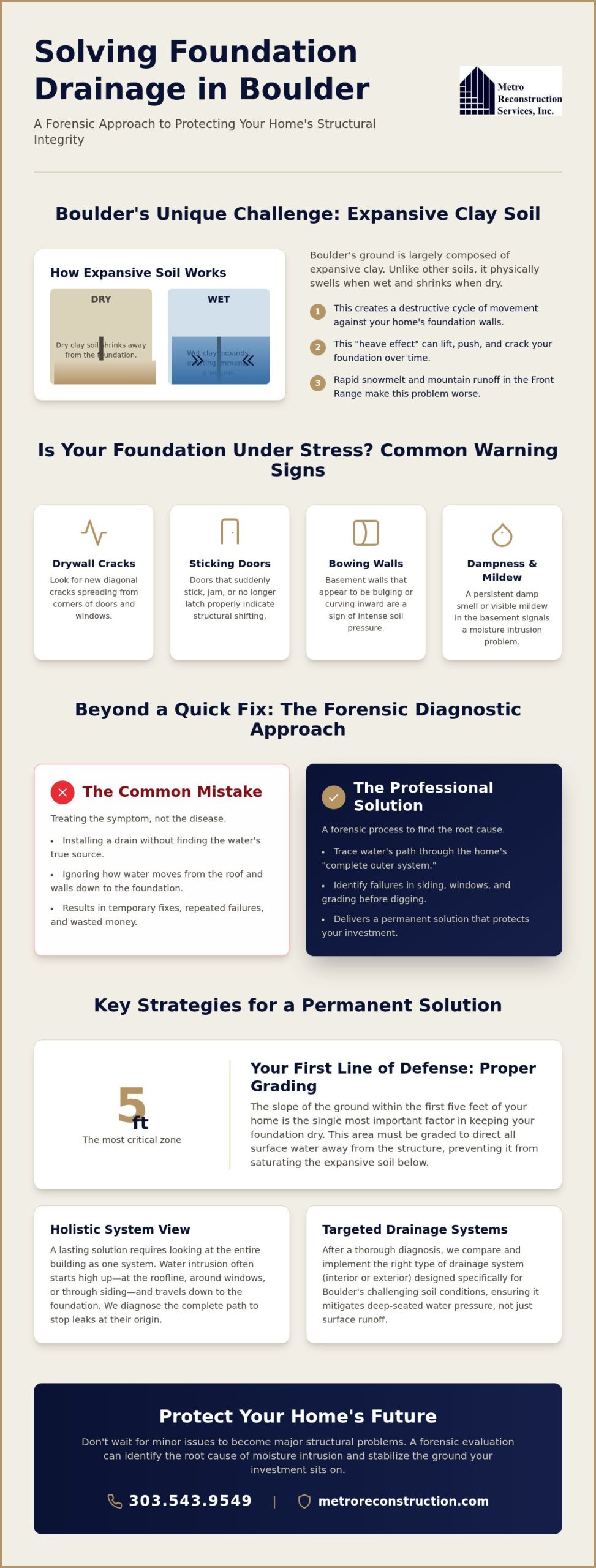
Boulder’s geological makeup presents a unique set of hurdles for property owners. The ground here is largely composed of expansive clay, a material that behaves quite differently than the sandy or loamy soils found in other parts of the country. When this clay encounters water, it doesn’t just get wet; it physically expands. This volume change creates immense pressure against foundation walls, often leading to structural movement that compromises the integrity of your home. Traditional methods often fail because they don’t account for this extreme soil behavior.
The Impact of Expansive Soils on Local Foundations
Clay particles are microscopic but have a massive surface area that attracts and holds water. As they absorb moisture, they exert lateral pressure, pushing inward on basement walls. This often results in a heave effect, where the soil literally lifts the foundation or pushes it out of alignment. While a basic French drain might manage surface water, it often lacks the capacity to mitigate the deep-seated pressure caused by saturated clay. In the Front Range, expansive soil behavior is defined by its ability to swell significantly when wet and shrink drastically when dry, creating a destructive cycle of movement.
This constant shifting is why many homeowners find themselves searching for permanent foundation drainage solutions Boulder experts can implement. Without a forensic approach to identify how water is entering the soil around your home, simple repairs are often temporary. True protection requires looking at the building’s complete outer system to ensure moisture stays away from the foundation footprint entirely. If you are noticing signs of movement, it is vital to address the root cause before the damage spreads.
Environmental Stressors Unique to the Front Range
Our local weather patterns exacerbate these soil issues. Rapid snowmelt cycles in the spring send high volumes of water into the ground in a very short time. This sudden influx often overwhelms basic systems that weren’t designed for the intensity of Colorado’s climate. Additionally, mountain runoff increases subterranean water pressure, forcing moisture through even the smallest gaps in your home’s exterior. Common signs of soil-related foundation stress in local properties include diagonal cracks in interior drywall, doors that suddenly stick, or bowing in basement walls.
Addressing these issues requires more than a superficial fix. It demands a professional understanding of how moisture interacts with your specific site. Investing in long-term moisture mitigation isn’t just about stopping a leak; it’s about stabilizing the ground your investment sits on. To protect your home’s structural integrity, we invite you to reach out for a professional evaluation through our contact page or by calling us directly at 303.543.9549. We are here to help you secure your property’s future.
Forensic Diagnostics: Identifying the Source of Water Intrusion
Many homeowners assume that a wet basement simply requires more pipe and gravel. However, installing foundation drainage solutions Boulder without first identifying the water’s point of origin is like treating a symptom without diagnosing the disease. Water doesn’t always come from where you see it pooling. It often travels complex paths through the building’s complete outer system, starting at the roofline or within the wall cavity before it ever reaches the foundation. A forensic diagnostic process eliminates the trial and error that often leads to repeated failures and wasted investment. For those already dealing with the aftermath of significant water intrusion, emergency specialists like Irish Fire And Flood Restoration provide the same level of precision in identifying and mitigating structural risks.
Tracing the Origins of Structural Moisture
Our methodology involves a close examination of how your home’s exterior elements interact. For instance, we look at where stucco or masonry transitions to the foundation. A small failure in the caulking around a window or a crack in the siding can allow water to track down the interior of a wall, eventually collecting at the floor. This can easily be mistaken for a ground-level seepage issue. It’s also vital to rule out hidden plumbing leaks before committing to major site work. Ensuring these systems are properly managed is required in accordance with IBC (International Building Code) to maintain structural integrity and safety.
By focusing on the underlying structural origins, we avoid the superficial fixes that fail when the next heavy rain arrives. We look for signs of moisture intrusion that others might miss, such as staining behind baseboards or subtle changes in the texture of your foundation walls. This thoroughness is a hallmark of our commitment to initial accuracy.
Tools and Techniques for Moisture Mapping
We utilize non-invasive moisture meters and thermal imaging to create a detailed map of moisture within the structure. Thermal imaging is particularly effective because it reveals temperature variations that signal the presence of trapped water behind finished surfaces. Beyond the walls, soil boring and site analysis help us understand the subterranean environment. We need to know if the pressure against your foundation is from surface water, which is often a grading issue, or from rising groundwater. Surface water is generally easier to redirect, while high groundwater levels require specialized drainage systems to relieve hydrostatic pressure.
This analytical depth is what separates a professional restoration from a temporary fix. If you are concerned about the stability of your home, our Foundation Repair Services in Boulder offer the forensic insight necessary to protect your investment. We believe in providing homeowners with the straightforward truth about their property’s condition. You can discuss your concerns with an expert by calling 303.543.9549 or by visiting our contact page.
Comparing Exterior and Interior Drainage Systems for Boulder Homes
Choosing the right foundation drainage solutions Boulder homeowners need involves weighing the benefits of stopping water before it touches the wall against the practicality of managing it once it enters. Hydrostatic pressure, which is simply the force of water in the saturated soil, is the primary driver behind foundation leaks in our region. This pressure builds as moisture accumulates, pushing against your basement walls with thousands of pounds of force. Effective drainage must relieve this pressure to prevent long-term structural damage.
Exterior Waterproofing and French Drains
The most comprehensive way to protect a home is by addressing the building’s complete outer system. This process requires excavating down to the foundation footing to install a waterproof barrier and a drainage system that intercepts water before it reaches the structure. By keeping the foundation dry, you eliminate the risk of the soil expansion and heave mentioned earlier. These exterior systems offer superior longevity because they prevent moisture from ever saturating the concrete walls. While this method involves more significant site work, it provides a permanent shield that safeguards your property value for decades.
Interior Drainage and Sump Pump Systems
In many established Boulder neighborhoods, mature landscaping or tight property lines make exterior excavation difficult. In these cases, interior sub-floor drainage is a highly effective alternative. These systems involve creating a channel around the inside perimeter of the basement to collect water that has breached the wall, directing it safely to a sump pump. This method is particularly useful for finished basements where you want to ensure the living space stays dry without disturbing the exterior yard. For crawlspaces, we often pair these drains with a high-quality vapor barrier to manage humidity and prevent wood rot.
Sump pump reliability is the heartbeat of any interior system. Because Boulder can experience sudden, heavy runoff from snowmelt, we recommend high-capacity pumps with battery backups to ensure your home remains protected even during power outages. If you’re unsure which approach fits your property’s specific needs, we can provide a detailed evaluation. You can reach our team at 303.543.9549 or visit our contact page to discuss your project. We’re here to help you find a solution that offers lasting peace of mind.
Grading and Moisture Mitigation: Beyond the French Drain
The first five feet of soil surrounding your home represent the most critical zone for structural preservation. While subterranean pipes are important, the way the surface ground is shaped determines how much water ever reaches the foundation in the first place. In Boulder’s environment, where expansive clay is prevalent, keeping this zone dry is the first step in any successful strategy for foundation drainage solutions Boulder properties require. When surface water is allowed to pool near the structure, it saturates the soil and puts unnecessary stress on the building’s complete outer system.
The Importance of Positive Grading
Positive grading is the intentional slope of the ground away from the foundation. It’s designed to use gravity to shed water before it can soak into the deeper soil layers. Over time, the soil used to fill the area around the foundation during original construction often settles, creating a “bowl” effect that traps moisture. This is known as negative grading. It’s particularly dangerous because it directs water toward the transition points where your stucco or masonry meets the foundation. For residential properties in Boulder, the ideal slope ratio is a drop of at least six inches over the first ten feet of distance from the house. Maintaining this slope is a foundational brand promise for long-term structural health.
Managing Roof Runoff and Surface Water
Roof runoff is often the largest source of concentrated moisture near a home. Dumping hundreds of gallons of water at the corners of your foundation through short downspout extensions is a primary cause of structural failure. We prefer to integrate gutter systems with underground solid-wall piping to discharge water far from the foundation footprint. This prevents the soil from becoming a heavy, expanding mass that pushes against your walls. Additionally, window wells require proper covers and dedicated drains. Without these, they act as collection points for snow and rain, leading to direct leaks into your basement.
A holistic approach to moisture mitigation ensures that every component, from the roofline to the soil grade, works together. You can learn more about these integrated strategies in our guide to Essential Exterior Home Repair in Boulder County. If you’ve noticed water pooling near your walls or your grading has settled over the years, it’s time for a professional evaluation. We’re dedicated to identifying the underlying structural origins of moisture issues rather than offering a temporary patch. Reach out to our specialists at 303.543.9549 or through our contact page to protect your investment today.
Long-Term Structural Mitigation with Metro Reconstruction
Since our founding circa 1982, Metro Reconstruction has focused on the complex relationship between a building’s exterior and its structural health. We understand that the foundation drainage solutions Boulder homeowners invest in must be more than a temporary barrier. They require a deep understanding of how moisture moves through every layer of a property. Our family-owned firm brings over 40 years of local experience to every project. We don’t just treat the visible damage; we identify the underlying structural origins that caused the failure in the first place. This forensic methodology ensures that the solutions we implement are as enduring as the homes they protect.
The Value of a Specialized Partner
Our expertise isn’t limited to what’s below the ground. Because we specialize in stucco restoration and masonry work, we have a unique perspective on how water interacts with the building’s complete outer system. A drainage system is only as effective as the moisture mitigation happening above it. We look at the transition points between your home’s siding and the foundation to ensure that water is directed away from the structure entirely. This engineering-led approach to restoration provides a level of precision that general contractors often overlook. It’s about creating a holistic shield that preserves your investment for the long term. You gain the peace of mind that comes from a solution designed by experts who understand the hidden mechanics of your home.
Starting Your Property Preservation Journey
Every project begins with a professional structural mitigation evaluation. We don’t believe in high-pressure sales tactics. Instead, we provide a quiet, authoritative assessment based on forensic diagnostics. We’re committed to transparent communication throughout the entire process. This includes providing fixed-price project fees so you know exactly what to expect before work begins. You can explore our comprehensive services to see how we address everything from foundation stabilization to exterior remodels.
Our goal is to be a dedicated partner in your property’s preservation. We take pride in our craftsmanship and the personalized project management that comes with being a local, family-run business. If you’re ready to secure your home’s future, we invite you to start the conversation. You can reach our experts directly at 303.543.9549 or visit our contact page to schedule your evaluation. Let’s ensure your foundation remains a stable, dry asset for decades to come.
Securing Your Home’s Structural Future
Preservation of a Boulder home requires more than a standard repair; it demands an understanding of how water interacts with our specific landscape. By identifying the underlying structural origins of moisture intrusion, you move beyond temporary fixes and toward permanent stability. Whether you choose exterior waterproofing or an interior drainage system, the goal remains a dry, protected environment that maintains your property’s value for the long term.
Implementing the right foundation drainage solutions Boulder homeowners trust is a significant step toward lasting peace of mind. It’s a protective choice. Our family-owned firm has provided specialized moisture intrusion and structural mitigation services since 1982. With over four decades of local industry expertise, we’re dedicated to being your partner in property preservation. We focus on the building’s complete outer system to ensure every detail is addressed with precision.
Protect your investment with a forensic structural evaluation. Contact Metro Reconstruction Services today or call us at 303.543.9549. You can rest easy knowing your home is in the hands of seasoned experts who value substance and integrity.
Frequently Asked Questions
What are the most common signs of poor foundation drainage in Boulder?
Common signs include diagonal cracks in drywall, doors that no longer close smoothly, and persistent musty odors in your crawlspace. You might also notice water pooling against the foundation or salt deposits on basement walls. These symptoms often signal that your existing foundation drainage solutions Boulder are failing to handle the pressure of saturated soil. Identifying these early markers allows for a forensic evaluation before minor moisture issues turn into major structural failures. If you are concerned that lingering dampness has led to mold issues, you can discover Floodsafe Restoration LLC for expert guidance on remediation.
How much does a professional foundation drainage system cost in Colorado?
Total project investment depends on several site-specific variables rather than a flat fee. Factors such as the depth of your foundation, the complexity of the soil composition, and whether you require interior or exterior excavation will influence the final scope. We provide fixed-price project fees based on a defined scope of work to ensure transparency. This removes the uncertainty often associated with structural repairs, allowing you to plan your property preservation with confidence.
Will a French drain solve my basement moisture problems permanently?
A French drain is a highly effective tool, but its permanence depends on whether it addresses the underlying source of the moisture. In our region, a drain alone may not be enough if the grading is poor or the building’s complete outer system is compromised. We focus on a forensic approach to ensure the drain is positioned correctly to intercept water before it reaches your foundation, providing a long-term solution rather than a temporary patch.
Do I need to excavate my yard to install a foundation drainage solution?
Excavation is not the only path to a dry home. While exterior waterproofing is a premium way to protect the foundation, interior sub-floor drainage systems are often a practical choice for established neighborhoods with mature landscaping. The decision depends on your specific goals and the foundation drainage solutions Boulder property owners prefer for their unique sites. A professional evaluation will determine which method best suits your home’s footprint while preserving your existing yard and gardens.
Can poor drainage affect my home’s stucco or exterior masonry?
Moisture trapped at the foundation level can migrate upward and damage your home’s stucco or masonry. When soil remains saturated, water can track into the wall cavity, causing the exterior finish to crack, bubble, or peel. Since we specialize in stucco restoration, we understand how these elements are connected. Protecting your foundation is a vital part of maintaining the integrity of your entire exterior remodeling investment and preventing costly surface repairs.
How does Boulder’s expansive soil impact the type of drain I need?
Boulder’s expansive clay soils swell significantly when wet, putting immense lateral pressure on your foundation walls. This requires a drainage system designed to quickly move water away before the soil has a chance to expand. Standard systems often fail here because they don’t account for the volume changes in the ground. You need a solution that relieves hydrostatic pressure and stabilizes the moisture levels in the soil to prevent the foundation from shifting or heaving.
What is the difference between a foundation drain and a yard drain?
A foundation drain is installed deep in the ground at the level of your footers to protect the structure itself from subterranean water. In contrast, a yard drain is a surface-level solution designed to manage rainwater or snowmelt across your lawn. While both are important, they serve different roles in a holistic moisture mitigation plan. A foundation drain is your last line of defense against basement leaks, while yard drains prevent water from pooling near the house.
How often should I inspect my home’s exterior drainage system?
We recommend a professional inspection of your home’s exterior drainage at least once a year, preferably in the spring before the heavy snowmelt begins. You should also check your gutters and downspout extensions after any major storm to ensure they are free of debris. Regular maintenance is a proactive way to protect your structural integrity. If you have concerns, reach us at 303.543.9549 or through our contact page for an evaluation.