
What if the choice between a traditional look and modern performance isn’t really about the finish at all, but about how your home actually breathes in the Colorado elements? Most homeowners feel caught between the classic appeal of cement and the high-tech promise of synthetic systems; they often worry that one wrong choice in the eifs vs stucco debate will lead to hidden rot or soaring heating costs. It’s a valid concern because an improperly integrated exterior can trap moisture against your home’s frame, leading to structural failures that aren’t visible until the damage is significant.
We understand that labels like “synthetic” or “traditional” often lead to more confusion than clarity for those trying to protect their investment. This guide will help you discover the critical differences between these systems so you can make a confident, long-term decision for your property’s structural integrity. We will examine the maintenance requirements, energy efficiency benefits, and moisture-proof capabilities of each professional option. By the end, you’ll see how a complete outer system approach ensures your home remains both beautiful and protected for decades to come.
Key Takeaways
- Learn the fundamental structural differences between cement-based finishes and multi-layered synthetic systems to identify the best fit for your property.
- Compare the insulation benefits and material flexibility of eifs vs stucco to understand how each handles Colorado’s intense temperature swings.
- Discover why a drainage-based moisture management system is the most reliable way to prevent hidden rot and protect your home’s structural integrity.
- Understand how local factors like high-altitude UV rays and rapid freeze-thaw cycles impact the long-term durability of your home’s complete outer system.
- Identify when a forensic diagnostic approach is needed to resolve underlying issues, and contact our team at 303.543.9549 or through our contact page for expert guidance.
Understanding the Basics: What Are EIFS and Stucco?
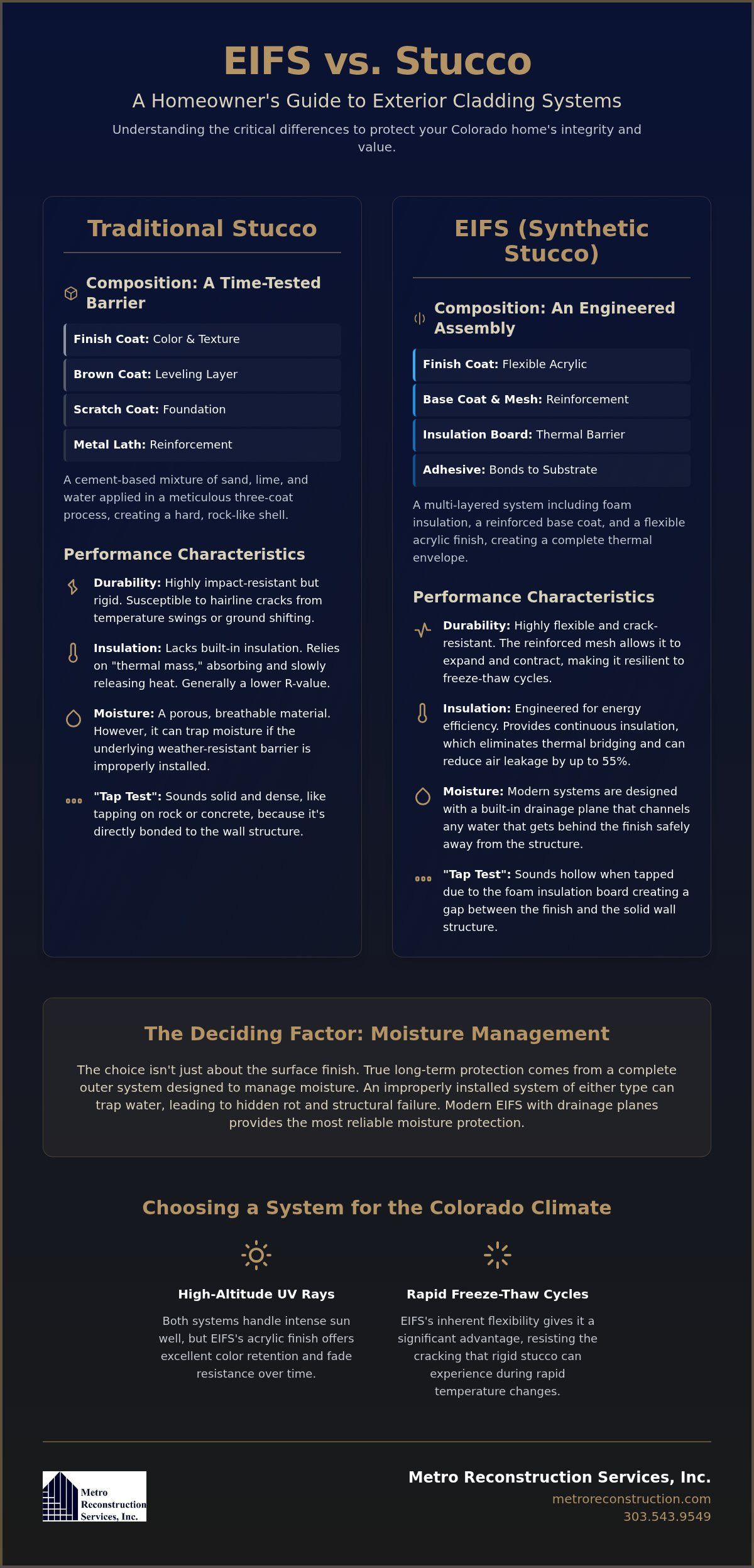
Choosing between eifs vs stucco requires looking past the surface finish to understand the underlying engineering of your home. Traditional stucco is essentially a thin layer of rock; it’s a cement-based cladding applied over a metal lath that creates a hard, durable shell. In contrast, EIFS (Exterior Insulation and Finish Systems) is a multi-layered synthetic cladding designed to wrap a building in a protective thermal envelope. While people often call EIFS “synthetic stucco” because they look similar from the street, their core materials aren’t the same. We view neither as a standalone product but as part of a complete outer system where every layer must work in harmony to prevent structural decay. Precision in the initial installation determines whether these systems protect the home or hide problems.
The Composition of Traditional Stucco
Traditional stucco relies on a time-tested mix of Portland cement, sand, lime, and water. This mixture is applied in a meticulous three-coat process: the scratch coat, the brown coat, and the final finish coat. The scratch coat provides the foundation, the brown coat levels the surface, and the finish coat adds the texture and color. Each layer serves a specific purpose, building a rigid barrier that is naturally fire-resistant and allows for a degree of breathability. Because it’s a masonry product, it handles the intense Colorado sun well. However, its rigidity means it relies heavily on a properly installed substrate to prevent cracking during our local temperature swings. It remains a heavy, solid choice for those prioritizing impact resistance and classic aesthetics.
The Layered Structure of EIFS
EIFS is an engineered assembly rather than a single material. It typically consists of a foam insulation board attached to the substrate, followed by a base coat reinforced with fiberglass mesh, and topped with a flexible acrylic finish. The insulation board acts as a thermal barrier, significantly reducing energy loss through the walls by eliminating thermal bridging. While early versions of this system faced scrutiny, modern EIFS installations include dedicated drainage planes. These pathways ensure that any moisture that finds its way behind the finish can escape safely, which is vital for maintaining the structural origins of the building. This flexibility allows the system to expand and contract without the surface cracking common in more rigid materials. It offers a sophisticated solution for modern energy requirements and architectural flexibility.
If you’re unsure which system currently protects your home, identifying the underlying structural origins is the first step toward long-term preservation. You can reach our team at 303.543.9549 or visit our contact page for a detailed evaluation of your exterior services needs.
Performance Comparison: Durability, Insulation, and Aesthetics
While both systems provide a professional finish, their performance characteristics vary significantly under the pressure of Colorado’s climate. Traditional stucco is a rigid masonry product. It offers high impact resistance but is susceptible to hairline cracks as the ground shifts or temperatures fluctuate. In the eifs vs stucco comparison, EIFS stands out for its flexibility. It uses a reinforced fiberglass mesh that allows for greater movement. This flexibility makes it highly resilient against the “freeze-thaw” cycles common in our region. If you aren’t sure which material is on your home, perform a simple “tap test.” Traditional stucco sounds solid, like stone, because it’s directly bonded to the wall. EIFS sounds hollow because of the foam insulation board behind the surface.
Energy Efficiency and Thermal Performance
Modern building systems allow for a wide range of aesthetic choices. Traditional stucco is best known for its hand-applied textures that range from smooth to heavy lace. It’s a classic look that fits perfectly with Southwestern or Mediterranean architecture. EIFS, however, provides unmatched design flexibility. Because the foam core is easily carved, we can create complex cornices, window trims, and decorative moldings that would be too heavy or expensive to execute in stone or cement. Modern acrylic finishes used in EIFS are also highly resistant to fading. This is vital under the intense UV radiation found at high altitudes in Boulder and Denver.
Ensuring your home’s exterior is performing at its peak requires a professional eye. You can reach our experts at 303.543.9549 to discuss your stucco restoration or EIFS replacement options. For a thorough evaluation of your property’s structural health, visit our contact page.
The Critical Difference: Moisture Management and Structural Protection
Moisture mitigation is the silent guardian of any property’s longevity. When analyzing the long-term health of eifs vs stucco, we prioritize the integrity of the drainage plane over the visual finish. Older exterior systems often relied on a “barrier” approach, where the surface itself was expected to be entirely waterproof. Modern engineering has shifted toward “drainage” systems. These designs acknowledge that water eventually finds a way past the outer skin; therefore, they provide a clear path for it to exit safely. We view the cladding as just one part of a complete outer system. Without proper flashing and high-quality caulking at every transition, even the most expensive materials will fail. Precision in these details is what prevents expensive structural decay.
Identifying common failure points is a forensic necessity for property preservation. Water typically enters through specific weak points in the building envelope:
- Window and door perimeters where sealant has degraded or was never applied.
- Kick-out flashing locations where rooflines meet vertical walls.
- Terminations near the ground or at deck attachments where the system isn’t properly sealed.
How Moisture Impacts Traditional Stucco
Traditional stucco is porous by nature. While it handles surface moisture well, hairline cracks can allow liquid to seep behind the cement shell. This is where the weather-resistive barrier (WRB) behind the metal lath becomes critical. If this barrier is torn or improperly lapped, moisture reaches the wooden structure and begins to cause rot. You might notice staining or white, powdery salt deposits known as efflorescence on the surface. These are not just aesthetic issues; they are signals that the underlying structural origins are being compromised by water. Proactive maintenance can often resolve these issues before they require a full restoration.
The Evolution of EIFS Drainage
The industry has learned significant lessons from early “face-sealed” EIFS installations that lacked an exit path for trapped water. Modern moisture-drainage EIFS incorporates specialized air and water barriers that protect the substrate while allowing internal moisture to escape. Most EIFS problems reported by homeowners actually stem from these early installation errors or a failure to maintain the complete outer system. Today’s specialized building systems are much more resilient when installed with forensic precision. We focus on identifying the source of intrusion rather than just patching the surface.
Preventative maintenance is the most cost-effective way to protect your investment. If you suspect moisture is trapped behind your exterior, call our team at 303.543.9549. We can perform a detailed diagnostic to identify the source of the issue before it requires a full replacement. You can also reach us through our contact page to schedule a professional evaluation.
Colorado Climate Factors: High Altitudes and Front Range Weather
Colorado’s environment places extreme demands on a building’s complete outer system. In the Front Range, we experience some of the highest UV indexes in the country. This intense radiation doesn’t just fade colors; it can actually break down the chemical bonds in lower-quality exterior finishes. When comparing eifs vs stucco for high-altitude properties, the quality of the finish coat determines how long your home maintains its protective shell. Beyond the sun, we face the relentless cycle of rapid temperature changes. A warm afternoon can quickly turn into a freezing night, forcing materials to expand and contract at a rate that would cause standard siding to fail. Precision in how these materials are applied is the only way to ensure they survive these stressors.
UV Resistance and Finish Longevity
High-altitude sun is significantly more aggressive than the light found at sea level. In Boulder and Denver, this exposure can cause certain synthetic finishes to become brittle or lose their bond over time. We recommend using high-quality acrylic polymers because they offer superior color retention and remain flexible under constant solar stress. If your home has mountain-facing walls, those surfaces should be inspected every few years to ensure the finish hasn’t begun to chalk or peel. Maintaining this top layer is the first line of defense in property preservation, as it prevents the underlying layers from being exposed to direct radiation.
Managing the Freeze-Thaw Cycle
The most destructive force in our region is the freeze-thaw cycle. When moisture finds its way into hairline cracks in traditional stucco, it stays there. Once the temperature drops, that water expands as it turns to ice. This internal pressure leads to spalling, where the surface of the cement begins to flake off and weaken. To prevent this, we emphasize the need for flexible caulking in all expansion joints to accommodate natural movement. This allows the system to breathe without breaking. We highly recommend annual exterior home repair checks to identify these small cracks before the winter months arrive.
Hail damage is another reality for Colorado homeowners. While traditional stucco is harder and more impact-resistant, large stones can still cause significant cracking. EIFS is softer and may dent, but its flexible mesh often prevents the substrate from being exposed. Additionally, for those in mountain communities, fire mitigation and prevention services are a vital part of your exterior strategy. Both systems are non-combustible, but they must be part of a correctly assembled, ignition-resistant wall to provide true safety against wildfires.
If your exterior shows signs of weather-related wear, don’t wait for the next storm to cause deeper structural issues. Call us at 303.543.9549 to schedule a professional assessment of your home’s integrity. You can also visit our contact page to learn more about our specialized construction services in Boulder.
Choosing Your Solution: Restoration and Replacement Strategies
Selecting between eifs vs stucco for your property isn’t a decision that should be made based on aesthetics alone. We utilize a forensic diagnostic approach to look past the surface and understand the underlying structural origins of any current issues. This allows us to determine whether your complete outer system requires a simple refresh or a comprehensive overhaul. Precision in this initial assessment is what prevents you from spending money on a temporary patch that fails to address the root cause of moisture intrusion. We focus on the long-term health of the building, ensuring that any solution we provide acts as a permanent shield against the Colorado elements.
When to Consider Stucco Restoration
If your exterior system is structurally sound but shows signs of surface-level cracking, staining, or fading, stucco restoration is often the most sensible path. This process involves a meticulous cleaning, patching minor imperfections with compatible materials, and applying a high-quality finish coat. Restoration is a proactive maintenance strategy that preserves the original architectural integrity of your home while refreshing its appearance. It’s an ideal choice for properties where the moisture barrier remains intact, allowing us to focus on extending the life of the existing cladding without the disruption of a full replacement.
The Case for EIFS Replacement
In scenarios where forensic testing reveals that moisture has already compromised the underlying substrate or insulation, full removal and replacement become a necessity. Continuing to patch a system with internal rot only hides the damage while the structural frame continues to degrade. Upgrading to a modern drainage EIFS system provides a sophisticated solution that significantly improves energy efficiency. We emphasize initial accuracy during the replacement process, ensuring that every flashing detail and seal is perfect. This engineering-led approach saves you money on future repairs by creating a moisture-proof barrier that is specifically designed for the Front Range’s demanding climate.
Selecting the right reconstruction partner is the final step in securing your home’s future. We recommend using this checklist during your search:
- Verify at least twenty years of specialized experience in moisture mitigation and structural protection.
- Ensure the company uses a forensic approach to identify underlying issues rather than offering low-cost, superficial fixes.
- Confirm they have deep knowledge of local Colorado environmental stressors, such as high-altitude UV and freeze-thaw cycles.
- Look for a partner who views the cladding as part of a complete outer system, including windows, decks, and roof transitions.
Protecting your home’s structural integrity starts with a reliable diagnostic from a seasoned expert. You can reach our specialists at 303.543.9549 to discuss the specific needs of your property. For a professional evaluation of your home’s exterior systems, please visit our contact page.
Protecting Your Property with Forensic Precision
Choosing between eifs vs stucco isn’t just about the visual appeal; it’s a strategic decision for your home’s structural health. As we’ve explored, the Front Range environment demands a complete outer system that integrates drainage planes, proper flashing, and high-quality finishes. Our forensic approach allows us to see beyond the surface, identifying the structural origins of failure to provide a lasting solution. With over 40 years of local experience, Metro Reconstruction Services, Inc. remains committed to the integrity and craftsmanship required for these complex building systems.
Ready to protect your investment? Contact Metro Reconstruction Services, Inc. today for a professional evaluation of your home’s exterior. You can also reach our team at 303.543.9549 to discuss your restoration or replacement options. We prioritize substance over superficial fixes, offering the peace of mind that comes from true property preservation. Your home is a significant asset, and it deserves a protective shell that is built to last.
Frequently Asked Questions
Is EIFS the same thing as synthetic stucco?
Yes, EIFS is the technical name for what most homeowners call synthetic stucco. While they appear identical on the surface, they are distinct systems. EIFS is a multi-layered assembly that includes a foam insulation board, a base coat with mesh, and a flexible finish. Traditional stucco is a cement-based masonry product. Knowing the difference in the eifs vs stucco comparison helps you understand how your home manages energy and moisture.
Does EIFS cause mold and rot in homes?
EIFS does not inherently cause mold or rot; rather, these issues stem from improper installation or a lack of a drainage plane. Early face-sealed systems trapped moisture behind the foam, leading to structural decay. Modern systems include a dedicated path for water to escape. We use a forensic approach to identify these underlying structural origins, ensuring your complete outer system is moisture-proof and protects your home’s frame from internal water damage.
Which is more expensive to install, stucco or EIFS?
Which is more expensive to install, stucco or EIFS?
Yes, you can transition between these materials, but it requires a thorough evaluation of your home’s current substrate. Because traditional stucco is much heavier than EIFS, we must ensure your walls can support the additional weight. This process involves removing the existing synthetic layers and installing a new weather-resistive barrier and metal lath foundation. It’s a complex project that benefits from the precision and local expertise of a seasoned reconstruction partner.
How do I know if my stucco has moisture damage behind it?
Signs of hidden moisture damage include dark staining, bubbling paint, or white powdery deposits known as efflorescence. You might also notice a musty smell or soft spots when pressing on the wall surface. If you see these indicators, it’s vital to act quickly. You can reach our experts at 303.543.9549 for a professional diagnostic to locate the source of the leak before it compromises your home’s structural integrity.
Does EIFS require special insurance in Colorado?
Some insurance providers in Colorado have specific guidelines regarding EIFS due to historical installation failures in the industry. While modern drainage systems are highly reliable, some insurers may ask for an inspection or exclude certain types of water damage coverage. We recommend speaking with your agent to confirm your policy details. Providing proof of a professional installation or a recent forensic evaluation can often help in securing the necessary coverage for your property.
How long do EIFS and traditional stucco systems typically last?
Both systems are designed to last for the life of the building, often exceeding fifty years when maintained correctly. The longevity of your exterior depends on the initial accuracy of the installation and regular upkeep of sealants and flashing. In our demanding climate, annual checks of the complete outer system are essential to prevent small cracks from turning into major failures. Proactive care is the most effective way to ensure your investment remains protected.
Can traditional stucco be applied over foam insulation?
Traditional cement-based stucco is not typically applied directly over the foam boards used in EIFS. It requires a rigid substrate and a metal lath for proper bonding and structural strength. If you desire the insulation benefits of foam with a stucco-like finish, a modern EIFS drainage system is the appropriate choice. Attempting to mix these systems incorrectly can lead to surface cracking and bond failure. Always consult a specialist to ensure material compatibility through our contact page.