
Think of your home’s exterior not just as a finish, but as a protective envelope that must function perfectly to keep the Colorado elements at bay. For many Denver homeowners, an Exterior Insulation and Finish System (EIFS) acts like a layer of plastic wrap that, while energy efficient, can trap moisture against your structural framing if the seals fail. Understanding how to tell if your EIFS has water damage is the first step in protecting your largest investment from the silent rot that often hides behind a seemingly perfect surface. You shouldn’t have to guess whether a small crack is a cosmetic blemish or a sign of an underlying system failure.
It’s completely natural to feel a sense of anxiety when the snow melts or the spring rains hit, especially when you aren’t sure if your cladding is traditional masonry or a synthetic alternative. In this guide, you’ll learn to identify the subtle, forensic warning signs of moisture intrusion before they compromise your home’s safety. We will explore the critical differences between a superficial patch and a true structural restoration; this knowledge ensures you have the clarity needed to maintain your building’s complete outer system with confidence.
Key Takeaways
- Recognize how synthetic stucco can act like a seal that traps moisture, making it essential to evaluate your home’s complete outer system.
- Identify external warning signs such as dark staining near windows or finish separation that often point to underlying structural concerns.
- Master how to tell if your EIFS has water damage by looking for indirect clues like musty odors, even if your indoor drywall looks perfect.
- Understand why forensic moisture testing is necessary to find hidden “hot spots” that a standard visual home inspection will likely miss.
- Learn to prioritize long-term restoration over superficial caulking to ensure your home remains safe and structurally sound through Colorado’s seasons.
Understanding EIFS: Why Water Damage Stays Hidden
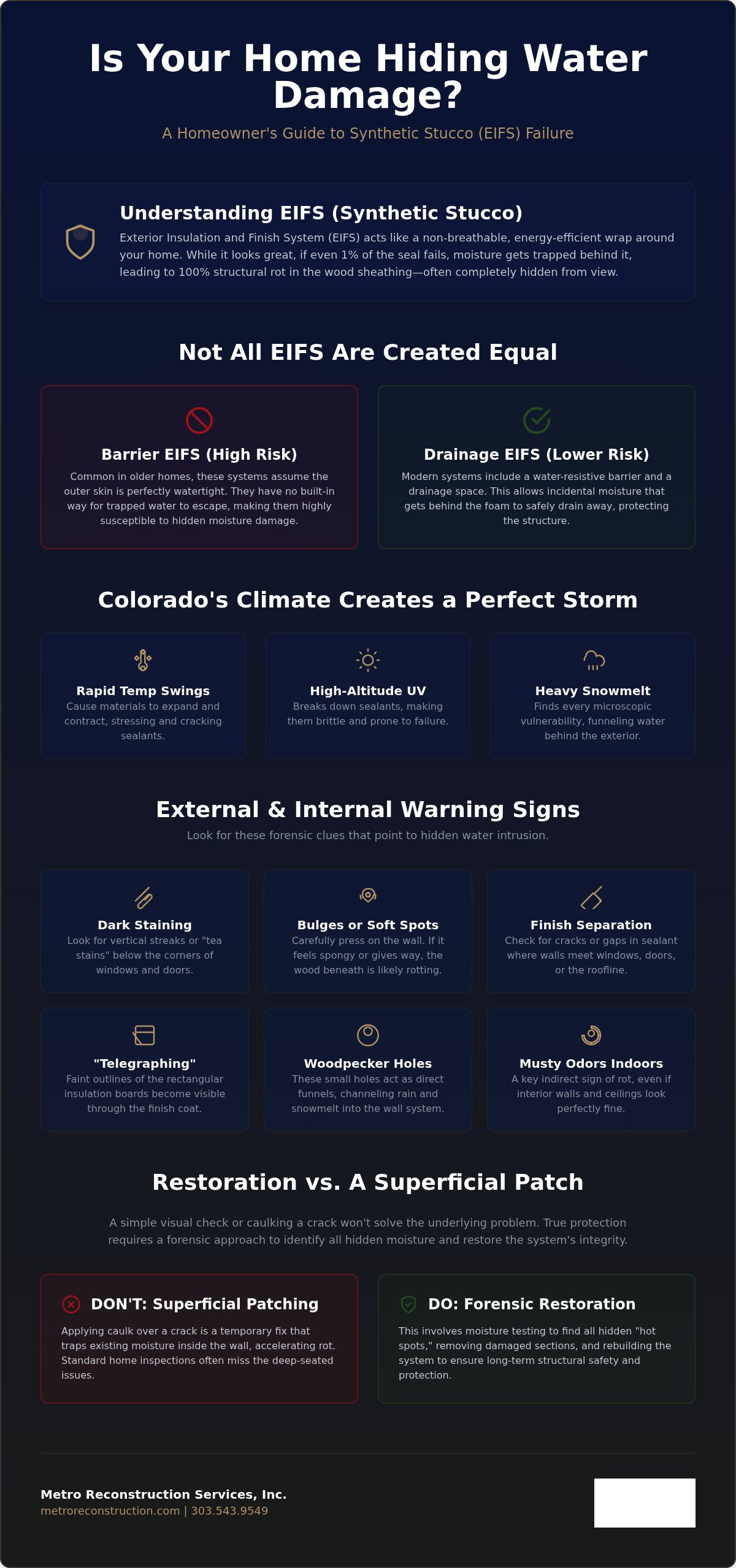
EIFS, or Exterior Insulation and Finish Systems, is often referred to as synthetic stucco. It’s a sophisticated, multi-layered cladding designed to provide excellent insulation and a modern aesthetic. Unlike traditional stucco, which is made of cement and naturally allows moisture vapor to pass through its pores, EIFS is a resin-based system. It acts like a layer of plastic wrap around your home. This non-permeable nature is excellent for energy efficiency, but it creates a high-stakes environment for your structural framing. If water finds a way behind this synthetic skin, it becomes trapped. There’s no breathability to allow for evaporation. Even a 1% failure in the seal around a window or a roofline can lead to 100% structural rot in the wood sheathing below. Learning how to tell if your EIFS has water damage requires moving past surface aesthetics to understand the hidden mechanics of the system.
Barrier Systems vs. Drainage Systems
The risk to your home often depends on when it was built. Older “Barrier” EIFS was designed on the assumption that the outer skin would remain perfectly watertight forever. These systems have no internal “exit strategy” for moisture. If a seal fails, the water stays. Modern “Drainage” EIFS, which became more common in the late 1990s and early 2000s, includes a water-resistive barrier and a small drainage space behind the foam. This allows incidental moisture to escape. Identifying which system your Denver home uses is a critical first step in our forensic diagnostic process. We look at the building’s complete outer system to determine if it has the necessary components to manage moisture effectively.
The Role of Colorado’s Climate in EIFS Failure
Our regional weather creates a perfect storm for EIFS problems. In the Denver and Boulder area, we experience rapid temperature swings that can move forty degrees in a single afternoon. These cycles cause the EIFS panels and the underlying structure to expand and contract at different rates, which puts immense stress on the caulking and sealants. Intense high-altitude UV radiation also plays a role. Over time, the sun breaks down the flexibility of the sealants, making them brittle and prone to cracking. When heavy snow piles up against your walls or sits on window sills, the resulting snowmelt finds every microscopic vulnerability. This moisture is the primary catalyst for the hidden rot we often find during our restoration services.
If you suspect your home’s exterior is failing or want to ensure your investment is protected, contact the experts at Metro Reconstruction Services, Inc. at contact us or call us directly at 303.543.9549.
External Red Flags: Identifying Visual Signs of Intrusion
While the synthetic nature of EIFS makes it durable, it also requires a keen eye to spot the early indicators of failure. Identifying these visual cues is the primary way to understand how to tell if your EIFS has water damage before the rot reaches your home’s structural framing. Because this material doesn’t show damage in the same way as wood or brick, you must look for the forensic evidence left behind by moisture. Often, the most telling signs are found where the system is most vulnerable: at the edges, transitions, and penetrations of the building’s complete outer system.
Staining and “telegraphing” are two of the most common red flags. If you notice dark, vertical streaks below the corners of windows or doors, it often indicates that water is bypassing the sealant and running behind the finish coat. Telegraphing occurs when the outlines of the rectangular insulation boards become visible through the finish, suggesting that moisture is affecting the bond between the layers. Another critical test is the “soft spot” check. By applying firm but careful pressure to areas near the ground or around windows, you can feel for a lack of resistance. If the wall feels spongy or gives under your hand, the wood substrate beneath has likely already begun to soften.
In our local environment, woodpecker holes are more than just a nuisance; they are a direct gateway for moisture. These birds easily peck through the thin finish coat to reach the foam insulation, creating a direct path for snowmelt and rain to enter the system. Once water gets inside these holes, it becomes trapped against the wood sheathing. If you see this type of avian damage, it is vital to seek professional stucco restoration to seal the breach before the damage spreads.
Critical Inspection Points: Flashings and Sealants
Denver’s extreme freeze-thaw cycles put immense pressure on expansion joints and sealants. When the temperature swings forty degrees in a day, the materials expand and contract, often causing the caulking around windows to detach or dry out. You should specifically inspect the kick-out flashings where your roofline meets an EIFS wall. If these metal diverters are missing or improperly installed, water will be directed straight into the wall system. Transitions where EIFS meets different materials, such as brick or stone, are also high-risk zones that require perfectly intact seals to prevent intrusion.
Bulging and Texture Changes
Visible changes in the texture of your walls often signal a deeper problem. Bubbling or “blistering” in the finish coat usually means that water vapor is trapped and trying to escape, causing the resin-based coating to pull away from the foam. You should also look for vertical cracks. While hairline cracks might be cosmetic, wider breaches are often the clearest indicator of how to tell if your EIFS has water damage that has reached the structural level. These aren’t just surface issues; they are indicators of a system that is no longer protecting your investment.
If you’ve noticed any of these warning signs on your home, don’t wait for the damage to worsen. Contact Metro Reconstruction Services, Inc. at contact us or call us at 303.543.9549 to discuss a professional evaluation.
Interior and Indirect Signs of Hidden Moisture
One of the most deceptive aspects of synthetic stucco is its ability to hide severe structural decay behind a pristine facade. You might look at your living room walls and see no evidence of a problem, yet the wooden studs and sheathing just inches away could be saturated. This happens because the EIFS layers act as a barrier that prevents water from evaporating outward, while the interior vapor barrier often prevents that same moisture from reaching your drywall. Understanding how to tell if your EIFS has water damage requires you to look for indirect clues that signal a breach in the building’s complete outer system.
Monitoring Interior Wall Finishes
While drywall is designed to stay dry, extreme or long-term moisture intrusion will eventually leave a mark. Look closely at the paint or wallpaper on your exterior-facing walls. If you see subtle bubbling, peeling, or “ghosting,” which appears as faint, dark stains that don’t have a clear liquid source, you are likely seeing the result of moisture vapor trying to escape the wall cavity. Warped or slightly detached baseboards are another forensic clue. Water often travels down the vertical studs and pools at the bottom of the wall, causing the wooden trim to swell and pull away from the floorboards.
Secondary Indicators: Pests and Humidity
Nature often finds the vulnerabilities in our homes before we do. Carpenter ants and termites are naturally drawn to the soft, damp wood found in a compromised EIFS system. If you see an unusual amount of pest activity along your foundation or near window sills, it may be a sign that the substrate is already decaying. Additionally, check the backside of large furniture pushed against exterior walls. If you find mold growth there, it suggests that the wall itself is releasing high levels of humidity into the room, a clear sign that the building’s complete outer system has been breached.
Identifying these hidden origins of failure is a specialized task that requires a forensic approach. If you are concerned about the integrity of your home, reach out to Metro Reconstruction Services, Inc. at contact us or call our experts at 303.543.9549.
The Forensic Diagnostic Process: Verifying the Damage
While the visual red flags and interior clues discussed previously are essential starting points, they only tell part of the story. A standard home inspection is often insufficient for EIFS properties because it relies on what can be seen with the naked eye. To truly understand how to tell if your EIFS has water damage, we must look through the synthetic layers using specialized diagnostic tools. Our forensic approach at Metro Reconstruction Services, Inc. identifies the underlying structural origins of failure, ensuring that we aren’t just treating a symptom but addressing the root cause of the moisture intrusion.
The Anatomy of a Professional EIFS Inspection
We follow a logical, step-by-step process to ensure we capture a complete picture of your home’s health. This forensic method moves from broad scans to specific, pinpoint tests that reveal the hidden mechanics of your wall system:
- Step 1: Visual Mapping. We perform a meticulous walk-through to identify every spot where the building’s outer system might be vulnerable, such as light fixtures, vents, and where the synthetic stucco meets other materials.
- Step 2: Heat-Sensing Scans. We use high-resolution cameras that detect heat patterns. Because wet wood and insulation hold heat longer than dry materials, these cameras reveal hidden damp spots that would otherwise remain invisible, allowing us to see through the synthetic layers without causing damage.
- Step 3: Targeted Probing. In areas that show unusual heat patterns, we use moisture probes. By inserting two small pins through the finish into the substrate, we can measure the exact moisture level within the wood framing, which provides the evidence needed to determine if a structural fix is necessary.
Interpreting the Data: What the Numbers Mean
The data we collect allows us to create a comprehensive moisture map of your property, which is the most reliable way to know how to tell if your EIFS has water damage that requires immediate attention. We categorize readings into three levels: dry, at-risk, and saturated. Generally, moisture levels below 15% are considered dry, while readings between 16% and 19% are at-risk, signaling that the wood is beginning to absorb incidental moisture. Any reading at or above 20% indicates saturation, which is the threshold where wood rot and structural decay begin to occur. This precision is what allows us to distinguish between a simple maintenance issue and a serious structural failure.
Professional diagnostics are the only way to gain true peace of mind regarding your home’s integrity. If you are ready for a forensic evaluation of your property, schedule a professional EIFS inspection with Metro Reconstruction Services, Inc. today or call us at 303.543.9549.
Restoration vs. Replacement: Protecting Your Investment
Once you have used the forensic testing methods discussed in the previous section to understand how to tell if your EIFS has water damage, the next step is determining the most responsible path forward for your property. It is easy to fall into the “Band-Aid” trap by simply applying new caulking over visible cracks. However, if moisture is already trapped against the wood, this superficial fix actually accelerates decay by sealing the water inside the wall cavity. A true solution requires addressing the underlying cause of the leak within the building’s complete outer system to ensure the structural framing remains dry and secure.
Targeted Stucco Restoration is a viable long-term option when the moisture intrusion is localized and the wood substrate remains strong. This process involves surgically removing only the compromised areas and replacing any soft wood before resealing the system with professional precision. If the forensic data reveals that the damage is widespread or the structural sheathing has lost its fastener-holding strength, a full EIFS replacement becomes a necessity. Making this distinction early is the key to protecting your home’s long-term value and preventing a minor leak from becoming a total structural failure.
Long-Term Moisture Mitigation Strategies
Restoration is an opportunity to improve how your home handles the unique Colorado weather. We often upgrade older “barrier” systems by adding a drainage plane, which gives incidental water a clear path to exit the wall rather than letting it pool against the wood. This is paired with expert Caulking using high-performance materials that maintain their flexibility during our intense temperature swings. For homeowners in Boulder or the foothills, these updates also help meet local home hardening standards, providing better exterior protection against both moisture and environmental risks.
The Value of a Specialized Partner
General handymen and low-cost contractors often lack the precision tools and specialized knowledge needed for complex synthetic stucco projects. Choosing a partner like Metro Reconstruction Services, Inc. ensures your repairs are guided by a forensic understanding of how your home’s exterior functions as a complete unit. By focusing on Essential Exterior Home Repair, we help you maintain your property as a high-value asset. Our engineering-led approach prioritizes long-term structural preservation over temporary, surface-level patches.
Don’t let hidden moisture compromise your home’s value. If you need a definitive answer regarding your home’s exterior health, contact Metro Reconstruction Services, Inc. today at contact us or call us at 303.543.9549.
Secure Your Home’s Future with Forensic Precision
Protecting your home from the hidden risks of synthetic stucco requires a shift from surface-level maintenance to a holistic understanding of your building’s complete outer system. By recognizing the subtle external red flags and interior clues discussed in this guide, you’ve already taken the first step in mastering how to tell if your EIFS has water damage. Knowledge is your first defense. However, because these systems effectively trap moisture against your structural framing, true peace of mind only comes from the accuracy of specialized forensic diagnostics. This approach moves beyond visual suspicion to provide the concrete evidence needed to make informed decisions about your property’s preservation.
Metro Reconstruction Services, Inc. has spent over 40 years helping Front Range homeowners identify the underlying structural origins of failure. Our family-owned commitment to structural integrity means we prioritize your home’s long-term health over superficial fixes. We use specialized forensic moisture diagnostic tools to ensure every restoration we perform is built on a foundation of accuracy. Schedule a Forensic EIFS Evaluation with Metro Reconstruction Services, Inc. today or call us at 303.543.9549.
You don’t have to navigate these complex structural challenges alone. We’re ready to act as your dedicated partner in property preservation, giving you the confidence that your investment is safe for the long term. Let’s work together to ensure your home remains a secure and high-value asset for years to come.
Frequently Asked Questions
Can I tell if my EIFS is damaged just by looking at it?
You can’t rely solely on a visual check because EIFS is a resin-based barrier that often conceals moisture until the damage is severe. While staining or cracks are clear red flags, the only way to be certain is through forensic testing. We use infrared cameras and moisture meters to see through the finish, which ensures we identify rot before it compromises your home’s structural framing. This proactive approach identifies problems that a standard visual inspection will miss.
How much does an EIFS moisture inspection cost in the Boulder area?
The cost of a professional evaluation depends on the size of your home and whether you require a non-invasive scan or a full intrusive probe. A forensic analysis typically involves specialized equipment like thermal imaging cameras and electronic moisture meters that provide a detailed map of your building’s complete outer system. Investing in an accurate diagnosis now prevents the massive costs associated with hidden structural failure later. We focus on providing long-term value through precision diagnostics.
Is EIFS water damage covered by my homeowner’s insurance?
Most standard homeowner’s insurance policies don’t cover damage caused by long-term moisture intrusion or a lack of maintenance. Coverage is typically reserved for sudden, accidental events like a burst pipe or storm damage. Since EIFS failures often involve slow seepage over several seasons, insurers frequently classify this as a maintenance responsibility. It’s important to review your specific policy and consult with a specialist to document the origin of the failure for your records.
What happens if I ignore minor cracks in my synthetic stucco?
Ignoring even hairline cracks can lead to catastrophic structural rot because EIFS doesn’t have the natural breathability of traditional materials. In Colorado’s environment, snowmelt and rain find these small breaches and pool against the wood sheathing. This trapped water creates a perfect environment for mold and wood-destroying organisms. What starts as a minor cosmetic issue can quickly evolve into a full-scale restoration project that requires replacing the home’s structural framing.
In cases where moisture has already caused significant damage, working with a dedicated disaster recovery team like Triangle Legacy Flood Restoration & Carpet Cleaning is vital to ensure that all mold is remediated and the structure is professionally dried before repairs begin.
Can EIFS be repaired without replacing the entire wall?
Yes, localized stucco restoration is a viable option if the moisture intrusion is caught before it spreads. We surgically remove the affected sections, replace any soft substrate, and integrate new materials into the existing system. This approach preserves your investment without the high cost of a full tear-down. However, the success of a repair depends on the accuracy of the initial forensic diagnostic process to ensure all underlying rot is completely removed.
How long does it take for trapped water to rot the wood framing behind EIFS?
Structural decay can begin in as little as a few months if the moisture levels remain high. In the Denver area, our rapid freeze-thaw cycles and heavy spring rains accelerate the breakdown of wet wood. If moisture levels in the sheathing stay above 20% consistently, the wood fibers begin to lose their integrity. Within one to two years, the damage can become significant enough to compromise the safety of the building’s complete outer system.
Is modern EIFS safer than the systems installed in the 1990s?
Modern systems are much more reliable because they include a dedicated drainage plane to manage moisture. Older systems from the 1990s were designed as “barrier” systems that relied on a perfect outer seal to keep all water out. Today’s EIFS allows incidental moisture to escape through a secondary water-resistive barrier. This design makes it much easier to manage the risks of hidden rot, provided the installation follows current building codes and manufacturer specifications.
What is the difference between EIFS and traditional hard-coat stucco?
Traditional stucco is a cement-based product that is porous and allows moisture vapor to pass through the wall naturally. EIFS is a multi-layered synthetic system that utilizes foam insulation and a resin-based finish coat. While EIFS offers superior insulation, it doesn’t have the natural breathability of cement stucco. This is why knowing how to tell if your EIFS has water damage is so critical for owners of synthetic systems. Understanding these differences helps you make informed decisions about your home’s maintenance.
If you have more questions or need a professional evaluation, contact Metro Reconstruction Services at contact us or call us at 303.543.9549.