
Foggy glass is more than a visual nuisance; it is a forensic indicator that the structural integrity of your window’s thermal barrier has collapsed. You likely feel the frustration of a blurred view or the quiet anxiety of watching your heating costs climb as your home’s insulation fades away. When you begin researching window replacement for condensation Longmont residents often require, it’s vital to recognize that this moisture signals a deeper breakdown in the building’s complete outer system. We understand how the extreme temperature swings of the Front Range stress these components, leading to the eventual failure of even high-quality seals.
Restoring your home’s comfort and curb appeal requires a precise diagnostic approach rather than a superficial patch. This guide will help you determine if a targeted repair can save your current installation or if the strict 2026 energy standards make a high-performance replacement the most responsible choice for your home’s resale value. We will examine the relationship between failed seals and the risk of underlying frame rot. By the end of this article, you will have the expert clarity needed to make a cost-effective decision that protects your property for the long term.
Key Takeaways
- Understand how Longmont’s intense sun and temperature shifts create a “solar pumping” effect that physically stresses window seals until they fail.
- Learn why foggy glass is often a symptom of a larger issue within your home’s complete outer system rather than just an isolated glass problem.
- Discover a clear framework to decide if you need a simple glass swap or a full window replacement for condensation Longmont homes require to meet upcoming energy standards.
- Identify how professional restoration protects your property’s resale value and stops hidden moisture from damaging your home’s underlying structure.
- Gain insight into the forensic diagnostic process that identifies the true root cause of window failure before any work begins.
The Mechanics of Failed Window Seals in Longmont
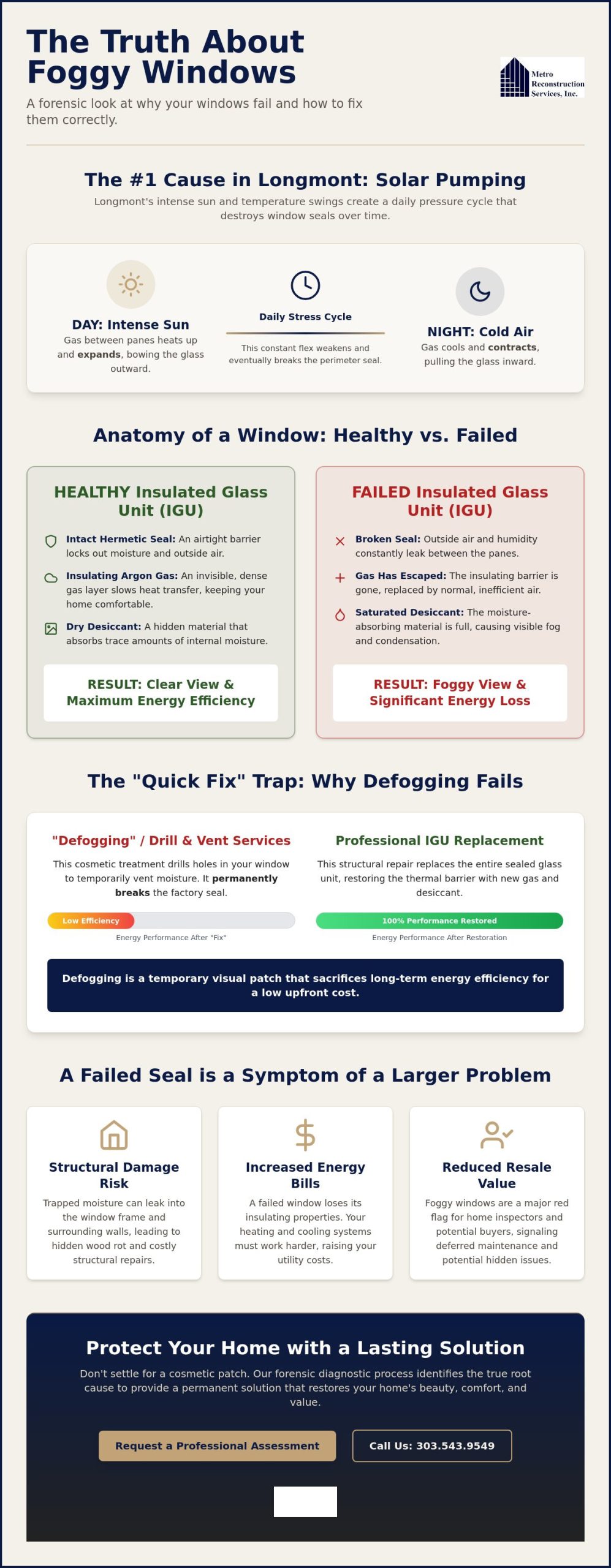
Modern windows rely on a sophisticated component known as an Insulated glazing unit (IGU) to maintain your home’s internal temperature. This unit isn’t just two pieces of glass stuck together; it’s a precision-engineered system where two or more panes are separated by a spacer and hermetically sealed to create an insulating air space. This space is often filled with inert gases like Argon to slow down heat transfer. When this seal remains intact, your windows act as a powerful barrier against the elements. However, once that seal is compromised, the window’s structural integrity is lost, leading to the foggy appearance that many homeowners mistake for a simple cleaning problem.
Longmont’s geography subjects these units to a phenomenon called “solar pumping.” Because of our high altitude and intense sunlight, the air or gas trapped between your window panes heats up and expands significantly during the day, causing the glass to bow outward. As the sun sets and temperatures drop, the gas contracts, and the panes pull inward. This daily cycle of expansion and contraction puts immense pressure on the perimeter seal. Over time, this constant physical stress creates microscopic fractures in the sealant. Once the seal is breached, outside air begins to leak in, carrying moisture that eventually overwhelms the window’s internal defenses.
Every IGU contains a desiccant, a moisture-absorbing material tucked inside the spacer bar. Think of this as a small, invisible sponge designed to soak up any trace amounts of humidity that might enter the unit. The moment you see visible fog or water droplets between the panes, it means the desiccant has reached its saturation point. It can’t hold any more water. At this stage, the window has undergone a permanent structural change. The insulating gas has escaped, and the moisture inside will begin to etch the glass over time, making a professional window replacement for condensation Longmont residents often require the only long-term solution for restoring clarity and thermal performance.
How Longmont’s Climate Accelerates Seal Failure
Our position on the Front Range creates a perfect storm for window degradation. The extreme temperature swings we experience, sometimes shifting 40 degrees in a single afternoon, accelerate the solar pumping effect. Additionally, our high-altitude UV exposure is significantly more intense than at sea level. These powerful ultraviolet rays break down the chemical bonds in the secondary seals that hold the glass in place. We also see localized moisture intrusion from wind-driven snow that sits on window sills, creating a constant source of humidity right at the seal’s most vulnerable point.
Anatomy of a High-Performance Insulated Glass Unit
A quality window is defined by the strength of its assembly. High-performance units often feature double-seal construction, using a primary seal to keep moisture out and a secondary seal to provide structural strength. The spacer bar isn’t just a divider; it’s a critical component that must move with the glass while keeping the desiccant active. When Argon gas escapes, it’s often the first silent sign of trouble, long before the fog appears. If you suspect your windows are failing, you can reach our team at 303.543.9549 or visit our contact page for a forensic assessment of your home’s complete outer system.
The Limitations of “Defogging” and Temporary Glass Repairs
Homeowners in the Front Range are frequently targeted by marketing for “defogging” or “drill and vent” services. These methods promise to clear up foggy glass at a fraction of the cost of a full restoration. While the visual improvement can be immediate, it’s vital to understand that these are cosmetic treatments rather than structural repairs. By drilling holes into the glass, a technician is fundamentally breaking the hermetic seal that defines a modern window. This process does nothing to replace the lost insulating gases or the saturated desiccant mentioned previously. Instead, it creates a permanent breach in your home’s thermal envelope.
A “cheap fix” often leads to higher energy bills because the window no longer functions as an effective thermal barrier. When the original Argon gas escapes and is replaced by standard air, the energy efficiency of windows drops significantly. This loss of R-value means your HVAC system must work harder to combat the Colorado cold. Choosing a professional window replacement for condensation Longmont homes require is often the only way to restore the engineering standards your property deserves.
Why Thermal Performance Cannot Be Drilled Back to Life
The physics of heat transfer are uncompromising. Dry air is a significantly inferior insulator compared to Argon or Krypton. Once a window is vented, it relies on the hope that moisture won’t return; however, the temporary vents used in these repairs often clog with dust or debris. When this happens, the fog returns quickly. Furthermore, the “cleaning” solutions used in these methods can leave behind a residue that eventually reacts with sunlight to create a permanent “silica haze.” This white, cloudy staining is actually mineral etching on the glass surface that no amount of washing can ever remove.
Warranty Risks and Long-Term Financial Costs
Most window manufacturers provide robust warranties against seal failure, but these protections are immediately voided the moment an aftermarket alteration like drilling occurs. By attempting a temporary patch, you may be throwing away the chance to claim a factory defect. Protecting your home investment requires looking past the surface. The math of repeat repairs rarely favors the homeowner; three temporary fixes often exceed the cost of a single, high-performance installation. If you are unsure if your windows are candidates for a glass-only swap or require a full frame update, you can speak with our experts at 303.543.9549 to schedule a detailed diagnostic evaluation.
How Failed Window Seals Impact Your Home’s Complete Outer System
A window is never an isolated component; it’s a critical intersection within your home’s complete outer system. Most homeowners view foggy glass as a standalone nuisance, but our forensic approach treats it as a symptom of potential systemic failure. When the hermetic seal of an insulated glass unit collapses, it often signals that the window’s integration with the surrounding siding, stucco, or masonry is also under stress. Because windows are the most dynamic parts of your building envelope, their failure can mask broader moisture intrusion issues that threaten the very bones of your property.
A professional window replacement for condensation Longmont homeowners invest in should always begin with a diagnostic look at the window-to-wall transition. Moisture that successfully enters the space between your window panes can also find its way into the wall cavity. If the flashing or drainage planes around the window frame have degraded alongside the glass seals, water will begin to collect in areas where it cannot easily evaporate. This hidden dampness is the primary driver of structural decay, making it essential to address the root cause rather than just the visible fog.
Moisture Intrusion and Structural Vulnerability
When water becomes trapped within a window sash or behind a frame, it initiates a slow process of wood rot or masonry degradation. In homes with specialized exteriors, a failing window can lead to the need for extensive stucco restoration if the moisture barrier behind the finish is compromised. We frequently find that what looks like a simple seal failure is actually a drainage problem where water is being funneled into the window assembly rather than away from it. Identifying these signs early prevents a localized glass issue from turning into a major structural repair project.
The Role of Windows in Building Envelope Integrity
Windows represent the most vulnerable points in your home’s thermal shell. Because they are the only parts of the wall designed to be transparent and, in many cases, operable, they are the first to show the effects of environmental stressors. Failed seals lead to air leakage, which doesn’t just reduce comfort; it forces your HVAC system to run longer cycles, shortening its lifespan. Any comprehensive exterior home repair must account for how these openings interact with the rest of the building. Ensuring a precise, airtight fit during installation is the only way to restore the integrity of the entire system.
If you suspect your foggy windows are part of a larger moisture issue, our team is ready to provide a detailed, professional evaluation. You can reach us at 303.543.9549 or visit our contact page to discuss a long-term solution for your home’s preservation.
Determining When to Repair vs. Replace Failed Windows
Deciding between a glass repair and a full system upgrade requires an honest assessment of the window’s current state. While an IGU swap, which involves replacing only the glass unit, is a viable middle ground for newer frames in excellent condition, it’s often a temporary measure for aging systems. We generally follow the “15-Year Rule” for property preservation. Windows older than fifteen years have usually reached the end of their intended design life. Even if the frames appear acceptable, the internal components and hardware are likely degraded beyond the point of reliable repair. Investing in a professional window replacement for condensation Longmont homeowners prioritize is the more prudent path when frames show signs of warping, rot, or hardware failure.
Structural integrity is the primary factor in this decision. If the window frame has lost its squareness or the surrounding materials are soft to the touch, a glass-only fix will fail prematurely. A forensic evaluation identifies if the moisture between the panes is an isolated seal breach or a symptom of a frame that can no longer protect the building’s complete outer system. Choosing a permanent solution now prevents the need for repeat repairs that offer no long-term value.
The Case for High-Performance Replacement
Modern glass technology has far surpassed the performance of units installed just a decade ago. New window installation provides access to advanced Low-E coatings and triple-pane options that meet the strict 2026 Colorado energy standards, requiring a U-factor of 0.30 or less. These upgrades don’t just lower your monthly utility costs; they significantly enhance your home’s resale value. Homeowners in the Mountain Region can expect to recover nearly 69% of their investment on upscale window replacements at the time of sale.
Diagnostic Checklist for Longmont Homeowners
You can perform a preliminary check by inspecting the frame’s squareness and looking for gaps where the sash meets the jamb. Feel for drafts or “cold spots” around the window perimeter on a windy day, as these indicate a total failure of the thermal barrier. It’s also wise to check for soft spots in the surrounding trim, which suggests moisture has already moved past the window and into the wall structure. If your home’s windows are showing these advanced signs of wear, it’s time to request a professional evaluation or call our team at 303.543.9549 to discuss a reliable path forward.
Professional Window Solutions: The Metro Reconstruction Standard
At Metro Reconstruction Services, Inc., we approach every project with a level of quiet confidence that only comes from decades of specialized experience on the Front Range. We don’t believe in the high-pressure tactics common in the home improvement industry; instead, we offer grounded, authoritative guidance focused on the long-term health of your property. When you require a window replacement for condensation Longmont specialists provide, you’re not just buying a piece of glass. You’re investing in a partner who understands how that window must function as a cohesive part of your home’s complete outer system. This holistic perspective is why we often coordinate our installations with stucco and masonry repairs, ensuring that every layer of your building envelope is secure and moisture-tight.
Our preference for high-performance systems, such as those from Pella, is rooted in their proven durability within Colorado’s demanding climate. These systems are engineered to withstand the intense UV exposure and rapid temperature swings we’ve analyzed, providing the reliability you need for peace of mind. By choosing materials that match our commitment to precision, we ensure that your window replacement for condensation Longmont project results in a permanent restoration of thermal performance.
Our Forensic Diagnostic Process
Accuracy is our foundational promise at Metro Reconstruction Services, Inc. Before we propose a specific solution, we perform a forensic assessment to identify the structural origins of the failure. We don’t just look at the foggy glass; we evaluate the building’s moisture mitigation systems and the condition of the surrounding substrate. This meticulous approach ensures that your new unit is perfectly integrated with the existing exterior, preventing the hidden rot or drainage issues that often follow low-quality patches. We focus on identifying underlying structural origins rather than superficial issues, reinforcing our identity as experts who understand the hidden mechanics of your home.
Partnering in Property Preservation
We are a family-owned firm with four decades of local expertise, and we treat your home’s resale value with the same care you do. Our goal is restoration and protection, not a quick sale. This seasoned perspective allows us to explain the difficult truth of a structural failure rather than offering a temporary, low-quality patch. If you’re ready for a decisive, professional conclusion to your window failures, we invite you to schedule a detailed consultation.
Contact the team at Metro Reconstruction Services, Inc. today at 303.543.9549 or visit our contact page to begin the process of restoring your home’s structural integrity and thermal efficiency.
Securing Your Home’s Future with Professional Restoration
Addressing foggy glass is an essential step in maintaining the structural integrity of your home’s complete outer system. As we’ve explored, visible moisture indicates that the window’s thermal barrier has collapsed, often leaving the surrounding frame and wall cavity vulnerable to hidden decay. Choosing a high-performance window replacement for condensation Longmont homeowners trust ensures that your property meets 2026 energy standards while restoring the comfort and resale value of your investment. Temporary fixes like drilling holes only compromise the unit further, making a forensic diagnostic approach the most cost-effective path forward.
With over 40 years of Front Range structural expertise, our team at Metro Reconstruction Services, Inc. specializes in moisture mitigation and the seamless integration of windows with stucco and masonry systems. We’re dedicated to providing long-term solutions that protect your home from the unique environmental stressors of the Colorado landscape. You can Schedule a Professional Window Evaluation with Metro Reconstruction Services, Inc. today to gain clarity on your home’s needs. Please reach out through our contact page or call us at 303.543.9549. We look forward to partnering with you in the meticulous preservation of your property.
Frequently Asked Questions
Can condensation between window panes be fixed without replacing the window?
No, a broken seal cannot be permanently repaired to its original factory standards. Once the hermetic seal fails and the internal desiccant becomes saturated, the window loses its insulating properties. While some companies offer cosmetic cleaning, these methods don’t restore the original Argon gas or the thermal vacuum. The only way to regain full energy efficiency is to replace the failed glass unit or the entire window assembly.
How much does it cost to repair foggy windows in Longmont?
The cost of restoring your windows depends on the specific nature of the failure and the condition of the surrounding building envelope. While simple glass replacement is an option for newer frames, a comprehensive evaluation is the only way to determine the most cost-effective path for your property. We focus on providing long-term value rather than low-quality patches that require frequent and expensive repeat attention.
What causes the seal on a double-pane window to break?
The primary cause is a process called solar pumping, which is particularly aggressive in Colorado’s climate. Daily temperature swings force the glass panes to expand and contract, putting constant physical stress on the perimeter sealant. Over time, this movement creates microscopic gaps. Our high-altitude UV exposure also accelerates the breakdown of the chemical bonds in the seals, leading to the eventual intrusion of moist air.
Is defogging a permanent solution for moisture between panes?
Defogging is a cosmetic treatment, not a structural repair. It involves drilling small holes to vent moisture, but it doesn’t address the root cause of the seal failure or replace the lost insulating gas. Most homeowners find that the fog eventually returns once the vents become clogged with environmental debris. This method also voids most manufacturer warranties, leaving you without protection for future structural issues.
How do I know if I need to replace the whole window or just the glass?
You likely need a full window replacement for condensation Longmont homeowners prioritize if your frames are over 15 years old or show signs of warping and rot. If the frames are structurally sound and relatively new, a glass-only replacement may be a viable middle ground. A forensic assessment of your home’s complete outer system is necessary to ensure that moisture hasn’t already compromised the surrounding wall structure.
Does condensation between panes mean my windows are leaking air?
Yes, moisture between the panes is a clear indicator that the hermetic seal has failed, allowing outside air to circulate within the unit. This breach significantly reduces the window’s R-value and creates drafts that impact your internal comfort. When the seal is gone, your windows no longer provide an effective thermal barrier, which forces your heating and cooling systems to work harder to maintain a steady temperature.
Can I fix a broken window seal myself with a DIY kit?
DIY kits cannot restore the thermal vacuum or the insulating gas lost during a seal breach. These kits often rely on temporary patches that fail to address the saturated desiccant inside the spacer bar. Attempting a self-repair can lead to permanent glass etching and often compromises the window’s integration with your home’s moisture barrier. Professional restoration is required to ensure the window remains a durable part of your home’s exterior.
How long do professional window replacements typically last in Colorado?
High-performance window systems installed with precision typically maintain their integrity for 20 to 25 years in our demanding regional environment. This longevity is achieved by using materials specifically engineered to handle the Front Range’s intense UV rays and extreme temperature shifts. Ensuring your windows are correctly integrated with your home’s moisture mitigation system is the most important factor in protecting this long-term investment in your property’s value.
For a detailed forensic diagnostic of your home’s windows, contact our experts at 303.543.9549 or visit our contact page to schedule a consultation.