
What if the standard double-pane window, often cited as the industry benchmark, is actually the primary point of failure for your home’s structural efficiency? In a high-altitude environment where atmospheric pressure and extreme temperature shifts are the norm, many homeowners find themselves asking are triple pane windows worth it in Colorado or if they’re simply paying for an unnecessary layer of glass. You’ve likely felt the draft during a Front Range blizzard or noticed the persistent hum of increasing urban density, leading to a justified concern that your home’s protective envelope isn’t performing as it should.
This forensic analysis moves beyond surface-level marketing to examine how triple-pane technology functions as a critical component of your building’s complete outer system. We’ll provide a definitive answer on the long-term ROI of this investment by evaluating how these specialized units resist seal failure and stabilize internal temperatures. You’ll gain a clear understanding of how advanced window systems protect your property’s integrity. This guide ensures peace of mind that your home is prepared for the demanding regional climate of 2026 and beyond. Precision in selection today prevents structural vulnerability tomorrow.
Key Takeaways
- Understand how Colorado’s 40-degree diurnal temperature swings and intense high-altitude UV radiation degrade traditional seals, necessitating a more robust structural solution.
- Analyze the technical advantages of a 0.20 U-factor and how three layers of glass effectively eliminate the “Cold Zone” drafts common in standard double-pane installations.
- Examine the structural and financial data to decide are triple pane windows worth it in Colorado for your specific property, focusing on long-term preservation rather than temporary fixes.
- Learn the critical importance of integrating new windows with your building’s complete outer system, focusing on precise flashing details to prevent moisture intrusion behind stucco or masonry facades.
- Gain a clear framework for identifying break-even scenarios, allowing you to choose between standard and high-performance upgrades with total confidence in your investment.
The Colorado Climate Challenge: Why Standard Windows Often Fail
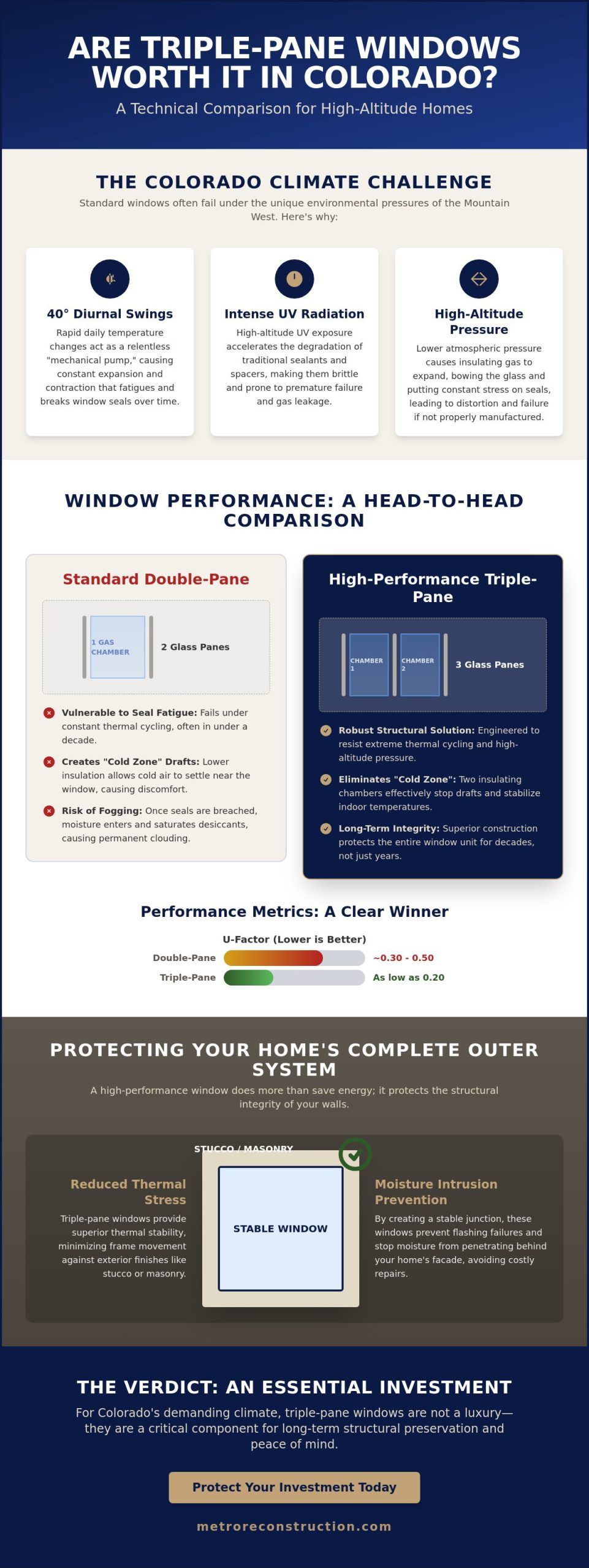
Colorado homeowners face a climate that is uniquely hostile to building materials. While many regions deal with consistent humidity or steady cold, the Front Range experiences 40-degree diurnal temperature swings that act as a relentless mechanical pump on window seals. This rapid expansion and contraction cycle, combined with intense high-altitude UV radiation, often leads to the premature degradation of traditional spacers and sealants. When these components fail, the resulting moisture intrusion doesn’t just cloud the glass; it threatens the structural integrity of the surrounding building envelope. This is why many residents find themselves questioning are triple pane windows worth it in Colorado after their builder-grade double-pane units fail in under a decade.
Standard Insulated glazing technology often struggles under these conditions because it wasn’t engineered for the specific physics of the Mountain West. Low-cost units frequently utilize sealants that become brittle when exposed to the high-UV environment found above 5,000 feet. Once the seal is compromised, the insulating gas escapes and the window becomes a liability rather than an asset. In our forensic evaluations, we frequently see the following issues with standard installations:
- Seal Fatigue: Constant thermal cycling causes the glass to move against the spacer, eventually creating microscopic gaps.
- Desiccant Saturation: Once a seal is breached, the internal drying agents quickly fail, leading to permanent fogging.
- Frame Warping: Extreme heat on dark-colored frames can lead to permanent deformation if the glazing doesn’t provide adequate thermal resistance.
Thermal Expansion and the ‘Complete Outer System’
A window is a single component within a complex, interconnected assembly. In Colorado, exterior finishes like stucco and masonry expand at significantly different rates than vinyl or aluminum frames. If a window lacks the thermal stability provided by high-performance glazing, the resulting frame movement can compromise the critical junction between the window and the siding. We view window selection through a forensic lens because a failure here often leads to moisture penetrating the “wet zone” behind your home’s facade. Choosing a more stable triple-pane system reduces this thermal stress, effectively protecting the entire outer system from expensive structural repairs.
The High-Altitude Factor: Pressure and Performance
Elevation adds another layer of complexity to the question of whether are triple pane windows worth it in Colorado. In Boulder and across the Front Range, the atmospheric pressure is significantly lower than at sea level. This pressure differential causes the gas fill between window panes to expand, often resulting in “bowed” glass that distorts reflections and stresses the primary seals. High-altitude window manufacturing requires specialized pressure equalization tubes or specific factory calibrations to ensure the glass remains flat and the seals remain intact. Without these precise adjustments, even a premium window can fail shortly after installation due to the simple physics of elevation.
The Technical Anatomy of Triple-Pane Glass for Colorado Homes
Triple-pane windows consist of three individual panes of glass separated by two distinct insulating chambers. This configuration represents a significant engineering shift from the single-chamber design found in standard units. By introducing a second pocket of space, these windows create a more complex barrier against thermal transfer. When evaluating if are triple pane windows worth it in Colorado, we must look at the R-value, which measures a material’s resistance to heat flow. While a standard wall has a high R-value, a window is typically the weakest point in the building’s thermal envelope. Triple-pane units can effectively triple the insulating power of these wall openings, moving the R-value from a 3 to as high as a 7 or 8 in premium configurations.
The performance of these two chambers depends heavily on the gas fill used between the panes. Argon is the industry standard for double-pane windows, but triple-pane units often utilize Krypton gas. Because Krypton is denser than Argon, it performs better in the thinner chambers required to keep the overall window weight manageable. These units also feature advanced Low-E (low-emissivity) coating stacks. These microscopic layers of silver reflect Colorado’s intense high-altitude sun during the summer while trapping interior heat during the winter. According to Department of Energy studies, this specialized glazing can significantly reduce a home’s energy consumption by stabilizing the interior environment.
Warm-Edge Spacer Technology
In many older Colorado homes, metal spacers serve as a “thermal bridge” that allows cold to bypass the glass and enter the home. This often leads to condensation and eventual mold growth along the bottom of the frame. Modern triple-pane systems utilize non-conductive composite spacers. These “warm-edge” spacers provide the necessary flexibility to prevent seal failure during our state’s rapid freeze-thaw cycles. This precision in component selection is why a professional window installation is a foundational step in preserving your property’s long-term value.
Capillary Tubes and Altitude Gradients
Capillary tubes are small breathing vents designed to equalize internal and external pressure for high-altitude glass. Windows manufactured at sea level face immense internal pressure when transported to the 5,000-plus foot elevations of Boulder or Denver. Without these tubes, the glass can bow or even shatter. However, these vents must be managed correctly to ensure the insulating gas isn’t entirely lost. Proper pressure equalization is a hallmark of a forensic approach to window selection, ensuring the unit remains structurally sound and thermally efficient for decades.
Double Pane vs. Triple Pane: The Colorado Comparison
When comparing double and triple-pane options, the U-factor serves as the most critical diagnostic metric for thermal performance. In the Front Range climate, a U-factor of 0.20 is the target for high-efficiency homes. While a standard double-pane window might offer a rating of 0.30, the leap to 0.20 represents a 50% improvement in thermal resistance. This difference is vital because windows are the primary source of heat loss in a building’s envelope. Many residents ask are triple pane windows worth it in Colorado when they realize that this increased efficiency directly correlates to a more stable interior environment during our state’s unpredictable weather shifts.
The technical superiority of triple-pane glass also addresses the “Cold Zone” phenomenon common in older properties. This effect occurs when the interior glass surface becomes so cold that it cools the adjacent air, causing it to sink and create a convection current. This movement feels like a draft, even when the window is perfectly sealed. Triple-pane units effectively eliminate this by maintaining an interior glass temperature much closer to the room’s ambient air. Additionally, the extra layer of glass and gas serves as a formidable barrier against the increasing noise pollution from urban density and the howling winds typical of a January storm.
Calculating the Real ROI in 2026
Resale value is a primary consideration when weighing the investment of a high-performance window system. For those determining are triple pane windows worth it in Colorado, the answer often lies in the long-term preservation of the home’s value. In 2026, buyers increasingly prioritize structural durability and energy independence. Beyond simple energy bill savings, triple-pane windows allow for “HVAC downsizing.” Because the home’s thermal envelope is more efficient, your furnace and air conditioner don’t have to be as large or work as hard, extending the lifespan of these expensive mechanical systems. Choosing precision-engineered windows also prevents the cost of premature replacement, a common issue with lower-quality units that often fail within ten years in our harsh UV environment.
The Comfort Factor: Eliminating the ‘Radiant Chill’
Human comfort depends more on the temperature of surrounding surfaces than on air temperature alone. This is known as the “Radiant Chill.” When you sit near a double-pane window during a blizzard, your body radiates heat toward the cold glass, making you feel chilled. We measure the “Comfort Delta,” which is the temperature difference between the interior glass and the room air. Triple-pane glass narrows this delta significantly. This thermal stability allows homeowners to maintain healthy humidity levels inside the home without the common problem of window “sweating” or condensation that leads to sill rot and mold. Precision in these details ensures your home remains a sanctuary regardless of the external conditions.
Integrating High-Performance Windows with Colorado Exteriors
A window’s performance isn’t defined solely by its glass; its value is dictated by how seamlessly it integrates into the building’s complete outer system. When homeowners evaluate if are triple pane windows worth it in Colorado, they often overlook the mechanical realities of the installation. Triple-pane units are significantly heavier than their double-pane counterparts, requiring specialized structural anchoring, especially in older homes where the original framing may have settled over decades. Without precise integration, even the most expensive glazing becomes a liability. A forensic approach ensures that the window functions as a protective shield rather than a source of stress for your home’s facade.
In the Front Range, the critical intersection between a window frame and the exterior finish is where most structural failures begin. This is particularly true for homes requiring stucco restoration, where moisture can easily bypass improper flashing. When determining are triple pane windows worth it in Colorado, the structural stability of the installation is just as important as the U-factor of the glass. High-performance windows must be paired with meticulous stucco and masonry repairs to maintain a watertight seal. Precision in these details is what separates a long-term solution from a temporary patch.
Window Replacement and Stucco Integrity
Many contractors prefer “pocket” installations because they’re faster; however, in stucco homes, this method often leaves the most vulnerable parts of the old frame in place. We advocate for full-frame replacement to ensure the new unit is properly tied into the home’s original weather-resistant barrier. This process includes installing proper expansion joints between the new window and the existing stucco. These joints allow the materials to expand and contract at different rates without causing the surface to crack. Protecting the complete outer system requires this level of analytical depth during every retrofit.
Moisture Mitigation and Forensic Installation
The drainage plane is the hidden layer behind your siding that allows moisture to escape before it reaches the structural sheathing. During a forensic window installation, we often identify previous moisture damage that a standard “swap-out” would simply cover up. By diagnosing these underlying issues, we ensure the new flashing system directs water away from the “wet zone” and out of the building. If you’re ready to secure your home’s future, consider a professional window replacement that prioritizes structural integrity over speed. Metro Reconstruction Services, Inc. remains committed to identifying underlying structural origins rather than offering superficial fixes.
Conclusion: Is the Investment Worth It for Your Property?
The decision ultimately hinges on your property’s specific environmental stressors and your goals for long-term preservation. For the discerning homeowner, the question of are triple pane windows worth it in Colorado is answered by the physics of the building envelope. While double-pane glass provides a baseline of protection, triple-pane technology offers the structural redundancy necessary for our high-altitude climate. Break-even scenarios typically favor the upgrade for properties with large western exposures or those situated in high-density areas where noise attenuation is a priority. Conversely, for secondary structures or north-facing walls with minimal solar gain, a premium double-pane unit may remain a viable choice. Precision in selection ensures that your investment matches the actual demands of the structure.
True property preservation goes beyond the glass itself. It requires a partner who understands the structural foundation of your home and how every component of the outer system interacts. By choosing a forensic approach, you aren’t just buying a product; you’re securing the integrity of your entire residence against the elements. The peace of mind that comes from a stabilized interior environment and a protected facade is a value that persists long after the initial installation is complete. Reliability is our result.
The Metro Reconstruction Services, Inc. Difference
Metro Reconstruction Services, Inc. views every window installation as a specialized engineering project rather than a simple commodity swap. Our commitment to fixed-price reconstruction and transparent project management eliminates the uncertainty often associated with complex structural work. We don’t believe in superficial fixes; our goal is the long-term restoration of your home’s complete outer system. This meticulous attention to detail ensures that every seal, joint, and anchor point performs exactly as intended for decades to come. We’re dedicated partners in your property’s future.
Next Steps for Boulder County Homeowners
Securing your home’s thermal and structural future begins with an accurate assessment of its current performance. You can request a forensic diagnostic of your existing windows to identify underlying seal failures or moisture intrusion points that often go unnoticed by general contractors. During our consultation, we’ll guide you through the technical selection process, explaining how different glazing options will affect your specific building envelope. Contact the seasoned experts at Metro Reconstruction Services, Inc. today to begin your journey toward a more resilient, efficient, and comfortable home. Precision starts here.
Protecting Your Investment Through Technical Precision
Deciding are triple pane windows worth it in Colorado requires a transition from viewing windows as isolated units to seeing them as critical nodes in the building’s thermal and structural envelope. The analysis provided demonstrates that the value lies in the mitigation of long-term risks, specifically the seal failure and moisture bypass that compromise a home’s integrity. By choosing high-performance glazing, you’re not just upgrading an aesthetic feature; you’re reinforcing the complete outer system against a uniquely demanding high-altitude environment. This proactive approach ensures that your property remains resilient against the relentless mechanical stress of the Front Range climate.
Metro Reconstruction Services, Inc. brings over 40 years of Boulder County expertise to this complex intersection of engineering and craftsmanship. As specialists in structural preservation and moisture mitigation, we prioritize the underlying health of the structure over superficial replacements. Being family-owned and operated, our focus remains on high-quality results that provide lasting peace of mind for our clients. We treat your investment with the protective care it deserves, ensuring that every component of your home’s facade functions in perfect harmony.
Schedule a Forensic Window Assessment with Metro Reconstruction Services, Inc. to ensure your property is prepared for the environmental stressors of 2026 and beyond. Precision in diagnostics today is the only way to guarantee reliability for the life of your home. We look forward to providing the expert guidance necessary to secure your property’s future.
Frequently Asked Questions
Are triple pane windows worth the extra cost in Colorado?
Triple-pane units are a justifiable investment for homeowners prioritizing property preservation and interior comfort. While the initial capital requirement is higher than standard double-pane options, the increased thermal resistance prevents premature seal failure caused by Colorado’s extreme diurnal temperature shifts. This durability ensures that the building’s complete outer system remains protected. Deciding are triple pane windows worth it in Colorado is a matter of evaluating long-term structural value over short-term savings.
How much do triple-pane windows actually save on energy bills in Boulder?
Energy savings typically manifest as a reduction in the operational frequency of your HVAC system. In the demanding climate of Boulder, triple-pane glass acts as a superior thermal barrier that keeps interior heat from escaping during sub-zero winter nights. By stabilizing the home’s temperature, these windows allow for more consistent climate control. This efficiency reduces the mechanical stress on your furnace and air conditioner, contributing to lower monthly utility expenditures throughout the year.
Do triple-pane windows really reduce noise better than double-pane?
The additional pane of glass and the secondary insulating chamber provide a formidable defense against exterior noise pollution. This is particularly beneficial for properties near high-traffic corridors or in areas with increasing urban density. The varying thicknesses of the glass layers disrupt sound waves more effectively than a standard double-pane unit. This configuration results in a noticeably quieter interior environment, shielding your living space from the howling winds and traffic hum common in the Front Range.
Can triple-pane windows break at high altitudes due to pressure?
They can if they aren’t manufactured with proper pressure equalization technology. High-altitude environments like those in Boulder and Denver exert significant pressure on sealed glass units, which can lead to bowing or glass failure. Precision-engineered windows must include capillary tubes or specialized factory calibrations to equalize internal and external pressure. Without these forensic adjustments, the gas fill can cause the panes to distort or shatter under the simple physics of elevation.
How long do triple-pane windows last in the Colorado sun?
When built with high-quality spacers and UV-resistant sealants, they can exceed twenty years of performance. The intense UV radiation at 5,000 feet and above is a primary cause of window seal degradation in Colorado. High-performance triple-pane units utilize advanced composite spacers and superior sealants designed to resist the brittleness that leads to failure. While builder-grade windows often fail within a decade, premium units installed with a forensic focus on moisture mitigation are built for regional longevity.
What is the difference between argon and krypton gas for Colorado homes?
Argon is an effective, cost-efficient insulator for the wider gaps found in double-pane windows. However, triple-pane units often require thinner chambers to keep the overall frame width manageable, making Krypton the superior choice for these narrow spaces. Krypton’s higher density provides better thermal resistance in a smaller volume. Choosing the correct gas fill is a critical detail in ensuring the window meets the target U-factors necessary for Colorado’s extreme seasonal shifts.
Is it possible to install triple-pane windows in a home with existing stucco?
Yes, but it requires a specialized full-frame replacement to protect the stucco’s integrity. Installing heavy triple-pane units in a stucco home requires careful integration with the existing building envelope. We prioritize full-frame replacement over simple pocket installs to ensure the new window is properly tied into the home’s drainage plane. Understanding are triple pane windows worth it in Colorado involves recognizing that the installation quality is just as vital as the window’s technical specifications.
Do triple-pane windows increase the resale value of a Colorado home?
Modern buyers in the Front Range increasingly prioritize energy independence and structural durability when evaluating potential properties. Triple-pane windows signal that a home’s been maintained with a commitment to quality and long-term preservation. This upgrade differentiates your property from those with standard builder-grade components. By providing documented proof of superior thermal performance and noise reduction, homeowners can justify a higher asking price and instill confidence in prospective buyers regarding the home’s total efficiency.