
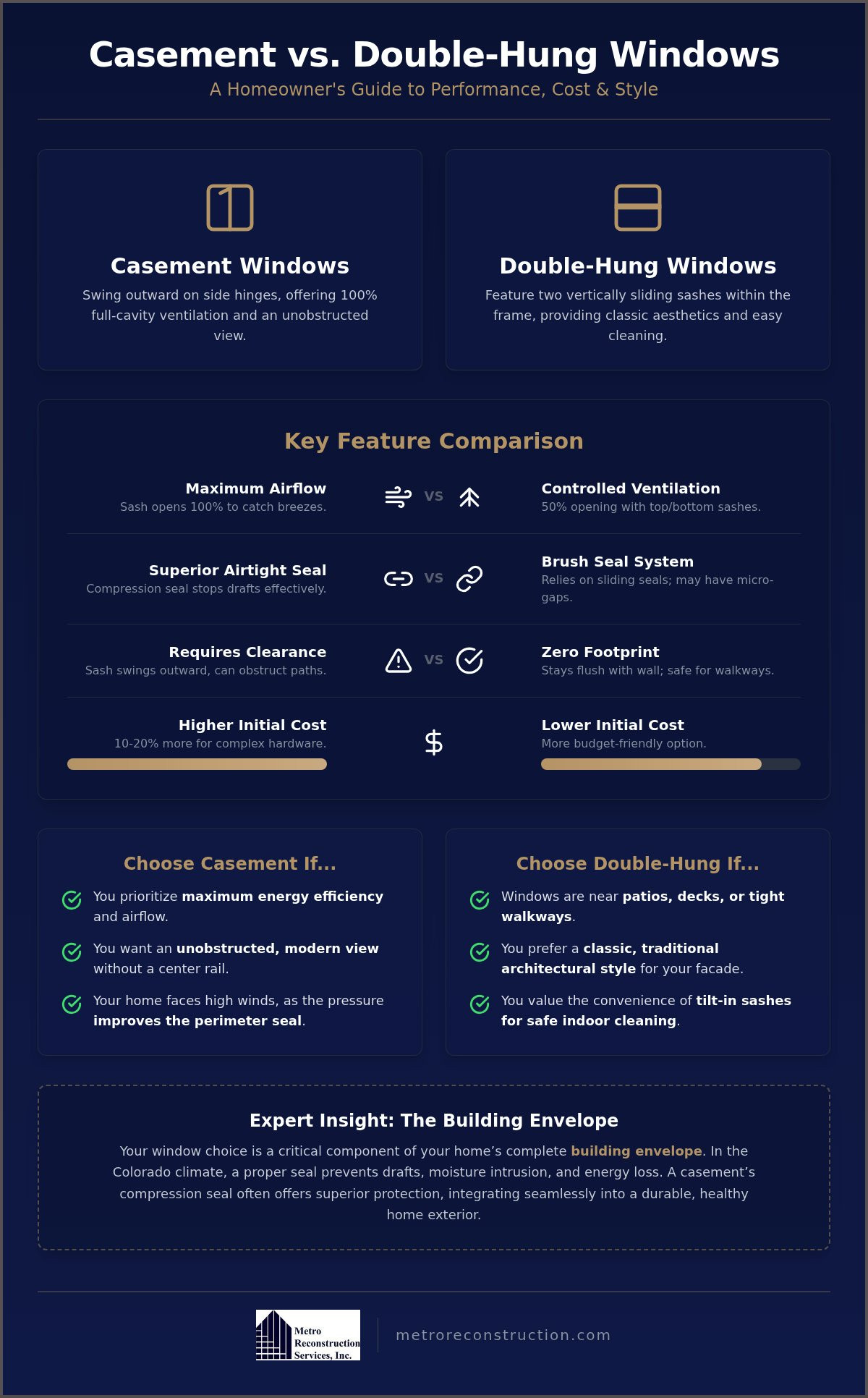
Casement windows swing outward on side hinges to offer 100% full-cavity ventilation and tighter air seals, while double-hung windows feature two vertically sliding sashes that provide classic aesthetics and safe indoor cleaning. On average, casements carry a 10% to 20% higher price tag than double-hung models due to complex mechanical hand cranks and heavier frame requirements. If you own a home in Boulder, CO, your decision rests on three practical questions: how much airflow you need, whether sashes may project into walkways, and which operating style keeps moisture and drafts out of your building envelope in local wind and cold.
Key Takeaways: Casement windows offer superior airtight compression seals and full ventilation, while double-hung windows provide a flush exterior footprint and easier cleaning at a lower cost.
- Casement windows typically carry a 10% to 20% higher price tag than double-hung models.
- Avoid casement windows in tight exterior walkways where an outward-swinging sash creates a hazard.
- Choose casement units for maximum energy efficiency because wind pressure improves the perimeter seal.
- The article details how mechanical hand cranks on casements can strip under wind load.
Match window style to airflow, walkways, and architecture
Your window choice follows the rooms you live in, not a catalog category. Three situations come up often in Boulder-area work:
- You want strong cross-ventilation in a living room or bedroom that can accept an outward swing: choose a casement so the sash opens the full cavity and catches side breezes.
- You have a classic facade or a tight exterior walkway where projecting sashes would block passage: choose double-hung units so both sashes stay inside the frame.
- You are weighing lower-sash-only movement against dual vertical ventilation on an existing opening: compare single- and double-hung options before you lock the order.
Traditional homes often read cleaner with vertical sash lines; contemporary builds often favor large glass panels with minimal division. Frame profiles set the sightlines you see from the street and from inside, so the geometry should support structural integrity rather than fight the elevation. A casement gives you full-cavity airflow and an unobstructed glass field when the hardware is sized correctly. A double-hung unit keeps patio edges and walkways clear because nothing swings outward.
Ask Metro Reconstruction Services, Inc. to map durable window systems to your local building envelope so the operating style matches wind exposure, moisture management, and the way you actually use each room.
How casement and double-hung mechanisms seal and operate
Casement windows crank open outward on side hinges, while double-hung units use two vertical sliding sashes inside a single frame.
The mechanisms differ in ways you feel every time you open a sash. Casements use a hand crank and a steel arm to push the sash outward. Double-hung designs commonly use constant-force spring balances (and, in older timber stock, sash weights and pulleys) so each sash travels in side tracks.
Hardware quality decides whether that motion stays reliable. Many homeowners worry that mechanical cranks will strip or seize. High-grade stainless steel operator gears resist stripping when they are installed square and used within their load rating. Vertical sliding channels need clean tracks; dirt and paint buildup cause binding long before the balances themselves fail.
Air infiltration rates diverge once the sash is closed. A casement pressed shut bears on continuous weatherstripping and forms a compression seal. Vertical sliders depend on brush seals along the tracks, so minor leakage can appear under high wind loads in Boulder, CO.
Room layout should lead the purchase. Casements suit open elevations where you want a clear, undivided view. Double-hung styles suit tight exterior walkways where a projecting sash would be a hazard. For a side-by-side look at vertical sash choices, use the Colorado property owners guide on single- versus double-hung units, then request a site-specific recommendation for your openings.
Casement vs double-hung features that change daily use
Casement windows crank outward on side hinges to deliver full-cavity airflow, whereas double-hung sashes slide vertically and keep the exterior footprint compact.
| Feature | Casement Windows | Double-Hung Windows |
|---|---|---|
| Mechanical Operation | Cranking handle on side hinges | Vertical sliding sashes |
| Airflow Efficiency | Full opening captures side breezes | Upper or lower half ventilation |
| Glass Area | Clear view (unobstructed view) | Divided frame sightlines |
Casement glass runs as a single operable field, so more of the opening works as clear aperture while the open sash can scoop breezes indoors. Double-hung units lean on stack-driven convection: warm air leaves through the top sash while cooler air enters at the bottom. Either way, thermal performance still depends on a continuous weatherseal at the frame. For practical notes on holding heat in (U-Factor) through the full exterior assembly, review the company blog on exterior systems. More on this: Metro Reconstruction Blog.
High-performance low-e coating on the glass helps any frame material manage radiant gain and loss. Frame geometry then decides how much daylight reaches the room and how divided the view feels. Pick casements when you need full-opening ventilation; pick double-hung units when exterior clearance is tight and classic sash lines matter more than an undivided pane.
Compression seals that limit drafts on casement units
Casement windows seal tighter than double-hung units because the sash presses into the frame when you crank it shut.
In field evaluations, perimeter weatherstripping is the first place wind load shows up as a comfort complaint. A compression seal forms an airtight barrier at that perimeter and limits infiltration during strong gusts. Double-hung sashes travel in vertical tracks, so micro-gaps along the brushes are part of the operating design. If draft control is your priority, specify casement units with high-performance low-e coating so the glass and the seal work together on U-Factor.
Qualifying energy-efficient window upgrades may support a federal tax credit; the IRS credit instructions for 2025 explain how homeowners claim the energy-efficient home improvement credit for exterior windows. A tighter building envelope lowers utility cost while you preserve structural integrity at the opening. For wall and cladding integration around new units, start at the Metro Reconstruction Services homepage and schedule a review of your Boulder elevation.
Proper installation is what keeps moisture management and draft control intact after the first heating season.
Tip: Choose triple-pane casement windows with low-E coatings on north-facing walls to maximize thermal efficiency during cold winters.
A commenter in the metrogeneralcontractorsinc.com thread "Client Reviews, Metro General Contractors, Inc.":
"We are so pleased with the commitment and hard work provided by Metro General Contractors." (source)
High-performance window work still depends on crews who treat the opening as part of a complete outer system. Precision at the rough opening and the weatherseal is what turns a rated unit into a quiet, draft-resistant assembly in daily use.
Materials and labor costs behind the 10% to 20% price gap
Casement units cost more in labor and materials than double-hung options because of their mechanical hardware and alignment demands.
On Boulder, CO installations, labor time rises when crews set hand-crank casement assemblies instead of balance-operated vertical sashes. Articulated hinge hardware needs a square, true frame so the sash does not bind against weatherstripping. Double-hung units ride on comparatively simple side-channel balances. A casement also needs accurate multi-point lock alignment; misalignment shows up later as air leakage or early seal wear. That extra fit-up time is a direct labor cost.
Budget-led retrofits often land on double-hung windows for that reason. Homeowners who rank air tightness first usually accept the casement premium.
A double-hung sash behaves like a sliding barn door; a casement behaves more like a vault hatch. The hatch seals harder, yet its hinges and operators only stay smooth when the opening is prepared with forensic attention to square and plumb. Share your opening schedule and finish goals to receive a personalized quote scoped to the hardware you actually need.
Among Metro Reconstruction Services, Inc. Google reviews, one client (5★) wrote:
"Ben and his crew at Metro Reconstruction Services are top notch. Their work ethic, and finished product are outstanding! They arrive on time, they work hard and they clean up. My husband and I highly recommend Ben and his team!! Their stucco work is terrific."
That sequence (careful prep, disciplined site habits, a clean finished edge) is the same discipline that keeps structural openings weather-tight after the crew leaves.
A commenter in the metrogeneralcontractorsinc.com thread "Client Reviews, Metro General Contractors, Inc.":
"My company has been subcontracting with Metro for over eight years. Their bidding and scheduling processes are painless and accurate." (source)
Clear bids and dependable scheduling keep framing and window setting on one coordinated path instead of a string of return visits.
Five inspection checks before you commit to a window brand
Score each candidate unit against published test data for your climate, not against brochure language alone.
- Check keeping heat in: Compare rated thermal numbers with the winter performance your local code path expects.
- Review solar heat gain: Confirm how much solar radiation passes through so summer cooling loads stay predictable.
- Inspect air leakage ratings: Favor low infiltration figures to limit drafts and moisture drive at the opening.
- Confirm structural water resistance: Read water-penetration results under wind pressure, not only still-air lab claims.
- Verify low-e and seal documentation: High-performance low-e coating and proven perimeter seals decide how the unit ages inside your building envelope; weak ratings leak heat the way a coarse screen leaks air.
Pull manufacturer data sheets side by side, then have a technician walk the rough openings with you so the written ratings match the walls you own. Metro Reconstruction Services, Inc. can review those structural window specifications with you before you place the order.
Crank wear, screens, and clearance limits on casements
Mechanical cranks take cyclic load whenever wind presses on an open sash. Extended sashes catch gusts and transfer that force into hinge arms and operator gears.
In a windstorm, an open casement acts like a small sail: load paths run straight into the frame and, if the unit was forced or left unsecured, can warp hardware over time. Sealant life at any exterior joint still depends on product chemistry and UV exposure, so perimeter details need the same maintenance attention you give the rest of the elevation.
Screen layout is a daily inconvenience many buyers miss. Because the sash swings out, the insect screen sits on the interior. Cleaning the outer glass means reaching through the opening or removing the screen. Aftermarket shades and some air-conditioning setups are harder to detail around that swing path as well.
If you want an unobstructed view without frequent operator service, weigh those mechanical and clearance limits honestly. Stripped operators from forced cranking are a recurring service call. Double-hung designs keep their balances and locks inside the frame, which removes those exterior hinge points in high-wind exposures. Have a specialist check your frame integrity and clearances before you finalize replacement units.
When a meeting rail splits the view you want
Double-hung windows place a horizontal meeting rail across the middle of the glass. That rail is structural to the two-sash design, yet it reads as a permanent break in the view.
Homeowners who wanted a wide, uninterrupted outlook toward foothills or garden lines often find that rail sits exactly in the sightline they care about. You give up glass area to the overlapping sash and the check rail compared with a single swing sash in the same rough opening.
Double-hung units still suit compact vertical openings and elevations where flush operation matters more than an undivided pane. Casements suit taller openings where you want the glass field as open as the framing allows. When outdoor visibility is the primary architectural goal, hinged casement layouts are the cleaner match. Metro Reconstruction Services, Inc. can evaluate your structural framing and align the layout with local code paths so the operating style supports both view and weather performance.
HOA clearance and lock rules that shape your choice
Window style affects security hardware and neighborhood architectural rules as much as it affects daylight. High-wind gusts in Boulder, CO make operable hardware and projection limits part of the same decision.
Outward-swinging casement sashes can violate HOA clearance rules near walkways or shared paths. Double-hung sashes stay flush in the frame and avoid exterior projection disputes.
Multi-point locks on casements pull the sash into the frame at several points and resist forced entry more effectively than a single latch. Double-hung sash latches mainly retain the sash vertically; matching that hold often means adding auxiliary locks.
Open casements also catch mountain wind. Left unsecured, they load the hinges the same way an open sail loads a mast, which is why hardware grade and shut procedure matter on exposed elevations.
Choose casements when compression lockup and air tightness lead your brief. Choose double-hung units when HOA setbacks and flush operation lead it. For envelope compliance on your lot, contact Metro Reconstruction Services, Inc. with your HOA guidelines and opening schedule.
Frequently asked questions
What are the downsides of casement windows?
Mechanical hand cranks use moving parts that wear under repeated load. The sash also needs outward clearance, so placement near walkways or low overhangs is limited.
Are casement windows outdated?
Contemporary elevations still use casement units for clean vertical lines and large undivided glass. Continuous perimeter seals support the air-tightness levels current energy codes expect.
Can I replace a casement window with a double hung window?
You can replace a casement with a double-hung unit when the rough opening size is compatible. Metro Reconstruction Services, Inc. adjusts the frame detailing so structural integrity and moisture management remain intact after the swap.
What is the difference between casement and double‑hung windows?
Casement windows hinge at the side and swing outward with a crank. Double-hung units use two vertical sashes that slide inside a fixed frame. Casements present one clear glass field; double-hung styles split the sightline at the center meeting rail.
Which style offers better energy efficiency?
Casement windows typically post stronger thermal results because wind pressure drives the sash into the weatherstripping and improves the compression seal that supports U-Factor performance. For assembly details suited to Boulder, CO, request a product-and-opening review from the installation team.
Final Choice for Your Home
You are still answering the same three questions you started with: how much ventilation each room needs, whether sashes may project into walkways or HOA setbacks, and which seal type will manage drafts and moisture in Boulder’s wind and cold within your budget. Casement designs deliver full-cavity airflow and an unobstructed view when clearance and hardware maintenance fit your habits. Double-hung models keep classic sash lines, indoor cleaning access, and a flush exterior footprint.
At altitude, high-performance low-e coating and a correctly detailed building envelope protect U-Factor performance and structural integrity through hard weather seasons. Metro Reconstruction Services, Inc. performs exterior envelope evaluations and professional installation across Boulder-area homes, with a forensic approach to openings that favors property preservation over short-cycle fixes. Review the high-altitude window buying guide for mountain-home context, then book an exterior evaluation so your measurements, ratings, and install sequence are confirmed before fabrication.