
Four of the five largest wildfires in Colorado history have occurred since 2020, and with 58.5% of the state facing extreme drought in 2026, the demand for specialized wildfire prevention construction in Boulder and Golden has never been more urgent. It’s natural to feel a deep sense of concern when watching the horizon, especially as insurance requirements and state building codes become increasingly complex. You deserve more than a temporary fix; you need a structural system designed to endure the specific environmental stressors of the Front Range.
In this article, you’ll learn how these specialized building techniques and the principles of home hardening can protect your property from the increasing threat of ember ignitions. We will examine the new Colorado Wildfire Resiliency Code requirements and provide actionable steps to improve your home’s structural resistance. By understanding the relationship between your building’s complete outer system and its environment, you can gain the peace of mind that comes from long-term, professional protection and forensic precision.
Key Takeaways
- Learn why embers are the primary threat to Colorado homes and how the practice of home hardening serves as a critical defense against ignition.
- Discover how professional wildfire prevention construction utilizes non-combustible materials like stucco and masonry to reinforce your building’s complete outer system.
- Identify the specific vulnerabilities in your home’s exterior, including windows and attic vents, where embers often find a path to the interior.
- Understand the “Zone 0” concept and why the first five feet around your structure are the most vital part of a multi-layered defense strategy.
- See how a forensic fire mitigation evaluation can pinpoint hidden risks and provide the precision needed for long-term property preservation.
What is Wildfire Prevention Construction and Home Hardening?
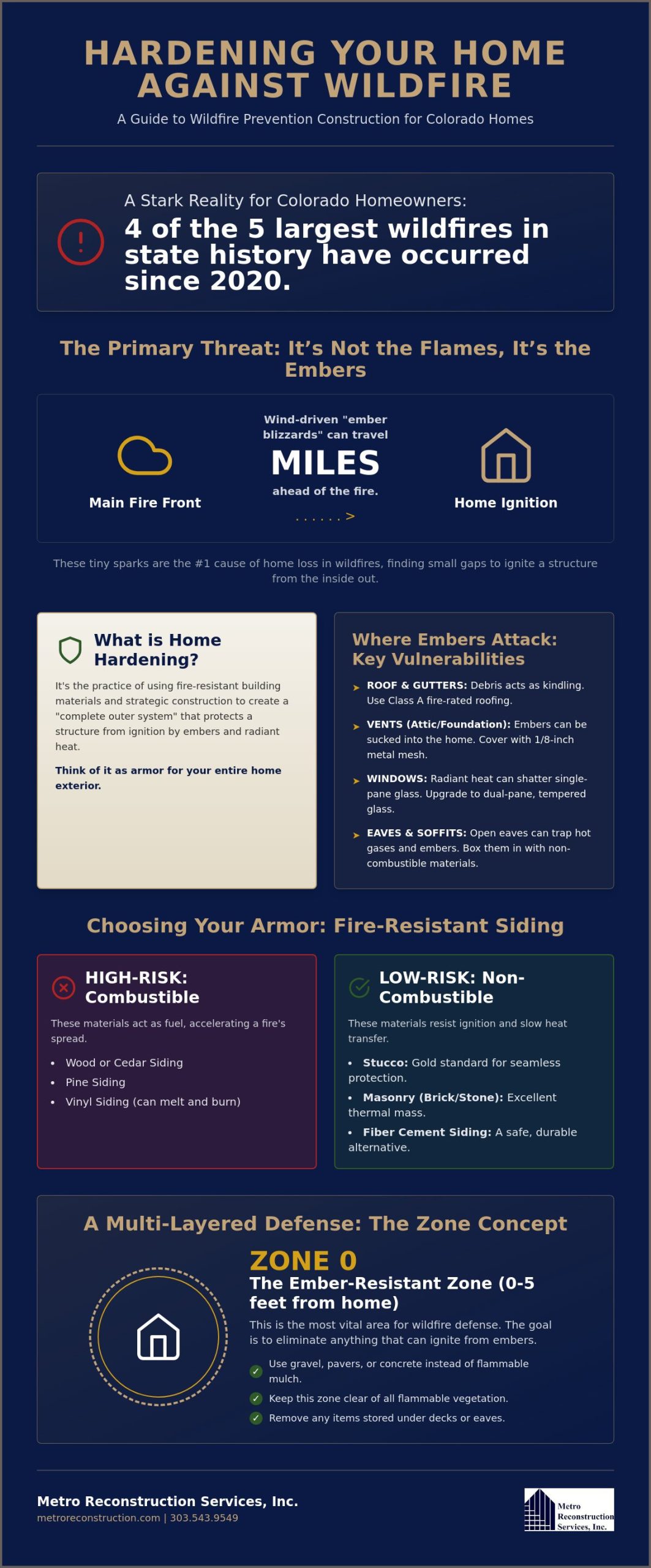
For many homeowners in the Front Range, the concept of a Wildfire has shifted from a distant seasonal concern to a year-round reality. This shift requires a forensic approach to how we build and maintain our properties. Home hardening is the practice of using fire-resistant materials to protect a structure from the two main ways fires spread: direct flame contact and airborne embers. While direct flames are terrifying, the “ember blizzard” is actually the primary threat to Colorado homes. These tiny, wind-driven sparks can travel miles ahead of the main fire front. They find small gaps in a building’s exterior to ignite the structure from the inside out.
Effective wildfire prevention construction isn’t about creating a single fireproof barrier. It’s about evaluating the building’s complete outer system as a single unit. We look at how different technical components interact with environmental stressors like extreme heat and high-velocity winds. Proactive construction is far more effective than emergency firefighting measures. It addresses the underlying structural origins of vulnerability before a crisis occurs. This methodology focuses on precision and the peace of mind that comes from a resilient home. This focus on structural integrity is common among top-tier builders; for example, those specializing in custom home construction and structural renovations like proconstructiontx.com apply similar precision to ensure long-term durability.
The Science of Ignition Resistance
Standard building materials often fail because of radiant heat. This intense energy can cause glass to break or wood to ignite even without direct flame contact. It’s vital to distinguish between fireproof and fire-resistant. In residential construction, very few things are truly fireproof. However, fire-resistant materials are designed to slow the spread of heat and resist ignition for a specific duration. This time is critical for the home’s survival. By reinforcing the entire exterior, we ensure that one weak point doesn’t lead to a total structural failure.
Why Colorado Homes Face Unique Risks
Our mountain communities face specific challenges that national building codes often overlook. High-altitude winds can push embers into eaves and vents with incredible force. Our regional climate cycles of wet springs followed by extreme droughts create a landscape of dry fuel. This is why local expertise in Boulder County construction is essential. A contractor who understands the rugged, regional environment will focus on property preservation rather than superficial fixes. Investing in wildfire prevention construction represents a commitment to the long-term value and safety of your home. If you have questions about your property’s safety, reach out to us at contact us or call 303.543.9549.
Fire-Resistant Materials: Hardening the Building’s Complete Outer System
True structural protection begins with the skin of the building. In the context of the Front Range, we view the exterior not just as a decorative layer, but as a high-performance shield designed to repel environmental stressors. Stucco and masonry are the gold standards for non-combustible exterior walls. These materials don’t ignite, and they provide a dense thermal mass that slows the transfer of radiant heat. For homeowners seeking professional installation of such systems, you can visit Royalty Construction to explore their exterior restoration and improvement services. When we analyze wildfire prevention construction, we focus on how these materials interact to create a continuous barrier. This prevents the “ember blizzard” from finding a way to reach the flammable wooden framing underneath.
The safety gap between traditional wood siding and modern alternatives is vast. While cedar or pine might offer a classic look, they act as fuel during a fire event. Fiber cement siding is a much safer alternative, yet its effectiveness depends entirely on the precision of the installation. If gaps are left at the joints or transitions, heat can bypass the siding and compromise the structure. We emphasize a forensic approach to assembly. This ensures every component of the complete outer system works in unison. For more detailed information on material standards, the Texas A&M Forest Service provides an excellent guide on Fire-resistant construction.
Stucco Restoration for Fire Safety
Stucco is exceptionally resilient, but its protective qualities diminish if the surface is compromised. Even small hairline cracks can allow wind-driven embers to lodge themselves against the building’s moisture barrier or sheathing. A traditional three-coat stucco system offers superior fire resistance compared to thinner, synthetic alternatives. We specialize in identifying these underlying structural origins of failure. If you’re wondering about your current exterior, you can learn more about is stucco fireproof? and how it fits into a modern safety plan.
Masonry and Stone Protection
Masonry provides an nearly impenetrable barrier at the most vulnerable points of a home, such as the foundation line. Using natural stone or brick creates a non-combustible transition between the ground and the rest of the siding. This is vital for stopping ground fires from climbing the walls. Our stucco and masonry repairs focus on restoring these barriers to their original integrity. A detailed evaluation of these components is often the first step in a successful wildfire prevention construction project. To discuss your property preservation needs, contact our experts at contact us or call 303.543.9549.
Eliminating Vulnerabilities: Windows, Vents, and Eaves
Identifying every entry point is critical for a structure to survive. While the walls provide the primary shield, the secondary systems are where the most dangerous failures often occur. Windows, vents, and eaves represent the weak links in a typical structure. This is the forensic reality of wildfire prevention construction. If these components aren’t addressed with technical precision, even the most fire-resistant siding can’t prevent a total loss. Accuracy in exterior home repair is a fundamental requirement for the preservation of your investment.
The interaction between glass and heat is a common point of failure. When a wildfire approaches, the radiant heat can cause standard glass to expand and shatter long before the flames reach the house. Once a window fails, the interior of the home is exposed to embers and smoke. This cause-and-effect relationship explains why many homes burn from the inside out despite having non-combustible siding. We approach these vulnerabilities by looking at the building’s complete outer system, ensuring that no single element compromises the whole.
High-Performance Window Solutions
Standard windows frequently fail during extreme temperature spikes. Vinyl frames can melt and deform, allowing the glass to fall out of the opening entirely. We recommend tempered, multi-pane glass which is specifically designed to resist the intense pressure of radiant heat. Metal frames provide a much higher level of stability than vinyl or wood. For a deeper look at technical specifications and material ratings, refer to our window installation guide.
Ventilation and Eave Hardening
Attic vents are designed to move air, but during a fire, they act as intake valves for embers. Standard mesh is often too large, allowing sparks to enter and ignite the insulation. We install ember-resistant mesh screens with openings of 1/16th inch or smaller to mitigate this risk. Additionally, boxing in open eaves, also known as soffit hardening, removes the fuel trap created by exposed rafters. This prevents fire from climbing the walls and becoming trapped under the roofline. In many modern mountain builds, we move toward unvented attic systems to eliminate these openings. These engineering-led solutions provide the long-term reliability you need. If you’re ready to evaluate your home’s defense, contact Metro Reconstruction Services, Inc. at contact us or call us at 303.543.9549.
Implementing a Multi-Layered Defense Strategy for Mountain Homes
A resilient home in the Front Range requires more than just fire-resistant walls. It needs a strategy that accounts for the relationship between the structure and the landscape. Mountain homes in areas like Golden and Boulder often sit on complex terrain where topography dictates fire behavior. On steep slopes, flames can pre-heat the vegetation and the house above them, causing a fire to move much faster than it would on flat ground. This environmental reality means that wildfire prevention construction must be paired with a meticulously managed perimeter to be truly effective.
We view the first five feet around your home, often called “Zone 0,” as the most critical layer of your defense. This area is the primary landing zone for wind-driven embers. If these embers land in dry mulch or organic debris, they can ignite and place intense heat directly against your siding or foundation. By creating a non-combustible break, you ensure that the “ember blizzard” has nothing to feed on when it reaches your home. This holistic approach is a form of property preservation that protects your investment from the ground up.
The Five-Foot Non-Combustible Perimeter
The transition between the ground and your home’s exterior should be entirely non-combustible. We recommend removing all mulch, woody plants, and flammable debris from the immediate foundation line. Replacing these materials with rock mulch, stone pavers, or concrete creates a permanent fuel break. It’s also vital to address wooden fences that attach directly to the house. These act as fuses, leading fire straight to your walls. Replacing the final five feet of a fence with metal or masonry ensures the fire cannot bridge the gap to your structure.
Hardening Decks and Porches
Decks are often the most vulnerable attachments to a mountain home. Embers can easily blow under an elevated deck and ignite stored items or accumulated leaf litter. To mitigate this risk, we use fire-rated decking materials and heavy timber construction which resists ignition much longer than standard dimensional lumber. Enclosing the underside of a deck with non-combustible materials like stucco or metal screens prevents the area from becoming a fuel trap. If you’re concerned about your current deck or perimeter, our fire mitigation inspections can identify these hidden vulnerabilities. Taking these steps now provides the reliability and peace of mind you need for the seasons ahead. To start your project, contact us at contact us or call 303.543.9549.
Expert Fire Mitigation and Structural Restoration with Metro Reconstruction Services, Inc.
Since 1982, Metro Reconstruction Services, Inc. has approached property preservation with the quiet confidence that only comes from decades of field experience. We understand that the Front Range presents unique structural challenges that require more than just surface-level fixes. Our forensic methodology identifies the underlying structural origins of vulnerability, ensuring that every component of the complete outer system is optimized for resilience. By choosing a partner dedicated to precision, you gain the peace of mind that your home is secured by professional wildfire prevention construction designed for long-term reliability.
Our identity as forensic experts means we look beyond the obvious to understand the hidden mechanics of a structure. This analytical depth is essential when evaluating how environmental stressors like high-altitude winds and radiant heat affect different building materials. We view ourselves not just as a service provider but as a dedicated partner in protecting your investment. This sense of integrity and protective care ensures that the solutions we implement today will provide lasting security for seasons to come.
Consultative Fire Mitigation Services
A professional evaluation is the foundational step in hardening your home against environmental stressors. We conduct a thorough diagnostic of your property, analyzing how specific technical components like siding, windows, and vents interact with the local landscape. Whether you are managing a custom home build or an exterior remodel, our project management team provides the authoritative professionalism needed for complex projects. You can visit our fire mitigation services page to learn how we evaluate your home’s readiness for the next season.
Reliable Craftsmanship for the Front Range
Our commitment to integrity and protective care for your investment defines our work across Colorado’s mountain communities. From the foothills of Golden to the rugged terrain of Boulder, we offer engineering-led solutions that prioritize substance over style. We would rather explain the difficult truth of a structural failure than offer a temporary, low-quality patch that leaves you at risk. Call Metro Reconstruction Services, Inc. today at 303.543.9549 to discuss your project. You can also reach us through our contact page at contact us to schedule a detailed evaluation of your property’s wildfire prevention construction needs.
Secure Your Property for the Future
The threat facing Front Range homeowners is significant, but it’s manageable through a forensic approach to property preservation. By evaluating your home as a complete outer system, you can eliminate the hidden vulnerabilities that lead to structural failure. The shift from a standard exterior to a hardened shell provides more than just safety; it offers long-term reliability and the confidence that your investment is protected against environmental stressors.
Metro Reconstruction Services, Inc. brings over 40 years of local expertise to every fire mitigation project. Our family-owned business values substance over style, ensuring that every detail of your wildfire prevention construction is handled with technical precision. Don’t wait for the next season to test your home’s defenses. Protect your investment with expert wildfire prevention construction. Contact Metro Reconstruction Services, Inc. today to schedule a diagnostic evaluation, or call us directly at 303.543.9549. Taking these steps today ensures your property remains a safe haven for years to come.
Frequently Asked Questions
What is the most important part of home hardening?
The most critical aspect of home hardening is ensuring the continuity of the building’s complete outer system. If one component fails, such as an unhardened vent or a standard window, the entire fire-resistive barrier is compromised. We focus on identifying these underlying structural origins of vulnerability to ensure every element works in unison to repel heat and embers.
Is stucco actually fireproof for Colorado homes?
While no material is truly fireproof, traditional three-coat stucco is one of the most fire-resistant options available for Front Range properties. Its dense thermal mass doesn’t ignite and effectively slows the transfer of radiant heat to the wooden frame. Proper stucco restoration ensures that hairline cracks don’t become entry points for wind-driven embers during a fire event.
Does home hardening increase my property value?
Investing in wildfire prevention construction increases property value by ensuring long-term property preservation and maintaining insurance eligibility in high-risk zones. As insurance companies in Colorado now provide wildfire risk scores, a hardened home is more attractive to buyers. It demonstrates a commitment to structural integrity and safety in a demanding regional environment.
How much does wildfire prevention construction cost?
The cost of wildfire prevention construction varies significantly based on the existing structure’s needs and the selected materials. We view these expenses as an investment in property preservation rather than a simple repair cost. A forensic evaluation is necessary to determine the specific scope of work required for your unique property and its surrounding topography.
Can I harden an existing home, or is it only for new builds?
You can absolutely harden an existing home through strategic retrofitting and exterior remodels. Most of our work involves identifying and correcting vulnerabilities in established structures throughout Boulder and Golden. Improving an older building’s complete outer system is a proactive way to ensure its survival and long-term reliability during future fire seasons.
What are the three zones of defensible space?
Defensible space is divided into three distinct zones that work together to slow fire spread. Zone 0 is the first five feet of non-combustible area around the foundation. Zone 1 extends from five to 30 feet and focuses on lean, clean, and green vegetation management. Zone 2 reaches from 30 to 100 feet to provide a final fuel break for the structure.
Do I need to replace my roof to be fire-safe?
You only need to replace your roof if it doesn’t meet the current Class A fire rating requirements. A Class A roof is essential because it provides the highest level of protection against fire penetration from falling embers. We evaluate your current roofing material as part of our fire mitigation inspections to see if it integrates safely with your home’s exterior.
Why are embers more dangerous than direct flames?
Embers are more dangerous than direct flames because they can travel miles ahead of a fire and enter a home through tiny gaps. Direct flames are visible and localized, but an “ember blizzard” searches for forensic weaknesses like open eaves or standard attic vents. This is why we prioritize hardening every entry point. To discuss your home’s vulnerabilities, contact us at contact us or call 303.543.9549.