
The fresh coat of paint you think is saving your home’s exterior might actually be the very thing destroying its structural health. If you are looking to refresh a faded color or seal up hairline cracks, the most common advice you’ll hear is to simply apply a new layer of paint. However, what looks like a cost-effective solution is actually a significant risk to your property’s long-term integrity. Understanding Why not to paint your Stucco is the first step in protecting your investment from the hidden mechanics of moisture intrusion and rot. Precision matters.
We know how frustrating it is to see your Denver home lose its curb appeal or to receive conflicting advice from painters and masons. It’s natural to want a beautiful exterior without the high cost of a full re-stuccoing, but surface-level patches often ignore the underlying structural origins of the problem. In this article, you’ll discover why painting stucco is a temporary fix that leads to long-term structural damage and why forensic restoration is the only way to truly protect your Colorado home. We’ll explain how your building’s complete outer system functions and why choosing precision over a quick fix saves you from expensive future repairs. Your peace of mind is our priority.
Key Takeaways
- Learn how stucco functions as a breathable building envelope and why obstructing its natural porosity leads to hidden structural rot.
- Understand Why not to paint your Stucco by discovering how non-permeable coatings create a destructive moisture trap against your home’s frame.
- See how Denver’s high-altitude UV rays and rapid freeze-thaw cycles accelerate the failure of rigid exterior paint layers.
- Explore fog coating as a professional restoration alternative that provides uniform color while maintaining critical vapor permeability.
- Discover the value of a forensic diagnostic approach that identifies underlying structural origins rather than settling for superficial patches.
Understanding Stucco as a Breathable Building Envelope
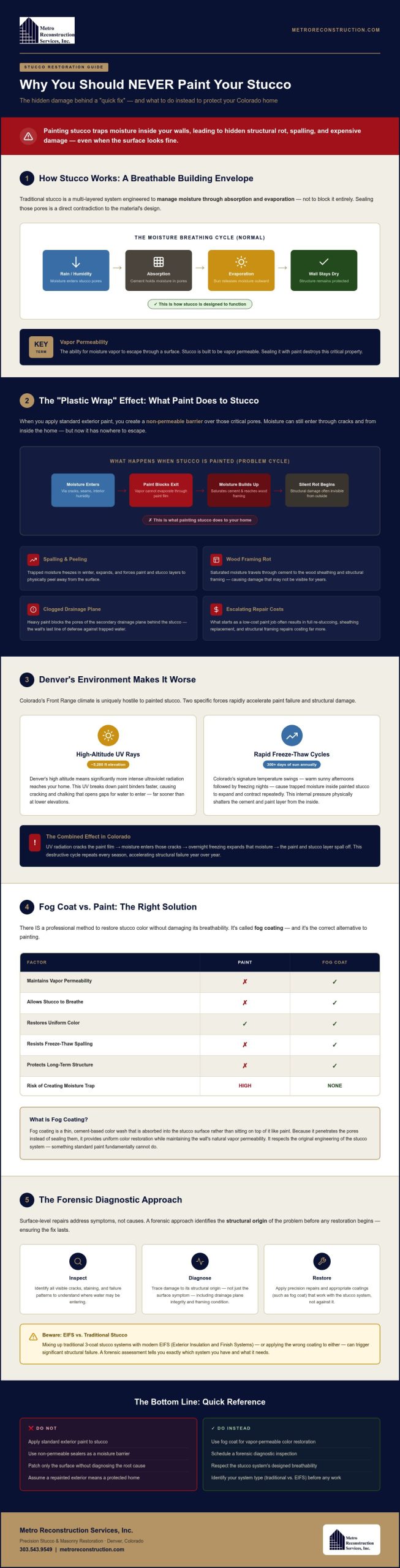
Traditional stucco is much more than a simple decorative finish; it is a complex, multi-layered system designed to protect your home while functioning as a breathable building envelope. Unlike materials that aim to completely block moisture, stucco is a porous material made from cement and sand. It is engineered to manage water through a process of absorption and evaporation. For many homeowners in the Denver area, the instinct to apply a standard exterior paint to refresh a faded look is strong. However, understanding Why not to paint your Stucco begins with recognizing that this material is meant to “breathe” alongside the environment. Precision in how we treat this surface determines the health of the entire structure.
Understanding Stucco requires looking at it as a reservoir. When it rains or the humidity rises, the stucco absorbs a controlled amount of moisture. As the sun comes out, that moisture is released back into the atmosphere through evaporation. This cycle is fundamental to the longevity of the structure. Traditional 3-coat stucco systems rely on this ability to stay dry. In contrast, modern synthetic systems, often called EIFS (Exterior Insulation and Finish Systems), use different layers and often require specialized drainage to prevent moisture buildup. Mixing up these systems or treating them with the wrong coatings can lead to significant structural failure.
The Porous Nature of Portland Cement
At a microscopic level, the cement used in stucco is full of tiny pores. These pathways allow air and water vapor to move through the material. This characteristic is what experts call vapor permeability. Simply put, vapor permeability is the ability for moisture to escape a surface. When you understand this, you see why surface-level sealing is a direct contradiction to the material’s design. If you seal those pores with a coating that acts like plastic, you aren’t protecting the wall; you’re trapping the humidity that naturally accumulates inside. This trapped moisture eventually seeks an exit, often pushing against the paint from the inside out.
Stucco vs. Other Siding Materials
Stucco handles moisture differently than wood or vinyl siding. While wood might rot if it stays wet and vinyl simply sheds water, stucco is part of a complete outer system. This system includes a drainage plane behind the stucco, which acts as a secondary defense. If water gets past the cement, the drainage plane allows it to exit at the bottom of the wall. Applying a heavy paint can clog the very pores that allow this system to dry out. For homeowners dealing with existing damage, choosing stucco and masonry repairs that respect this breathability is essential. We focus on restoration that aligns with the original engineering of your home.
If you are concerned about the health of your home’s exterior system, our team is ready to provide a professional assessment. Please contact us at 303.543.9549 or visit our contact page to discuss your home’s specific needs.
The Moisture Trap: Why Paint Leads to Stucco Rot
Applying a standard exterior paint to your stucco creates what we call the “Plastic Wrap” effect. While it might look clean for a season, you’ve essentially wrapped your home in a non-permeable barrier. This barrier prevents the natural evaporation process discussed in the previous section. When water vapor can’t escape through the pores of the cement, it accumulates behind the paint film. This is the primary reason Why not to paint your Stucco. Over time, this trapped moisture saturates the cement and eventually reaches the wood sheathing and framing. This leads to silent, structural rot that often goes unnoticed until the damage is severe.
The physical consequences are often visible through a process called spalling. During Denver’s cold nights, trapped moisture within the stucco expands as it freezes. This expansion creates internal pressure that forces the paint and the top layer of stucco to peel away. Research from the Building Science Corporation provides a detailed look at how paint leads to stucco rot by interrupting the drying potential of the wall assembly. Once this cycle begins, the protective qualities of your home’s exterior are compromised. Identifying these underlying structural origins early is the only way to avoid a complete failure of the building’s outer system.
The Myth of ‘Breathable’ Elastomeric Paint
Many painters suggest elastomeric paint as a solution because it’s marketed as “breathable.” In reality, this is often a marketing term that masks very low actual permeability. Elastomeric coatings are significantly thicker than standard acrylics. While they’re excellent at bridging hairline cracks, that same thickness contributes to vapor entrapment. You might achieve a temporary aesthetic improvement, but you’re sacrificing the internal structural integrity of the masonry. We’ve seen many cases where these coatings lead to more rapid deterioration than standard paint because they hold water against the substrate for longer periods.
Forensic Signs of Painted Stucco Failure
Identifying the early signs of failure can save you from a full replacement. Look for “stucco tears,” which are dark, vertical stains running down from window corners or trim. These indicate that water is trapped and trying to find an exit. Other forensic signs include:
- Bubbling Paint: Pockets of water or air trapped behind the coating.
- Efflorescence: A white, salty buildup that appears when minerals are carried to the surface by moisture and trapped under the paint.
- Delamination: The finish coat of the stucco physically separating from the base layers.
If you notice these symptoms, it’s time to move beyond surface fixes. Exploring professional Restoration Services can help identify the source of the moisture before mold begins to grow in your wall cavities. For a thorough evaluation of your home’s exterior health, you can reach our experts at 303.543.9549 or visit our contact page to schedule a consultation.
Environmental Stressors in the Front Range: UV and Freeze-Thaw
The Front Range presents a unique set of environmental challenges that standard building materials often struggle to withstand. With over 300 days of sunshine annually, our high-altitude environment subjects your home to intense radiation that is far more aggressive than what homes face in coastal or lower-elevation regions. This environmental reality is a primary reason Why not to paint your Stucco. While a fresh coat of paint might look appealing initially, the combination of high UV exposure and extreme temperature fluctuations creates a hostile environment for rigid coatings. Precision in material choice is the only way to ensure long-term protection.
Colorado’s semi-arid conditions also play a critical role in how masonry behaves over time. Stucco requires a specific moisture exchange to maintain its structural integrity. When a non-breathable paint is applied, it disrupts the natural hydration balance, leading to a brittle substrate that is more prone to damage from hail and wind. We focus on solutions that respect these regional demands rather than applying generic fixes that ignore the hidden mechanics of our climate. Understanding these stressors is the first step toward property preservation.
High-Altitude UV Degradation
Intense UV radiation acts as a chemical catalyst, breaking down the molecular bonds that give exterior house paint its flexibility and color. In the Denver area, this degradation happens at an accelerated rate. You’ll likely notice your home’s color fading within just a few years, but the deeper issue is “chalking.” This occurs when the paint resin disintegrates, leaving a powdery residue on the surface. This powder acts as a bond-breaker, making it incredibly difficult for any future restoration coatings to adhere correctly. It turns a simple aesthetic update into a complex forensic cleanup.
The Boulder Freeze-Thaw Challenge
Temperature swings in Boulder and Denver are notorious, sometimes shifting 50 degrees in a single afternoon. When moisture is trapped behind a layer of paint, these rapid changes trigger the destructive freeze-thaw cycle. As the water turns to ice, it expands by roughly 9 percent, creating “ice lenses” within the stucco layers. This internal expansion exerts immense pressure, forcing the stucco to crack or the paint to delaminate. Proactive exterior home repair is essential to address these issues before they compromise the building’s complete outer system.
If you’ve noticed hairline cracks or fading on your home, don’t settle for a temporary patch. Our team understands the specific needs of Colorado structures and the importance of maintaining a breathable exterior. For a professional evaluation, call us at 303.543.9549 or visit our contact page to schedule a consultation. We’re here to provide the peace of mind that comes from expert, long-term solutions.
Fog Coating vs. Painting: The Professional Restoration Alternative
Homeowners often feel caught between a fading exterior and the high cost of a full re-stuccoing. While painting is the most common suggestion from general painting contractors, we’ve established the structural risks involved in sealing a breathable system. There is a superior alternative that respects the engineering of your home: fog coating. This process provides a way to refresh your home’s color without compromising the building’s complete outer system. If you’re weighing your options, understanding the technical differences between these two methods will clarify Why not to paint your Stucco and instead choose a solution that lasts for decades.
Fog coating is a vapor-permeable, cement-based colorant for unpainted masonry. Unlike paint, which sits on the surface as a separate layer, fog coating is designed to integrate with the existing substrate. Before any coating is applied, a professional restoration involves deep cleaning the surface and performing precise crack repairs. This ensures the new finish has a stable, clean base to bond with. By choosing this path, you avoid the “plastic wrap” effect and maintain the moisture-management properties that your home was designed to provide.
What is Fog Coating?
Fog coating is essentially a thin liquid made of lime, Portland cement, and mineral pigments. When applied to an unpainted stucco surface, it creates a bond that becomes a permanent part of the wall. It doesn’t peel or flake because it isn’t a film. One of the most remarkable features of cement-based finishes is their natural ability to seal tiny cracks over time as the material reacts with moisture. However, it’s vital to remember that fog coating cannot be applied over existing paint. The pores of the stucco must be open for the bond to occur, which is why keeping your masonry unpainted is so critical for future maintenance. This level of care for historic surfaces is common in professional restoration; for instance, you can explore Brownstone Facade Restoration and Masonry Services to see how specialized treatments are applied to heritage buildings.
Restoration vs. Patchwork
A high-quality restoration focuses on matching both the texture and the color of the original finish. Simple patchwork often leaves a home looking like a quilt of different shades and patterns. Professional restoration ensures a uniform look while preserving the masonry’s ability to shed water vapor. If a home has already been painted, the more intensive option of sandblasting and re-stuccoing may be necessary to restore breathability. This labor-intensive process involves stripping the non-permeable layers back to the base coat, which is why we advocate for correct initial choices to avoid such expensive future repairs.
Don’t let a temporary aesthetic fix lead to long-term structural damage. If you want to protect your investment with a beautiful, breathable finish, explore our specialized Stucco Restoration options. Our team is ready to help you navigate these technical choices with quiet confidence and deep expertise. Contact us today at 303.543.9549 or visit our contact page to schedule a forensic evaluation of your home’s exterior.
Long-Term Stucco Preservation with Metro Reconstruction Services, Inc.
Preserving a home in Colorado requires more than a bucket of paint. It demands a holistic understanding of how different building elements interact with our rugged climate. Since 1982, Metro Reconstruction Services, Inc. has operated as a family-owned specialist dedicated to property preservation. We don’t believe in temporary patches that mask deeper failures. Instead, we advocate for the health of your building’s complete outer system. Understanding Why not to paint your Stucco is just the beginning; the next step is choosing a partner who views your home through a forensic lens. Precision is our foundational promise.
Our Forensic Diagnostic Process
We treat every home as a unique engineering challenge. Our process goes beyond surface-level work to ensure your home remains protected against the elements. We prioritize identifying the underlying cause of stucco cracks and moisture intrusion before proposing any restoration. As a leading construction company in Boulder, CO, we focus on structural integrity over superficial aesthetics. This analytical depth ensures that our work addresses the root issue, providing you with lasting peace of mind.
Protecting Your Investment
Investing in professional restoration offers a significantly higher long-term value than the recurring costs of painting. By maintaining the natural ability of your exterior to breathe, you prevent the rot and mold that can devalue your property. One way we provide certainty is through our “Fixed-Price” project fee. This approach eliminates the stress of hidden costs or unexpected changes, allowing you to focus on the preservation of your home. Metro Reconstruction Services, Inc. brings over 40 years of industry expertise to every project, ensuring your home remains both beautiful and structurally sound.
While exterior preservation is critical for structural health, many homeowners also choose to refresh their interior living spaces with the same level of professional precision. If you are looking for Cabinet refinishing Denver specialists to update your kitchen, you can learn more about their professional refinishing services.
If you’re ready to protect your home’s exterior with an engineering-led approach, contact our team today. Reach us at 303.543.9549 or visit our contact page to schedule your initial diagnostic evaluation. Let’s ensure your home stands strong for the next 40 years.
Protecting Your Home’s Structural Integrity for the Long Term
Choosing the right treatment for your exterior is a decision that affects the health of your home for decades. Precision matters. We’ve explored how stucco functions as a breathable reservoir and why standard paint disrupts that essential cycle by creating a non-permeable moisture trap. Understanding Why not to paint your Stucco prevents the silent structural rot that often follows superficial fixes. By prioritizing vapor permeability and addressing the underlying structural origins of damage, you ensure your building’s complete outer system remains resilient against Colorado’s intense UV and freeze-thaw cycles.
Since 1982, Metro Reconstruction has served Boulder and the Front Range as specialists in specialized structural mitigation. We focus on forensic diagnostics to provide long-term solutions rather than temporary patches. Our family-owned firm is dedicated to the craftsmanship and precision required to protect your investment. To secure the peace of mind that comes from expert care, Schedule a Forensic Stucco Evaluation with Metro Reconstruction today. You can also reach our team directly at 303.543.9549. We look forward to helping you preserve your home’s beauty and strength.
Frequently Asked Questions
Can I paint my stucco if it has already been painted before?
You can apply a new coat of paint to previously painted stucco, but doing so won’t resolve the underlying breathability issues. Once a non-permeable layer is present, the stucco’s natural moisture-management cycle is already compromised. Adding more layers simply thickens the barrier, increasing the risk of trapped moisture and eventual delamination of the finish coat.
What is the best type of paint for stucco if I absolutely must paint?
If painting is unavoidable, the least damaging option is a high-quality, 100% acrylic latex paint with a high vapor permeability rating. You should avoid heavy elastomeric coatings unless they are specifically required for a unique structural reason. While these “breathable” paints exist, they still offer significantly less moisture exchange than the original cementitious surface.
How do I know if my stucco is currently rotting underneath the paint?
Look for forensic indicators such as bubbling, peeling, or dark vertical stains often called “stucco tears” near window corners. You might also notice a soft or hollow sound when tapping on the surface, which suggests the stucco has separated from the lath. These signs indicate that moisture is trapped and the underlying wood sheathing may be experiencing structural rot.
Is fog coating more expensive than painting my stucco?
The initial cost of fog coating is often comparable to a premium paint job, but it provides much greater long-term value. Because fog coating becomes a permanent part of the cement and never peels, you avoid the recurring expense of scraping and repainting every five to seven years. It is a one-time restoration solution for unpainted masonry surfaces.
How often should stucco be professionally inspected for damage?
We recommend a professional inspection every three to five years to account for the intense freeze-thaw cycles in the Denver area. Regular evaluations allow us to identify hairline cracks or sealant failures before they lead to significant moisture intrusion. This proactive maintenance is the most effective way to preserve your building’s complete outer system and avoid large-scale repairs.
Can hairline cracks in stucco be fixed without painting the whole house?
Hairline cracks can be addressed through targeted repairs and fog coating without the need for a full-house paint job. Unlike paint, which creates a visible patch if not applied to the entire wall, fog coating integrates with the original texture and color. This allows for precise restoration that maintains the masonry’s breathability while achieving a uniform aesthetic finish.
Does painting stucco void any warranties or impact home value?
Painting stucco can negatively impact home value by signaling potential moisture issues to forensic inspectors and savvy buyers. Many professional stucco warranties are also voided the moment a non-breathable coating is applied to the surface. This loss of protection is a primary reason Why not to paint your Stucco if you want to maintain your property’s long-term market interest.