
That dark stain spreading across your stucco isn’t just an eyesore. It’s a warning. What looks like a surface-level discoloration is often the visible signature of a deeper moisture problem working its way through your home’s exterior system, quietly compromising the structural integrity beneath.
If you’ve noticed water stains, soft spots, or crumbling sections on your stucco, you’re right to take it seriously. Stucco water damage repair is one of those challenges where the visible symptom rarely tells the full story. Colorado’s climate, with its dramatic freeze-thaw cycles, intense UV exposure, and sudden moisture swings, places exceptional stress on exterior building systems. A surface patch might mask the problem temporarily, but without understanding the underlying cause, that moisture will find another way in.
This guide is designed to give you a clear, honest picture of what’s actually happening when water infiltrates stucco, which repair methods address the root cause rather than just the surface, and how to protect your home from recurring damage. By the end, you’ll have the diagnostic framework to make informed decisions, whether you’re assessing a small section of concern or planning a full exterior restoration.
Key Takeaways
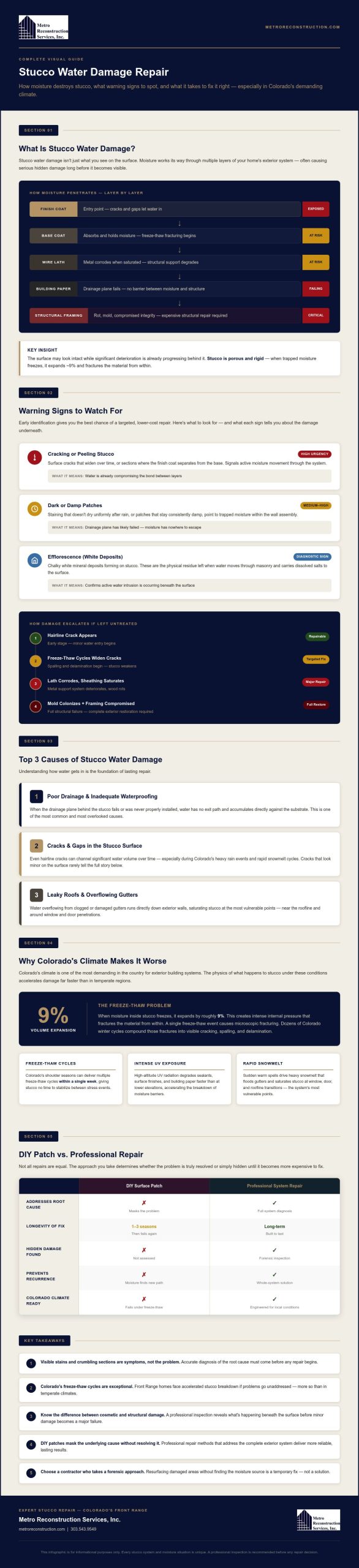
- Stucco water damage repair is rarely a surface-level fix — visible stains and crumbling sections are often symptoms of deeper moisture infiltration that requires accurate diagnosis before any repair begins.
- Colorado’s freeze-thaw cycles and dramatic climate swings place exceptional stress on stucco exteriors, making the region’s homes especially vulnerable to accelerated moisture damage if problems go unaddressed.
- Knowing the difference between cosmetic discoloration and structural compromise is critical — a professional inspection can reveal what’s happening beneath the surface before minor damage becomes a major failure.
- DIY patches frequently mask the underlying cause without resolving it, which is why professional repair methods focused on the complete exterior system deliver more reliable, long-lasting results.
- Working with an experienced contractor who takes a forensic approach to moisture diagnosis — rather than simply resurfacing damaged areas — is the most effective way to protect your home’s long-term structural integrity.
What is Stucco Water Damage?
Stucco water damage occurs when moisture penetrates the exterior cladding system and begins compromising the layers beneath, including the base coat, wire lath, building paper, and ultimately the structural sheathing and framing. It’s a deceptively complex problem. The surface of your stucco may look relatively intact while significant deterioration is already progressing behind it, hidden from plain view and quietly eroding the materials your home depends on for structural stability.
What makes water damage particularly destructive in stucco systems is the material’s composition. Traditional stucco is a cementitious product, meaning it’s rigid and relatively porous. When moisture infiltrates and then freezes, the expansion creates internal pressure that fractures the material from within. Repeated cycles of this process, which are a routine feature of Colorado’s climate, accelerate the breakdown far faster than in more temperate regions. This is why stucco water damage repair in this region demands more than a cosmetic fix; it requires a thorough understanding of how moisture moves through a complete exterior system.
Common Causes of Stucco Water Damage
Understanding what allows water in is the first step toward keeping it out. The most frequent entry points include:
- Poor drainage and inadequate waterproofing: When the drainage plane behind the stucco fails or was never properly installed, water has no exit path and accumulates against the substrate.
- Cracks and gaps in the stucco surface: Even hairline cracks can channel significant water volume over time, especially during Colorado’s heavy rain events or rapid snowmelt cycles.
- Leaky roofs and gutters: Water overflowing from clogged or damaged gutters runs directly down exterior walls, saturating the stucco at the most vulnerable transition points near the roofline and around window and door penetrations.
Signs of Potential Damage to Look For
Recognizing the early warning signs gives you the best chance of addressing the problem before it becomes a structural failure. Watch for these indicators:
- Cracking or peeling stucco: Surface cracks that widen over time, or sections where the finish coat is separating from the base, signal that moisture is working its way through the system.
- Damp or discolored patches: Dark staining that doesn’t dry uniformly after rain, or patches that remain consistently damp, point to moisture trapped within the wall assembly.
- Efflorescence: Those chalky white mineral deposits forming on your stucco’s surface aren’t cosmetic. They’re the physical residue left behind when water moves through masonry and carries dissolved salts to the surface, confirming that active water intrusion is occurring beneath.
Left unaddressed, these symptoms escalate. Saturated sheathing rots. Metal lath corrodes. Mold colonizes wall cavities. What begins as a visible stain can, over several seasons, develop into compromised framing that requires far more extensive intervention to correct. Early, accurate diagnosis isn’t just advisable; it’s the difference between a targeted repair and a full-scale restoration.
Understanding the Impact of Colorado’s Climate on Stucco
Colorado doesn’t offer stucco a gentle environment. The state’s climate is, in many respects, one of the most demanding in the country for exterior building systems, and the physics of what happens to a cementitious material under those conditions explains a great deal about why stucco water damage repair is such a persistent challenge for homeowners along the Front Range.
The core mechanism is freeze-thaw cycling. When moisture infiltrates stucco and temperatures drop below freezing, that water expands by roughly nine percent as it becomes ice. The pressure generated within the material’s pore structure is substantial. A single freeze-thaw event causes microscopic fracturing. Dozens of cycles across a single Colorado winter compound those fractures into visible cracking, spalling, and delamination. What makes this especially problematic is that Colorado’s shoulder seasons, particularly late autumn and early spring, can deliver multiple freeze-thaw cycles within a single week, giving the material little opportunity to stabilize between stress events.
Snowmelt adds another layer of complexity. Accumulated snow against a wall face doesn’t drain the way rainfall does. It sits, slowly releasing moisture as temperatures fluctuate, creating a sustained saturation condition that persistent rain rarely replicates. That prolonged contact gives water more time to work through any existing micro-cracks in the stucco system, loading the wall assembly with moisture before the next freeze arrives.
High UV exposure compounds the problem from the opposite direction. Colorado receives more annual sunshine than Miami or Los Angeles, and that intense UV radiation accelerates the degradation of sealants, caulking, and the surface finish coat itself. As these protective layers break down, the stucco system loses its first line of defense against moisture intrusion. The result is a material that’s simultaneously being dried out and made brittle by sun exposure while remaining vulnerable to the next moisture event.
Seasonal Challenges for Stucco in Boulder
Boulder’s position at the base of the Foothills creates a microclimate with its own specific pressures. Winter brings heavy snow accumulation at grade level and along roof transitions, where meltwater channels directly toward wall penetrations and foundation interfaces. Summer delivers intense heat that causes stucco to expand and contract, widening existing cracks and stressing any repairs that weren’t made with Colorado’s thermal range in mind. These aren’t abstract seasonal variations; they’re active, recurring forces working against your exterior system year-round.
Mitigating Climate Risks for Stucco Homes
Protecting stucco in this climate requires a proactive, system-level approach rather than reactive patching. Practical measures that make a measurable difference include:
- Annual pre-winter inspections: Identifying and sealing hairline cracks before freeze-thaw cycles begin prevents small vulnerabilities from becoming structural failures by spring.
- High-performance sealant application: Elastomeric sealants designed for Colorado’s thermal range can accommodate the expansion and contraction that rigid products crack through. Proper selection and application at all penetrations, joints, and transitions is critical.
- Gutter and drainage maintenance: Keeping water away from wall surfaces during snowmelt events reduces the sustained saturation conditions that accelerate moisture infiltration.
- UV-resistant finish coats: Selecting finish materials rated for high-altitude UV exposure extends the protective life of the outer surface and reduces the frequency of sealant breakdown.
These measures are most effective when they’re part of a comprehensive maintenance strategy rather than isolated responses to visible damage. If you’re evaluating the current condition of your stucco system, exploring professional stucco restoration services designed specifically for Colorado’s climate is a sound starting point for understanding what your home actually needs.
Diagnosing Water Damage in Stucco: When to Call a Professional
Visible damage is rarely the whole story. A stain on your exterior wall might represent nothing more than surface runoff, or it might be the only visible indicator of a wall cavity that’s been saturated for months. Distinguishing between cosmetic discoloration and active structural compromise isn’t something you can do reliably from the sidewalk, and making that distinction accurately is what separates a targeted, effective repair from a costly misdiagnosis.
The core diagnostic question is straightforward: is the damage isolated to the finish coat, or has moisture penetrated through the base coat, building paper, and into the substrate? Cosmetic damage stays at the surface. It doesn’t return after cleaning, doesn’t feel soft or spongy under pressure, and doesn’t correspond to interior symptoms like musty odors or damp drywall. Structural compromise behaves differently in every one of those respects.
Signs You Need Professional Help
Certain symptoms reliably indicate that a professional inspection is the appropriate next step, not a can of patching compound:
- Stains that return after cleaning: If discoloration reappears within days or weeks of being cleaned, it’s not residual. Active moisture is moving through the wall system and continuing to deposit minerals or biological growth at the surface.
- Soft spots or flex in the stucco surface: Healthy stucco is rigid. Any section that gives under hand pressure has lost its bond to the substrate, which typically means the material behind it is saturated, deteriorated, or both.
- Interior moisture symptoms near exterior walls: Peeling paint, damp baseboards, or mold growth on interior wall surfaces adjacent to stucco exteriors confirm that moisture has already breached the complete outer system and is working inward.
- Cracks that widen seasonally: A crack that’s measurably wider in spring than it was in fall is responding to freeze-thaw pressure, meaning water is already present within the stucco assembly and actively expanding it.
The Forensic Approach Explained
Accurate stucco water damage repair begins with accurate moisture detection, and that requires more than a visual assessment. A forensic approach uses calibrated instruments to map moisture content across the wall assembly, identifying not just where damage is visible but where saturation exists below the threshold of visibility.
Professionals use tools like pin-type and pinless moisture meters to measure moisture levels at different depths within the wall system, along with infrared thermal imaging to identify temperature differentials that indicate wet areas behind intact stucco surfaces. Probe testing at strategic locations, particularly around window and door penetrations, roofline transitions, and grade-level interfaces, reveals whether the drainage plane is functioning or has failed.
The value of this comprehensive moisture audit goes beyond identifying the damage that’s already visible. It maps the full extent of infiltration, locates the actual entry points rather than just the symptoms, and gives the repair contractor a complete picture of what needs to be addressed. Without it, a repair targets the stain. With it, a repair targets the source.
Metro Reconstruction’s approach to diagnosis reflects more than four decades of working with Colorado’s exterior systems. If you’re seeing symptoms that don’t resolve on their own, reviewing their stucco restoration services is a practical starting point for understanding what a thorough professional assessment actually involves.
Effective Repair Strategies for Stucco Water Damage
Knowing the damage exists is only half the equation. What happens next, specifically the method chosen to address it, determines whether your home gets a genuine solution or a temporary cosmetic mask that fails within a season or two.
The appeal of DIY patching is understandable. Pre-mixed stucco compounds are widely available, the application looks straightforward, and the immediate visual result can be convincing. The problem isn’t the material; it’s the sequence. A patch applied over saturated substrate traps moisture behind it. That trapped moisture continues its work, and the repair fails, often taking surrounding material with it when it goes. Without first drying the wall assembly, removing compromised layers, and verifying that the original entry point has been sealed, any surface repair is building on a compromised foundation. It doesn’t fix the problem. It delays it, and usually makes the eventual professional repair more extensive.
Professional stucco water damage repair follows a fundamentally different logic. It starts with the source, not the symptom.
The professional process typically involves:
- Complete removal of compromised material: Damaged stucco, deteriorated building paper, and corroded lath are removed down to sound substrate. Partial removal that leaves compromised layers in place undermines everything applied over it.
- Substrate assessment and remediation: Sheathing and framing are inspected for rot, mold, or structural compromise. Any affected material is replaced before the new system goes on.
- Drainage plane restoration: New weather-resistant barrier is installed correctly, with proper lapping and integration at all penetrations, to re-establish the drainage plane that failed in the first place.
- Layered stucco application: Scratch coat, brown coat, and finish coat are applied with appropriate cure times between layers, using materials suited to Colorado’s thermal range.
- Penetration sealing: Every window, door, utility penetration, and transition point is sealed with elastomeric products rated for the region’s expansion and contraction demands.
Long-Term Solutions for Moisture Control
Repairing the damage without addressing the conditions that allowed it to develop is an incomplete strategy. Proper drainage systems, including correctly sloped grade at the foundation perimeter, functioning gutters, and downspout extensions that carry water well away from the wall base, remove the sustained saturation conditions that accelerate infiltration. Paired with annual pre-season inspections that identify new cracks or sealant failure before freeze-thaw cycles begin, these measures extend the life of any professional repair significantly. Maintenance isn’t optional; it’s what protects the investment.
Professional Repair Services Offered by Metro Reconstruction
Metro Reconstruction has been working with Colorado’s exterior systems since 1982. Their stucco restoration process reflects that depth of regional experience: a forensic moisture assessment first, followed by a complete system repair that addresses the entry point, the drainage plane, and the finished surface as integrated components rather than isolated problems. It’s a methodology built around long-term performance in a climate that doesn’t forgive shortcuts.
If your stucco is showing signs that go beyond surface wear, the right starting point is an honest assessment of what’s actually happening behind the finish coat. Contact us today to schedule a consultation and get a clear picture of what your home needs.
Contact Metro Reconstruction for Expert Stucco Repair
At some point, the research ends and a decision has to be made. If the signs are there, soft spots, recurring stains, cracks that widen each spring, the most protective thing you can do for your home is get an accurate assessment from someone who understands what’s actually happening behind the surface. Not a sales call. A real diagnostic conversation with a contractor who has spent decades solving exactly this kind of problem.
Stucco water damage repair done correctly is a system-level intervention, not a cosmetic procedure. The contractor you choose needs to understand the difference, and more importantly, needs to have the regional experience to recognize how Colorado’s specific climate conditions have shaped the damage pattern in front of them. That context changes everything about how a repair is scoped, sequenced, and executed.
Why Choose Metro Reconstruction?
Metro Reconstruction has been restoring Colorado exteriors since 1982. That’s more than four decades of working in the same demanding climate, on the same types of homes, with the same freeze-thaw pressures and UV exposure that accelerate deterioration along the Front Range. That depth of regional experience isn’t incidental. It’s what allows their team to recognize failure patterns quickly, diagnose moisture pathways accurately, and recommend repairs that are built to last in this specific environment rather than in a more forgiving one.
What distinguishes their approach is the forensic methodology applied before any repair work begins. Moisture mapping, thermal imaging, and systematic probe testing at penetration points give their team a complete picture of where water has traveled, not just where it’s visible. That diagnostic foundation is what separates a repair that holds from one that fails within a season.
As a family-owned company, Metro Reconstruction brings a straightforward commitment to quality craftsmanship and honest communication. They’d rather explain the full scope of what a wall assembly needs than sell a partial fix that leaves the underlying problem intact. That’s the kind of transparency that earns long-term trust, and it reflects a business philosophy built around protecting your investment, not just completing a transaction.
Their full range of stucco restoration services is designed to address the complete exterior system, from drainage plane restoration to finish coat application, with every layer treated as a functional component rather than an afterthought.
If your stucco is showing signs that concern you, don’t wait for a small problem to become a structural one. Call Metro Reconstruction at 303.543.9549 to schedule a consultation and get a clear, honest assessment of what your home actually needs.
Take the Next Step Before the Damage Does
Stucco water damage repair isn’t a problem that resolves on its own. The freeze-thaw cycles will keep coming, the moisture will keep moving, and a small vulnerability left unaddressed today becomes a structural problem that costs significantly more to fix tomorrow. What this guide makes clear is that accurate diagnosis always comes before effective repair, and that surface-level fixes rarely address what’s actually happening inside the wall assembly.
The right approach starts with understanding the complete exterior system, not just the visible stain. It requires regional expertise, forensic moisture detection, and a contractor committed to solving the root cause rather than masking it.
Metro Reconstruction brings over 40 years of Boulder-based experience, specialized forensic moisture mitigation, and the integrity of a family-owned business that prioritizes your home’s long-term protection over a quick transaction.
Protect your home from hidden moisture damage. Contact the experts at Metro Reconstruction today or call 303.543.9549 to schedule your consultation. Your home is worth getting it right.
Frequently Asked Questions About Stucco Water Damage Repair
What causes water damage in stucco?
Water damage in stucco typically originates from failed or missing drainage planes behind the cladding, cracks in the finish or base coat that channel moisture inward, and compromised sealants at penetration points like windows, doors, and utility openings. Overflowing gutters and poor grade drainage at the foundation perimeter are also common contributors, directing sustained water contact against wall surfaces that weren’t designed to handle prolonged saturation.
How can I tell if my stucco needs repair?
Look for staining that reappears after cleaning, sections that feel soft or flex under hand pressure, visible cracks that have widened over time, and chalky white efflorescence deposits on the surface. Interior symptoms near exterior walls, such as peeling paint or damp baseboards, are a strong indicator that moisture has already moved through the complete wall assembly. If you’re seeing any combination of these signs, a professional moisture assessment is the appropriate next step.
Is it possible to fix stucco water damage myself?
Minor cosmetic blemishes on an otherwise sound surface can sometimes be addressed with careful DIY patching, but most stucco water damage repair situations involve more than the surface layer. Applying patch material over saturated or compromised substrate traps moisture behind the repair, which typically causes the new section to fail faster than the original damage. Without accurate moisture detection and proper drainage plane restoration, a DIY patch treats the symptom while the underlying cause continues working.
What are the signs of serious water damage?
Serious damage is indicated by stucco that sounds hollow when tapped, sections that visibly bulge or delaminate from the substrate, and any soft or spongy areas that suggest the sheathing behind the wall has absorbed significant moisture. If you’re detecting musty odors inside the home, or noticing mold growth on interior wall surfaces adjacent to stucco exteriors, the moisture has already moved through the full wall system and likely requires substrate replacement, not just surface repair.
How long does it take to repair stucco water damage?
Timeline varies considerably depending on the extent of the damage and how much of the wall assembly needs to be replaced. A localized repair involving a single compromised section might take a few days once the substrate has dried sufficiently. Larger restorations that require removing and replacing building paper, lath, and sheathing across multiple wall sections can take considerably longer, particularly because proper stucco application requires adequate cure time between the scratch coat, brown coat, and finish coat layers.
Will my homeowners insurance cover stucco repair?
Coverage depends heavily on the cause of the damage and the specific terms of your policy. Sudden, accidental water intrusion from a covered event like storm damage may qualify for a claim, while damage attributed to long-term moisture infiltration or deferred maintenance is typically excluded. It’s worth reviewing your policy carefully and documenting the damage thoroughly before filing. A professional inspection report that identifies the cause and scope of damage can be valuable supporting documentation during the claims process.
What is the best way to prevent water damage in stucco?
Prevention centers on two priorities: keeping water away from wall surfaces and maintaining the integrity of every penetration point in the stucco system. Annual pre-winter inspections to identify and seal new cracks before freeze-thaw cycles begin, properly functioning gutters and downspouts, and elastomeric sealants rated for significant thermal expansion at all window and door transitions form the foundation of an effective maintenance strategy. These measures are most protective when applied consistently rather than reactively.
Can you paint over water-damaged stucco?
Painting over water-damaged stucco without first resolving the underlying moisture problem is a cosmetic fix that typically fails quickly. Paint applied to a damp or compromised surface won’t bond correctly, and active moisture moving through the wall will cause blistering, peeling, and continued surface deterioration. If the stucco surface is sound, fully dry, and the moisture source has been properly addressed and sealed, a quality exterior paint or elastomeric coating can then serve as an additional protective layer.