
That hairline fracture on your home’s exterior is rarely just a surface-level blemish; it’s often a silent warning from your building’s complete outer system. While a simple stucco crack repair might seem like a cosmetic task, these gaps frequently serve as forensic clues to underlying structural movement or moisture intrusion. If you’ve felt the frustration of a recurring crack after a quick fix or the fear of hidden water damage, you aren’t alone. It’s natural to worry about the health of your property when the protective shell of your home begins to show signs of stress.
By understanding the root cause of these issues, you can move beyond superficial patches toward a permanent solution that ensures your home remains moisture-free. This guide will help you diagnose the specific type of failure you’re seeing and explain the professional methods used to match your existing texture perfectly. We’ll explore how environmental factors like expansive soils impact your walls and provide a clear path to restoring your peace of mind and your home’s structural integrity.
Key Takeaways
- Learn why external cracks are often symptoms of deeper environmental or structural stressors rather than just surface-level blemishes.
- Discover how to distinguish between minor shrinkage and serious structural shifts to determine the urgency of your home’s needs.
- Understand the “sandwich effect” and why improper DIY patching can trap moisture and lead to more expensive stucco crack repair projects in the future.
- Explore the five-step forensic restoration process that focuses on the root cause of damage to ensure a permanent, weather-tight solution.
- Gain peace of mind by learning how a holistic approach to your building’s complete outer system protects your long-term investment.
Understanding Stucco Cracks: Why Your Home’s Exterior Fails
Stucco is a remarkably durable material, but its strength is also its primary vulnerability. Because it is essentially a rigid shell of cement and sand, it doesn’t have the natural ability to bend or stretch when your home moves. When we evaluate a property for stucco crack repair, we don’t view the damage as a simple surface blemish. Instead, we see it as a sign of the pressures acting on your building’s complete outer system. These breaks are often symptoms of deeper issues, ranging from the natural settling of the house to more aggressive environmental forces unique to our region.
In the Front Range, our homes face some of the most demanding weather patterns in the country. The intense sun during the day causes the exterior to expand, while the rapid cooling at night forces it to shrink. This constant change creates wear and tear within the material. Understanding the stucco composition and properties helps explain why these stresses lead to failure. Traditional cement-based stucco is designed to be a protective barrier, but without proper care, it can become brittle. Ultimately, a stucco crack is a break in the building’s protective envelope that requires diagnostic attention.
The Role of Moisture in Stucco Failure
Water is the most persistent threat to your home’s health. Even a tiny crack can pull moisture behind the protective finish, much like a straw drawing up liquid. Once water gets inside, it starts to rot the wood framing, often staying hidden until the damage is severe. You might see white, powdery salt stains near a crack. These marks show that water is moving through the wall and carrying minerals to the surface. Because of this, professional stucco crack repair must always start by making sure the inside is dry before the outside is sealed.
Colorado’s Expansive Soils and Your Foundation
The ground in Boulder and Denver often contains clay that swells when wet and shrinks as it dries. This movement at the foundation level creates tension that pulls on the rest of the house. Since stucco is so stiff, it’s often the first part of the home to break when the foundation shifts even a small amount. These cracks usually show up as diagonal lines near windows or doors. In these cases, we often suggest specialized foundation repair services to fix the root cause before we restore the exterior walls.
Identifying Different Types of Stucco Damage
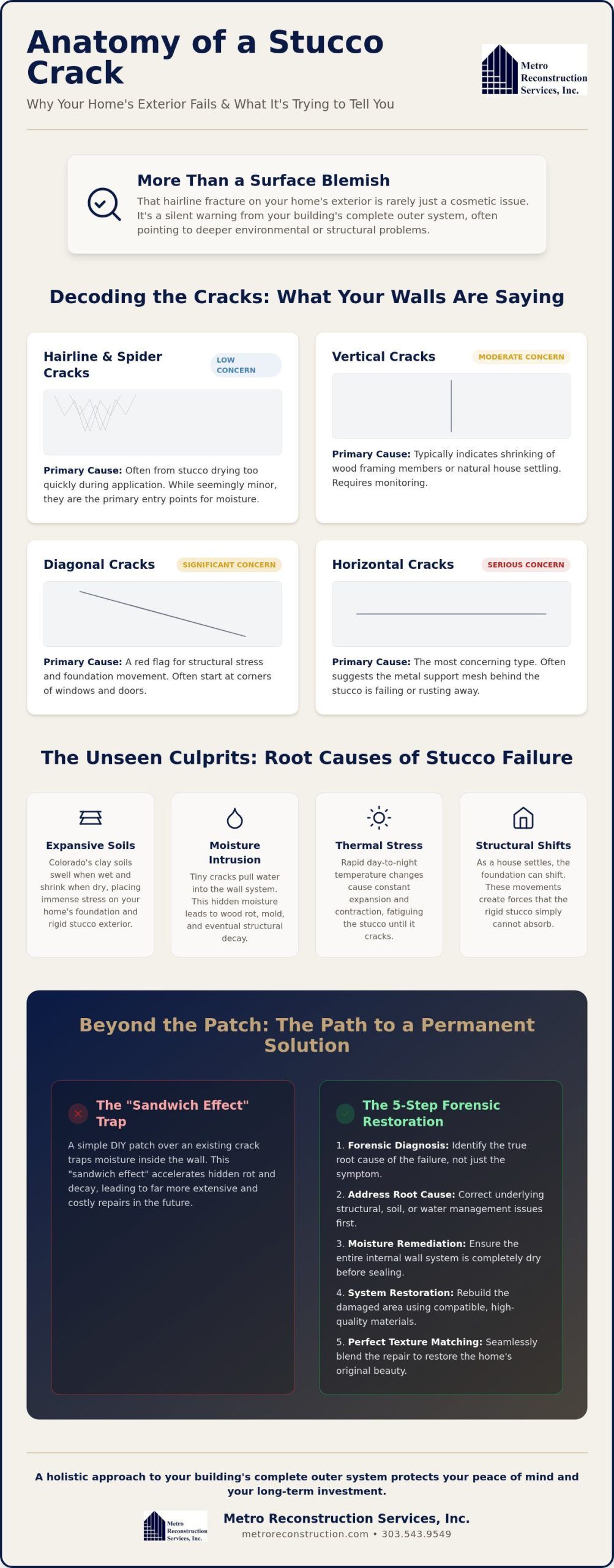
Every homeowner eventually notices a blemish on their exterior, but not all fractures carry the same weight. The shape and direction of a crack reveal the specific forces at play behind your walls. By categorizing these issues by their size and location, we can determine whether the damage is a natural result of aging or a sign of a deeper structural failure. Accurate identification is the first step toward an effective stucco crack repair that lasts for decades rather than months.
Hairline Cracks vs. Spider Cracking
Hairline cracks are typically thin, often measuring less than 1/16th of an inch. While they might seem small, they are the primary entry point for moisture in our volatile climate. Spider cracking, which looks like a tangled web or a map, usually happens when the stucco was applied too thickly or dried too quickly during the initial build. These patterns often indicate that the material itself is failing to bond correctly. Even if these appear to be just surface issues, sealing them is vital to prevent water from reaching the building’s complete outer system and causing hidden rot.
Vertical, Horizontal, and Diagonal Cracking
The direction of a crack often points directly to its cause. Vertical cracks can appear when wood framing members shrink or when the house settles into the soil. Diagonal cracks, particularly those extending from the corners of windows and doors, are red flags for structural stress. These indicate that the building is shifting in ways the rigid stucco cannot handle. Horizontal cracks are perhaps the most concerning, as they often suggest that the metal support mesh behind the surface is rusting or pulling away. Following the standards for professional stucco restoration ensures that we address the underlying tension before applying a new finish.
Localized bulging or staining is another critical warning sign. If a section of your wall looks swollen or feels soft when pressed, water is likely trapped between the layers. This creates a high risk for mold and structural decay. To help you evaluate your home, use this quick checklist during your next walk-through:
- Check the corners: Look for diagonal lines stretching away from window and door frames.
- Inspect the base: Search for cracks near the foundation line where moisture often pulls upward.
- Look for streaks: Identify brown or grey stains beneath windows, which suggest internal moisture.
- Listen for hollows: Gently tap areas near cracks; a hollow sound means the stucco has detached from its support.
If you discover directional cracks or signs of moisture, it’s time to move beyond simple patches and consider a more comprehensive strategy for stucco crack repair. You can reach the team at Metro Reconstruction Services, Inc. by visiting our contact page or by calling us at 303.543.9549 for a professional evaluation.
The Hidden Dangers of Improper Stucco Patching
The impulse to reach for a tube of hardware-store caulk when you spot a fracture is understandable, yet this reactive approach often compromises the building’s complete outer system. A successful stucco crack repair requires more than just filling a gap; it requires an understanding of how the repair material interacts with the existing wall. When a stiff, non-breathable sealant is applied to a moving crack, it creates a temporary barrier that eventually fails under environmental stress. This failure leads to the “sandwich effect,” where moisture becomes trapped between the original stucco and the new patch. Without a way to escape as a gas, this trapped water moves inward, causing invisible wood rot and mold growth within the wall cavity that can remain undetected for years.
The choice between a DIY approach and professional expertise is a frequent consideration for homeowners regardless of their location. For those also managing interior surfaces, Chaparro’s Painting, LLC offers an insightful comparison of DIY versus professional wall patching that can serve as a valuable guide for ensuring quality repairs.
According to the Stucco Manufacturers Association crack policy, proper assessment is required to determine if a crack is stable or moving before any repair material is selected. Choosing the wrong material for stucco crack repair can inadvertently turn a cosmetic issue into a structural emergency. If the patch doesn’t allow the wall to breathe naturally, the moisture levels behind the stucco will rise, eventually damaging the metal support mesh and the wooden framing. This hidden decay often leads to costly reconstruction that could have been avoided with a forensic approach to the initial repair.
Why DIY Sealants Often Fail
Most DIY sealants lack the flexible, rubber-like properties found in professional-grade coatings. While a standard caulk might look fine initially, it doesn’t have the stretch needed to survive Colorado’s temperature swings. As the building expands and contracts, the stiff patch pulls away from the edges of the crack, creating a new entry point for water. Professional restoration utilizes materials specifically engineered to match the expansion and contraction rates of the surrounding wall. This ensures the seal remains intact even as the structure moves, providing a long-term solution rather than a temporary fix.
The Aesthetic Cost of Poor Repairs
Beyond the structural risks, improper patching significantly impacts your home’s curb appeal and resale value. Stucco comes in various specialized textures, such as dash, lace, or smooth finishes, and matching these requires a high level of craftsmanship. A “patchy” repair is often visible even after a fresh coat of paint because the light hits the mismatched texture differently than the rest of the wall. These visible blemishes signal to potential buyers that the home hasn’t been maintained with precision. To achieve a seamless finish that protects your investment, it’s essential to work with experts who understand the nuances of texture matching and stucco restoration.
If you’re concerned about previous repairs or new damage, contact Metro Reconstruction Services, Inc. at 303.543.9549 or visit our contact page for a professional evaluation.
The Forensic Approach to Lasting Stucco Restoration
Effective restoration requires a perspective that looks beyond the surface to the hidden mechanics of your home. While many online tutorials suggest applying a patch directly over a fracture, this superficial method ignores the underlying stressors that caused the break. Our forensic approach treats your home as a complete outer system, where every layer must work in harmony to repel moisture and accommodate movement. This methodology ensures that the root cause is resolved, preventing the same issues from resurfacing in a few months. Professional restoration involves removing loose material back to a sound substrate before rebuilding.
Step 1: Forensic Diagnosis and Moisture Testing
The most critical phase of any project is the initial identification of failure origins. We begin by determining if the damage stems from environmental factors like Colorado’s expansive soils or internal issues like poor original installation. Using specialized moisture meters, we verify that the underlying wooden structure is dry and free from decay. We also evaluate the weather-resistive barrier and the metal lath to ensure they still provide the necessary support for a new finish. This step replaces guesswork with data, providing a solid foundation for the repair.
Step 2: Preparation and Structural Stabilization
Once we understand the cause, we prepare the area to receive new material. This involves widening the crack to create a “key,” which allows the new stucco to bond securely to the old. If the crack was caused by structural shifts, we address foundation or framing stabilization first. A clean, dust-free surface is essential for maximum adhesion. Without this meticulous preparation, even the highest quality materials will eventually peel or separate from the wall. Precision at this stage is what separates a temporary patch from a long-term stucco crack repair.
Step 3: Multi-Layer Application and Texture Matching
True craftsmanship is most visible during the application of the scratch, brown, and finish coats. Each layer must be applied with precision to match the thickness and strength of the original wall. The art of blending the new repair into the existing texture, whether it is a heavy dash or a smooth finish, requires a steady hand and years of experience. We finish the project with high-quality, flexible coatings that allow the building to breathe while protecting it from future movement. This ensures your home remains structurally sound and aesthetically consistent.
If you are ready to secure your home’s exterior with a permanent solution, explore our specialized stucco restoration services or contact our team at contact us. You can also reach us directly at 303.543.9549 to discuss your specific project needs.
Professional Stucco Solutions in Boulder and the Front Range
Choosing the right partner for your home’s exterior restoration is a decision that impacts the long-term health of your property. Metro Reconstruction Services, Inc. is a family-owned firm that has spent over 40 years mastering the nuances of the Front Range’s unique building environment. We don’t just provide a service; we act as a dedicated partner in property preservation. Our deep expertise allows us to move beyond the superficial fixes offered by many in the industry, opting instead for grounded, engineering-led solutions that prioritize the integrity of your building’s complete outer system. Precision is our foundational promise.
Complex structural challenges require more than just technical skill; they demand personalized project management and analytical depth. Because we understand the relationship between environmental stressors and rigid building materials, we approach every stucco crack repair with a forensic mindset. We identify the specific cause-and-effect chain that led to the failure, ensuring that the repair we implement today won’t need to be redone tomorrow. This meticulous attention to detail protects your investment and provides the quiet confidence that comes from a job done correctly the first time.
Serving the Front Range and Mountain Communities
Our team specializes in the demanding regional environments of Boulder, Denver, and the surrounding mountain communities. We’ve spent decades navigating local building codes and the specific challenges posed by our climate’s intense thermal cycling and expansive soils. This localized knowledge allows us to deliver high-quality craftsmanship that is tailored to the needs of Colorado homeowners. We offer a holistic suite of restoration services designed to maintain your home’s protective envelope and ensure it remains weather-tight for years to come.
Protect Your Home Today
The risk of waiting to address exterior damage is significant. What begins as a minor hairline fracture can quickly evolve into a major structural failure as moisture penetrates the substrate and degrades the framing. We’d rather explain the difficult truth of a structural issue now than see you face an expensive reconstruction later. Proactive maintenance is the most effective way to secure your home’s value and your family’s peace of mind. Our straightforward communication ensures you have a clear understanding of your home’s needs without the pressure of typical industry marketing tactics.
If you’ve noticed signs of stress on your home’s exterior, don’t leave its protection to chance. Contact Metro Reconstruction at 303.543.9549 to discuss your specific stucco crack repair needs or to schedule a professional evaluation. You can also reach our team through our Contact Us page to begin the process of restoring your home’s structural integrity and aesthetic beauty.
For comprehensive property maintenance that includes all major exterior components, you can visit Father & Son Garage Door Company for expert garage door repair and service.
Securing Your Home’s Structural Future
Your home’s exterior is more than just a facade; it’s a complex system that requires precise care to withstand the Front Range’s specific environmental stressors. We’ve explored how identifying the root cause of movement is the only way to achieve a permanent stucco crack repair that truly protects your investment. By moving past superficial patches and choosing a forensic restoration strategy, you prevent the hidden moisture intrusion that leads to costly structural decay. Precision is the foundation of long-term reliability.
With over 40 years of local experience, our family-owned firm remains committed to the integrity of every project we undertake. We prioritize initial accuracy to ensure your home’s complete outer system remains resilient against Colorado’s expansive soils and volatile weather patterns. Ready for a permanent solution? Contact Metro Reconstruction Services today or call us at 303.543.9549 to schedule your forensic stucco evaluation. We look forward to helping you preserve the long-term value and safety of your home.
Frequently Asked Questions
How can I tell if a stucco crack is structural or just cosmetic?
Cosmetic cracks are typically hairline fractures, while structural cracks are often wider than 1/16th of an inch or appear diagonally at window and door corners. These directional patterns indicate that the building’s complete outer system is under tension from foundation shifts or soil movement. If you notice a crack that you can fit a credit card into, it’s a sign that your home requires a forensic evaluation to ensure its long-term structural integrity.
Can I just paint over the cracks in my stucco to seal them?
Painting over cracks is a temporary aesthetic fix that fails to address moisture intrusion or building movement. Standard exterior paint doesn’t have the elasticity to bridge a dynamic fracture, so the crack will quickly reappear as the building expands and contracts. More importantly, paint can trap moisture behind the surface, leading to hidden wood rot and mold growth. Professional stucco crack repair involves deeper diagnostics and specialized materials rather than a superficial layer of paint.
Why do stucco cracks keep coming back after I fix them?
Recurring cracks are almost always a sign that the root cause of the movement was never addressed during the initial repair. If a patch is applied to a wall that is still shifting due to expansive soils or moisture intrusion, the new material will eventually fail under the same stress. Lasting restoration requires stabilizing the underlying structure and using flexible, professional-grade coatings that can accommodate minor building shifts without breaking the protective seal of your home.
How much does it cost to have a professional repair stucco cracks?
The investment for professional repair depends entirely on the severity of the underlying issue and the extent of the damage to the building’s complete outer system. Minor surface restoration is naturally less intensive than a project requiring structural stabilization or moisture mitigation. We focus on providing long-term value through accurate diagnostics, ensuring you don’t pay for superficial fixes that fail. For a detailed project estimate, contact our team directly at 303.543.9549.
What is the best time of year to perform stucco repairs in Colorado?
Late spring through early autumn provides the most stable conditions for stucco restoration in Colorado. The material requires consistent temperatures above freezing to cure correctly and achieve its maximum strength. Our high-altitude sun can also cause stucco to dry too quickly, so we carefully manage the application process to ensure the new layers bond perfectly with your existing exterior. Planning your project during these optimal months ensures the highest quality results for your home.
Does hail damage cause cracks in stucco exteriors?
Hail can absolutely cause significant damage to stucco exteriors, particularly during the intense storms common in the Front Range. While some impacts are visible as chips or bruises, others create micro-fractures that compromise the building’s moisture barrier. Over time, these small entry points allow water to seep behind the finish, leading to larger cracks and eventual material failure. A post-storm inspection is a proactive way to protect your property from hidden structural decay.
How long does a professional stucco repair typically last?
A professional stucco crack repair is designed to last for the remaining life of the building’s exterior when the root cause is correctly identified. By using high-quality elastomeric coatings and ensuring the underlying structure is stable, we create a durable seal that withstands Colorado’s harsh climate. This forensic approach ensures that the repair becomes a permanent part of your home’s protective envelope rather than a temporary patch that requires constant maintenance.
What happens if I ignore the small cracks on my exterior walls?
Ignoring small cracks often leads to expensive structural repairs as moisture slowly degrades your home’s framing and insulation. What begins as a minor hairline fracture can eventually cause wood rot, mold growth, and the failure of the metal lath system. Taking action early prevents these hidden issues from escalating, saving you from the stress of a major reconstruction project. Reach out to us at contact us for a professional evaluation.