
What if those small flakes of brick on your porch aren’t just an eyesore, but a warning that your home’s complete outer system is failing? It’s deeply unsettling to see your exterior literally crumbling away, and it’s natural to worry about whether you need a professional brick spalling repair or if the issue is merely cosmetic. You’ve likely spent time wondering if a quick patch will suffice or if the very bones of your house are at risk. We understand that your home is your most significant investment, and seeing it deteriorate feels like a breach of the protection it’s supposed to provide.
In this guide, you’ll learn how to accurately identify these signs and why a precise approach is essential for navigating Colorado’s intense freeze-thaw cycles. We’ll show you how to diagnose the root causes of moisture intrusion so you can stop the damage permanently rather than just hiding it. Precision is our foundation. We’re going to walk through the forensic steps required to restore structural integrity, ensuring your masonry remains resilient against the harsh Front Range environment for decades to come.
Key Takeaways
- Learn to recognize the physical signs of masonry deterioration, such as peeling or popping, before trapped water causes deeper structural fractures.
- Understand why a forensic approach to brick spalling repair is the only way to permanently stop damage by identifying and fixing hidden moisture sources like gutter failures.
- Discover how to determine if a damaged brick can be saved with a professional patch or if a full unit replacement is necessary for long-term stability.
- Gain peace of mind by learning the step-by-step restoration process, from initial wall stabilization to the careful removal of damaged materials.
- Find out how simple annual inspections and proactive maintenance can protect your home’s complete outer system from Colorado’s demanding environment.
What is Brick Spalling? Identifying the Warning Signs in Colorado
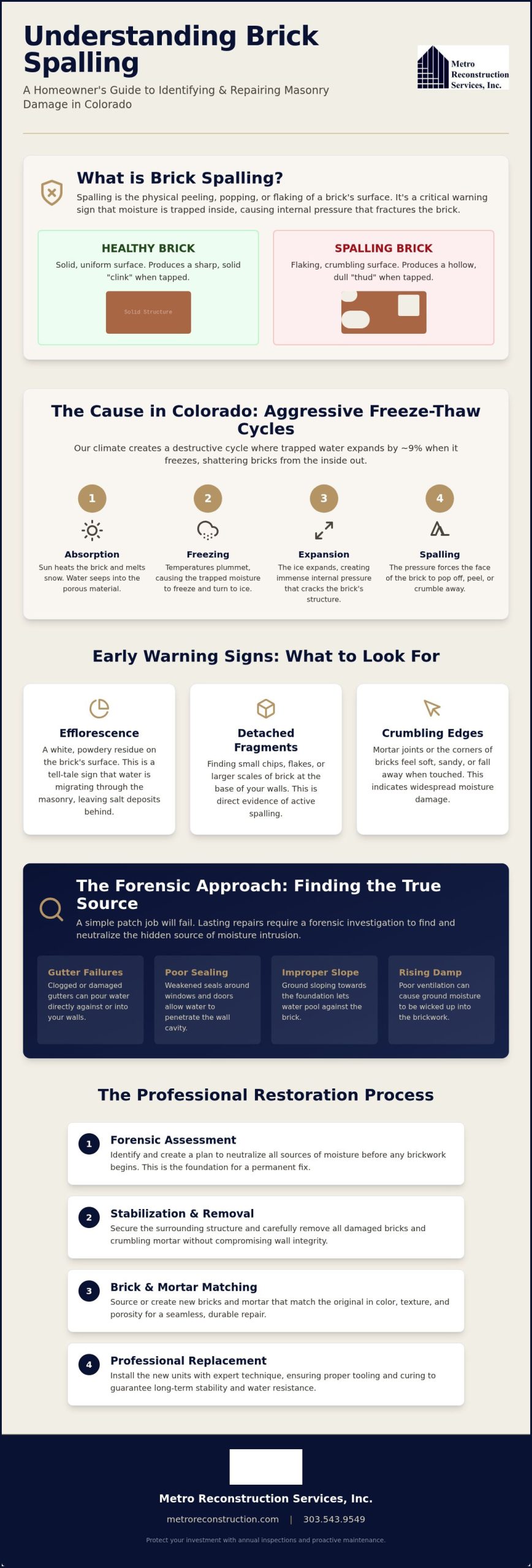
Understanding What is Brick Spalling is the first step toward preserving your home’s exterior. In its simplest form, spalling is the physical peeling, popping, or flaking of the brick’s surface. This isn’t just a cosmetic flaw. It occurs when moisture becomes trapped within the porous material of the brick. When that water cannot escape, internal pressure builds until the face of the brick literally fractures and separates from the unit. For homeowners in the Front Range, this is a common challenge. Our local environment puts immense stress on masonry, making professional brick spalling repair a necessity rather than an option. If you ignore these early signs, the damage often spreads to the mortar and the underlying structure, compromising your home’s complete outer system.
The Role of Colorado’s Freeze-Thaw Cycles
Colorado’s climate is uniquely aggressive toward masonry. We often experience 300 days of intense sunshine. This heats the brick surfaces significantly. When the sun sets and temperatures plummet below freezing, any moisture trapped inside the brick expands by approximately 9 percent. This rapid expansion creates a jacking effect that shatters the brick’s internal structure from the inside out. High-altitude UV exposure also plays a role, as it dries out and weakens older sealants, allowing even more water to penetrate during the next snowmelt or rainstorm. Without a resilient barrier, the brick remains in a constant state of stress, leading to accelerated deterioration that requires specialized intervention.
Common Visual Symptoms Homeowners Should Watch For
Identifying the problem early can save you from high reconstruction costs. Expert brick spalling repair focuses on identifying these symptoms before they escalate into structural failure. Watch for these specific signs:
- Efflorescence: A white, powdery residue on the brick face. This indicates that water is migrating through the masonry and leaving salt deposits behind.
- Detached Fragments: Finding small chips or large scales of brick at the base of your walls.
- Crumbling Edges: Mortar joints or brick corners that feel soft or fall away when touched.
You can also perform a simple tap test. Use the handle of a screwdriver to gently tap the brick. A healthy brick will produce a sharp, solid clink, while a spalling brick will sound hollow or dull. If you notice these symptoms, it’s time to seek a specialist’s evaluation. You can reach our team at 303.543.9549 to discuss a long-term solution. For a comprehensive forensic assessment of your masonry, visit our contact page to get started.
The Forensic Approach: Finding the Source of Spalling Brick
Repairing a flaking brick surface without first identifying the moisture source is a temporary measure that often leads to repeated failure. At Metro Reconstruction Services, Inc., we treat brick spalling repair as a forensic investigation into the building’s complete outer system. If the underlying cause of water intrusion isn’t neutralized, new bricks will eventually suffer the same fate as the old ones. We look beyond the surface to examine how roofing transitions, window flashings, and gutter systems interact with your masonry. A failing gutter or a poorly sealed window frame can funnel gallons of water directly into the wall cavity, saturating the brick from behind. The fix must be total to be effective.
Internal moisture also plays a critical role in masonry health. In some cases, poor ventilation in crawlspaces or basements creates a “rising damp” effect where moisture is pulled upward into the brickwork through capillary action. By utilizing industry-standard masonry restoration techniques, we ensure that the fix is permanent by addressing these hidden mechanical failures first. Identifying these origins is what separates a professional restoration from a simple patch job.
Analyzing Moisture Intrusion and Drainage Patterns
The relationship between stucco and masonry repairs and effective water management is inseparable. We evaluate the ground’s slope around your foundation to ensure water moves away from the structure rather than pooling against the brick. “Splashback” damage is a common culprit in Colorado, occurring when downspouts or hard surfaces bounce rainwater directly onto the lower courses of masonry. Over time, this constant saturation weakens the brick’s integrity. If you’re concerned about recurring dampness, viewing our restoration services can provide insight into how we stabilize these environments.
Structural Origins of Masonry Failure
Sometimes, the problem isn’t just water; it’s movement. Colorado is known for its expansive soils, which can shift and cause foundation settling. This movement creates stress points in the brickwork, leading to cracks that allow moisture to bypass the brick’s natural defenses. Identifying when masonry damage is a symptom of a larger issue is vital. In these instances, brick spalling repair may need to be paired with foundation repair services to ensure the wall is stable enough to support new masonry.
Precision in the diagnostic phase prevents costly mistakes later. If you suspect your masonry issues are tied to deeper structural shifts, call us at 303.543.9549 for an expert evaluation. Our team is ready to help you preserve your home’s value through our contact page.
Evaluating Your Options: Brick Repair vs. Full Replacement
Choosing the right path for brick spalling repair requires an analytical look at the depth of the damage. While surface flaking might suggest a simple patch, deep fractures often indicate that the brick’s internal structure has already failed. If more than 25 percent of a brick’s face is missing, or if the unit has become loose within the wall, localized replacement is usually the most reliable solution. A superficial fix on a severely compromised brick only masks the problem, allowing water to continue its path toward your home’s wooden framing. This hidden moisture can lead to rot and mold, turning a masonry issue into a full-scale structural crisis.
One of the most critical factors in a lasting fix is the compatibility of the mortar. Older bricks are often “softer” and more porous than modern versions. If a contractor uses a modern, high-strength mortar for a repair on a historic home, the mortar will be harder than the brick. This prevents the wall from expanding and contracting naturally during Colorado’s temperature swings. Instead of the mortar joints absorbing the stress, the bricks themselves will crack and shatter. Precision in selecting the right material properties ensures the repair works with your home, not against it.
When to Patch and When to Rebuild
We prioritize the long-term value of your investment. Localized repairs are cost-effective for isolated damage, but when spalling covers large, contiguous sections of a wall, a broader reconstruction is often necessary. We assess structural safety by checking for wall “bowing” or signs that the brick veneer is detaching from the house. Aesthetically, we strive for a seamless match, ensuring that new masonry blends perfectly with the existing structure. Our goal is to provide a solution that restores both the visual appeal and the protective barrier of your complete outer system.
The Dangers of Improper DIY Masonry Work
It’s tempting to try a quick fix with a hardware store sealant, but these products often cause more harm than good. Many off-the-shelf sealants are non-breathable, which means they trap moisture inside the brick. This trapped water accelerates the freeze-thaw decay we discussed earlier, leading to even more rapid spalling. Additionally, matching the color and texture of historic brick and mortar is a specialized craft that requires a seasoned expert. Investing in professional restoration services saves you money in the long run by avoiding the need for expensive corrective work later.
If you’re unsure whether your masonry needs a minor touch-up or a major overhaul, call us at 303.543.9549. You can also reach out through our contact page for a detailed consultation on your property’s needs.
The Restoration Process: Steps for a Lasting Professional Fix
A successful brick spalling repair begins with the structural stabilization of the target area. Before any masonry is removed, we evaluate the load-bearing requirements of the wall to ensure that the surrounding healthy units remain undisturbed. This protective step is foundational to our process, preventing collateral damage that often occurs with less meticulous contractors. Once the area is secure, we carefully extract the damaged brick face or the entire unit, depending on the depth of the moisture intrusion we diagnosed in the forensic phase. Precision during this removal is vital to maintain the integrity of the complete outer system.
Achieving a seamless visual result requires a deep understanding of material science. Color-matching isn’t a matter of simple guesswork; it involves analyzing the mineral composition of the original brick and the specific pigment of the aged mortar. We replicate textures by hand to ensure the new work is indistinguishable from the old. To finish the project, we apply a high-quality, vapor-permeable coating. This breathable barrier allows internal moisture to escape as a gas while preventing liquid water from entering, which is the only way to break the destructive cycle of freeze-thaw expansion in Colorado. If you’ve noticed your exterior walls losing their protective finish, schedule a forensic masonry evaluation to see if our restoration process is right for your home.
Preparation and Forensic Cleaning
We don’t simply place new material over old problems. Our preparation phase involves a forensic cleaning process that removes loose debris and neutralizes salt deposits. These salts, often seen as white efflorescence, must be completely addressed to prevent them from pushing through the new repair. We ensure the internal substrate is thoroughly dry before proceeding, as any trapped moisture would compromise the bond of the new materials. This meticulous attention to detail ensures the foundation of the repair is as solid as the brick itself.
Expert Mortar Application and Finishing
The final phase of restoration involves tuckpointing and the application of specialized repair compounds. We apply these materials in layers to mimic the original brick’s density and thermal properties. This allows the wall to breathe and move naturally. Our craftsmen focus on achieving a seamless finish that blends with the exterior home repair of the rest of the house. By restoring the mortar joint integrity and the brick face simultaneously, we provide a long-term solution that protects your investment from future environmental stressors. For immediate assistance with your masonry restoration, contact our experts at 303.543.9549.
Protecting Your Investment: Long-Term Masonry Maintenance
Completing a professional brick spalling repair is a significant step in restoring your home’s integrity, but the process doesn’t end when the mortar dries. Long-term property preservation requires a shift from reactive fixes to proactive maintenance. For homes in the Front Range and Mountain communities, the environmental load is constant. Establishing a routine of annual inspections allows you to identify minor issues before they evolve into systemic failures. By treating your masonry as part of a complete outer system, you ensure that every component, from the roofline to the foundation, works together to repel moisture.
Simple maintenance tasks are the most effective way to prevent the need for full-scale reconstruction in the future. When you partner with an experienced construction company in Boulder, CO, you gain a dedicated partner in property care. This collaborative approach focuses on the small details that often go unnoticed but have a cumulative impact on masonry health. High-quality caulking at transition points, such as where brick meets window frames or door sills, is a critical defense. These seals prevent water from sneaking behind the brickwork, where it can cause silent damage to the underlying structure.
Preventative Strategies for Colorado Homeowners
Managing the immediate environment around your home is vital during our intense winters. We recommend avoiding snow accumulation directly against brick foundations. As snow melts, it creates a concentrated moisture source that can saturate the masonry, leading to the same internal pressure that caused the initial spalling. Additionally, ensuring your gutters and downspouts remain clear is a foundational requirement. If water isn’t directed away from the house, it will inevitably find a way in. Regularly checking window seals and flashings acts as a secondary barrier, stopping hidden water paths before they reach the wall cavity.
Why Precision and Expertise Matter
With over 40 years of local craftsmanship, we’ve seen how temporary patches fail under the weight of Colorado’s climate. Our family-owned business has focused on moisture mitigation and structural stabilization since 1982. This depth of knowledge allows us to provide engineering-led solutions that prioritize the health of your entire building envelope. A professional restoration does more than just fix a crumbling brick; it maintains your property’s curb appeal and long-term market value. If you’re ready to transition from surface-level fixes to true property preservation, call us at 303.543.9549. You can also reach our team through our contact page to schedule your next inspection.
Securing Your Home’s Future Against the Elements
Addressing masonry deterioration requires a move beyond surface-level patches toward a complete understanding of your building’s envelope. Brick spalling is a clear signal that moisture is compromising your home’s complete outer system. By choosing a forensic approach to brick spalling repair, you ensure that the root causes of water intrusion are neutralized, preventing the destructive cycle of freeze-thaw damage from returning. This precision-led restoration is the only way to provide the long-term peace of mind you deserve as a homeowner.
Metro Reconstruction Services, Inc. has been family-owned and operated since 1982. With over 40 years of local expertise, we are specialists in forensic moisture mitigation and masonry restoration, serving Boulder, Denver, and the entire Front Range. We pride ourselves on being a dedicated partner in property preservation, offering engineering-led solutions that prioritize substance and structural integrity over quick fixes. Protect your home’s structural integrity. Contact Metro Reconstruction Services, Inc. today or call us at 303.543.9549 for a professional evaluation. We look forward to helping you preserve the value and beauty of your home for decades to come.
Frequently Asked Questions
Is brick spalling a serious structural problem for my home?
Yes, it is a serious warning sign that water is compromising your wall’s integrity. While a few flakes might seem minor, they indicate that the internal structure of the brick is fracturing. If left unaddressed, this moisture can reach the wooden framing, leading to rot and mold. Our forensic approach identifies these risks early to prevent the total failure of your building’s complete outer system. We focus on long-term structural health rather than superficial fixes.
Can I just paint over spalling brick to stop it from crumbling?
No, painting over damaged brick actually accelerates the decay by trapping moisture inside. Most standard paints act as a non-breathable barrier, which prevents trapped water from evaporating. This trapped moisture then goes through the freeze-thaw cycles we discussed, causing the brick to shatter behind the paint. A professional brick spalling repair requires removing the damaged material and applying vapor-permeable coatings that allow the masonry to breathe naturally. It’s a vital step for lasting protection.
How much does professional brick spalling repair typically cost?
The cost of masonry restoration depends entirely on the extent of the moisture damage and the number of bricks requiring replacement. Factors such as the height of the wall, the complexity of the mortar match, and any necessary structural stabilization will influence the final project fee. We provide fixed-price reconstruction fees based on a forensic evaluation of your specific property’s needs. This ensures you receive a long-term solution rather than a temporary, low-quality patch that fails.
What is the most common cause of brick damage in the Boulder area?
The primary culprit in Boulder and Denver is the combination of high-altitude UV exposure and intense freeze-thaw cycles. Our region experiences rapid temperature swings where snowmelt enters porous brick during the day and freezes at night. This expansion exerts thousands of pounds of pressure per square inch, shattering the brick from within. Improper drainage and failing gutter systems often exacerbate this by funneling excessive water directly into the masonry. We’ve seen this pattern since 1982.
How long does a professional masonry repair last?
A correctly executed restoration can last for decades when the underlying moisture source is neutralized. Our team focuses on engineering-led solutions that match the density and breathability of your original materials. By combining these techniques with high-quality caulking at transition points, we provide a repair that withstands the Front Range and Mountain environments. Regular annual inspections help ensure these protective systems remain functional, preserving your property’s value and curb appeal long after the initial fix is complete.
Can individual bricks be replaced without tearing down the entire wall?
Yes, we can carefully extract individual damaged units and replace them with matching bricks. This process involves stabilizing the surrounding masonry before removing the compromised brick and its old mortar. We then install a new unit using a compatible mortar mix that matches the strength and color of the existing wall. This surgical approach is a core part of our restoration services, allowing us to fix specific issues without unnecessary reconstruction costs. It’s a meticulous, detail-oriented process.
Why is my brick turning white before it starts to crumble?
That white, powdery substance is called efflorescence, and it is a sign of active moisture migration. As water moves through the brick, it dissolves internal salts and carries them to the surface. When the water evaporates, it leaves the salt behind. This process indicates that your masonry is becoming saturated, which is often the precursor to physical crumbling. Identifying this early allows for a more cost-effective brick spalling repair before the structure fractures and fragments begin to detach.
How do I know if my brick damage is caused by foundation issues?
Brick damage caused by foundation movement usually appears as long, stair-step cracks rather than surface flaking. While spalling is a moisture-driven issue, foundation settling creates stress points that can physically pull the masonry apart. In Colorado, expansive soils often cause this shifting. If you notice large cracks paired with crumbling brick, a forensic evaluation is necessary to determine if you need foundation stabilization. You can reach our specialists at 303.543.9549 or through our contact page.