
The crumbling face of a brick on your Colorado home is rarely just a cosmetic flaw; it’s usually a symptom of a failing outer system that a simple patch cannot fix. You might feel a sense of dread as you watch the exterior of your property slowly deteriorate, wondering if escalating repair costs will eventually compromise your home’s structural integrity. It’s a valid concern because effective freeze-thaw damage brick repair requires more than a surface level solution to be successful. We understand that seeing your investment chip away is stressful, especially when you aren’t sure if the issue is merely an eyesore or a sign of deeper trouble.
This guide will help you identify the forensic origins of masonry failure so you can stop the cycle of deterioration for good. You’ll learn how to distinguish between surface wear and structural threats, ensuring you invest in a long term fix rather than a temporary bandage. We will examine the latest 2026 Colorado building standards and moisture mitigation techniques that restore both the aesthetic appeal and the fundamental strength of your masonry. By understanding the relationship between environmental stressors and your building’s components, you can protect your property’s value with quiet confidence.
Key Takeaways
- Understand how Colorado’s rapid temperature shifts drive the expansion of trapped moisture, leading to internal pressure that compromises masonry strength.
- Learn to distinguish between minor surface wear and deep structural failure to ensure you address the root cause before costs escalate.
- Discover why professional freeze-thaw damage brick repair requires a forensic approach to moisture mitigation rather than simply covering cracks with caulk.
- Explore precision restoration techniques like tuckpointing that stabilize your home’s exterior and prevent future moisture penetration.
- Realize how a holistic approach to your building’s complete outer system preserves structural integrity and maximizes long-term property value.
Understanding the Freeze-Thaw Cycle in Colorado’s Climate
Colorado’s environment is uniquely demanding on building materials. While our state is known for its abundant sunshine, it’s the rapid transition between that daytime warmth and the biting cold of night that creates a significant structural challenge. This cycle is the primary driver behind the need for specialized freeze-thaw damage brick repair. It’s a simple physical reality with complex consequences for your property’s exterior.
The Science of Porosity and Expansion
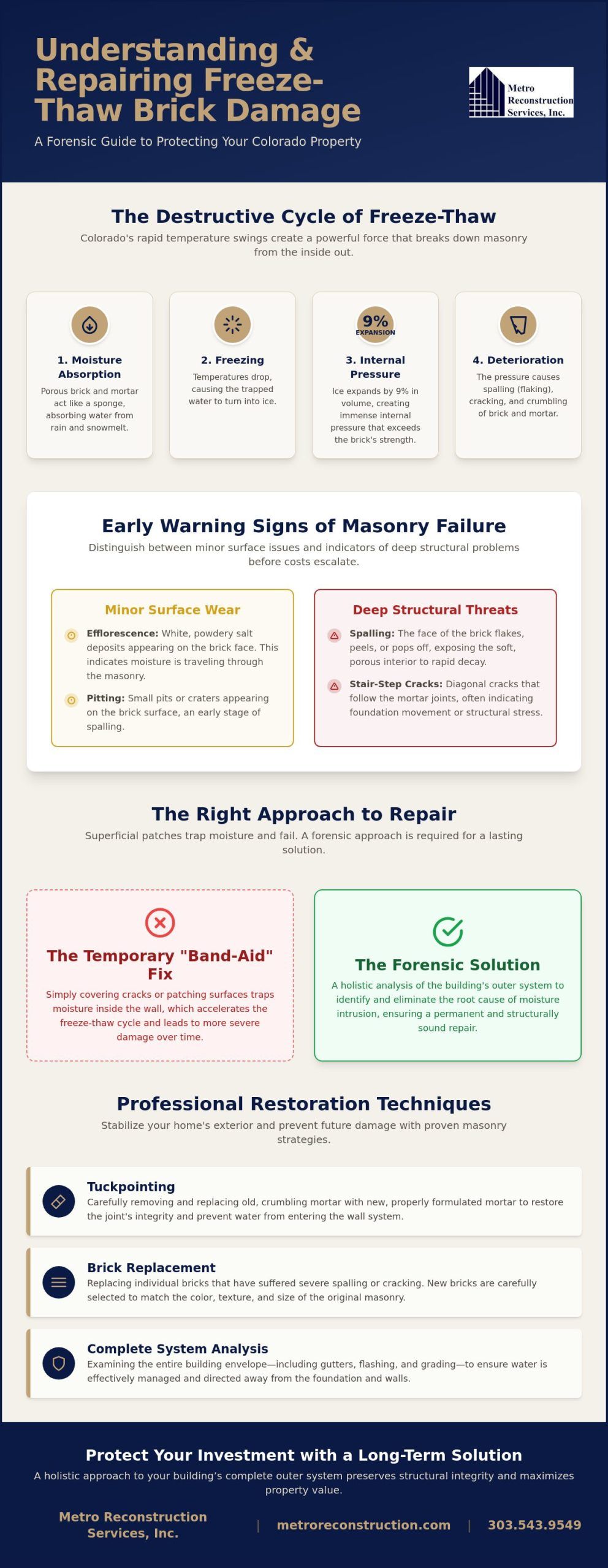
Masonry materials like brick and mortar are naturally porous. They act like sponges, drawing in moisture from snowmelt or spring rains through capillary action. When temperatures drop, the water trapped within these microscopic pores undergoes a phase change into ice. This process, known as frost weathering, causes a 9% increase in the volume of the water. Because brick lacks the elasticity to accommodate this expansion, the resulting internal pressure eventually exceeds the material’s tensile strength. Freeze-thaw damage is the mechanical failure of masonry caused by this internal ice pressure. Over time, this force pushes against the structure from the inside out, causing the brick face to flake off or the mortar to crumble.
Regional Factors: Boulder to Breckenridge
The Front Range and mountain corridors experience some of the most dramatic temperature swings in North America. A sunny afternoon in Boulder can quickly warm a south-facing brick wall, causing the materials to expand. Once the sun dips behind the peaks, the temperature can plummet 40 degrees in a matter of hours. This rapid cooling causes the building’s outer system to contract at a different rate than the moisture trapped inside. In higher elevations like Breckenridge, heavy snowpack often leans directly against masonry for months. This creates a constant source of moisture that seeps into the structure during the day and freezes solid at night. In these high-risk areas, proactive freeze-thaw damage brick repair is the only way to halt the progression of deep-seated structural decay.
Many homeowners believe that newer construction is naturally protected from these issues. However, modern building practices often prioritize speed over the meticulous moisture management seen in historic masonry. If the complete outer system isn’t designed to shed water effectively, even a five year old home can require professional restoration services. Addressing these underlying structural origins early prevents a cosmetic issue from becoming a full-scale structural emergency. If you notice your home’s exterior showing signs of these environmental stressors, contact us at 303.543.9549 or visit our contact page to discuss a long-term solution for your property.
Identifying the Signs of Masonry Deterioration
Early detection is the primary factor in controlling the scope and cost of freeze-thaw damage brick repair. While some aging is expected, specific visual cues signal that your building’s complete outer system is under significant stress. We approach every inspection through a forensic lens, looking for the underlying structural origins of visible wear. Understanding these signs allows you to intervene before moisture creates a structural emergency. If you notice any of these symptoms, it’s a sign that the cycle of damage has already begun:
- Small pits or craters appearing on the brick surface.
- White, powdery salt deposits (efflorescence) on the wall face.
- Mortar that crumbles easily when touched with a finger.
- Diagonal “stair-step” cracks following the mortar joints.
Spalling: When Bricks Begin to Peel
Spalling is the most recognizable symptom of freeze-thaw cycles. It occurs when the outer face of a brick flakes, peels, or pops off entirely. This happens because the internal pressure from expanding ice becomes too great for the material to hold together. The “fire-baked” outer layer acts as the brick’s primary armor. Once this protective shell is compromised, the softer, more porous interior is exposed to the elements. This leads to a cycle of rapid decay. You might first notice “pitting,” where small craters appear on the brick’s surface. If left unaddressed, these small pits will eventually lead to the loss of the entire brick face, requiring more extensive freeze-thaw damage brick repair to restore the home’s aesthetic and structural integrity.
Mortar Failure and Efflorescence
Efflorescence refers to the white, powdery salt deposits that often appear on masonry. It’s a common misconception that this is just a cosmetic stain. In reality, these salts are carried to the surface by moisture moving through the wall. Their presence is a definitive sign of deep moisture intrusion. When this moisture is combined with soft, crumbling mortar joints, the wall’s stability is threatened. Look specifically for “stair-step” cracking. These cracks follow the mortar joints in a diagonal pattern and often indicate that the wall is shifting. To address these issues, we follow industry standards for tuckpointing and structural stabilization to ensure the repair is as durable as the original construction.
You can perform a simple diagnostic called a “tap test” to check for hidden damage. Use a small, hard object to gently tap on bricks that appear suspect. A solid brick will produce a sharp “click,” while a brick suffering from internal separation will sound hollow or drum-like. This indicates that the face is no longer bonded to the core. It’s also important to determine if moisture is coming from the outside or from behind the wall. Dampness concentrated near the ground or around window frames often suggests a failure in the drainage system or flashing. If you notice these patterns, our restoration services can provide a precise diagnosis. Taking proactive steps now preserves your home’s integrity and value. For a detailed assessment, please call us at 303.543.9549 or visit our contact page.
Why Superficial Patches Fail and the Forensic Repair Approach
Many property owners fall into what we call the “Handyman Trap” when they first notice signs of masonry distress. The instinct is often to hire a general contractor to caulk over cracks or apply a heavy coat of waterproof sealant. While this might temporarily hide the problem, it frequently accelerates the underlying decay. Effective freeze-thaw damage brick repair is not about hiding the symptoms; it’s about moisture mitigation and understanding the forensic origin of the failure. If you only address the surface, you’re leaving the internal structure vulnerable to the next winter cycle.
Our forensic methodology begins long before we touch a trowel. We evaluate the building’s complete outer system to determine why moisture is accumulating where it shouldn’t. This includes a detailed analysis of roof flashing, gutter efficiency, and ground grading—critical areas that Advanced Roofing focuses on to ensure the entire building envelope remains watertight. We also pay close attention to the technical specifications of the materials. Using a mortar that is too hard for the surrounding brick is a common mistake. If the mortar doesn’t allow for natural movement, it can actually crush older, softer bricks as they expand and contract, leading to permanent structural damage.
The Problem with DIY Sealants
Non-breathable sealants are often marketed as a solution for leaky walls, but they are frequently the cause of rapid masonry failure. These products trap liquid water inside the brick, preventing it from evaporating. When the next freeze occurs, the trapped moisture has nowhere to go but through the brick face. This leads to the very spalling you were trying to prevent. Investing in professional structural preservation ensures that your masonry can “breathe” while still remaining protected from the elements. Patching without fixing the drainage is a temporary and expensive mistake that often leads to higher repair costs down the road.
Identifying the Root Cause
Masonry failure is rarely an isolated event. It’s often the result of a failure in a different part of the building’s exterior. Leaking gutters can dump gallons of water directly onto a brick wall, while improper roof flashing can direct snowmelt behind the masonry veneer. We also look for signs of “rising damp,” which occurs when poor ground drainage allows foundation moisture to wick upward into the brickwork. A forensic evaluation is the only way to ensure a permanent fix. By identifying these underlying structural origins, we can implement a strategy that stops the damage at its source. If you’re concerned about the integrity of your home’s exterior, we invite you to call us at 303.543.9549 or visit our contact page for a professional assessment.
Professional Repair Strategies: From Tuckpointing to Structural Stabilization
Once the forensic origin of the moisture failure is identified, we move from diagnosis to precision execution. Restoration is a meticulous process that requires a deep understanding of both historical and modern building systems. For homeowners across the Front Range, effective freeze-thaw damage brick repair involves a series of steps designed to restore the wall’s structural integrity while maintaining its original aesthetic. We don’t just patch; we reconstruct the damaged sections to ensure they function as a cohesive part of your building’s complete outer system.
Tuckpointing and Mortar Restoration
Tuckpointing is the precise art of removing damaged, crumbling mortar and replacing it with fresh material. We use specialized tools to grind out failed joints to a specific depth, ensuring we don’t nick or damage the edges of the surrounding brick. This is a delicate task. If the grinding is too aggressive, it can permanently weaken the masonry unit. Once the joints are clean and prepared, we apply custom-mixed mortar. We pay close attention to color-matching and texture to ensure the new work is indistinguishable from the original construction. You can learn more about our specific Stucco and Masonry Repairs in Boulder and the craftsmanship required for these high-stakes projects.
Structural Masonry Mitigation
Sometimes the damage goes deeper than the mortar joints. When a brick’s face is completely gone, we perform a “Dutchman repair,” which involves carefully removing the individual damaged brick and replacing it with a matching unit that fits perfectly into the existing pattern. However, if we find bricks cracking in a straight line above a window or door, the culprit is often a rusted steel lintel. A lintel is the horizontal support beam that carries the weight of the masonry over an opening. As steel rusts, it expands, a process known as “rust jacking,” which exerts immense pressure on the bricks above it. We also address failing wall ties, which are the hidden metal connectors that secure your brick veneer to the home’s frame. Structural mitigation addresses the “why” of the failure, not just the “what.”
If your home is showing signs of these complex issues, it’s time to partner with a specialist who understands how environmental stressors affect your home’s longevity. Our team provides comprehensive masonry work designed to provide a permanent fix rather than a temporary patch. Don’t let a small crack turn into a major structural failure. Contact our experts at 303.543.9549 or visit our contact page to begin your restoration project today.
Protecting Your Property Value with Metro Reconstruction
Professional masonry repair is far more than a simple maintenance task; it is a strategic investment in your home’s long-term resale value. In the demanding Colorado real estate market, potential buyers and inspectors look closely at the condition of the exterior, especially vulnerable components like chimneys. To ensure these features are properly evaluated, consulting with experts such as Best Chimney Services can provide the necessary insight into structural health before a sale. Performing a comprehensive freeze-thaw damage brick repair provides documented proof that your property has been maintained with precision. This proactive care ensures that your investment remains protected against the harsh environmental stressors of our high-desert climate.
At Metro Reconstruction, we bring a level of authoritative professionalism that comes from over forty years of dedicated service. Since 1982, our family-owned company has operated with a sense of integrity and protective care for our clients’ investments. We don’t rely on loud marketing or high-pressure sales tactics. Instead, we offer quiet confidence and engineering-led solutions that address the forensic origins of masonry failure. When you partner with us, you’re choosing a team that values substance over style and accuracy over speed.
Why Experience Matters in Colorado
Our history of serving the Front Range and mountain communities has allowed us to refine our methodology for the specific challenges of the region. This “Wise Craftsman” approach means we understand the relationship between your home’s building elements and the local weather patterns. For property owners seeking a complete transformation beyond a standard repair, our Design-Build Services provide a holistic path toward an exterior that is both beautiful and resilient. We would rather explain the difficult truth of a structural failure than offer a low-quality patch that will fail within a few seasons.
Take the First Step Toward Restoration
The best time to address masonry concerns is before the next winter cycle begins. Early diagnostics allow us to identify minor issues before they escalate into major structural emergencies, saving you significant time and money in the long run. Our consultative process is designed to educate you about your home’s complete outer system, giving you the clarity needed to make informed decisions. We invite you to experience the reliability and peace of mind that comes from a long-term structural fix. Taking action today preserves the structural integrity and aesthetic appeal of your masonry for years to come.
To schedule your professional evaluation and ensure your home is ready for the seasons ahead, Contact Metro Reconstruction Services, Inc. or call us directly at 303.543.9549.
Securing Your Home’s Future Against the Colorado Elements
Protecting your home from the destructive cycles of the Front Range requires a shift from temporary fixes to a holistic understanding of your building’s complete outer system. Successful freeze-thaw damage brick repair depends on identifying the underlying moisture source rather than simply masking surface cracks. By addressing structural origins like rusted lintels or failing drainage, you ensure the long-term stability of your masonry while preventing expensive future failures. Precision matters in every restoration effort.
Metro Reconstruction has served the Boulder community since 1982, bringing over 40 years of local expertise to every project. As a family-owned and operated firm, we specialize in moisture mitigation and structural preservation to provide the peace of mind that only engineering-led solutions can offer. We prioritize accuracy and substance over superficial patches. It’s a commitment to quality that safeguards your investment. We invite you to schedule your forensic masonry evaluation today or reach us directly at 303.543.9549. Taking these proactive steps now will protect your home’s beauty for generations to come.
Frequently Asked Questions
How do I know if my brick damage is just cosmetic or structural?
You can identify structural damage by looking for cracks that pass entirely through the brick or mortar joints that show a stair-step pattern. Cosmetic issues usually appear as surface pitting or light flaking on the brick face. If the wall is leaning or bricks are loose, the issue has likely progressed to a structural failure. Our forensic evaluation helps distinguish between these states to ensure the repair matches the severity of the problem.
Can I just paint over spalling bricks to stop the damage?
Painting over damaged masonry is a mistake that often accelerates the decay of the building’s complete outer system. Most paints act as a non-breathable barrier that traps moisture inside the brick. This trapped water has no way to evaporate, which causes even more pressure during the next freeze. Effective freeze-thaw damage brick repair requires the material to breathe while shedding liquid water from the surface.
How much does professional freeze-thaw brick repair typically cost?
The cost of restoration depends on the forensic origin of the failure and the total area of the damage. Factors like the height of the wall, the type of brick being matched, and whether structural lintels need replacement will influence the final investment. We focus on providing long-term value through engineering-led solutions rather than low-quality patches. Addressing these issues early prevents the need for more expensive full-scale reconstruction later.
Is it better to repair individual bricks or replace the entire wall?
Individual brick replacement, often called a Dutchman repair, is the preferred method when the surrounding masonry and structural ties are still sound. This targeted approach preserves as much of the original material as possible while restoring the wall’s integrity. We only recommend a full wall replacement if the moisture intrusion has caused systemic failure throughout the entire assembly. Most homeowners find that localized, professional restoration is sufficient to protect their property’s value.
What is the best time of year to perform masonry repairs in Colorado?
The ideal window for masonry work in the Front Range is from late spring through early autumn. Mortar requires consistent temperatures above freezing to cure properly and achieve its full design strength. If the water in the fresh mortar freezes before it hydrates, the bond will be permanently weakened. Performing freeze-thaw damage brick repair during the warmer months ensures the materials bond correctly for a lasting fix.
How long do professional tuckpointing and brick repairs usually last?
High-quality masonry repairs can last 20 to 30 years if the underlying moisture issues are fully resolved. The longevity of the repair depends heavily on the accuracy of the initial diagnosis and the quality of the mortar match. By addressing the root cause, such as a leaking gutter or improper flashing, we ensure the new masonry isn’t subjected to the same stressors that caused the original failure. Precision in the early stages leads to decades of reliability.
Does homeowners insurance cover freeze-thaw masonry damage?
Insurance providers generally categorize freeze-thaw deterioration as a maintenance issue or “wear and tear” rather than a sudden, accidental loss. Most standard policies don’t cover damage that occurs gradually over several seasons. Because this is usually an out-of-pocket investment, it’s vital to choose a partner who offers permanent solutions rather than temporary bandages. We recommend reviewing your specific policy details with your agent for confirmation.
Can I use a pressure washer to clean damaged bricks?
Avoid using high-pressure water on masonry that already shows signs of distress. The intense force can blast away the protective fire-baked face of the brick and drive moisture deep into the wall system. This added water only fuels the next cycle of internal expansion when temperatures drop. We use gentle, specialized cleaning methods that preserve the masonry while preparing the surface for professional restoration. For a safe assessment of your home’s exterior, please visit our contact page or call us at 303.543.9549.