
Polyurethane foam can lift a settled concrete slab without stabilizing a building’s foundation. If you’re choosing a foundation stabilization contractor Denver property owners can trust, that distinction matters: the right repair depends on what is moving and why. Foam injection can fill voids beneath concrete and raise a slab, but it isn’t a fix for every crack, uneven floor, or failing foundation wall.
A crack or sloping floor can raise concerns about ongoing structural movement. In the Denver area, expansive clay soil can swell when wet and shrink as it dries. Drainage and changing moisture conditions can also affect foundation performance. This article explains what polyurethane foam injection can and cannot stabilize, how it compares with other repair approaches, and why the location and source of movement guide the repair choice. You’ll also learn what an assessment should establish, including whether the issue is limited to a concrete slab or involves the foundation and surrounding moisture conditions. Accurate diagnosis comes first: a repair can only address the problem it is designed to solve.
Key Takeaways
- Foam injection may lift settled concrete or fill voids, but the right repair depends on whether movement affects a slab or the building’s foundation.
- Compare repair approaches by their target, intended function, and assessment findings, not by the surface symptom alone.
- Record cracks, sticking doors, uneven floors, and changes over time to help a foundation stabilization contractor understand what may be moving.
- Note drainage, roof runoff, grading, and moisture patterns around your home. These details can help clarify conditions related to foundation movement.
- For project-specific foundation stabilization in the Denver area, contact Metro Reconstruction Services, Inc. or call 303.543.9549.
Polyurethane Foam Injection for Foundation Lifting: What It Actually Does
Polyurethane foam injection places expanding material through small access points beneath concrete. Depending on the system and project design, the material may fill an empty space below a slab or raise settled concrete. Polyurethane is a broad family of materials with different properties, so the product and its intended use matter. Learn more about polyurethane.
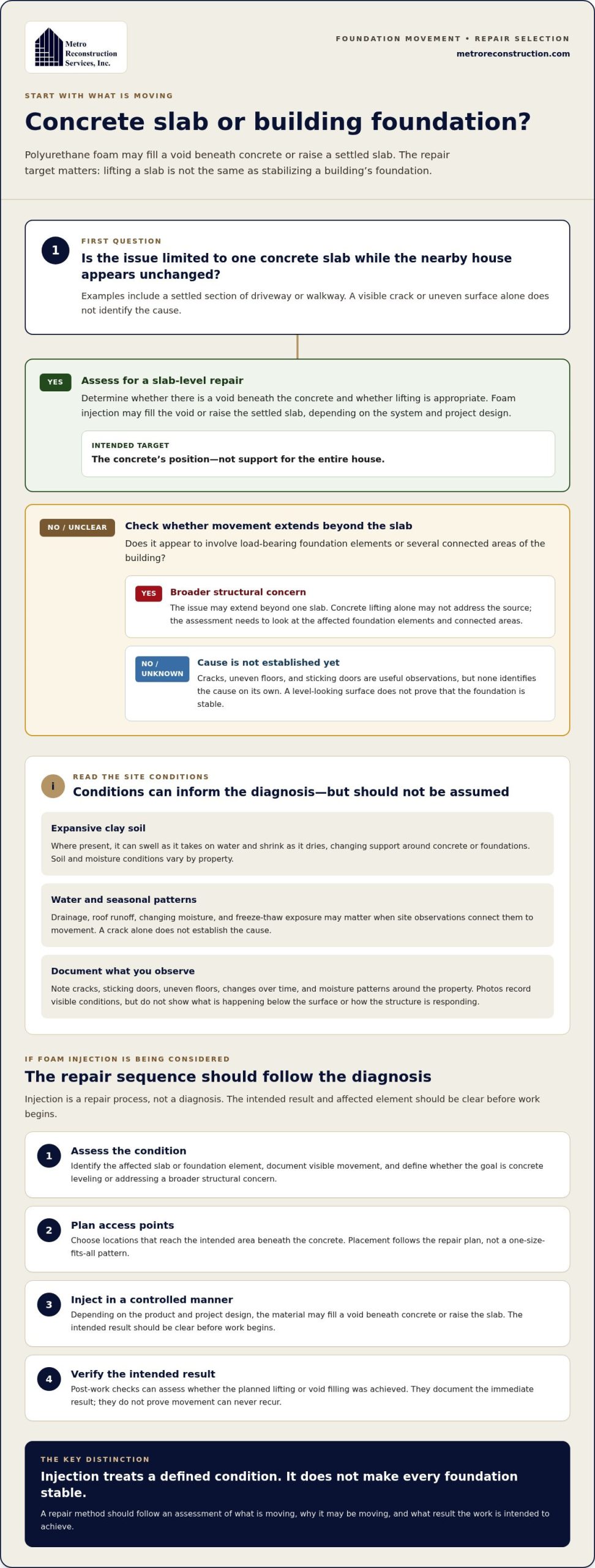
The target of this work is the concrete slab. Lifting a driveway, walkway, or other slab is not the same as stabilizing a building’s foundation. A level-looking surface does not prove that the building’s load-bearing foundation is stable. A visible crack does not prove that the foundation is moving either. The repair method should follow a diagnosis, not take the place of one.
Concrete lifting versus structural foundation stabilization
Imagine a section of walkway that has settled while the nearby house appears unchanged. The repair question is whether there is a void beneath the slab and whether lifting is an appropriate way to address it. The goal is to correct the concrete’s position, not support the entire house.
The assessment changes if movement appears to involve load-bearing foundation elements or several connected areas of the building. The concern may extend beyond one slab, and concrete lifting alone may not address its source. Cracks, uneven floors, and sticking doors are useful observations, but none identifies the cause on its own. Photos can document visible conditions, but they cannot show what is happening below the surface or establish how the structure is responding.
What Denver-area site conditions can change
Soil and moisture conditions vary from property to property. Where expansive clay soil is present, it can swell as it takes on water and shrink as it dries, changing the support around concrete or foundations. That does not mean every Denver-area property has the same soil, moisture pattern, or movement history. Site-specific conditions should inform the repair objective.
Seasonal moisture changes may be relevant when they align with documented structural changes. Freeze-thaw exposure may also matter if site observations connect it to movement of a slab or surrounding ground. Neither condition should be assumed to explain a crack without supporting evidence. The affected element, movement pattern, site conditions, and intended result all help determine whether foam injection is suitable.
If you’re looking for a foundation stabilization contractor Denver property owners can turn to for a project-specific evaluation, Metro Reconstruction Services, Inc. provides foundation repairs and stabilization across Denver and Front Range communities. Contact Metro Reconstruction Services, Inc. or call 303.543.9549 to discuss the conditions affecting your property.
How Polyurethane Foam Injection Works, and Where Its Limits Matter
Injection is a repair process, not a diagnosis. Before access points are planned, an assessment should identify what has moved, which concrete or foundation element is affected, and what result the repair is meant to achieve. Without that distinction, a surface may appear level after work while the underlying cause remains unresolved.
The assessment and injection sequence
A project generally moves through assessment, access-point planning, controlled injection, and verification. The sequence is project-specific. The material, how it behaves, and where it is placed depend on the selected system and repair design.
- Assess the condition. Identify the affected slab or foundation element and document visible movement. Define the repair area and distinguish a concrete-leveling objective from a broader structural concern.
- Plan access points. Select locations that reach the intended area beneath the concrete. Placement should follow the repair plan rather than a one-size-fits-all pattern.
- Inject in a controlled manner. Depending on the product and project design, the material may fill a void beneath concrete or raise the slab. These uses are related, but the intended result should be clear before work begins.
- Verify the intended result. Post-work checks can assess whether the planned lifting or void filling was achieved. They document the immediate result, not proof that movement can never recur.
When lifting concrete may not resolve the structural issue
Injection addresses a defined condition where material is placed. By itself, it does not establish why soil or moisture conditions may be changing, or correct those conditions elsewhere. If movement involves a foundation wall, multiple areas of the building, or recurring displacement, the assessment needs to look beyond whether a slab can be raised.
For example, correcting the height of one concrete area may not address a separate source of movement affecting connected parts of the structure. Drainage patterns, roof runoff, changing moisture, and expansive clay soil may remain relevant to the site after concrete lifting. Their role should be assessed from the property’s conditions, not assumed from a symptom alone.
Injection treats a defined condition; it does not make every foundation stable. That distinction helps you understand what a proposed repair is designed to do and what remains outside its scope. A foundation repair assessment in Boulder offers related context on evaluating structural concerns. For project-specific foundation stabilization in Denver and the Front Range, contact Metro Reconstruction Services, Inc. or call 303.543.9549.
Foam Injection Compared With Other Foundation Stabilization Approaches
Repair methods address different parts of a property. The useful comparison is not which method sounds strongest, but whether its target and intended result match the observed movement. A slab repair may address concrete that has moved independently. A structural system may be considered when the building’s foundation is involved. Before selecting a method, an assessment should distinguish between these conditions.
Match the method to the element that moved
Start by identifying the affected component and movement pattern. A surface crack alone does not show whether the concrete has settled, the foundation has shifted, or another condition is involved. Consider the location, extent, and changes over time, as well as whether nearby areas of the building show related movement.
| Approach | Repair target | Intended function | Evidence to assess | Key limitation |
|---|---|---|---|---|
| Polyurethane foam injection | Concrete slab with a diagnosed void or settlement | Fill space beneath concrete or raise the slab, depending on the system and design | Slab movement and conditions beneath the affected area | Does not establish or correct every cause of soil or moisture movement |
| Conventional mudjacking | Settled concrete slab | Pump a cement-based mixture beneath the slab to fill space or raise it | Whether the slab can be addressed by filling beneath it and lifting | Addresses the slab, not necessarily the underlying cause of movement |
| Slab replacement | Concrete that requires removal and replacement | Replace the affected slab rather than lift the existing piece | Condition of the concrete and whether replacement fits the repair objective | Replacement alone may not resolve movement in the supporting soil |
| Foundation piers or other structural systems | Foundation elements with diagnosed structural movement | Provide support or stabilization as designed for the specific structure | Foundation movement, building conditions, and project-specific engineering | Not a universal solution; design depends on site and structural findings |
Compare durability by checking causes and conditions
Judge a repair against the movement it is meant to address, not just by how the surface looks immediately afterward. Consider whether the assessment identifies affected building components and investigates relevant site conditions, including moisture patterns or expansive clay soil where present. If those factors remain active, lifting or replacing concrete may not address why movement is recurring.
For a foundation stabilization contractor serving Denver property owners, the key is a project-specific evaluation that connects evidence to a repair objective. Metro Reconstruction provides foundation repair services as part of its structural work. To discuss a foundation concern, contact Metro Reconstruction Services, Inc. or call 303.543.9549.
What a Denver-Area Foundation Stabilization Assessment Should Establish
A useful assessment turns visible symptoms and site observations into a clear explanation of what needs attention. You can help by keeping a simple record before repair planning begins. Note where cracks appear, whether doors stick, which floors seem uneven, and when you first noticed each change. Record whether a condition looks different over time. Photos taken from the same position can help show changes, but they do not establish the cause.
Evidence to document before repair planning
Walk the property and note conditions without trying to diagnose them. Include the room or exterior area, approximate location, and whether the symptom is new, recurring, or apparently unchanged. Outside, look for water collecting near the house, downspouts releasing water close to the foundation, areas where the ground appears to slope toward the building, and other drainage concerns. Share these observations during the evaluation.
These details matter because a foundation is part of the complete building, not an isolated surface. An evaluator can compare interior symptoms with exterior conditions and consider whether multiple areas show related changes. A crack is a useful starting point, but it does not tell the full story by itself. Symptoms identify where to investigate, not the underlying cause. Before proposing a repair objective, the assessment should connect observations across the structure and surrounding site.
Turn findings into a durable repair scope
A clear scope should state the suspected source of movement, which building components are affected, what the repair is intended to accomplish, and whether follow-up monitoring is appropriate. It should explain how the observations support the proposed work. If the assessment identifies moisture as a relevant factor, the plan should address that relationship rather than treating a visible crack or uneven surface as the whole problem.
Drainage, grading, and roof runoff can influence moisture around a foundation. Where site findings show that water management is part of the concern, foundation drainage solutions or changes to how water is directed away from the structure may support the repair plan. The appropriate response depends on actual site conditions; the same symptom can have different causes on different properties.
For Denver-area projects, code requirements can depend on the jurisdiction and the work being planned. Requirements may differ between Denver, Boulder, and nearby cities or counties, so the project scope should account for the rules that apply to its location.
Metro Reconstruction serves Front Range and Mountain communities, including Parker, Morrison, Boulder, Longmont, Niwot, Evergreen, Cherry Creek, Cherry Hills Village, Golden, Genesee, Littleton, Broomfield, Denver, Silverthorne, Breckenridge, Vail, and Larkspur. For additional context on structural evaluation, see Metro Reconstruction’s foundation repair discussion in Boulder. To discuss documented concerns at your property, contact Metro Reconstruction Services, Inc. or call 303.543.9549.
Work With a Denver-Area Contractor on the Right Stabilization Plan
Choosing a foundation stabilization contractor in Denver starts with more than selecting a repair method. The findings should explain what is moving, which parts of the structure are affected, and what the proposed work is intended to address. A plan built around those answers can distinguish a concrete-leveling need from movement affecting the building’s foundation.
A project-specific plan starts with accurate diagnosis
Metro Reconstruction is a family-owned construction firm based in Boulder, with more than four decades of industry experience serving Denver and Front Range communities. Its foundation stabilization work is tailored to project findings. The repair scope should follow observed conditions and structural needs rather than assume one method suits every property.
A clear plan connects the suspected source of movement to the affected building components and the intended repair objective. It should also account for relevant moisture conditions. Water reaching the foundation through surface drainage or roof runoff may affect the surrounding soil, so the evaluation should consider how the foundation relates to the property’s complete exterior envelope. Addressing structural concerns without considering water movement around the home may leave an important part of the assessment unanswered.
Before work is defined, you should be able to understand:
- Which areas and structural components show evidence of movement.
- What site or moisture conditions may contribute to the observed changes.
- What the proposed repair is designed to do, and what it does not address.
- Whether follow-up observation or monitoring is part of the project plan.
This clarity keeps the scope tied to evidence. It also gives you a basis for understanding why an approach fits the documented conditions, without treating a visible symptom as a diagnosis or promising a result that has not been established.
Discuss your foundation stabilization concerns
Metro’s Boulder construction team serves Denver and Front Range communities, bringing regional experience to project-specific structural evaluations. If you’ve noticed changing cracks, uneven areas, or other concerns, share what you observed and when the changes began. Those details can help frame an evaluation of the structure and surrounding conditions.
For a foundation stabilization assessment in the Denver area, contact Metro Reconstruction Services, Inc. to discuss your property, or call 303.543.9549.
Make Your Next Foundation Decision With Clarity
A visible change in your home can raise urgent questions, but the next step does not have to be a guess. Before discussing repairs, gather your observations, note when conditions changed, and consider what you want the evaluation to clarify. That gives the conversation a practical starting point: the affected areas, the movement pattern, and the questions that matter to your property.
A foundation stabilization contractor serving Denver homeowners should connect those observations to a clear repair objective, not treat one symptom as the whole problem. Metro Reconstruction takes a root-cause-focused approach to structural concerns, with foundation repair and stabilization work shaped by project findings.
Ready to discuss what you’ve noticed? Share your foundation stabilization concerns with Metro Reconstruction Services, Inc. or call 303.543.9549. A clear understanding of the problem is a sound place to begin, and the right next step can help you move forward with greater confidence.
Frequently Asked Questions
Can polyurethane foam injection lift a house foundation?
Polyurethane foam injection is generally used to fill spaces beneath concrete or lift a concrete slab, not to raise an entire house foundation. A house’s foundation supports connected structural elements, so movement affecting it calls for an evaluation of those elements and site conditions. Do not assume a slab-lifting method can correct a structural concern. The appropriate repair depends on what is moving and what the assessment finds.
Is polyurethane foam injection the same as foundation underpinning?
No. Foam injection places material beneath concrete to fill a void or lift a slab, depending on the system and repair design. Underpinning refers to adding support to a foundation, often through a structural system such as piers when project findings call for it. These methods address different repair targets. An assessment determines whether the concern is limited to concrete or involves the building’s foundation.
How do you know whether a Denver property needs slab lifting or structural foundation stabilization?
You cannot determine the right repair from a single crack or floor slope. Note which areas are affected, whether symptoms appear connected, and whether conditions have changed. A slab with a localized height change may call for a different evaluation than movement involving walls or multiple parts of a building. A foundation stabilization contractor serving Denver property owners should relate the repair objective to observed conditions and the affected structure.
Can expansive clay soil cause foundation movement in the Denver area?
Yes. Expansive clay soil can swell as it becomes wet and shrink as it dries, which may affect support around a foundation. Soil conditions are site-specific and should not be assumed from a property’s location alone. If movement changes alongside moisture conditions, record when you observe it and share that history during an assessment. Site findings help determine whether soil behavior is relevant to the repair plan.
Will foam injection stop foundation movement caused by drainage problems?
Not by itself. Injection may fill a void or lift concrete, but it does not correct a drainage problem or control how water reaches the foundation. If runoff or water accumulation contributes to soil movement, those conditions may continue unless the water-management issue is also addressed. An assessment should consider downspout discharge, grading, and moisture patterns, then distinguish concrete repair from work needed to manage water around the home.
Does polyurethane foam injection require drilling through the concrete slab?
Foam injection commonly involves small access holes through the slab so material can be placed beneath it, but the layout and process depend on the selected system and repair plan. The number and placement of openings depend on the project. Before work starts, the repair plan should identify the concrete area being addressed and explain how access locations relate to the intended lifting or void-filling result.
How long does injected polyurethane foam take to cure?
There is no single cure time that applies to every polyurethane injection product or project. Timing depends on the material and the conditions specified for its use, so a general estimate could be misleading. Follow the product-specific instructions and confirm when the treated area can be used as intended. To discuss a structural concern with Metro Reconstruction, contact the team or call 303.543.9549.