
What if the crack you’re watching is a clue to movement beneath your home, rather than the whole problem? It’s understandable to wonder whether a foundation crack is cosmetic or structural, especially when advice about foundation crack repair near me can seem inconsistent. In Colorado, expansive clay soil can swell when wet and shrink as it dries, while freeze-thaw cycles add seasonal stress to foundations.
A lasting repair starts with understanding the cause, not simply covering the visible crack. The crack’s pattern and progression matter, along with soil movement, moisture, drainage, and the condition of connected exterior materials. This article explains what to monitor and how a forensic approach considers the foundation as part of your home’s complete outer system.
Metro Reconstruction Services takes an analytical approach to structural mitigation and moisture intrusion resolution. The aim is to understand the conditions affecting your home and develop a repair strategy based on the findings, so you can make informed decisions about protecting your property.
Key Takeaways
- Learn which crack patterns and related changes deserve closer attention and how to monitor them.
- See how expansive clay soil, moisture, drainage, and freeze-thaw cycles can affect Colorado foundations.
- Understand why covering a crack may not address the underlying cause if soil or moisture conditions continue to affect the structure.
- Discover how a forensic assessment considers the foundation alongside stucco, masonry, and the home’s complete outer system.
- For guidance on foundation crack repair near me, contact Metro Reconstruction or call 303.543.9549.
Foundation Cracks: When to Worry and When to Watch
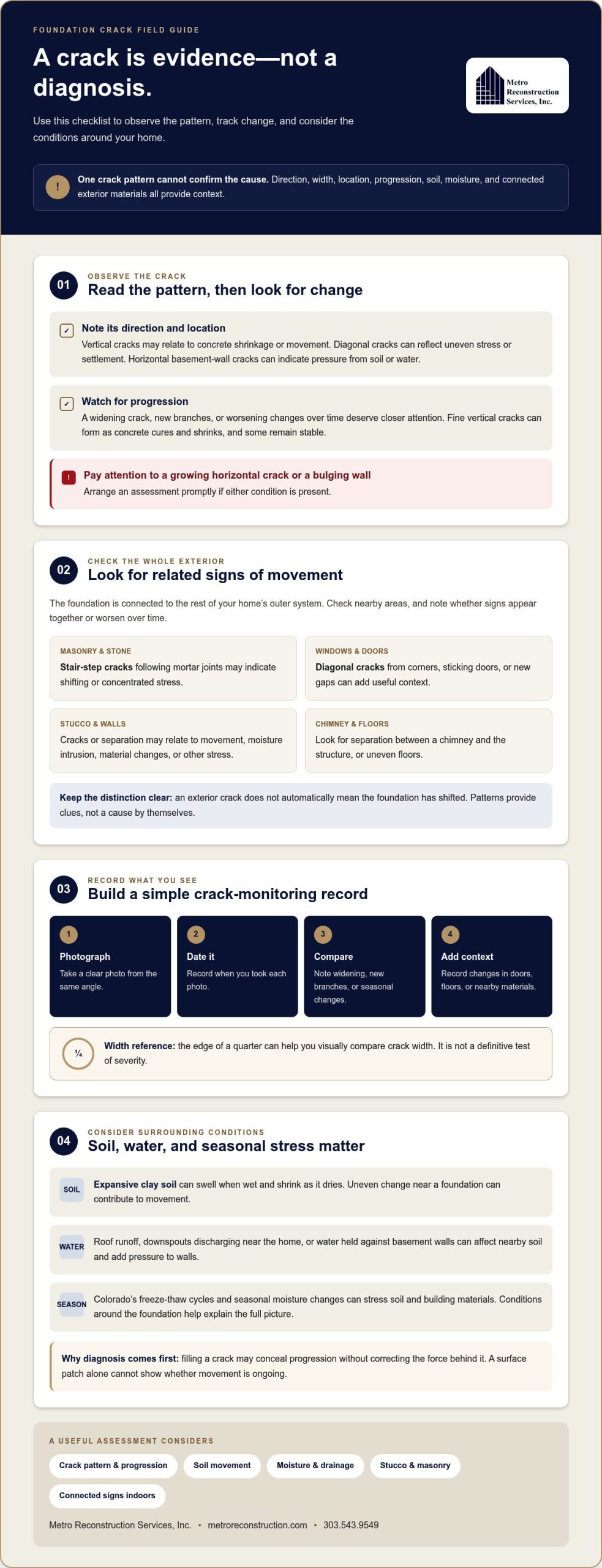
A crack’s direction, width, location, and change over time all provide useful information. Fine vertical cracks can form as concrete cures and shrinks, and some remain stable. A widening crack, a wall that appears to bow, or several signs of movement together warrant closer attention. No single crack pattern confirms the cause on its own.
Horizontal cracks in a basement wall can indicate pressure from outside, including pressure from soil or water. Arrange an assessment promptly if a horizontal crack is growing or the wall is bulging. Vertical cracks may relate to concrete shrinkage or movement, while diagonal cracks can reflect uneven stress or settlement. Seasonal moisture changes and freeze-thaw conditions affect soil and building materials, so the conditions around the foundation matter as much as the crack itself.
Look beyond the foundation. Cracks in exterior stucco or masonry may relate to movement, moisture intrusion, material changes, or other stresses. Sticking doors, uneven floors, and new gaps where walls meet ceilings add context. These signs are more significant when they appear together or worsen over time.
Visual Red Flags in the Complete Outer System
Check for stair-step cracks following mortar joints in masonry or stone veneer, separation between a chimney and the main structure, and diagonal cracks extending from window or door corners. These patterns may indicate shifting or concentrated stress, but they do not identify the cause by themselves. Consider the connected parts of your home’s outer system, including stucco and masonry, rather than treating each crack as an isolated surface flaw.
Assessing Crack Severity and Progression
Use the edge of a quarter as a visual reference for crack width, not as a definitive test of severity. Take clear photos from the same angle, note the date, and record whether the crack changes over time or through seasonal cycles. A gradual increase in width, new branches, or changes in doors and floors are useful observations to share during an assessment.
Expansive clay soil can swell when wet and shrink as it dries, so moisture conditions are relevant when assessing movement. Filling a crack may conceal its progression without correcting the force behind it. A surface patch alone cannot show whether movement is ongoing, which is why accurate diagnosis comes first.
If you’re concerned about a changing crack or several signs of movement, contact Metro Reconstruction to discuss your property. You can also call 303.543.9549.
The Science of Colorado Soils: Why Foundation Cracks Form in the Front Range
A foundation responds to the ground and water around it. Across parts of the Front Range, including Boulder, Denver, and Parker, expansive clay soil can swell as it takes in moisture and shrink as it dries. Repeated changes can push against foundation walls or leave uneven support beneath a home. Colorado’s semi-arid climate does not eliminate this risk. Dry periods followed by concentrated moisture from storms, snowmelt, or drainage problems can change soil conditions around a foundation.
Expansive Soil: The Silent Mover
Expansive clay soil changes volume as its moisture content changes. It can swell, or heave, when wet, then contract as it dries. If one area beneath or beside a foundation changes more than another, the structure may move unevenly. This is called differential settlement, though movement can include upward pressure as well as downward shifting. The Colorado Geological Survey’s report on the Denver metropolitan area describes local soil and foundation concerns that can inform a forensic diagnostic process.
Freeze-thaw cycles create another seasonal stress. Water in soil can freeze and expand, then thaw as temperatures rise. If moisture remains against a basement wall, these cycles may contribute to pressure and movement. The effect depends on soil, drainage, wall conditions, and the pattern of moisture around the home. A crack alone cannot identify the cause.
Moisture Intrusion and Structural Stress
Water management is one part of protecting a foundation. When roof runoff spills beside the house or downspouts discharge near the foundation, water can collect in nearby soil. Water held against basement walls can create hydrostatic pressure, meaning the water pushes against the wall. Gutters and downspouts should carry roof runoff away from the foundation, and the ground around the home should not direct water toward it.
Exterior materials offer useful clues, too. A crack or separation in stucco may relate to moisture entering behind the finish, movement in the wall, or stress where materials meet. It does not automatically mean the foundation has shifted. Looking at stucco, masonry, drainage, and foundation conditions together can help distinguish a surface issue from a broader moisture or movement concern.
If you’re searching for foundation crack repair near me, focus on conditions that may be driving the change, not just the visible opening. Contact Metro Reconstruction to discuss structural or moisture concerns, or call 303.543.9549.
Structural Mitigation vs. Superficial Fixes: Protecting Long-Term Value
A filled crack can look repaired while the force that opened it remains active. Soil movement, water pressure, and drainage conditions may continue to affect a foundation after a surface patch or injection. The appropriate response depends on what the crack is doing, what may be driving it, and whether the wall or foundation has lost stability.
Epoxy or similar injections can be suitable for certain cracks, but they are not a universal fix. If a crack is stable and the surrounding concrete remains sound, an injection may seal the opening in appropriate conditions. If soil movement continues, the wall is bowing, or water keeps collecting outside, sealing the crack alone will not correct those conditions. The Colorado Geological Survey’s information on Colorado’s expansive soils explains why ground conditions can affect foundations and why identifying the source of movement matters.
The Limits of Injection and Patches
Think of a patch as treatment for a visible symptom, not proof that the underlying issue is resolved. A growing crack may reopen, while a coating can make changes harder to track. Bowing or leaning basement walls deserve particular attention. Covering the wall without assessing its movement leaves the structural concern unanswered. Before selecting a repair, an assessment should consider the crack pattern, wall condition, moisture, drainage, and signs of movement elsewhere in the home.
Choosing Between Stabilization and Restoration
Cosmetic restoration addresses appearance, such as repairing a finish after the underlying cause has been understood. Structural mitigation focuses on reducing or correcting movement that threatens stability. Depending on the findings, work may involve surface restoration, a method to stabilize a wall, moisture management, or a combination of measures. Where structural design is needed, the repair plan should reflect the site and building conditions rather than assume one method suits every crack.
This is why accurate diagnosis matters more than choosing a repair by appearance alone. Metro Reconstruction considers the foundation as part of the home’s complete outer system, including stucco and masonry, because movement and moisture can affect connected parts of the structure. A carefully planned repair can address the documented cause and help preserve the home’s condition, though no repair can guarantee a particular resale outcome.
If you’re weighing foundation crack repair near me, start with the source of the damage, not just the repair material. Contact Metro Reconstruction to discuss your property, or call 303.543.9549.
Our Forensic Diagnostic Process: Precision Foundation Repair
A repair plan is only as sound as the diagnosis behind it. Metro Reconstruction examines what may be causing the stress and how the foundation connects to the rest of your home. This helps distinguish a visible surface defect from a concern involving movement, moisture, or multiple parts of the exterior.
Phase 1: Forensic Evaluation
The evaluation starts with the crack’s direction, location, and pattern, along with any signs of change. These details are considered alongside the foundation wall’s condition and site conditions that may contribute to pressure or movement. The assessment also looks for places where water may enter behind exterior finishes, since moisture can affect building materials and nearby soil.
Stucco and masonry are part of the same outer system as the foundation, not separate details to overlook. A crack or separation in stucco may relate to water intrusion or building movement, so the assessment considers whether stucco restoration services are needed alongside structural work. Findings guide the next steps. A crack alone does not determine the repair.
Phase 2: Tailored Mitigation Strategies
Structural mitigation addresses the underlying forces contributing to damage rather than only covering visible signs. The appropriate plan depends on the evaluation and relevant engineering information. Stabilization methods vary with site and wall conditions. Options used in the industry include helical piles or carbon fiber reinforcement, but a specific method should not be selected without understanding the structure and cause of movement.
Moisture resolution may also be part of the work. If roof runoff, drainage, or a failure in the exterior envelope contributes to the problem, those conditions need attention in a coordinated plan. Otherwise, water may continue to affect the soil or enter the building after a crack is repaired.
Once the scope is established, careful reconstruction matters. The repair should follow the findings and address affected components in context, including the foundation, stucco, and masonry where applicable. Metro Reconstruction brings more than four decades of experience in structural mitigation, moisture intrusion resolution, and stucco restoration to property preservation across Boulder and the Front Range.
If you’re considering foundation crack repair near me, contact Metro Reconstruction to discuss the conditions at your home. You can also call 303.543.9549.
Partnering with Metro Reconstruction: Expert Property Preservation
Structural concerns call for clear explanations and careful decisions, not pressure to approve a quick fix. Metro Reconstruction Services is a family-owned company serving Boulder and the Front Range. With more than four decades of experience in structural mitigation, moisture intrusion resolution, and stucco restoration, the company focuses on understanding the building and the conditions affecting it.
That means looking beyond a single crack. A foundation, masonry, stucco, and other exterior components work together as the home’s complete outer system. A change in one area may call for a closer look at connected surfaces and moisture pathways. Recommendations should reflect what the evidence shows and the property’s actual condition.
Serving the Front Range and Mountain Communities
Homes in Boulder, Evergreen, and Niwot can face different conditions depending on elevation, exposure, drainage, and soil. Snowmelt, changing moisture levels, and freeze-thaw cycles may affect materials and the ground around each property differently. Local context helps frame the right questions, but a site-specific assessment is still needed to understand the conditions at your home.
The Metro Promise: Integrity in Every Project
Metro Reconstruction’s approach is measured and attentive. That includes explaining the difference between a surface defect and evidence that may point to a deeper issue, while considering how the foundation relates to stucco and masonry. Craftsmanship matters, as does the accuracy of the diagnosis that guides the work.
Responsible property preservation starts with understanding the cause. Rather than promise an outcome before the conditions are understood, the focus is on clear communication and a repair strategy suited to the findings. This gives you a sounder basis for deciding how to protect your home, including when the work may involve more than the visible damage.
If you’re considering foundation crack repair near me, discuss your structural concerns with Metro Reconstruction. Contact the team or call 303.543.9549.
Protect Your Home with a Clear Next Step
A foundation crack is a visible sign, not a diagnosis. Its pattern and progression matter, as do soil movement, moisture, drainage, and the condition of connected exterior materials. Understanding these factors helps distinguish a surface repair from structural work that addresses the underlying cause.
Metro Reconstruction brings more than four decades of structural and moisture intrusion experience to property preservation across Boulder and the Front Range. An assessment considers the foundation alongside stucco and masonry, so recommendations reflect the home’s complete outer system. You get a clearer explanation of the concern and a more informed path forward.
If you’re considering foundation crack repair near me, take the next step with an evaluation focused on your home’s actual conditions. Contact Metro Reconstruction or call 303.543.9549 to discuss your property.
Frequently Asked Questions
Is a crack in my foundation always a sign of structural failure?
No. Fine cracks can form as concrete cures and shrinks, while widening cracks, bowing walls, or several new cracks may point to ongoing movement. Watch for changes over time and related signs, such as uneven floors or doors that begin sticking. An assessment can consider the crack’s pattern, location, and surrounding conditions before recommending a response.
What determines the right foundation crack repair approach in Colorado?
The right approach depends on what caused the crack, whether movement is active, the foundation’s condition, and any related moisture or exterior damage. Soil conditions, drainage, and connected parts of the building also affect the assessment. Metro Reconstruction evaluates the property and relevant engineering requirements before defining a scope of work, rather than assuming every crack calls for the same repair.
Can expansive soil cause my foundation to move every year?
Expansive clay soil can swell when it absorbs moisture and shrink as it dries, so seasonal changes may contribute to recurring movement. The amount and pattern depend on site conditions, water exposure, drainage, and the foundation itself. This is relevant for homes in Parker, Morrison, Boulder, Longmont, Niwot, Evergreen, Cherry Creek, Cherry Hills Village, Golden, Genesee, Littleton, Broomfield, Denver, Silverthorn, Breckenridge, Vail, and Larkspur. Track changes, but do not assume soil is the only cause.
What is the difference between a cosmetic stucco crack and a foundation crack?
A cosmetic stucco crack is visible in the exterior finish; a foundation crack is in the concrete or masonry foundation itself. The distinction is not always clear from the surface, since movement or moisture can affect both connected parts of the home. A crack in stucco alone does not prove the foundation has moved. An assessment should consider the finish, foundation, moisture pathways, and related changes in doors, floors, or walls.
How long does a typical structural mitigation project take?
There is no single timeline for every structural mitigation project. Duration depends on the findings, the work required, engineering needs, site conditions, and whether moisture or exterior repairs are part of the scope. A focused repair and a project involving several connected parts of the building differ in scale. Once the conditions are assessed and the scope is defined, the project schedule can be discussed.
Will foundation repair damage my home’s exterior stucco or masonry?
Some structural work may require access near exterior finishes, and the effect depends on the repair location and method. That is why the foundation should be considered alongside stucco and masonry before work begins. A clear scope can identify where finishes may be affected and whether restoration is part of the project. Metro Reconstruction handles structural mitigation and stucco restoration, which can help address connected exterior conditions as part of property preservation.
Is foundation repair covered by standard Colorado homeowners insurance?
Coverage depends on your policy and the cause of the damage, so a crack by itself does not establish whether a claim is covered. Review your policy and contact your insurance company for guidance specific to your home. Keep dated photos and notes about changes, and arrange an assessment to document visible conditions and possible contributing factors. Do not assume soil movement or water-related damage is treated the same under every policy.
What happens if I ignore a small foundation crack for too long?
A small crack may remain stable, but if it grows or allows water into the home, delaying attention can leave movement or moisture problems unaddressed. Watch for widening, new branches, dampness, bowing, or changes in doors and floors. Photos taken from the same angle can help you track progression. If you’re concerned, contact Metro Reconstruction or call 303.543.9549 to discuss an assessment.