
Is your home’s exterior acting as a protective shield or a potential fuel source when the next wildfire season arrives? For homeowners in Boulder and Evergreen, property preservation has shifted from simple maintenance to a forensic necessity under the Colorado Wildfire Resiliency Code. As of July 2026, the implementation of fire resistant siding systems is no longer just a recommendation for those in the Wildland-Urban Interface; it’s a critical requirement for maintaining insurance coverage and meeting state-mandated safety standards. We believe initial accuracy is the foundation of every lasting solution.
We understand the anxiety surrounding property loss and the confusion caused by complex material ratings like Class A and WUI compliance. You deserve the peace of mind that comes from a structure built to withstand environmental stressors rather than succumb to them. This article identifies WUI-compliant materials like James Hardie fiber cement and steel, explains the precision required during the installation process, and explores how a complete outer system approach shields your investment. You’ll gain a clear understanding of how to navigate new regulations while finding a partner who understands the unique structural demands of the Colorado climate. Reliable protection begins with a thorough understanding of your home’s vulnerabilities.
Key Takeaways
- Understand the critical differences between material fire ratings to ensure your property meets the strict safety standards required in Boulder and Evergreen.
- Discover why fire resistant siding systems like James Hardie fiber cement and three-coat stucco are the most reliable choices for shielding your home from the Front Range’s unique wildfire risks.
- Learn why true protection requires a “complete outer system” approach, where every component of your home’s exterior works together to prevent fire penetration.
- Identify the practical steps for home hardening, starting with a professional evaluation to detect hidden vulnerabilities in your current siding assembly.
- Find out why specialized local installation is necessary to ensure your home remains compliant with new wildfire resiliency codes and insurance requirements.
Understanding Fire-Resistant Siding Classifications and Ratings
Selecting the right materials for a home in the Front Range requires moving beyond aesthetics to evaluate the fundamental physics of heat transfer. Protection isn’t just about the surface; it’s about how the entire wall assembly responds to extreme environmental stressors. Fire resistant siding systems are designed to disrupt the path of a wildfire by preventing ignition from radiant heat and wind-driven embers. We prioritize initial accuracy in material selection because a single vulnerability can compromise your entire property preservation strategy. Precision is paramount.
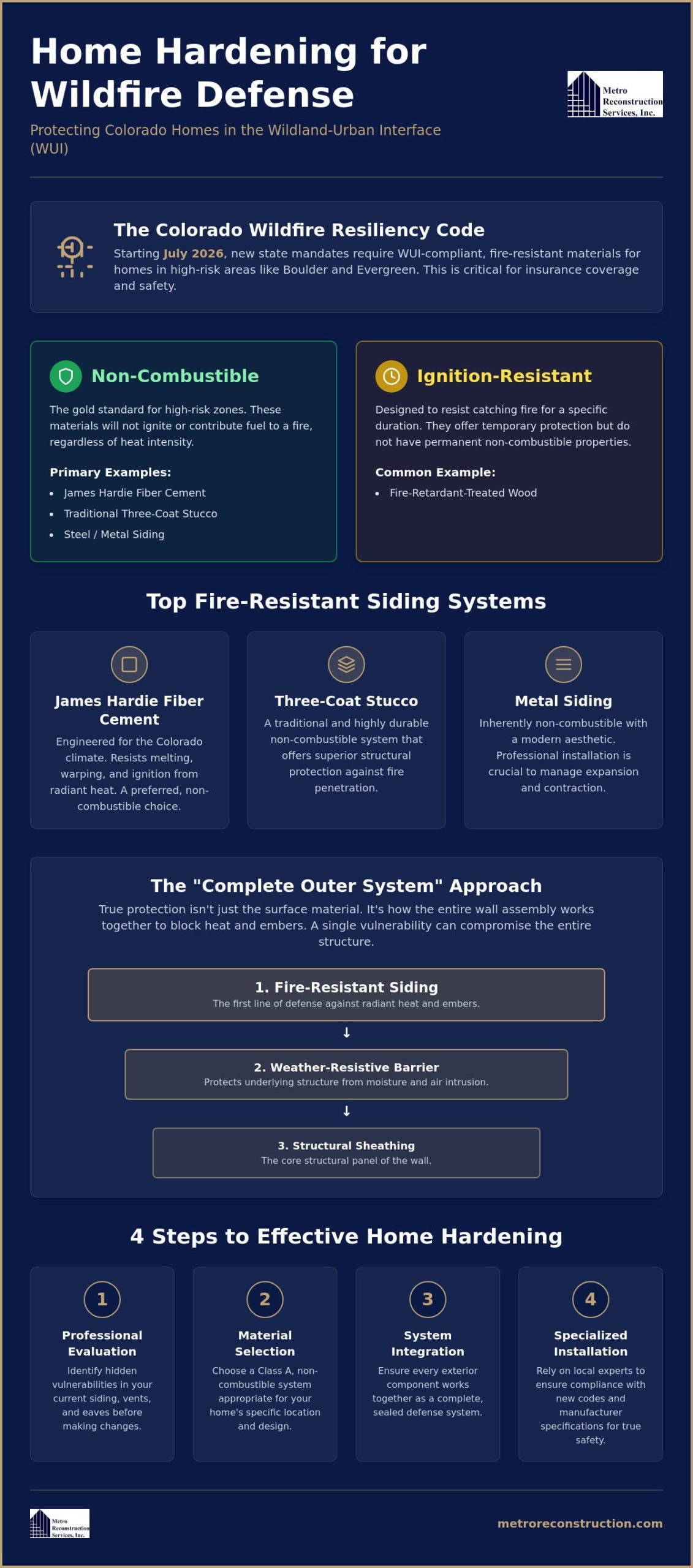
Class A fire ratings represent the highest industry standard for surface burning characteristics under the ASTM E84-26a standard. Materials with this rating have the lowest flame spread index, meaning they don’t contribute significant fuel to a fire. When we discuss a “complete outer system,” we’re looking at how your siding interacts with the weather-resistive barrier and structural sheathing behind it. This forensic approach ensures that even if embers find a gap, the underlying mechanics of the structure remain protected. Reliability is a choice made during the design phase.
Non-Combustible vs. Ignition-Resistant Materials
Non-combustible materials are the gold standard for high-risk zones because they won’t ignite or act as fuel regardless of heat intensity. Fiber cement siding and traditional three-coat stucco fall into this category, offering superior structural protection. Ignition-resistant materials, such as fire-retardant-treated wood, are designed to resist ignition for a specific duration but don’t offer the same permanent non-combustible properties. We favor non-combustible solutions to provide long-term peace of mind.
The Role of WUI Building Codes in Colorado
The Wildland-Urban Interface (WUI) refers to areas where residential developments meet undeveloped wildlands, creating a specific risk profile. As of July 1, 2026, the Colorado Wildfire Resiliency Code mandates specific fire-resistant materials for homes in these zones. These regulations influence everything from material selection to installation methods for new builds and major remodels in Boulder and Evergreen. You can learn more about meeting these requirements through our fire mitigation and prevention services.
If you’re concerned about how these new standards affect your property, our team is here to provide a detailed diagnostic evaluation. We help you move past superficial fixes toward engineering-led solutions that safeguard your investment. Reach out to us through our contact page or speak with an expert directly at 303.543.9549 to discuss your home hardening needs.
The Best Fire-Resistant Siding Systems for the Front Range
Choosing the right exterior for your home in Boulder or Evergreen is a balance between aesthetic appeal and structural defense. In our high-altitude environment, fire resistant siding systems must do more than just resist flames; they have to withstand intense UV radiation and rapid temperature shifts that compromise lesser materials. We focus on systems that offer long-term stability rather than superficial updates. Identifying the correct material for your specific topography is the first step toward true property preservation.
Metal siding provides a modern, industrial level of protection that is inherently non-combustible. In high-altitude regions, we carefully consider the expansion and contraction of metal panels due to extreme temperature swings. A professional approach ensures these movements don’t create gaps where embers could enter the wall cavity. If you’re ready to evaluate your home’s exterior, you might consider our fire mitigation and prevention services to identify the best system for your specific lot.
James Hardie Fiber Cement: Performance and Aesthetics
James Hardie siding is a preferred choice for Front Range properties because it’s engineered specifically for the climate. Unlike vinyl, which can melt or warp when exposed to the heat of a nearby fire or even intense summer sun, fiber cement remains dimensionally stable. The ColorPlus technology is particularly valuable here in Colorado. It resists the fading caused by thin mountain air and high UV exposure, ensuring your home’s protective layer doesn’t degrade over time. However, the effectiveness of these materials depends entirely on precise siding installation. Without correct flashing and gap management, even the best materials can fail to protect the building’s core.
Stucco and Masonry: Time-Tested Fire Protection
Traditional three-coat stucco and masonry work are among the most resilient non-combustible options available. These systems create a significant thermal mass barrier, slowing the transfer of heat from the exterior to the interior framing. Stucco restoration and new installation provide a seamless, ignition-resistant surface that leaves no room for wind-blown embers to find purchase. By combining stone masonry with stucco, homeowners can achieve a rugged mountain look that meets the strictest safety codes. It’s a holistic way to preserve your investment. Reliability is built into the system, not just the surface.
Our team understands that your home is a complete outer system where every component must work in harmony. We’d rather explain the difficult truth about a vulnerable material than offer a temporary, low-quality patch. To discuss how these systems can harden your home against local risks, please visit our contact page or call us at 303.543.9549.
The “Complete Outer System” Approach to Home Hardening
Fire resistant siding systems represent a critical layer of defense, yet they don’t function in isolation. A forensic look at property preservation reveals that the performance of your home’s exterior is dictated by the entire wall assembly, including the weather-resistive barrier and structural sheathing. If we only address the surface, we ignore the hidden mechanics that determine whether a structure survives a wildfire. We view the home as a complete outer system where every transition point is a potential vulnerability. Precision is not optional.
The relationship between different technical components is what creates true reliability. When we evaluate a home in Boulder or Evergreen, we look beyond the panels to the diagnostics of the underlying structure. A high-quality siding installation must account for how the material interacts with environmental stressors like wind-driven rain and extreme heat. For a truly comprehensive approach to fire safety, specialized contractors like Firemex Solutions Inc. emphasize that structural hardening should be paired with robust fire protection systems. This analytical depth ensures that your investment provides long-term value rather than a superficial fix. Reliability is built from the inside out.
Moisture Intrusion and Structural Integrity
There is a direct relationship between moisture mitigation and fire resistance. When flashing fails or caulking degrades, water penetrates the building envelope, leading to underlying rot and structural decay. This compromised wood becomes brittle and highly flammable, providing an internal fuel source that can ignite even if the exterior siding remains intact. For homes with existing masonry or cementitious finishes, professional fire mitigation and prevention services are essential to seal these gaps and preserve the underlying integrity of the home. Precision in moisture control is a foundational promise of our work.
Vents, Eaves, and Soffits: The Hidden Fire Risks
Wind-driven embers are responsible for the majority of home ignitions during Colorado wildfires. These small, super-heated particles find their way into attic spaces through standard vents or under unprotected eaves and soffits. Hardening these areas with ignition-resistant materials and ember-resistant venting is just as vital as the siding itself. Our design-build approach ensures that these transitions are engineered for safety from the start. We don’t believe in superficial patches; we focus on long-term solutions that protect your entire investment.
Integrating fire-resistant siding with high-performance window systems completes the protective envelope. Windows are often the weakest point in a fire, where radiant heat can cause glass to fail, allowing flames to enter the interior. By coordinating these elements into a unified system, we eliminate the weak links that typical contractors might overlook. If you want to ensure your home’s outer system is truly prepared, reach out to us via our contact page or call 303.543.9549. Our commitment to accuracy ensures your home remains a sanctuary.
Practical Steps for Home Hardening in Wildfire Zones
Transitioning from the theoretical understanding of materials to the physical hardening of your property requires a methodical, step-by-step approach. We begin by evaluating the building as it stands today, identifying where the existing envelope fails to meet current safety standards. For many homes in the Front Range, the most immediate threat comes from the presence of combustible materials like vinyl or cedar siding. Replacing these with fire resistant siding systems is the most impactful action a homeowner can take to reduce ignition risk. We prioritize precision over speed.
The Inspection Process: Identifying Vulnerabilities
A forensic structural evaluation goes beyond a simple walkthrough. It involves a detailed diagnostic of how embers might interact with your specific home design, from the roofline to the foundation. To see how professional roofing standards contribute to overall structural resilience, visit United Roofing & More!. We look for underlying structural origins of potential failure, such as gaps in the building envelope or degraded sealant. Home Hardening is a proactive defensive strategy designed to reinforce a building’s exterior against ember intrusion and radiant heat through the use of non-combustible materials and specialized construction methods. By identifying these vulnerabilities early, we can create a prioritized roadmap for restoration that addresses the highest risks first.
Siding Replacement Logistics for Mountain Homes
Executing a major exterior remodel in high-altitude environments like Genesee or Evergreen presents unique logistical challenges. Steep grades and limited access require a contractor who understands how to manage materials and staging without compromising the surrounding landscape. During a siding overhaul, we also address thermal performance, ensuring that new insulation and weather-resistive barriers work in tandem with your fire-resistant layer. This is often the ideal time to perform essential exterior home repair, as it allows us to correct hidden structural issues before the new system is installed. Reliability is built on these foundational corrections.
Beyond the walls, establishing a defensible space is essential. This involves managing vegetation and ensuring structural setbacks that prevent a fire from moving easily from the forest to your home. Upgrading to fire-rated windows with tempered glass further secures the envelope, preventing radiant heat from shattering the glass and exposing the interior. If you are ready to begin this process, we invite you to schedule a fire mitigation inspection and evaluation through our contact page or by calling 303.543.9549. We are your partners in property preservation.
Why Professional Installation is Critical for Fire Safety
The effectiveness of fire resistant siding systems is inextricably linked to the precision of their installation. Even the most advanced non-combustible materials will fail to protect a structure if the underlying mechanics of the building envelope are ignored. We often see properties where superficial patches have been applied to cover structural decay, which creates a false sense of security for the homeowner. Our approach is different. We utilize a forensic methodology to identify the structural origins of failure, ensuring that every layer of the building’s complete outer system is reinforced against the specific threats of the Front Range.
Local expertise in the Boulder County climate is non-negotiable because our environment presents stressors that generic installers often overlook. High-altitude UV exposure can degrade seals, while extreme temperature swings cause materials to expand and contract. If these movements aren’t accounted for during installation, gaps can form, allowing wind-driven embers to bypass your protective shield. We leverage the 40-year legacy of Metro Reconstruction Services, Inc. to ensure that your home hardening project is executed with total accuracy. Your property preservation shouldn’t be left to chance.
We believe in transparency and reliability, which is why we utilize fixed-price project management. This approach protects your investment by eliminating the financial uncertainty often associated with complex reconstruction projects. By integrating fire-resistant siding with specialized services like stucco restoration and masonry work, we provide a holistic solution that addresses both aesthetics and structural integrity. Reliability is a foundational brand promise we’ve kept for decades.
The Forensic Expert Advantage
Our forensic approach allows us to look behind the surface to find why a system is failing before we begin the restoration process. This diagnostic depth is what distinguishes a long-term solution from a temporary fix. As a family-owned and operated firm, we take a personal interest in the safety of our neighbors in Boulder and Evergreen. You gain the peace of mind that comes from working with seasoned experts who understand the hidden mechanics of your home. We invite you to schedule a professional evaluation to identify the specific vulnerabilities of your property’s outer system.
Contact Metro Reconstruction Services, Inc.
Protecting your home from the unique wildfire risks of the Colorado Front Range requires a dedicated partner in property preservation. We provide personalized project management tailored to the demanding regional environments of mountain and foothills communities. Our team is ready to help you navigate the complexities of WUI compliance and home hardening with quiet confidence and technical precision. Visit our contact page to start your consultation or speak with a specialist directly by calling 303.543.9549. Let’s ensure your home remains a sanctuary for the long term.
Secure Your Home’s Future with Engineering-Led Protection
Investing in your home’s exterior is about more than aesthetics; it’s a commitment to property preservation in an increasingly volatile environment. By integrating fire resistant siding systems into a complete outer system, you move beyond superficial fixes toward a structure that can withstand wind-driven embers and radiant heat. We’ve seen how the right materials, such as fiber cement and traditional stucco, provide a formidable barrier when installed with technical precision. Reliability is built from the inside out.
As a family-owned firm with over 40 years of Front Range experience, we believe that initial accuracy is the foundation of every successful restoration. Our specialized fire mitigation inspections and evaluations identify the underlying structural origins of vulnerability, giving you a clear path toward WUI compliance and long-term peace of mind. You don’t have to navigate these complex code changes alone. Precision is our promise to every homeowner we serve.
Protect your investment with a professional forensic evaluation. Contact Metro Reconstruction Services, Inc. today or call us at 303.543.9549. We look forward to helping you safeguard your home for generations to come.
Common Questions Regarding Fire-Resistant Home Hardening
Is stucco actually fireproof for homes in Boulder?
Traditional three-coat stucco is a non-combustible material that provides exceptional resistance to radiant heat and direct flame contact. While no material is entirely fireproof under extreme conditions, stucco does not ignite or contribute fuel to a fire. It acts as a significant thermal mass barrier, which slows the transfer of heat to the interior framing and helps preserve the structural integrity of the building’s complete outer system.
Can I install fire-resistant siding over my existing wood siding?
We strongly advise against installing new materials over existing wood siding because it creates a dangerous pocket of fuel within the wall assembly. This practice can trap moisture, leading to hidden rot that compromises the structure’s stability. A professional approach requires the full removal of combustible layers to perform a forensic inspection of the underlying sheathing and to ensure the new weather-resistive barrier is installed with total accuracy.
What is the difference between Class A and Class B fire ratings for siding?
Class A is the highest fire rating available, indicating a material has the lowest flame spread index and provides the maximum protection against fire penetration. Class B materials have a moderate resistance but allow for more rapid flame movement across the surface. For homes in the Colorado Front Range, utilizing Class A fire resistant siding systems is often a legal requirement under the 2026 wildfire resiliency codes to ensure long-term safety.
How much does it cost to replace siding with a fire-resistant system?
The total investment for a fire-resistant overhaul depends on the specific material chosen and the complexity of the home’s architecture. We utilize fixed-price project management to provide our clients with financial transparency and to avoid the uncertainty of mid-project cost increases. This approach ensures that your property preservation goals are met within a clearly defined budget without compromising on the quality of the engineering-led solution.
Do fire-resistant siding systems require special maintenance?
Most fire-resistant materials, such as fiber cement and masonry, are significantly more durable and lower maintenance than traditional wood. However, they still require routine diagnostic evaluations to identify potential sealant failures or minor cracks that could allow moisture intrusion. We focus on identifying these underlying structural origins of wear during regular inspections to ensure your home’s protective envelope remains intact and functional for decades.
Will fire-resistant siding lower my Colorado homeowners insurance premiums?
Many insurance providers in Colorado offer discounts or improved coverage terms for properties that have undergone verified home hardening. By replacing combustible materials with WUI-compliant alternatives, you demonstrate a proactive commitment to risk reduction. While we recommend speaking directly with your agent, implementing these systems is a recognized strategy for maintaining insurance eligibility in high-risk mountain and foothills communities.
Are James Hardie products WUI-compliant for mountain communities?
James Hardie fiber cement products are non-combustible and are widely recognized as WUI-compliant throughout the Colorado Front Range. These fire resistant siding systems are engineered to withstand the extreme environmental stressors of high-altitude climates, including intense UV radiation and rapid temperature shifts. Their inclusion in a home’s exterior design provides a reliable shield that meets the strict safety standards required for modern property preservation.
How long does a full home hardening siding project typically take?
A comprehensive siding replacement and home hardening project typically spans several weeks, depending on the size of the structure and the terrain challenges. We prioritize initial accuracy and a thorough forensic approach over a rushed timeline to ensure every transition point is properly sealed. Our team manages the logistics of mountain construction with quiet confidence, providing steady progress updates until the complete outer system is fully secured.
If you have further questions about shielding your property, we invite you to reach out for a professional evaluation. Contact Metro Reconstruction Services, Inc. today or call us at 303.543.9549 to discuss your specific home hardening needs. We are dedicated partners in preserving your investment.