
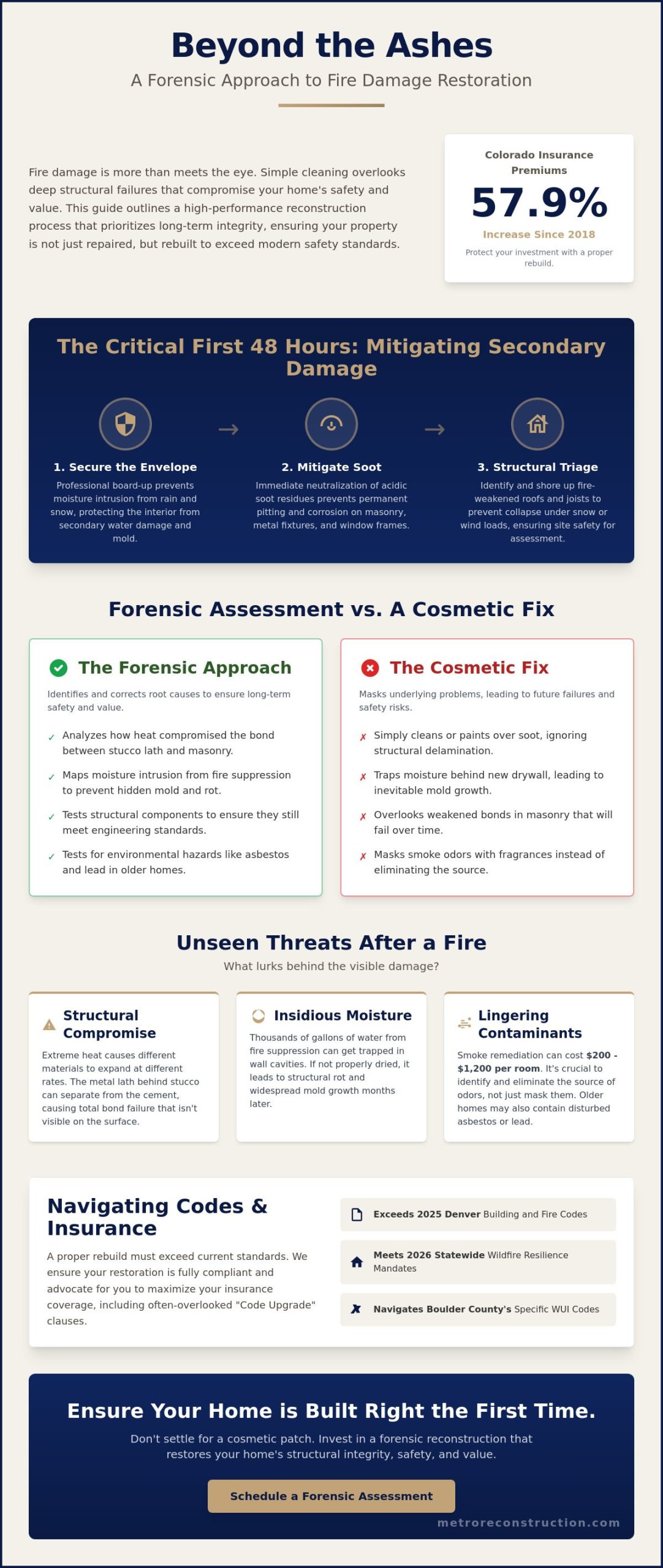
If you believe fire restoration is simply a matter of cleaning soot and replacing charred drywall, you are likely overlooking the forensic structural failures that compromise your home’s long-term safety. We understand the anxiety of facing a property that feels fundamentally changed; it is a heavy burden, especially as Colorado insurance premiums have surged 57.9% since 2018. It is natural to worry about lingering odors or whether your exterior envelope can still protect you from the next Front Range winter. Our team recognizes that your home is your most significant investment, and seeing it compromised requires more than a cosmetic fix.
This guide will show you how to navigate the complex recovery process by prioritizing structural integrity and high-performance reconstruction that exceeds the 2025 Denver Building and Fire Codes. We will examine the technical requirements of the 2026 statewide wildfire resilience mandates and explain how a forensic approach to fire damage restoration denver ensures your home is built right the first time. By understanding the relationship between moisture management and thermal damage, you can restore your property value and gain genuine peace of mind regarding your family’s safety.
Key Takeaways
- Learn why professional board-up services and immediate soot mitigation within 48 hours are essential to prevent secondary moisture intrusion and corrosive damage.
- Understand the importance of a forensic assessment to identify how extreme heat has compromised the structural integrity of your stucco lath and masonry bonds.
- Discover how specialized fire damage restoration denver focuses on the entire exterior envelope to restore property value and exceed modern safety standards.
- Navigate the complexities of Boulder County’s WUI codes and insurance “Code Upgrade” clauses to ensure your rebuild is both compliant and fully funded.
- Shift your focus from aesthetic patches to high-performance reconstruction that addresses root causes, ensuring your home is built right the first time.
Immediate Steps for Fire Damage Restoration in Denver and Boulder
While many restoration companies emphasize speed, the initial phase of recovery requires a level of forensic precision that goes beyond simply boarding up a broken window. The first 48 hours are critical for mitigating corrosive soot damage on high-end masonry and metal fixtures. Soot is chemically aggressive. When high-thermal events occur, the resulting carbon-based residues become acidic upon contact with moisture, leading to the permanent pitting of masonry and the oxidation of metal window extrusions. Effective fire damage restoration denver begins with securing the entire exterior envelope to prevent secondary moisture intrusion from Colorado’s frequent afternoon thunderstorms.
This stabilization is a vital component of the broader disaster restoration process, ensuring the building remains safe for detailed forensic analysis. In the Front Range and Mountain communities, we prioritize initial structural triage to identify immediate collapse risks. Fire-weakened roofs or floor joists can become lethal hazards under the weight of heavy snow or high wind loads. We coordinate directly with local Boulder County emergency services to ensure site clearance is handled with technical accuracy before any reconstruction begins. Our goal is to protect your investment from the moment we arrive on-site.
- Professional Board-Up: We use specific attachment methods that avoid further damage to stucco and masonry surfaces.
- Soot Mitigation: Immediate neutralization of acidic residues on high-performance window frames and stone veneers.
- Site Clearance: Coordination with local authorities to ensure all safety protocols meet the 2025 Denver Building and Fire Codes.
Securing the Structural Envelope
Structural shoring is a critical safety measure for fire-damaged properties, providing temporary support to load-bearing elements that have lost their engineering capacity. We don’t just cover holes; we stabilize the building’s skeleton to prevent further shifting. Protecting the interior during the assessment phase is paramount, as moisture from the environment can exacerbate the damage already caused by fire suppression efforts. By securing the envelope correctly, we ensure the home is built right the first time during the eventual reconstruction phase.
Environmental Hazard Assessment
Older Denver-area reconstructions often involve hidden risks like asbestos or lead-based materials. We conduct thorough testing before any structural work begins to protect both the workers and your family. In Boulder County, managing runoff is equally important to protect local watersheds during the initial cleaning phase. We establish a baseline for smoke remediation through initial air quality testing, targeting the root cause of odors rather than masking them with temporary fragrances. As of early 2026, smoke damage restoration alone can cost between $200 and $1,200 per room, making early containment a financial necessity.
Forensic Assessment: Understanding the Root Cause of Fire Damage
Forensic reconstruction assessment is the sophisticated process of analyzing how intense heat has fundamentally altered a building’s core engineering. It moves beyond a simple visual inspection of charred surfaces to determine if the structural components can still perform their intended functions. During a high-thermal event, the expansion rates of different materials vary significantly. For instance, the metal lath behind a stucco finish expands at a different rate than the cementitious layers, which often leads to a total loss of bond and hidden delamination. This is why fire damage restoration denver requires a deep understanding of material science to ensure the building is safe before any aesthetic work begins.
Water damage often presents a more insidious threat than the flames themselves. Fire suppression efforts can introduce thousands of gallons of water into the building’s interior and wall cavities. If this moisture is trapped behind the exterior envelope, it creates an environment ripe for mold growth and structural rot that may not manifest for months. We analyze the flashing and thermal barriers to ensure the moisture management system hasn’t been compromised by heat or high-pressure water streams. Understanding these forensic reconstruction requirements is the only way to avoid the “quick fix” trap that leads to long-term failure and ensures your home is built right the first time.
Thermal Damage to Masonry and Stucco
Extreme heat causes stucco delamination, where the finish separates from the substrate, often leaving the home vulnerable to the elements. In stone veneers, “spalling” occurs as moisture trapped within the stone expands rapidly, causing the surface to flake or crack. We test the integrity of the weather-resistive barrier (WRB) located behind the exterior finish to see if it has melted or become brittle. For historic Denver brickwork, we evaluate mortar strength post-fire, as temperatures exceeding 1,000 degrees Fahrenheit can cause mortar to calcify and lose its structural capacity.
Smoke and Soot Penetration
Soot chemistry is complex and depends entirely on the fuel source. Wood-based fires produce dry, powdery soot, while synthetic materials like plastics and foams create greasy, smeary residues that bond to surfaces. Each type requires specific chemical neutralizers to prevent permanent staining and odor retention within the exterior envelope. Smoke particles are microscopic, frequently migrating through wall cavities and settling behind insulation where they remain as a source of recurring odor. We utilize thermal imaging to detect hidden smoldering or moisture pockets that are invisible to the naked eye, addressing the root cause of the damage rather than just the visible symptoms.
Reconstructing the Exterior: Stucco, Masonry, and Windows
Rebuilding the exterior of a home after a thermal event requires a shift in perspective from simple repair to comprehensive reconstruction. While many contractors suggest localized patches to save on costs, effective fire damage restoration denver often necessitates a full stucco replacement. Because high heat compromises the chemical bond between the cementitious layers and the metal lath, the surrounding material becomes brittle and prone to future delamination. Attempting to bridge new material with heat-damaged sections creates a structural weak point that will inevitably fail under the stress of Colorado’s extreme temperature swings.
Integrating new masonry with existing structures presents a specific challenge in Boulder County, where aesthetic continuity is often mandated by local architectural guidelines. We don’t just lay new stone; we analyze the mortar composition and stone origin to ensure the revitalized section is indistinguishable from the original. This process involves more than visual matching. It requires a technical understanding of how new masonry expands and contracts relative to the older, settled components of the building. By addressing these engineering nuances, we protect your property value and ensure the structural safety of the entire exterior envelope.
Specialized Stucco Restoration
Heat exposure causes catastrophic failures in both EIFS and traditional hard-coat stucco systems. High-thermal events often melt the foam insulation in EIFS or cause the wire lath in traditional systems to buckle, creating hidden voids. During the reconstruction phase, we prioritize the installation of high-performance drainage planes and weather-resistive barriers (WRB) to prevent moisture from becoming trapped. Our methodology follows the forensic approach detailed in our guide to stucco restoration, which focuses on identifying and fixing the root cause of failure rather than masking visible symptoms.
Window and Masonry Integration
Selecting the right windows is a critical investment in your home’s durability. We install high-performance windows designed to withstand the Front Range’s specific environmental stressors, including high-altitude UV radiation and wind loads that can exceed 100 miles per hour during downslope events. Proper flashing at the transitions between windows and masonry is the most vital step in preventing future leaks. The principle of being built right the first time ensures that every transition between windows and masonry is perfectly flashed to eliminate the root cause of future water intrusion. This holistic approach to the exterior envelope ensures your home meets the 2025 Denver Building and Fire Codes while providing lasting peace of mind.
Navigating Boulder County Building Codes and Insurance
The intersection of regulatory compliance and insurance recovery is where many restoration projects stall. For owners of older Boulder properties, understanding “Code Upgrade” or “Law and Ordinance” coverage is essential because modern requirements often exceed the original building standards. Since Colorado homeowners insurance premiums rose 57.9% between 2018 and 2023, insurers are scrutinizing claims more closely than ever. We provide the technical documentation required to justify necessary upgrades, ensuring that your fire damage restoration denver project is fully funded to meet current safety mandates rather than just returning the building to a sub-standard state.
Compliance with the Wildland-Urban Interface (WUI) codes is now a non-negotiable aspect of rebuilding in Front Range mountain communities. An ordinance approved on May 15, 2025, and effective as of August 1, 2025, established strict rules for over 16,000 properties in Boulder’s WUI. These rules mandate a five-foot buffer of noncombustible material around the structure and the use of ignition-resistant materials for the exterior envelope. By documenting forensic evidence of how heat compromised your home’s original materials, we help you maximize legitimate insurance claims to cover these mandatory, high-performance upgrades.
Local Regulatory Compliance
Navigating the permit process differs significantly between the City of Boulder and unincorporated Boulder County. Each jurisdiction has specific interpretations of the 2021 International Energy Conservation Code (IECC), which governs efficiency standards for renovated small buildings. We ensure your stucco and masonry textures not only meet these thermal requirements but also align with local HOA or historic district guidelines. This meticulous attention to detail prevents costly delays and ensures your project remains in full legal compliance from start to finish.
Professional Project Management
Choosing a single partner for both forensic mitigation and full-scale reconstruction streamlines the recovery process and reduces business interruption time for commercial properties. We maintain a detailed “cause-and-effect” log that translates technical failures into the language insurance adjusters require for claim approval. This transparency builds trust with all stakeholders and reinforces our commitment to doing the job right. If you are facing the complexities of a major rebuild, contact our expert team today to secure your investment with a fixed-price reconstruction fee.
The Metro Difference: Built Right the First Time
Forty years of experience in the Denver-Boulder corridor has provided us with a unique perspective on how local buildings respond to extreme stress. We’ve watched the Front Range evolve, and we understand that the high-altitude environment requires a specific engineering approach that national restoration chains often overlook. Our “Wise Craftsman” philosophy dictates that we value substance over style; we’re more interested in the integrity of your wall cavities than the immediate shine of a fresh coat of paint. Choosing a partner for fire damage restoration denver means selecting a firm that understands the technical nuances of our local climate, from 100-mile-per-hour wind loads to the rapid freeze-thaw cycles that challenge every exterior envelope.
We’re committed to addressing the root cause of structural failure rather than just the visible symptoms of fire damage. When heat compromises a building, the damage is rarely limited to what you can see on the surface. Our forensic reconstruction methodology involves a meticulous analysis of how thermal expansion has affected the hidden mechanics of your home. By identifying these deep-seated issues early, we ensure that your property is preserved for decades, not just until the next season. We don’t offer temporary patches. We offer long-term solutions that ensure your home is built right the first time.
A Partner in Home Preservation
Moving from the shock of a catastrophe to a “better than before” structural state requires a dedicated partner. As a family-owned, locally-operated specialist, we take a protective interest in your investment. Our deep expertise in moisture management and foundation repair informs every fire restoration project we undertake. We understand that the water used to extinguish a fire can be as destructive as the flames, often leading to secondary issues like soil subsidence or mold growth. We manage these complexities with quiet confidence, providing you with the peace of mind that comes from true professional oversight.
Ready to Rebuild?
If your property has been affected by a fire, the next steps you take will define the long-term health of your building. We invite you to experience the reliability of a firm that understands the entire exterior envelope as a single, high-performance system. We provide comprehensive forensic assessments that translate technical data into a clear, actionable reconstruction plan. Don’t settle for a contractor who only sees the soot. Partner with a team that sees the solution. Schedule a professional consultation for your fire restoration project today and let us help you revitalize your home with the precision it deserves.
Securing Your Home’s Future with Forensic Precision
Rebuilding after a fire is not a task for generalists; it is a complex engineering challenge that demands a deep understanding of the entire exterior envelope. We’ve explored how identifying the root cause of structural failure is the only way to ensure your home meets the rigorous 2025 Denver Building and Fire Codes. By prioritizing a forensic assessment over surface-level cleaning, you protect your investment from the long-term effects of thermal damage and moisture intrusion that often go unnoticed by standard contractors. This analytical approach is essential for successful fire damage restoration denver, ensuring that every structural component is returned to its full engineering capacity.
With over 40 years of expertise in the Denver-Boulder corridor, our team provides the technical depth and fixed-price project management necessary to navigate these difficult transitions. We understand the specific environmental stressors of the Front Range and are dedicated to ensuring your property is revitalized to a high-performance standard. If you are ready to move from catastrophe to a state of permanent safety, trust your fire reconstruction to the seasoned experts at Metro Reconstruction. Our commitment to quality ensures your home is built right the first time, providing you with the peace of mind you deserve as you move forward.
Frequently Asked Questions
How long does the fire damage restoration process typically take in Denver?
The timeline for restoration typically ranges from 3 to 9 months depending on the extent of structural damage and permit requirements. Complex projects involving the 2025 Denver Building and Fire Codes require detailed plan reviews that can extend the pre-construction phase. We provide a fixed-price schedule to ensure the reconstruction moves forward without unnecessary delays while maintaining engineering standards.
Can I stay in my home during the fire restoration and reconstruction phase?
Occupancy is generally prohibited if the fire has compromised the structural integrity or the air quality of the interior. Even if the damage seems localized, smoke particles and acidic soot often migrate through wall cavities, requiring professional remediation. Local building officials must verify that the environment is safe and that all thermal barriers are intact before you return.
Does insurance cover the cost of upgrading my home to current Boulder building codes?
Most standard homeowners policies include Law and Ordinance coverage that pays for mandated upgrades to meet current building standards. This is a vital provision for properties in Boulder County that must now comply with the updated 2025 Wildfire Resilience Codes. We help you document the forensic necessity of these upgrades to ensure your insurer covers the cost of a high-performance rebuild.
What is the difference between fire mitigation and fire reconstruction?
Fire mitigation involves immediate stabilization and soot neutralization while reconstruction is the permanent rebuilding of the structural components. Mitigation happens within the first 48 hours to prevent secondary damage from moisture or corrosion. In contrast, fire damage restoration denver focuses on the long-term integrity of the exterior envelope, ensuring the home is built right the first time.
How do you remove the smell of smoke from a stucco or brick exterior?
Eliminating smoke odors requires neutralizing the acidic soot residues that have bonded to the porous surfaces of brick or stucco. We don’t rely on surface washing alone; we analyze the drainage plane behind the finish to ensure smoke particles haven’t settled in the wall cavity. If the weather-resistive barrier is compromised, we replace the affected sections to remove the root cause of the odor.
Is it possible to repair fire-damaged masonry, or does it always need to be replaced?
Masonry can be repaired if the thermal event didn’t cause the mortar to calcify or the stone to lose its compressive strength. We use forensic testing to evaluate the masonry bond post-fire. If the heat reached levels that compromised the structural engineering of the wall, a full replacement is the only way to protect your long-term investment and safety.
What are the specific Wildland-Urban Interface (WUI) codes I need to know about in Boulder?
The WUI codes mandate the use of ignition-resistant materials and the creation of noncombustible defensible spaces. For properties within the designated boundaries, you must maintain a five-foot buffer of noncombustible material directly around the structure. Additionally, any new fences or gates installed within eight feet of the home must be constructed from fire-resistant materials to prevent flame spread.
Why is water damage a concern after a fire has been extinguished?
Water used during fire suppression often causes more insidious decay than the flames by saturating the building’s interior and insulation. If this moisture is trapped behind the exterior envelope, it leads to rapid mold growth and the rot of structural framing. We utilize thermal imaging to detect these hidden moisture pockets, addressing them early to avoid the “quick fix” failures that plague many restoration projects.