
On a Tuesday morning in late October, a Longmont homeowner might look through their living room window only to find the view of the Front Range obscured by a milky, internal haze. This isn’t just a cosmetic nuisance; it’s a physical signal that the insulating argon gas has escaped and moisture has begun its slow, destructive work within the glass unit. When you’re facing the need for window seal failure repair Longmont homes require, it’s natural to feel concerned about rising utility bills or the potential for hidden mold growth within the wall cavity.
We understand that your home is your most significant investment, and seeing it compromised by Colorado’s intense UV radiation and 40-degree daily temperature swings is unsettling. You deserve a solution that moves beyond a temporary patch to address the fundamental integrity of your exterior envelope. This article explains the technical mechanics of thermal pumping and outlines how our forensic reconstruction process identifies the root cause of moisture intrusion. We’ll show you how to revitalize your home’s performance and ensure your property is built right the first time.
Key Takeaways
- Understand how Longmont’s rapid temperature fluctuations and expansive soils create mechanical stress that breaches your window’s perimeter seal.
- Identify the hidden risks that failed seals pose to your home’s exterior envelope, including potential moisture migration into wall cavities and stucco systems.
- Learn why professional window seal failure repair Longmont requires a forensic assessment to distinguish between simple glass replacement and necessary structural reconstruction.
- Evaluate the long-term ROI of comprehensive repairs over “quick-fix” drilling methods that fail to address the root cause of condensation.
- Discover how a holistic approach to moisture management ensures every component of your home’s exterior works in harmony to prevent future failures.
Identifying Window Seal Failure in Longmont’s Climate
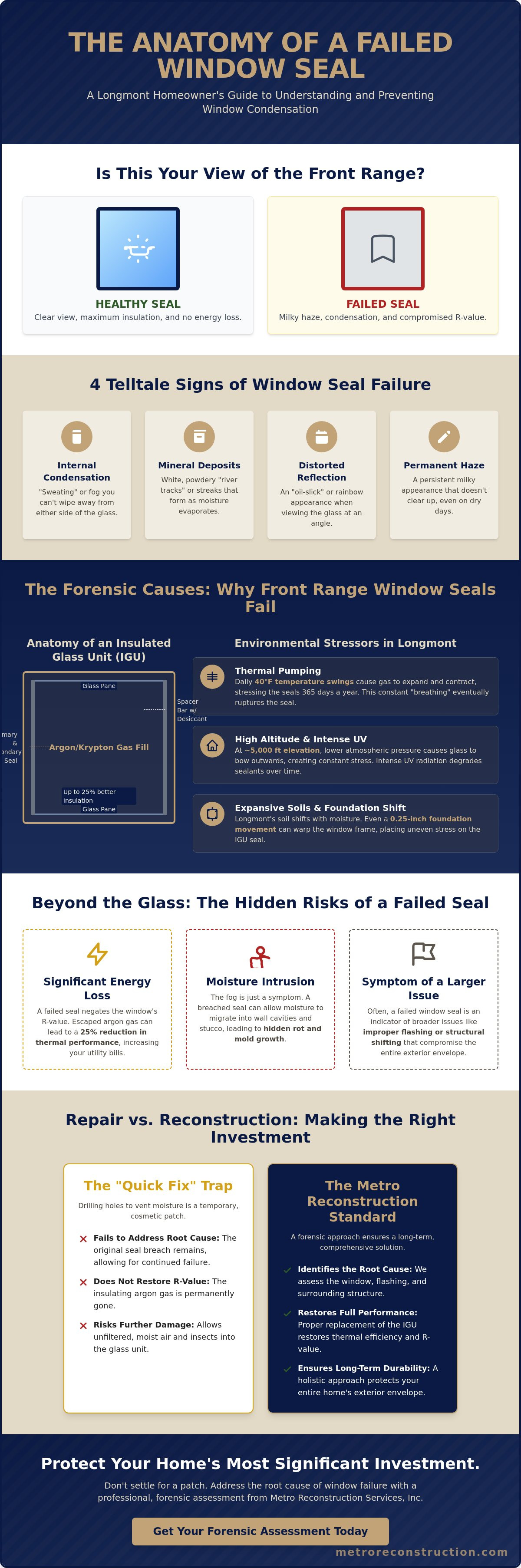
Longmont homeowners often overlook the early signs of window degradation until a clear view of the St. Vrain Valley becomes obscured by a milky haze. This phenomenon, known as window seal failure, occurs when the perimeter seal of an Insulated glazing unit (IGU) loses its airtight integrity. Once this barrier is breached, the inert gases that provide thermal resistance escape, replaced by moisture-laden air from the outside. This is more than a nuisance; it represents a fundamental breakdown in your home’s exterior envelope. When seeking window seal failure repair Longmont residents must understand that the visible fog is merely a symptom of a deeper mechanical failure that compromises the entire building’s efficiency.
Visual Cues for Homeowners:
- Condensation or “sweating” that cannot be wiped away from either the interior or exterior surface.
- White, powdery mineral deposits that form “river tracks” or hazy streaks on the glass surfaces.
- A distorted or “oil-slick” appearance in the glass when viewed at a sharp angle.
- Permanent hazing that persists even during dry, low-humidity afternoons.
Ignoring these signs leads to a significant loss of R-value and potential moisture damage to the surrounding window frame. At Metro Reconstruction Services, Inc., we view these failures through a forensic lens, identifying the root cause to ensure your home remains protected against the elements.
The Anatomy of a Modern Insulated Glass Unit
A high-performance IGU relies on a multi-stage defense system to manage moisture. Spacer bars separate the two panes of glass, containing desiccants that act like high-capacity sponges to soak up residual moisture within the unit. The primary seal acts as a vapor barrier, while a secondary sealant provides the structural rigidity needed to hold the unit together. In Colorado, these units are often pressurized and filled with argon or krypton gas to reduce thermal transfer by up to 25 percent compared to standard air-filled units.
Why Longmont’s 5,000ft Altitude Accelerates Failure
Longmont sits at an elevation of roughly 4,979 feet, where atmospheric pressure is significantly lower than at sea level. This pressure differential causes the glass panes to bow outward, putting constant, mechanical stress on the perimeter sealants. This stress is compounded by the intense UV radiation and temperature swings common along the Front Range. Solar pumping is the daily expansion and contraction of gas between panes that eventually ruptures the seal. This cycle happens 365 days a year, making window seal failure repair Longmont a critical service for homeowners who want to invest in long-term durability rather than temporary patches.
The Forensic Causes: Why Front Range Window Seals Fail
Identifying the root cause of window seal failure repair Longmont homeowners require involves more than a glance at the glass. In the Front Range, the primary antagonist is thermal pumping. Colorado’s environment regularly produces 40-degree temperature swings within 24 hours. These fluctuations force the air between glass panes to expand and contract aggressively. Over time, this constant pressure exhausts the sealant’s elasticity, leading to the eventual rupture of the atmospheric barrier.
The geological reality of Longmont adds another layer of complexity. Much of the region sits on expansive soils that shift significantly with moisture levels. When a foundation moves even 0.25 inches, it translates that torque into the window buck. A warped frame places uneven mechanical stress on the Insulated Glass Unit (IGU) seal. While many contractors treat the fogged glass as an isolated issue, we recognize it as a symptom of the entire exterior envelope’s performance.
Budget-grade windows often succumb to these pressures within 5 to 10 years. These units typically utilize thin-walled vinyl or low-performance spacers that lack the structural integrity required for Boulder County’s climate. When homeowners begin understanding window energy performance ratings, they realize that a failed seal negates the thermal benefits of the entire unit. Improper flashing also plays a silent role. If the perimeter flashing fails, water collects in the glazing pocket, causing the bottom seal to sit in standing water and undergo chemical breakdown.
UV Degradation and Chemical Outgassing
At an elevation of 5,000 feet, UV radiation is approximately 20% more intense than at sea level. These high-altitude rays penetrate the glass and attack the molecular bonds of standard sealants. This often results in a phenomenon known as “puddling,” where the sealant loses its viscosity, melts, and runs down the interior of the glass. Standard sealants used in milder climates simply cannot withstand this localized heat intensity without outgassing and losing their structural grip.
Structural Stress and Frame Misalignment
Window health is inextricably linked to the home’s structural integrity. Minor settling in the foundation creates a racking effect on the window opening. This misalignment pinches the IGU, creating a focal point of stress that eventually shears the seal. Addressing the root cause of structural movement through foundation stabilization is often the only way to ensure that new window installations don’t face the same premature failure as their predecessors. We focus on these forensic details to ensure your home’s protection is built right the first time.
Beyond the Glass: Impact on Your Home’s Exterior Envelope
Window seal failure is rarely a localized aesthetic problem; it signals a breach in the building’s thermal and moisture barrier. When the integrity of an Insulated Glass Unit (IGU) is compromised, the window stops acting as a shield and starts acting as a conduit for environmental damage. Moisture migrates from the frame into the internal wall cavities, where it can remain trapped for months. This hidden moisture often leads to structural rot before the homeowner notices a single drop on the interior floor. Understanding the technical causes of insulated glass failure helps illustrate how environmental stressors, such as the intense solar gain and rapid temperature fluctuations in Colorado, accelerate this degradation.
We view window systems as a critical component of the entire exterior envelope. A failure in one area creates a ripple effect that compromises the performance of siding, framing, and insulation. Professional window seal failure repair Longmont residents trust must address these secondary impacts to ensure the home remains protected from the elements. Ignoring a foggy pane isn’t just about the view; it’s about preventing the slow erosion of your home’s structural integrity.
The Window-Stucco Connection
Improper window integration is a leading cause of failure in stucco and Exterior Insulation and Finish Systems (EIFS). When a seal fails, a “wicking” effect occurs where moisture travels from the saturated window frame directly into the surrounding masonry or substrate. This often results in stucco cracking, bulging, or delamination near the window corners. At Metro Reconstruction, we treat stucco restoration as a forensic process because the damage behind the exterior finish is often more extensive than the surface indicates. Forensic signs of moisture damage include:
- Discoloration or “shadowing” around the window perimeter.
- Hairline cracks radiating from the window frame.
- Soft spots in the substrate detected during a professional probe.
Addressing these issues early prevents the need for a total system replacement. Our approach ensures that every window seal failure repair Longmont homeowners commission is part of a holistic home preservation strategy.
Energy Efficiency and Thermal Bridging
Modern high-performance windows rely on inert gases like argon to provide thermal resistance. Once a seal breaks, this gas escapes and is replaced by humid, ambient air. This transformation turns a once-efficient window into a thermal liability. In Longmont, where winter temperatures frequently drop below 20 degrees Fahrenheit, this loss creates significant thermal bridging. HVAC systems must work harder to compensate for the continuous draft and heat loss. Research suggests that multiple failed seals in a large residence can increase energy consumption by up to 15% as the home loses its ability to regulate heat transfer. By restoring the seal, you aren’t just fixing a window; you’re reinvesting in your home’s operational efficiency.
Repair vs. Replace: Making the Right Investment for Your Home
Deciding between a targeted repair and a total replacement requires an analytical look at the window’s current state. For many homeowners, window seal failure repair Longmont begins with determining if the issue is isolated to the glass or symptomatic of a failing frame. You should avoid “defogging” services that drill holes into the glass to vent moisture. This tactic fails to address the saturated desiccants within the spacer bar. It’s a temporary cosmetic patch that leaves the unit vulnerable to further moisture ingress and reduced thermal performance. True restoration requires replacing the failed component, not just masking the fog.
When to Choose IGU Replacement
If your window frames are structurally sound and the seal failure is a recent development, an Insulated Glass Unit (IGU) replacement is often the most efficient investment. This glass-only approach is ideal for units where the frame material remains intact and functional. Our process involves precise measurement for custom-fabricated glass that matches your existing specifications. IGUs for Longmont must be manufactured with capillary tubes to equalize pressure between the production facility and our 4,974-foot elevation. This specific engineering requirement prevents the glass from bowing or cracking due to atmospheric pressure differentials common in the Front Range.
When Full Reconstruction is Necessary
Glass replacement cannot fix a failing exterior envelope. When our team identifies root cause issues like frame rot, masonry damage, or structural warping, a full-frame reconstruction becomes necessary. Modern window technology has advanced significantly since the early 2000s. Investing in high-performance fiberglass or wood-clad windows can provide a return on investment of roughly 61% according to 2023 national cost vs. value reports. Metro Reconstruction manages these projects with a focus on comprehensive moisture management rather than simple aesthetics.
- Frame rot that has penetrated the structural rough opening.
- Warped sashes that no longer create an airtight seal when locked.
- Evidence of water intrusion behind the siding or masonry trim.
We don’t just swap out units. We revitalize the window opening to ensure the new system exceeds local building codes and protects your home for decades. If you’re unsure if your windows require a simple glass swap or a complete overhaul, contact Metro Reconstruction for a professional assessment of your exterior envelope.
The Metro Reconstruction Standard: Built Right the First Time
At Metro Reconstruction, we treat every window seal failure repair Longmont homeowners request as a forensic investigation. Foggy glass is rarely an isolated symptom; it’s often the visible result of a breakdown within the entire exterior envelope. Our team doesn’t rely on surface-level patches that fail within a few seasons. Instead, we identify the root cause of moisture intrusion, whether it stems from shifting masonry, failing stucco, or improper original installation. By analyzing how these components interact, we ensure your home remains airtight and energy efficient for the long term.
Our 40-year legacy of serving Boulder County and the Front Range has taught us that durability requires a commitment to engineering-led solutions. We understand the specific climate pressures of the Colorado landscape, from rapid temperature swings to high-altitude UV exposure. To provide our clients with total financial clarity, we utilize fixed-price project fees. You won’t encounter hidden costs or mid-project surprises; you receive a transparent budget that reflects the true scope of a high-performance restoration. It’s about providing a grounded, professional experience that respects both your time and your investment.
Our Technical Methodology
Effective moisture management depends on the invisible details behind the wall. We prioritize the installation of high-grade flashing and advanced drainage systems that direct water away from structural components. While many contractors focus on quick aesthetic fixes, we emphasize structural integrity. We ensure the transition between your windows and the surrounding stucco or siding is seamless and impenetrable. This family-owned approach means you’ll have a dedicated project manager overseeing every technical detail, ensuring the work meets our rigorous internal standards before we consider the job finished.
Protecting Your Investment
Choosing a holistic reconstruction approach provides the peace of mind that comes from knowing your home is protected against future rot and mold. A simple glass replacement might clear your view today, but our comprehensive evaluation identifies the underlying issues that could lead to much costlier repairs down the road. We look at the big picture to revitalize your home’s performance and value. You can begin this process by inviting our specialists to perform a detailed site analysis of your property’s exterior health.
If you’ve noticed recurring fogging or drafts, it’s time for a definitive solution. Contact Metro Reconstruction for a professional window evaluation and discover what it means to have your home built right the first time.
Protecting Your Home Investment Through Technical Precision
A fogged window pane is rarely an isolated incident; it’s often the first visible sign of a compromised exterior envelope. In Longmont, our unique high-altitude environment subjects window seals to intense UV radiation and rapid pressure changes that standard installations aren’t designed to withstand. Addressing the root cause requires more than a simple aesthetic fix. It demands a forensic understanding of how moisture management systems interact with your home’s structure. Metro Reconstruction brings over 40 years of Boulder County expertise to every project, ensuring that your window seal failure repair Longmont is executed with technical precision. As a family-owned and operated firm, we prioritize the long-term integrity of your investment over quick patches. We specialize in high-altitude moisture mitigation strategies that have protected local properties for four decades. Choosing a partner who understands the complex relationship between flashing, siding, and glazing ensures your home is built right the first time.
Schedule your forensic window and exterior evaluation today to secure your home’s future.
Frequently Asked Questions
Is window seal failure covered by my homeowner’s insurance in Longmont?
Standard homeowner’s insurance policies in Colorado generally exclude window seal failure because they classify it as gradual wear and tear rather than sudden, accidental damage. Unless your seal failed due to a specific covered peril, such as the 2023 hailstorms or a documented impact from a falling tree limb, you’ll likely be responsible for the repair costs. It’s best to review your policy’s exclusions section to confirm your specific coverage for the building’s exterior envelope.
How much does window seal repair typically cost in Boulder County?
According to 2024 industry data from Angi, the average cost for professional glass replacement ranges from $200 to $600 per pane. In Boulder County, these figures fluctuate based on the window’s size, the type of glass coating, and the complexity of the frame assembly. Investing in a professional window seal failure repair Longmont ensures you aren’t just paying for a temporary fix but are addressing the root cause of the moisture intrusion correctly.
Can I fix a foggy window myself with a DIY kit?
DIY kits typically involve drilling small holes to vent moisture, but they don’t restore the insulating argon gas or the structural integrity of the seal. This approach is a cosmetic patch that fails to address the underlying thermal inefficiency of the unit. At Metro Reconstruction, we focus on high-performance solutions that protect your investment rather than offering short-term aesthetic improvements that eventually lead to more expensive structural issues.
What are capillary tubes and why do I need them for my Longmont windows?
Capillary tubes are small, hollow tubes inserted into the window seal to equalize pressure between the glass panes during transport across Colorado’s 5,000-foot elevation changes. Without these tubes, the pressure differential between a low-altitude manufacturing plant and Longmont’s altitude can cause the glass to bow or the seal to rupture entirely. These tubes prevent the bellows effect, ensuring your windows maintain their structural shape and long-term durability in our mountain environment.
How long do window seals usually last in the Colorado climate?
High-quality double-pane windows typically last between 15 and 20 years, though Colorado’s intense UV radiation and 40-degree daily temperature swings can accelerate seal degradation. Windows on the south and west sides of a home often fail 5 years sooner than those in shaded areas due to thermal expansion. Monitoring your seals after the 10-year mark is a proactive way to manage your home’s moisture management system and prevent hidden damage.
Will replacing just the glass improve my home’s energy efficiency?
Replacing a failed Insulated Glass Unit (IGU) restores the thermal barrier, which can improve a window’s R-value by up to 50 percent compared to a unit filled with moist, conductive air. When we replace the glass, we ensure the new unit features modern Low-E coatings and high-performance spacers. This targeted approach revitalizes your home’s energy performance and protects the entire exterior envelope without the unnecessary expense of a full frame replacement.
What happens if I ignore a failed window seal for several years?
Ignoring a failed seal leads to permanent calcium etching, where mineral deposits from evaporated moisture physically scar the glass surface and make it impossible to clean. Beyond aesthetics, the trapped moisture creates a localized greenhouse effect that can rot wooden sashes or damage the surrounding wall assembly over a 24-month period. Addressing window seal failure repair Longmont early prevents these secondary issues from compromising your home’s structural integrity and increasing your long-term restoration costs.
Does Metro Reconstruction handle small window repairs or only full replacements?
Metro Reconstruction handles both targeted glass repairs and comprehensive exterior renovations, focusing on the specific mechanics of your building’s failure. We believe in being a dedicated partner in home preservation, whether you need a single pane replaced or a full-scale forensic reconstruction of your building’s exterior. Our goal is to ensure every component of your home is built right the first time to provide lasting peace of mind for our clients.