
Your deck is more than just a platform for summer gatherings; it’s a critical component of your home’s complete outer system that must withstand some of the most demanding environmental stressors in the country. Many homeowners feel a sense of unease when considering the deck replacement cost colorado residents face in 2026, especially as material prices and labor rates continue to fluctuate. It’s a significant investment, and the uncertainty of whether your existing frame can support new materials or meet updated snow load requirements only adds to the complexity. We understand that you’re looking for more than just a surface-level estimate; you need a forensic understanding of how your deck interacts with the local climate and strict building codes.
This guide provides a detailed breakdown of the real-world expenses you’ll encounter this year, from the impact of the 2026 Colorado Wildfire Resiliency Code to the long-term value of various material choices. You’ll gain the clarity needed to budget effectively, choose between wood and composite with confidence, and determine if your current structure is truly salvageable or requires a foundational restoration. By examining the underlying structural origins of deck failure and the requirements for high-altitude durability, we’ll help you move toward a professional and lasting conclusion for your property.
Key Takeaways
- Gain a clear perspective on the current deck replacement cost colorado residents can expect in 2026, including the specific labor and material trends affecting the Front Range.
- Evaluate the long-term value of various materials by understanding how Colorado’s intense UV exposure and dry climate impact the maintenance needs of wood versus composite options.
- Identify the underlying structural origins of deck failure through a forensic check of your existing frame, ensuring your new deck is built on a stable and secure foundation.
- Prepare for regional building complexities by learning about the unique permit timelines and environmental stressors found in communities from Denver to the high mountains.
- Discover how viewing your deck as part of your home’s complete outer system leads to more reliable, high-quality results that protect your property for decades.
Understanding the 2026 Landscape for Colorado Deck Replacement
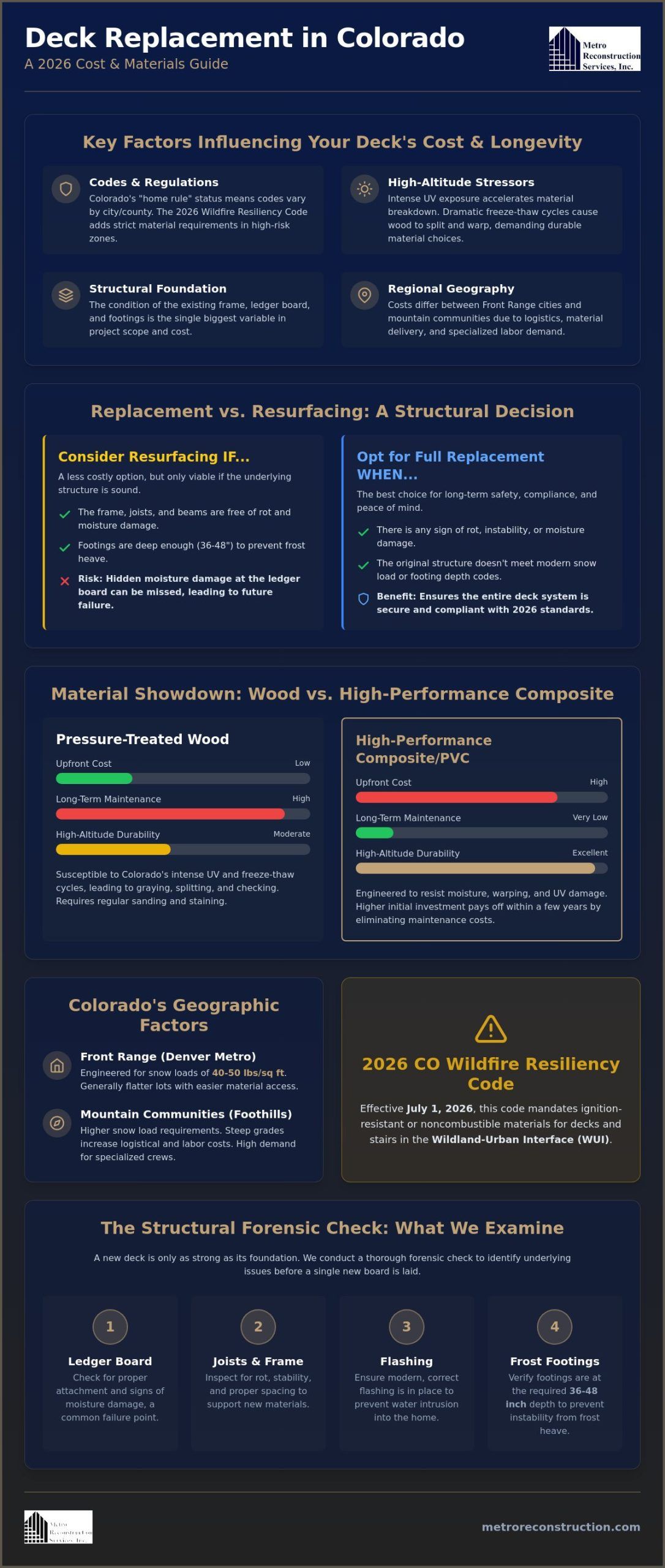
The deck replacement cost colorado homeowners encounter in 2026 is shaped by a complex intersection of local building codes, high-altitude logistics, and evolving safety standards. Because Colorado operates as a home rule state, there is no single statewide mandate; instead, cities and counties adopt specific amendments to the International Residential Code. This means the engineering required for a home in the Denver metro area, which must handle snow loads of 40 to 50 pounds per square foot, differs significantly from the requirements in high-elevation mountain communities. We view your deck as a vital part of your home’s complete outer system, requiring a forensic understanding of how environmental stressors impact long-term structural integrity.
Replacement vs. Resurfacing: Which Do You Need?
Determining whether you need a full replacement or a simple resurfacing depends on the condition of the underlying frame. Many existing structures in our region suffer from hidden moisture damage at the ledger board or joist ends because of improper flashing. If the original frame wasn’t built with modern frost footing depths of 36 to 48 inches, simply swapping old boards for new deck construction materials won’t solve the underlying instability. Choosing a full tear-down ensures that the foundation of your investment is secure and compliant with 2026 safety standards, avoiding the cost of a secondary failure in the future.
For those considering a complete departure from elevated structures, ground-level hardscaping is an increasingly popular alternative. You can see examples of how professional installation enhances durability and aesthetics by exploring the work of Bayside Pavers, who specialize in creating high-quality outdoor living spaces that withstand the elements.
The Colorado Price Factor: Why Geography Matters
Geography plays a decisive role in project budgeting across the Front Range and mountain corridors. In areas like Boulder and the surrounding foothills, the logistical challenges of material delivery on steep grades often increase the overall investment compared to flat urban lots. Labor market conditions also vary, with specialized crews in high demand for projects that require advanced technical precision. National pricing averages don’t account for these regional realities or the specialized building systems needed for our rugged environment.
As of July 1, 2026, the implementation of the Colorado Wildfire Resiliency Code has fundamentally changed material requirements for homes in the Wildland-Urban Interface. In these zones, new regulations mandate ignition-resistant or noncombustible materials for deck walking surfaces and stairs. This shift toward fire-hardened construction is a proactive measure to protect your property, though it requires a deeper level of diagnostic expertise to execute correctly. If you’re ready to discuss the specific needs of your property, contact us at contact us or call us at 303.543.9549 for a professional consultation.
Material Selection: Balancing Upfront Cost with High-Altitude Durability
Choosing materials for a Colorado deck requires more than an aesthetic preference; it’s a calculated decision based on high-altitude environmental stressors. The intense UV radiation at our elevation breaks down the natural binders that hold wood fibers together at an accelerated rate, leading to premature graying and structural checking. When calculating the total deck replacement cost colorado residents face, you must factor in the long-term expense of maintenance against the higher initial investment of modern alternatives. Selecting a material that can withstand 300 days of sun and heavy snow loads is essential for protecting your property’s value.
The High-Performance Composite Advantage
High-performance composites and PVC decking have become the standard for homeowners in mountain communities like Genesee and Evergreen. These materials are engineered to resist the dramatic freeze-thaw cycles that cause natural wood to split and warp. While the material cost is higher, the ROI is realized within a few years as you avoid the recurring expense of professional sanding and staining. Modern 2026 composite options also offer improved heat dissipation and slip-resistant surfaces, making them safer for sunny south-facing exposures. It’s vital to remember that these materials are significantly heavier than traditional lumber. This weight often necessitates a forensic evaluation of your joist spacing to ensure the frame can support the load without sagging.
Natural Wood Options for Colorado Homes
Natural wood remains a popular choice for those who prioritize the traditional look of cedar or redwood. Cedar offers natural rot resistance, but the dry Colorado air quickly saps its moisture, requiring consistent oiling to prevent splintering. Pressure-treated lumber is the most budget-friendly entry point, though it’s the most prone to twisting under the intense sun. For those in high-risk fire zones, the 2026 regulations now mandate the use of ignition-resistant or noncombustible materials. This might include fire-retardant-treated wood for exterior use, which provides a balance between the warmth of wood and modern safety requirements. These specialized treatments can influence the overall deck replacement cost colorado homeowners see in their final quotes.
Selecting the right material is just one step in preserving your home’s complete outer system. If you’re unsure which material best suits your local micro-climate, our team can provide a detailed structural assessment to guide your decision. You can also reach us directly at 303.543.9549 to discuss your project’s specific needs and ensure your investment is built to last.
The Structural Forensic Check: Why Replacement Costs Vary
Understanding the deck replacement cost colorado homeowners face requires looking beneath the surface boards to the hidden mechanics of the structure. Many project quotes vary significantly because they fail to account for the labor-intensive first step: professional demolition and haul-away. Removing an aged structure involves more than just prying up wood; it requires a careful disconnection from the home’s exterior to prevent damage to the building’s complete outer system. This initial phase sets the stage for a forensic evaluation of the existing frame to determine if any components are truly salvageable or if a total restoration is the only safe path forward.
Forensic Evaluation of the Ledger Board
The ledger board acts as the primary connection point between your deck and your home’s rim joist. It’s also the most common point of structural failure due to moisture mitigation issues. When flashing is improperly installed or has degraded over time, water becomes trapped against the house, leading to rot that can spread into the home’s internal framing. Identifying these underlying structural origins early is a foundational brand promise we provide. Discovering this damage during the demolition phase can impact your budget, but addressing it is a critical part of Essential Exterior Home Repair. Ignoring a soft rim joist compromises the safety of the entire new installation.
Snow Loads and Structural Integrity
Structural integrity in our region is dictated by heavy snow loads and the specific engineering required to manage them. In the Denver metro area, decks must be designed to handle a snow load of 40 to 50 pounds per square foot, with even higher requirements in mountain communities. This often necessitates larger beam sizes and closer joist spacing than what was standard twenty years ago. If you’re upgrading to heavy composite materials or planning for a hot tub, the existing frame almost certainly requires reinforcement. We ensure every footing meets the mandatory 36 to 48 inch depth to prevent frost heave from shifting your deck during the freeze-thaw cycles common to the Front Range.
A precision-led approach ensures that your new deck is more than just a cosmetic upgrade; it’s a long-term solution for property preservation. By focusing on fundamental diagnostics rather than superficial fixes, we protect your investment from the environmental stressors unique to Colorado. If you have concerns about the stability of your current structure, reach out to our experts at contact us or call us directly at 303.543.9549 to schedule a detailed structural assessment.
Regional Cost Factors: Front Range vs. Mountain Communities
The deck replacement cost colorado homeowners encounter is rarely uniform across the state because local geography and municipal regulations create distinct pricing tiers. While a project in a flat suburban lot might follow standard logistical patterns, a build in the foothills or high alpine regions requires specialized planning for material transport and site staging. We approach every project by first identifying the regional stressors that will impact the build, ensuring that the final structure is tailored to its specific environment. This geographic reality means that a quote for a home in Denver will look fundamentally different than one for a property in the high country.
Building in Mountain Communities (Vail, Silverthorne, Breckenridge)
Construction in mountain communities like Vail, Silverthorne, and Breckenridge often carries a “mountain premium” that can increase total project investment by 10% to 30% compared to the Front Range. This increase is driven by the logistical complexity of transporting heavy materials over mountain passes and the limited availability of specialized labor in rural corridors. Furthermore, these areas often have the strictest environmental regulations and HOA architectural reviews in the state. As of July 1, 2026, many of these jurisdictions are strictly enforcing the Colorado Wildfire Resiliency Code, which mandates noncombustible materials for decks in high-risk zones. Integrating these safety measures is a core part of our Fire Mitigation and Prevention Services, ensuring your deck contributes to your home’s overall hardening against environmental threats.
Front Range Considerations (Boulder, Longmont, Cherry Creek)
In urban and suburban areas like Boulder, Longmont, and Cherry Creek, the challenges shift toward navigating tight lots and strict municipal codes. Accessing a backyard in an established neighborhood often requires manual material hauling or specialized equipment that fits through narrow side yards, which adds to the labor portion of your budget. Permit fees in these areas generally range from $100 to $500, though the timeline for approval in cities like Denver can be longer due to high demand. Hiring a local expert who understands these specific municipal nuances ensures that your safety railings and deck heights meet local safety standards on the first inspection. Seasonal timing also plays a role; while Front Range winters are milder, scheduling around the freeze-thaw cycle is essential to ensure footings are poured correctly during stable temperatures.
Understanding these regional variables is the first step in a successful property preservation project. If you are ready to receive a detailed, accurate assessment of your project’s needs based on your specific Colorado location, contact our team today to begin the diagnostic process. You can also reach our Seasoned Experts directly at 303.543.9549 to discuss how we can secure your investment against the unique challenges of your local landscape.
Investing in Structural Integrity with Metro Reconstruction Services
Investing in a high-quality outdoor space is a significant decision for any property owner. The deck replacement cost colorado homeowners manage in 2026 reflects more than just the price of lumber or composite; it represents a commitment to the long-term preservation of their property. We believe that a successful project begins with a forensic understanding of why the previous structure failed. By identifying the underlying structural origins of decay or instability, we ensure that your new investment is built on a foundation of precision and engineering-led solutions rather than temporary, low-quality patches.
The Metro Reconstruction Difference
Our approach is rooted in four decades of industry expertise, dating back to our family-owned beginnings in 1982. We distinguish ourselves by viewing your deck as a critical component of the building’s complete outer system rather than an isolated attachment. This holistic perspective allows our team to address complex interactions between your deck, the home’s siding, and the moisture mitigation systems that protect your rim joist. Through our Design-Build Services, we manage the entire lifecycle of the project, from initial diagnostics to the final restoration. This seamless process eliminates the gaps in communication that often lead to technical errors and unexpected budget increases during construction.
Take the Next Step Toward a Safer Exterior
Starting your project with us begins with a detailed site evaluation where we perform a fundamental diagnostic of your current structure. We don’t offer superficial fixes or high-pressure sales tactics. Instead, we provide a transparent, fixed-price reconstruction proposal that outlines the specific technical requirements for your local environment, whether you’re in the Denver metro area or a high-altitude mountain community. This clarity allows you to move forward with the peace of mind that comes from a dedicated partner in property preservation. You’ll know exactly how your budget is being utilized to meet 2026 safety codes and specific environmental demands. For homeowners seeking broader context on industry standards for large-scale projects, it can be beneficial to explore Residential Construction and Remodeling Contracts to see how quality agreements are structured.
A lasting solution for your home is only a phone call away. We invite you to experience the reliability and quiet confidence of a seasoned expert who prioritizes substance over style. To schedule your professional deck evaluation and begin the process of securing your home’s exterior, contact us today through our secure form. You can also speak directly with our team by calling 303.543.9549. Let’s work together to restore the safety and value of your Colorado property.
Securing Your Home’s Structural Future
A successful project requires a shift in perspective from surface aesthetics toward long-term structural protection. We’ve explored how the deck replacement cost colorado homeowners navigate in 2026 is shaped by rigorous snow load requirements, high-altitude UV exposure, and the critical need for fire-hardened materials. By focusing on the underlying structural origins of failure, you ensure that your investment is more than a temporary fix. It’s a foundational part of your building’s complete outer system that must perform under pressure for years to come.
Our family-owned team brings over 40 years of local construction expertise to every project, specializing in the forensic diagnostics that identify hidden mechanics before they become costly failures. We invite you to partner with a specialist who values precision and integrity in every restoration. Take the first step toward a safer, more durable exterior by reaching out for an expert assessment. Contact Metro Reconstruction for a Professional Deck Evaluation today. You can also call us directly at 303.543.9549 to discuss your property’s specific needs. We look forward to helping you preserve your home for decades to come.
Frequently Asked Questions
How much does it cost to replace a 12×12 deck in Colorado in 2026?
The investment for a standard 144-square-foot deck depends on the specific environmental stressors of your property and the condition of the underlying frame. While basic installations follow regional price trends for labor and materials, a professional quote accounts for the necessary structural upgrades required by 2026 safety standards. Factors such as site access in established neighborhoods or the need for deeper footings to prevent shifting during freeze-thaw cycles will influence the final budget for your deck replacement cost colorado project.
Can I reuse the existing frame of my deck to save on replacement costs?
Reusing an existing frame is only possible if a forensic evaluation confirms that the wood is free from internal rot and meets current engineering requirements. Many older decks in our region were built with footings that do not reach the mandatory 36-inch frost depth, which leads to instability over time. If your frame was built more than 15 years ago, it likely requires a full restoration to safely support the weight of modern high-performance materials or heavy snow loads.
Do I need a building permit for a deck replacement in Boulder or Denver?
Yes, most jurisdictions along the Front Range require a permit for any deck attached to a house or elevated more than 30 inches off the ground. Because Colorado is a “home rule” state, the specific requirements and fees vary between cities like Denver, Boulder, and Littleton. We manage the entire permit and inspection process to ensure your project is fully compliant with local safety codes and insurance requirements.
How long does a professional deck replacement typically take in the Front Range?
A high-quality deck replacement generally takes between two and four weeks from the start of demolition to the final restoration. This timeline allows for the meticulous installation of moisture protection systems and the precise alignment of the new frame. While urban projects in areas like Cherry Creek may move faster, mountain builds often require additional time for material transport and navigating steep terrain.
What is the best material for a deck in Colorado high-altitude environments?
High-performance capped composite or PVC materials are the most reliable choices for Colorado’s intense sun and dry air. These products are engineered to resist the cracking and splintering that occurs when natural wood fibers break down under heavy UV exposure. While they represent a higher initial investment, they eliminate the recurring costs of sanding and staining, providing better long-term value for your property.
Does deck replacement increase the resale value of my Colorado home?
A professionally installed deck significantly enhances home value by expanding your usable living space and ensuring the home’s exterior system is structurally sound. Buyers in our region look for outdoor spaces that are built to last and require minimal upkeep. Providing documentation that your deck meets 2026 snow load and wildfire safety codes offers potential buyers the peace of mind they need to make a confident offer.
Are there specific wildfire-resistant deck materials required in mountain areas?
As of July 2026, many communities in the foothills and mountains require ignition-resistant or noncombustible materials for deck surfaces and stairs. These regulations are part of a broader effort toward home hardening in high-risk zones. We specialize in identifying approved materials that meet these strict safety mandates while maintaining the aesthetic appeal and comfort you expect from a premium outdoor space.
How do Colorado snow loads affect the cost of deck framing?
Heavy snow loads require larger support beams and closer joist spacing to prevent the structure from sagging or failing under pressure. In areas like Parker or Golden, the frame must be engineered to support significantly more weight than decks in milder climates. This focus on structural integrity ensures that your deck remains level and secure, even after the heaviest winter storms common to our rugged environment.
If you are ready to begin your project with a detailed diagnostic of your current structure, we are here to act as your partner in property preservation. You can schedule your initial consultation by visiting our contact page or by calling our experts directly at 303.543.9549. We look forward to providing the long-term solutions your home deserves.