
The safety of your outdoor living space isn’t determined by the color of the stain or the smoothness of the boards, but by the silent health of the structural connections hidden beneath them. In our demanding Front Range environment, the intense sun and heavy snow loads can age a structure faster than many realize, making the choice of deck repair vs replacement Boulder a critical safety decision. You might find yourself questioning whether a simple board swap is enough or if the integrity of the entire frame has been compromised. It’s a common concern for Boulder homeowners who want to enjoy their mountain views without the nagging fear of a structural failure during a summer gathering.
We understand that deciding how to handle an aging deck can feel like a complex puzzle. This guide provides the clarity you need to evaluate your deck’s remaining lifespan by looking at the complete outer system of your home. You’ll learn how to identify the underlying origins of rot and moisture damage before they spread to your home’s siding or foundation. We’ll walk through the specific environmental stressors unique to our region so you can make a decisive, professional choice. Our goal is to ensure your property preservation efforts result in lasting reliability and true peace of mind.
Key Takeaways
- Identify how Boulder’s intense high-altitude UV rays and heavy snow cycles specifically break down the structural integrity of your outdoor wood over time.
- Learn to distinguish between surface-level cosmetic wear and fundamental frame failure when deciding on deck repair vs replacement Boulder.
- Understand the importance of a forensic evaluation of your home’s complete outer system to prevent deck moisture from damaging your siding or stucco.
- Gain a clear decision framework based on the age of your deck and the extent of rot to ensure a safe, long-term solution for your property.
- For a professional evaluation of your deck’s structural safety, contact our experts at contact us or call 303.543.9549.
Assessing Your Deck in the Boulder Climate
In the Colorado Front Range, a deck typically faces a lifespan influenced more by altitude than by age alone. While a standard wood deck might last 15 to 20 years in other climates, Boulder’s environment accelerates material fatigue through extreme UV exposure and intense moisture cycles. Understanding the science of wood preservation is key to recognizing how high-altitude sun breaks down lignin, the natural glue holding wood fibers together. When this occurs, the wood becomes brittle and porous, losing its ability to repel water and hold fasteners securely.
Heavy snow loads further complicate the structural health of your outdoor space. A single heavy spring storm can deposit thousands of pounds of weight onto aging joists and ledger boards. This pressure tests the limits of every connection point. If your deck was built before modern lateral load requirements were established, these stressors can lead to a dangerous transition from a merely weathered surface to a fundamentally compromised frame. Deciding on deck repair vs replacement Boulder involves more than just looking at the surface; it requires a forensic look at these hidden mechanical stressors.
Environmental Stressors Unique to Boulder
Boulder’s semi-arid climate creates a constant cycle of expansion and contraction. With over 300 days of sunshine, surface boards bake during the day and cool rapidly at night, causing wood to check and split. Rapid snowmelt is equally deceptive. Water often finds its way into the small gaps between the deck and the house, creating hidden moisture traps. This moisture can seep behind your home’s siding or stucco, threatening the complete outer system of your property. We take a holistic view of these interactions at Metro Reconstruction Services, Inc. to prevent secondary damage to your home’s exterior.
The First 5 Minutes of a DIY Deck Inspection
You can begin your assessment by checking for soft spots in high-traffic areas or where the deck meets the house wall. Use a screwdriver to gently probe the wood; if it sinks in easily, you’re likely looking at deep-seated structural rot rather than surface splintering. Test the stability of your railings and stair stringers by applying firm pressure. Any wobbling suggests that the fasteners have pulled away from the framing. If you find multiple points of concern, it’s time for a professional evaluation of your deck repair vs replacement Boulder options.
For a precise diagnostic of your deck’s structural health, contact our experts at 303.543.9549 or visit our contact page. We specialize in identifying underlying structural origins to ensure your home remains safe and protected.
The Anatomy of Deck Failure: Structural vs. Cosmetic
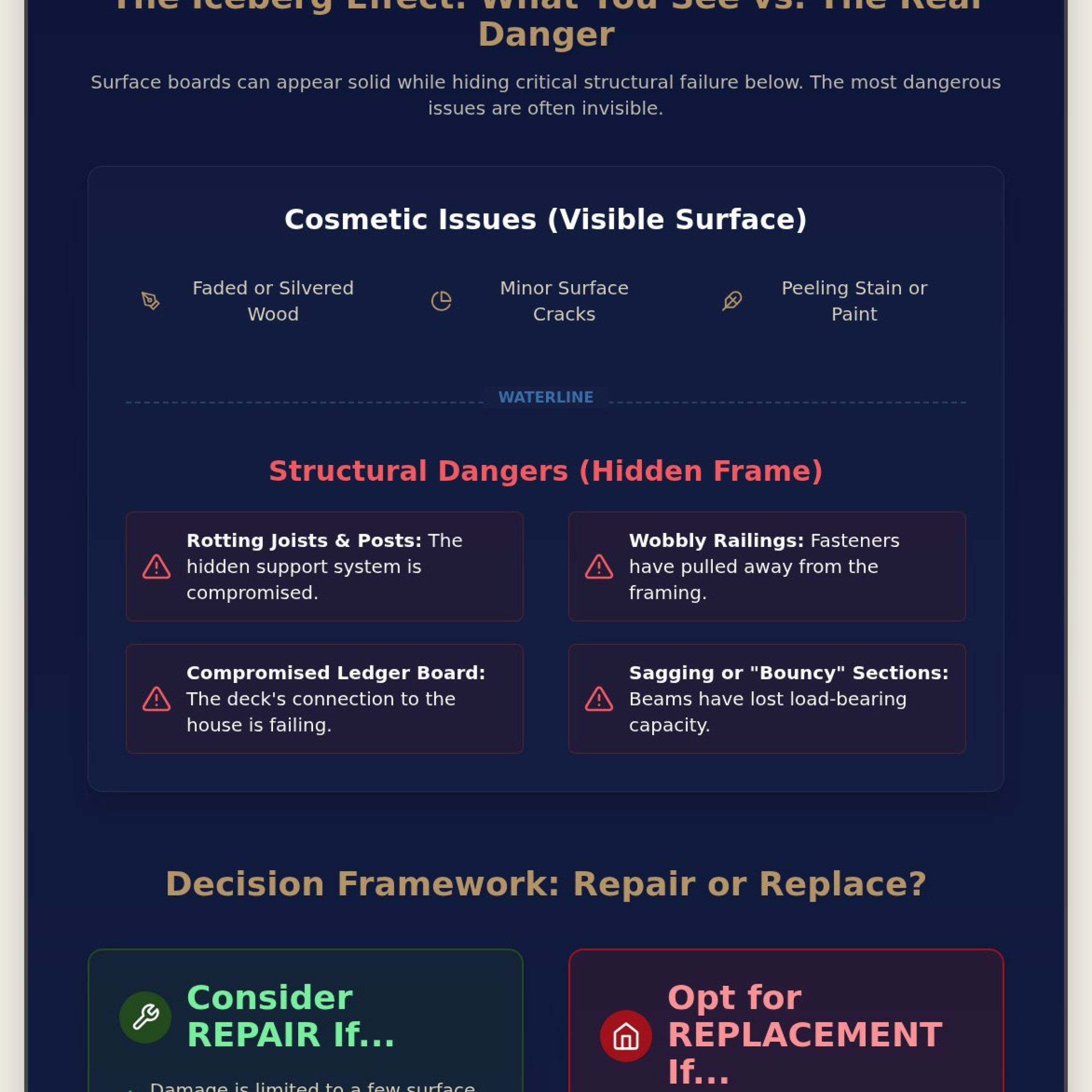
The distinction between a deck that looks old and one that is dangerous often lies in the components you cannot see from your patio chair. While silvered wood or minor surface cracks are aesthetic concerns, the true health of the structure depends on the integrity of the framing and its connection to your home. This is why we often refer to deck failure as an “iceberg effect.” Surface boards might appear solid, yet they often hide rotting joists or corroded fasteners below that are no longer capable of supporting a full load. When evaluating deck repair vs replacement Boulder, a forensic look at these hidden elements is necessary to ensure the safety of your family and guests.
The ledger board is arguably the most critical component of your deck’s anatomy. It acts as the primary anchor, tethering the weight of the deck to your house’s rim joist. If this connection is compromised by moisture or improper installation, the entire structure is at risk of a sudden collapse. We often find that failures here aren’t isolated; they are symptoms of issues within the home’s complete outer system, where water has bypassed the flashing and begun to rot the house’s internal framing. If you’re unsure about the state of your deck’s framing, a professional structural assessment can provide the clarity you need.
Identifying Structural Red Flags
Advanced corrosion on joist hangers or fasteners that have begun to “pull out” from the wood are immediate signals of structural distress. If you notice “bouncy” or sagging sections while walking across the deck, the support beams have likely lost their load-bearing capacity. These issues are often exacerbated by shifting footings or foundation piers that have settled unevenly in Boulder’s expansive soils. Rusted flashing is another silent threat; once it fails, it allows water to move from the deck directly into your home’s wall cavity, causing extensive damage to your stucco or siding.
Moisture Intrusion and the Ledger Board
The intersection of your deck and your home’s exterior is a high-risk zone for water penetration. Improperly installed flashing allows snowmelt to seep into the wall cavity, leading to hidden rot that can cost thousands to remediate. Moisture mitigation is the prevention of water entering the structural envelope. By identifying these underlying structural origins, we protect not just your deck, but your entire home investment. For a detailed inspection of your deck’s connection to your home, contact our team at 303.543.9549 or visit our contact page.
Deck Repair vs. Replacement: A Decision Framework
Choosing between deck repair vs replacement Boulder requires a logical evaluation of both current safety and future costs. We utilize a 15-Year Rule as a primary benchmark for our assessments. In the high-altitude environment of the Front Range, wood structures often reach a critical point of fatigue after a decade and a half of intense UV exposure and snow cycles. If your deck is approaching this age, the financial investment required for localized repairs frequently begins to exceed 50% of the cost of a full replacement. At this stage, continuing to patch a failing system becomes a compounding expense that yields diminishing returns.
Analyzing the percentage of damage is the next step in our forensic process. If rot or structural decay has compromised more than 20% of the underlying framing, a targeted repair is no longer a responsible solution. While replacing a few surface boards might temporarily improve the deck’s appearance, it fails to address the underlying structural origins of the problem. Safety remains the ultimate deciding factor in property preservation. We prioritize long-term reliability over superficial fixes to ensure your outdoor space remains a secure environment for your family.
When to Choose Professional Repair
Targeted repairs are a viable and cost-effective option when the deck is less than 10 years old and the damage is isolated to non-structural elements. If our inspection confirms that the joists, beams, and ledger board are dry and structurally sound, we can focus on restoring the “complete outer system” of the deck. This approach is ideal when your goal is to extend the life of a fundamentally solid structure by an additional 3 to 5 years. It’s a precise solution for decks that have been well-maintained but show minor wear from Boulder’s semi-arid climate.
When Full Replacement is the Only Logical Path
A full replacement becomes necessary when the structural integrity of the frame can no longer be guaranteed. This is often the case for decks built prior to modern building codes, which now require specific lateral load connectors to prevent the deck from pulling away from the house. If you are already planning an exterior remodel, such as stucco restoration, replacing the deck simultaneously allows for a seamless integration of flashing and moisture mitigation systems. This holistic approach ensures that your new deck doesn’t inadvertently damage your home’s siding. For a professional evaluation of your deck’s safety, call us at 303.543.9549 or visit our contact page.
Long-Term Preservation: Planning for a New Deck
Material Selection for Boulder Homes
Selecting the right materials during a deck repair vs replacement Boulder project is the first step in ensuring your investment survives the Front Range’s harsh climate. While natural wood remains a traditional choice, high-performance composites have gained significant popularity because they resist the lignin breakdown caused by high-altitude UV rays. For those living in mountain communities, we often recommend steel framing for the under-structure. Steel provides a level of precision and durability that wood cannot match, as it’s immune to rot, warping, and insect damage. Protecting these components with high-quality specialized sealants is a foundational brand promise we make at Metro Reconstruction Services, Inc. This attention to detail ensures that moisture cannot reach the rim joist of your home, preventing the hidden rot issues that often plague older builds.
Fire Mitigation and Home Hardening
In our region, a deck should be integrated into a broader fire mitigation strategy. Home hardening services are now a standard part of responsible property preservation in Boulder County. By selecting non-combustible materials for both the surface and the framing, you significantly reduce the risk of your deck becoming a fuel source during a wildfire. A properly designed deck serves as a structural buffer, preventing embers from accumulating against your home’s exterior walls or under the joists. This engineering-led approach provides peace of mind that goes beyond surface-level beauty. If you’re ready to build a structure that prioritizes safety and long-term reliability, reach out to Metro Reconstruction Services, Inc. today. You can start the conversation by visiting our contact page or calling us directly at 303.543.9549.
The Metro Reconstruction Approach to Deck Integrity
At Metro Reconstruction Services, Inc., we don’t start with a simple estimate; we start with a forensic diagnosis. The decision regarding deck repair vs replacement Boulder is never a matter of guesswork for our team because we rely on structural evidence to guide our recommendations. We look far beyond the silvered surface boards to find the story written in the joists, ledger connections, and foundation piers. This analytical approach is what distinguishes our work from superficial patches that often fail within a few seasons. By identifying the underlying structural origins of decay, we ensure that our solutions are long-term investments in your home’s safety rather than temporary cosmetic fixes.
Our Forensic Diagnostic Process
Our team evaluates the complete outer system of your home to understand exactly how your deck interacts with your siding, stucco, and foundation. We scrutinize the flashing at the ledger board because this is the primary site where moisture intrusion begins to threaten your home’s internal framing. We believe in providing transparent, straightforward truths about your deck’s condition, even when the structural reality is complex. By utilizing our design-build expertise, we create custom restoration plans that address these fundamental mechanical weaknesses. This level of precision ensures that once we complete a project, the structural integrity of your outdoor living space is restored for decades.
Ready to Secure Your Home’s Exterior?
Boulder homeowners face unique environmental stressors that demand more than standard construction knowledge. With 40+ years of local experience in the Front Range, we’ve developed a deep understanding of how high-altitude UV rays and rapid snowmelt cycles affect structural materials over time. Our approach is specifically tailored to the demanding regional environment of Boulder County, ensuring that every connection and fastener is chosen for its ability to withstand the expansion and contraction cycles of our semi-arid climate. This specialized focus distances our services from low-cost alternatives that often overlook the hidden mechanics of a structure.
We view ourselves as your dedicated partner in property preservation, offering the peace of mind that comes from engineering-led solutions and rugged craftsmanship. We’re committed to protecting your investment with meticulous care and integrity. To schedule a structural evaluation of your deck, call Metro Reconstruction Services, Inc. at 303.543.9549 or visit our contact page to begin your project today.
Securing Your Outdoor Investment for the Long Term
Deciding on deck repair vs replacement Boulder is a significant step toward ensuring the safety and longevity of your home’s complete outer system. As we’ve discussed, the health of your deck is inextricably linked to the integrity of your home’s stucco and framing; therefore, a forensic approach is essential for identifying hidden rot before it compromises the structural envelope. By prioritizing moisture mitigation and choosing materials that thrive in the Front Range environment, you protect your property from the accelerating effects of high-altitude UV rays and heavy snow cycles.
Metro Reconstruction Services, Inc. brings over 40 years of local expertise to every project as family-owned specialists in structural moisture mitigation and foundation stabilization. Our engineering-led approach to home preservation provides the reliability and precision needed for long-term property value. If you’re ready to move forward with confidence, Contact Metro Reconstruction Services, Inc. for a Professional Deck Evaluation. You can also reach our team directly at 303.543.9549 to discuss your specific structural needs. We look forward to helping you preserve the safety and beauty of your Boulder home.
Common Questions Regarding Deck Integrity in Boulder
How do I know if my deck boards are rotting or just weathered?
Weathering usually involves surface-level silvering or minor cracks caused by intense UV exposure. Rot feels soft or spongy when probed with a screwdriver. Deep rot indicates a breakdown of the wood’s internal fibers, often caused by trapped moisture. If the wood crumbles or the screwdriver sinks in easily, the board is structurally compromised and needs immediate attention to prevent the decay from spreading to the rest of your framing.
Can I replace just the surface boards if the joists are okay?
Yes, you can replace surface boards if a forensic inspection confirms the underlying joists and beams are structurally sound. This process is often called re-decking. It’s vital to ensure the existing frame meets current safety standards and has no hidden moisture damage. If the frame is solid, replacing the boards can be a cost-effective way to improve your home’s complete outer system without a full reconstruction.
What is the average lifespan of a wood deck in Boulder, Colorado?
In our high-altitude environment, a standard wood deck typically lasts between 15 and 20 years. The intense UV rays at 5,000 feet break down wood lignin faster than at sea level. Heavy snow loads and rapid temperature swings also stress the wood fibers. Regular maintenance can extend this lifespan, but most homeowners find that a choice between deck repair vs replacement Boulder becomes necessary around the 15-year mark.
How much does it cost to repair a deck versus replacing it?
Repair costs vary based on the extent of the damage, while a full replacement is a larger investment in your property’s future. Industry data suggests that repairs are often more cost-effective if they total less than 50% of a full replacement price. However, repeated small fixes on an aging structure can lead to higher long-term expenses. We recommend a professional evaluation to determine which path offers the best reliability and value.
Does a new deck increase the resale value of my Boulder home?
As of July 1, 2026, Boulder County has adopted the 2021 International Codes with specific local amendments. These codes require robust lateral load connectors to ensure the deck remains securely attached to the house. Permits are generally required for most projects, except for free-standing decks under 200 square feet and less than 30 inches high. Our engineering-led approach ensures every project meets these high standards for structural safety and legal compliance.
Is it possible to repair a deck that has started to pull away from the house?
This situation indicates a critical failure of the ledger board connection and requires immediate professional intervention. While it’s sometimes possible to install new lateral load anchors and structural fasteners, the underlying cause is often rot in the house’s rim joist. We perform a forensic assessment to see if the house’s complete outer system is compromised. If the damage is extensive, a full replacement is the only way to ensure safety.
What are the best low-maintenance materials for decks in high-altitude areas?
High-performance composite and PVC decking are excellent choices for the Colorado climate because they resist fading and moisture. Steel framing is another superior option for the under-structure, as it won’t warp or rot like traditional lumber. These materials are particularly effective for wildfire prevention and home hardening. Choosing these specialized building systems ensures your deck repair vs replacement Boulder decision results in a structure that lasts for decades with minimal upkeep.
For a professional structural evaluation of your outdoor living space, contact Metro Reconstruction Services, Inc. through our contact page or call us at 303.543.9549 today.