
Could the most affordable decking material actually be the most expensive mistake you make for your Colorado home? When you’re weighing the choice of composite decking vs wood, it’s easy to focus on the initial price tag rather than the long term structural health of your property. At Metro Reconstruction Services, Inc., we’ve seen how homeowners appreciate the organic beauty of a cedar deck, yet they naturally dread the inevitable reality of dry rot, warping, and the relentless maintenance required in our high altitude climate. It’s a common frustration for those who want to enjoy their outdoor space without becoming a slave to its upkeep every spring.
This guide provides the definitive comparison you need to ensure your outdoor investment survives Colorado’s intense UV exposure and heavy snow loads while delivering genuine value. We’ll examine the total cost of ownership over twenty years, address common fears about surface temperatures in the summer sun, and explain why your deck material is a critical component of your home’s complete outer system. By understanding the relationship between material science and environmental stressors, you can make a decision that protects both your lifestyle and your home’s resale value for 2026 and beyond.
Key Takeaways
- Learn how to evaluate the long-term financial impact of composite decking vs wood by comparing initial installation costs against two decades of maintenance expenses.
- Understand why Colorado’s high-altitude UV rays and dry climate lead to rapid wood degradation, requiring annual sealing that composite materials naturally avoid.
- Discover how modern composite technologies address heat retention in direct sunlight while providing superior resistance to heavy snow loads and moisture.
- Recognize why the underlying sub-structure is the most critical part of your deck and how it must integrate with your home’s complete outer system to prevent structural failure.
- Evaluate the 2026 resale value for different materials to ensure your outdoor remodel provides a high return on investment for your property.
Understanding the Core Differences Between Wood and Composite Decking
The choice between composite decking vs wood isn’t just about color or cost; it’s a decision about how your home interacts with the environment. As a specialist construction company in Boulder, CO, Metro Reconstruction Services, Inc. has seen how natural wood has been the standard for decades. Pressure-treated pine offers an entry-level price point, while cedar provides natural oils that resist decay. Exotic hardwoods like Ipe are prized for their density. However, these materials are essentially “living” products. They expand and contract with Colorado’s humidity swings. This movement can eventually compromise the fasteners and the structural frame if not managed with precision. We take a forensic approach to these failures, identifying how water infiltration at the deck ledger can impact the entire building envelope.
Modern Wood-plastic composites (WPCs) represent a significant shift in building science. These materials blend recycled wood fibers with durable plastics to create a board that doesn’t rot or warp. In 2026, the industry has moved almost entirely toward “capped” technology. This involves an extra layer of polymer bonded to the core. This shell acts as a shield against moisture and UV rays. It’s a proactive solution for homeowners who view their deck as a permanent extension of their home’s complete outer system.
Material Composition and Aesthetics
Visual appeal used to be the primary argument for natural timber. Early versions of synthetic decking often looked like flat plastic. That’s no longer the case. Manufacturers now use advanced embossing techniques to create deep, varied grain patterns that mimic the texture of real wood. The 2026 color palettes favor warm neutrals and earth tones, including popular taupe and charcoal streaks. These designs provide the rugged look of a mountain retreat without the splinters or fading associated with traditional lumber. Homeowners no longer have to choose between the soul of natural wood and the resilience of modern engineering.
Initial Investment Factors
When comparing composite decking vs wood, the budget often dictates the starting point. Pressure-treated wood remains the most affordable option for the initial build. Cedar sits in the middle, while high-performance composites represent a larger upfront investment. It’s vital to look beyond the first invoice. While wood is cheaper on day one, it requires professional staining and sealing every few years to survive the Front Range sun. Composite materials offer a higher resale value, often reaching 70-80% ROI in Northern Colorado. This makes the premium choice a more stable long-term financial move. Beyond the material costs, the complexity of the installation plays a role. Composite boards often require specialized hidden fastener systems that provide a clean surface, which adds to the labor but significantly enhances the final aesthetic and safety of the structure.
If you’re ready to discuss a deck that integrates perfectly with your home’s structure, contact Metro Reconstruction Services, Inc. at 303.543.9549 or visit our contact page to schedule a consultation.
Maintenance and Longevity: Comparing the Real-World Lifespan
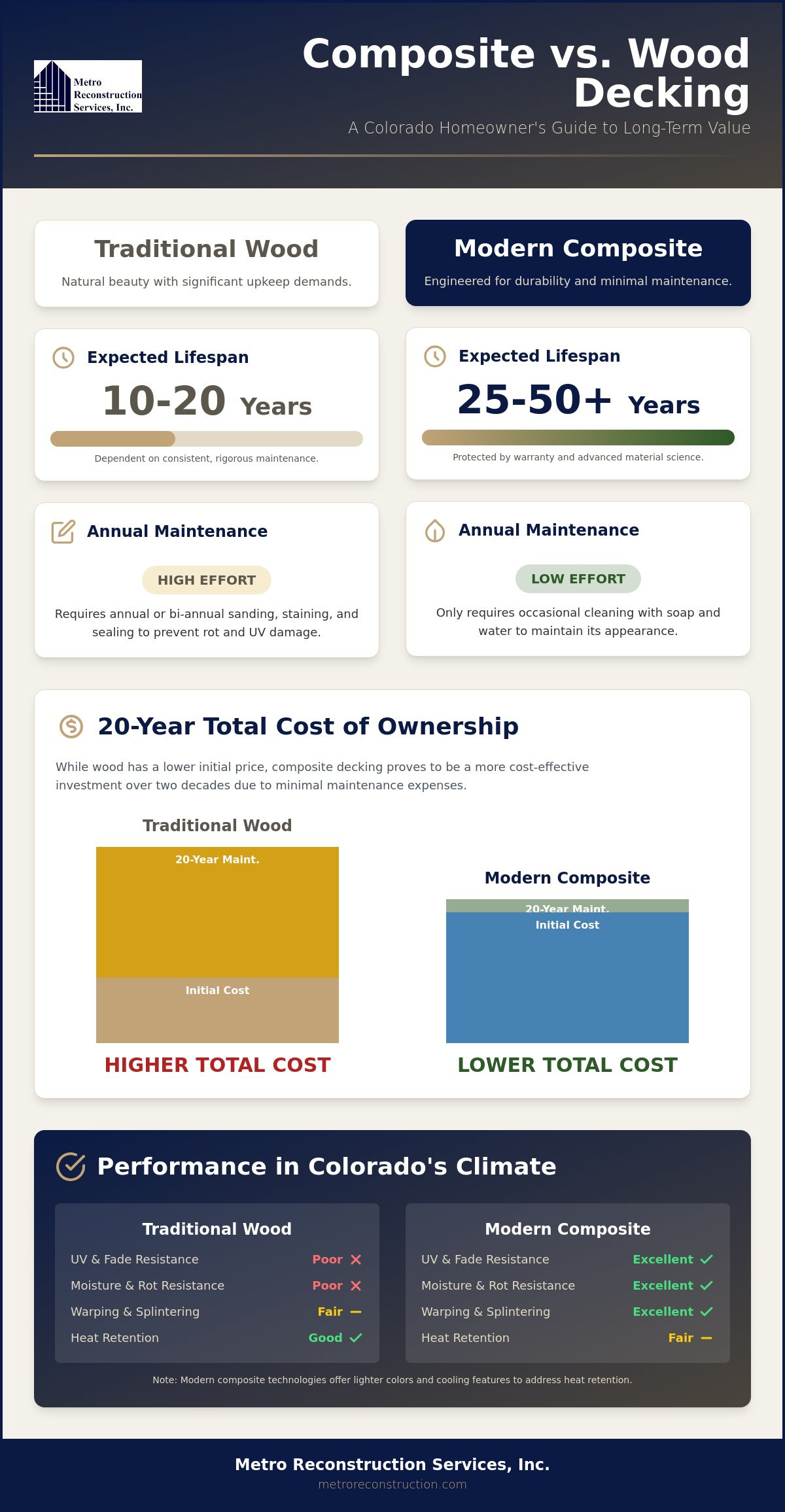
Colorado’s high-altitude environment acts as a harsh laboratory for building materials. When evaluating composite decking vs wood, the most significant delta is the investment of time required to maintain structural integrity. A traditional pressure-treated deck might only provide 10 to 15 years of service before the cycle of freeze and thaw compromises the fiber of the wood. Cedar offers a slightly better window of 15 to 20 years, but these lifespans are only achievable if the homeowner adheres to a strict maintenance schedule. In contrast, modern composite systems are engineered to last between 25 and 50 years. For those seeking a comprehensive decking material comparison, it’s clear that longevity is deeply tied to how a material resists the specific stressors of its environment.
The Hidden Labor of Natural Wood
Colorado’s arid mountain air is notorious for drawing moisture out of timber with aggressive speed. This process causes wood to splinter, “check,” or warp as the internal tension of the boards changes. In areas like Boulder or Evergreen, you don’t just stain for aesthetics; you seal to prevent the wood from becoming brittle and dangerous. We recommend a professional cleaning and resealing every 18 to 24 months to protect the surface. Neglecting this ritual allows water to penetrate deep into the grain. This often leads to fungal decay that can spread from the deck boards into the home’s ledger board, threatening the complete outer system of the structure.
Composite Durability and “Low-Maintenance” Reality
The term “low-maintenance” is often misunderstood as “no-maintenance.” While you won’t spend your weekends sanding or staining, composite boards still require a basic cleaning with soap and water to remove pollen, dirt, and organic debris. This prevents surface mold from taking root in the texture of the board. The true advantage of modern boards lies in their capped polymer shells. These shields prevent internal moisture buildup, which is the primary cause of rot in older synthetic products. This protection ensures the boards remain resistant to scratching and fading even under intense UV exposure. If you’ve noticed soft spots or splintering on your current deck, you can reach the team at Metro Reconstruction Services, Inc. at 303.543.9549 or explore our restoration services to see how we can protect your investment.
Ultimately, the longevity of any deck depends on the resistance of its components to pests and decay. Natural wood is vulnerable to wood-boring insects and woodpeckers, whereas composite materials offer no nutritional value to these pests. By choosing a material that resists biological breakdown, you ensure that your deck remains a safe, stable platform for decades rather than a decaying liability that requires frequent repairs.
Performance in the Colorado Climate: UV, Snow, and Temperature Swings
The Front Range presents a unique set of atmospheric challenges that most national material guides simply don’t address. When you compare composite decking vs wood in our region, you’re essentially choosing how your home will respond to extreme solar radiation and heavy, wet snow cycles. The sun is a relentless force at 5,000 feet. Because the atmosphere is thinner in the Front Range, UV radiation hits building materials with greater intensity, leading to a rapid breakdown of the lignin in natural wood fibers. This isn’t just a cosmetic issue; it’s a structural one. As the sun draws out natural oils, the wood becomes brittle, leading to the deep cracks and splintering that characterize many older Colorado decks.
Sun Exposure and High-Altitude UV
Heat retention is a common concern for homeowners considering synthetic materials. This “burning feet” factor is a physical reality, as composite boards can absorb more heat than natural cedar. However, the industry has responded with lighter color palettes and heat-dissipating technologies that make modern boards more comfortable. Choosing a light taupe or greige shade is a strategic move for south-facing decks. While wood stays cooler, it pays for that temperature difference with rapid silvering. Without a UV-inhibiting stain applied every year, natural timber will lose its color within months of installation. Composite materials use integrated UV-inhibitors throughout the “cap” of the board, ensuring that the color you choose in 2026 remains consistent for decades.
Moisture Mitigation and Snow Management
Snow management is the second half of the performance equation. In Colorado, snow doesn’t just fall; it sits, melts, and refreezes in a destructive cycle. When snow accumulates on a deck surface, the moisture migrates into the fasteners and the ledger board. If your deck isn’t designed with proper spacing for drainage and airflow, this moisture becomes trapped against your home’s siding. We view the deck as a critical component of your essential exterior home repair strategy. Proper installation ensures that snowmelt flows away from the foundation and the sub-structure, preventing the hidden rot that often compromises the entire outer system of the property.
Temperature swings also play a role in material selection. A single spring day in Colorado can see a 40-degree shift. Natural wood handles these shifts by expanding and contracting, which can eventually loosen nails and screws. Composite decking also moves, but manufacturers provide specific gapping requirements to account for this thermal expansion. This precision prevents the boards from buckling or warping over time. If you’re concerned about how your current deck is handling these cycles, call Metro Reconstruction at 303.543.9549 or visit our contact page to discuss a more resilient solution for your home.
Financial Analysis: Initial Investment vs. 20-Year ROI
The decision between composite decking vs wood often starts with a look at the bottom line. While pressure-treated wood remains the most accessible entry point at $15 to $35 per square foot, premium composite systems typically require an initial investment of $30 to $60 per square foot. It’s a significant gap that can lead to sticker shock during the planning phase. However, our forensic evaluations of older structures often reveal that the cheaper option carries heavy hidden liabilities. To find the true value, you have to look at the total cost of ownership over two decades. By year seven or eight, the accumulated costs of professional maintenance usually exceed the initial price difference of a high-quality composite system.
The 20-Year ROI Framework
Consider the math of a 500-square-foot deck in Northern Colorado. A professional staining service in Loveland or Boulder can cost between $400 and $600. When you perform this service every two years to combat our intense UV exposure, you’re spending thousands of dollars just to keep the wood from failing. Composite materials eliminate this recurring expense. Additionally, wood decks in our climate often need full replacement after 15 years. A composite deck built in 2026 will likely still be in its prime in 2041, effectively doubling the value of your initial labor costs. This longevity prevents the need for a second major capital expenditure down the road.
- Wood Maintenance Costs: Cleaning, sanding, and staining every 24 months.
- Composite Maintenance Costs: Seasonal soap and water cleaning.
- Structural Integrity: Composite resists the internal rot that often compromises wood sub-structures.
- Break-even Point: Typically reached between year seven and nine of the deck’s life.
Resale Value and Curb Appeal
Resale value is another critical metric for Front Range homeowners. In the 2026 market, composite decking delivers a 70% to 80% return on investment, which significantly outpaces the 50% to 60% ROI seen with traditional wood. Boulder buyers increasingly prioritize turn-key outdoor living spaces. They don’t want to inherit a maintenance project. A deck featuring a transferable warranty provides a level of peace of mind that translates directly into higher property appraisals. It signals that the home’s complete outer system has been managed with foresight and quality. Choosing wood might make sense if you’re on a strict short-term budget, but for long-term property preservation, composite is the superior financial move.
Once your outdoor living space is ready for hosting, you might find that large events require additional logistical support. For professional-grade mobile refrigeration at your next gathering or commercial function, KC Frost Wagon offers specialized cooler and freezer trailer rentals to keep everything perfectly chilled.
If you’re planning a project and want a precise analysis of which material fits your long-term goals, explore our design-build services or call us at 303.543.9549 to schedule a site evaluation with our team.
The Professional Approach to Deck Design and Installation
While the debate of composite decking vs wood often centers on surface aesthetics, the true longevity of your investment is determined by what lies beneath. A deck isn’t an isolated structure; it’s a critical component of your home’s complete outer system. If the sub-structure is compromised by moisture or poor design, the most expensive composite boards in the world won’t prevent a structural failure. At Metro Reconstruction, we take a forensic approach to every project, identifying why previous systems failed so we can build a replacement that lasts for decades. We look for the underlying structural origins of decay rather than just offering a superficial fix.
Designing for Your Lifestyle and Location
Your deck should reflect how you live while respecting the local environment. Whether you need a sprawling layout to capture Front Range views or a tiered design for suburban privacy, the initial planning phase is where you prevent future headaches. We offer comprehensive design-build services to ensure every component is engineered for Colorado’s specific snow loads and soil conditions. Precision in the initial design stage is your best defense against moisture intrusion. It allows for proper pitch and drainage that directs water away from your home’s foundation and siding.
Why Precision Installation Matters
The most dangerous part of any deck is the ledger board connection. This is where the deck attaches to your house, and it’s a prime spot for structural failure if handled poorly. If the flashing is installed incorrectly, water will eventually seep behind your siding. This hidden moisture often leads to significant damage that requires stucco and masonry repairs. We’ve seen countless homes where a simple deck replacement revealed deep structural rot because the original builder didn’t understand the relationship between the deck and the home’s complete outer system. Our commitment to reliability means we focus on these hidden mechanics as much as the visible finish.
Choosing a partner with over 40 years of local experience ensures that your project meets all regional building requirements, including the latest wildfire resiliency codes. We don’t just sell a service; we provide the peace of mind that comes from a permanent, engineering-led solution. This grounded approach protects your investment from the demanding Colorado climate. To discuss your vision for a new outdoor space, contact Metro Reconstruction at 303.543.9549 or visit our contact page to schedule a professional evaluation of your property.
Securing Your Outdoor Investment for the Next Generation
Selecting the right material for your home in 2026 is a decision that impacts your property’s structural health for decades. When you weigh the benefits of composite decking vs wood, you’re choosing how your home interacts with Colorado’s demanding environment. Our family-owned firm has specialized in moisture mitigation and structural integrity since 1982. We bring over 40 years of expertise to every project, ensuring that your outdoor space is a durable part of your home’s complete outer system.
A professional installation focuses on the hidden mechanics that prevent future failures. By identifying underlying structural origins of decay early, we provide solutions that prioritize long-term value over temporary fixes. We’re dedicated partners in preserving your investment through technical precision and quiet confidence. Serving both the Front Range and mountain communities, we understand the specific regional challenges your structure faces and how to address them with reliability.
While our expertise is focused on the Front Range and mountain communities, homeowners in the Northeast who are looking for a similar level of craftsmanship and structural reliability can check out Black Bear Construction for professional general contracting and home improvement services.
Ready to build a deck that lasts? Contact Metro Reconstruction today or call us at 303.543.9549 for a professional evaluation. We look forward to helping you secure your home’s future.
Frequently Asked Questions
Does composite decking get too hot for pets and bare feet in Colorado?
Composite materials do retain more heat than natural wood, which can be a concern in the intense high-altitude sun. However, choosing lighter shades like taupe or light gray significantly reduces surface temperatures. Many modern boards also incorporate heat-dissipating technology designed to keep the surface cooler for bare feet and pets. If your deck has a southern exposure, we recommend specific color selections to maintain a comfortable environment throughout the summer months.
How much more does composite decking cost compared to cedar?
The initial investment for a composite deck is generally higher than cedar, with premium boards often representing a 20% to 50% increase in material costs. While cedar is a classic choice, it requires professional sealing every two years to prevent the dry mountain air from causing rot. When you factor in these recurring maintenance expenses, the price gap between composite decking vs wood usually closes within seven to nine years of ownership.
Can I install composite decking over my existing wood frame?
You can sometimes install new boards over an existing frame, but only if a forensic evaluation confirms the sub-structure is structurally sound and properly flashed. Composite boards are often heavier than wood and require specific joist spacing, usually 12 to 16 inches on center, to prevent sagging. We always inspect for hidden rot in the ledger board and joists, as the frame is the foundation of the home’s complete outer system.
How long does a natural wood deck last in the Boulder area?
In the Boulder area, a pressure-treated pine deck typically lasts 10 to 15 years, while a well-maintained cedar deck can reach 15 to 20 years. The aggressive UV radiation and heavy snow cycles of the Front Range accelerate the breakdown of natural fibers. Without consistent staining and moisture mitigation, wood structures can fail prematurely, leading to safety concerns and the need for extensive structural repairs to the home’s exterior.
What is the best material for a deck that gets direct afternoon sun?
High-performance capped polymer or light-colored composite decking is the most resilient choice for decks with intense afternoon sun exposure. These materials include UV-inhibitors that prevent the rapid fading and “checking” seen in natural timber. While wood stays slightly cooler, it requires constant maintenance to survive the solar load. We recommend choosing earth-toned composites that balance heat dissipation with the rugged aesthetic required for Colorado’s high-altitude environment.
Do composite decks fade over time like wood does?
Modern composite boards are engineered to resist fading, maintaining their original color for 25 years or more. Unlike natural wood, which turns silver or gray within months of exposure to the Colorado sun, capped composites feature a protective shell that blocks UV rays. While a very slight shift in color may occur during the first few months of weathering, the dramatic fading and loss of structural integrity common in wood are virtually eliminated.
What maintenance is required for a composite deck in the winter?
Winter maintenance for a composite deck is minimal, primarily involving the safe removal of heavy snow to ensure proper drainage. It’s important to use a plastic shovel rather than metal to avoid scratching the protective cap. You should also ensure that the gaps between boards remain clear of ice and debris to allow snowmelt to flow away from the home’s siding, protecting the integrity of the entire building envelope during freeze-thaw cycles.
Is composite decking more slippery than wood when it snows?
Modern composite decking is designed with deep grain textures that provide traction comparable to, and sometimes better than, smooth natural wood. While any surface becomes slippery when covered in ice or packed snow, the embossed patterns on 2026 composite materials offer reliable slip resistance for residential use. Proper installation ensures the deck drains effectively, which reduces the standing water that often turns into dangerous ice patches during Colorado winters.
If you have more questions about protecting your home’s exterior, contact Metro Reconstruction at 303.543.9549 or visit our contact page for a professional consultation.