
Could the small pile of sand on your roof be the first warning sign of a looming structural failure? For many homeowners, seeing bits of mortar in the yard is a confusing signal that leads to a difficult choice between a minor patch and a complete rebuild. You’ve likely noticed how Colorado’s extreme weather patterns take a toll on your home’s exterior. The process of chimney repointing Boulder County homes require often comes down to addressing the damage caused by our relentless freeze-thaw cycles. When moisture enters small cracks and expands as ice, it creates internal pressure that slowly pushes your masonry apart.
We understand that you want a permanent solution that protects your investment without unnecessary costs. This guide will show you how professional restoration preserves your masonry for decades and prevents expensive water damage inside your attic or fireplace. We’ll examine the technical differences between superficial fixes and deep-rooted repairs, including the updated 2026 local building codes for spark arrestors and structural safety. You’ll gain a clear understanding of the diagnostics needed to ensure your chimney remains a structurally sound, beautiful part of your home’s complete outer system.
Key Takeaways
- Understand how Boulder County’s intense sun and freeze-thaw cycles create hidden stress on your chimney’s mortar joints.
- Identify the specific visual signs of decay, such as sanded joints, that indicate it’s time for chimney repointing Boulder County.
- Learn why a forensic approach to mortar matching is essential for preserving the structural integrity and original aesthetic of your masonry.
- Discover the technical steps involved in removing damaged mortar and sealing your chimney against future water intrusion and internal leaks.
- Ensure your property’s long-term protection by calling 303.543.9549 or visiting our contact page for expert masonry guidance.
Understanding Chimney Repointing in Boulder County’s Climate
Chimney maintenance often begins with a fundamental diagnostic of the mortar joints. In the context of professional masonry, Understanding Chimney Repointing is the first step toward long-term property preservation. This process involves the meticulous removal of weathered or failing mortar and its replacement with fresh material designed to match the original structure. It’s a critical restoration service that differs significantly from tuckpointing, which often focuses on the cosmetic appearance of joints. While a full rebuild involves a complete structural overhaul, chimney repointing Boulder County residences require focuses on maintaining the integrity of the existing masonry. We view the chimney not as an isolated feature, but as a vital component of your home’s complete outer system.
Boulder County presents a unique set of environmental stressors. Our region is famous for 300 days of sunshine, but this high-altitude UV exposure degrades building materials faster than in lower elevations. Rapid temperature shifts, often swinging 40 degrees in a single afternoon, cause building materials to expand and contract at different rates. This constant movement places immense stress on the bond between brick and mortar. It’s a matter of physics that requires a specialized approach to masonry.
The Freeze-Thaw Cycle: Masonry’s Greatest Enemy
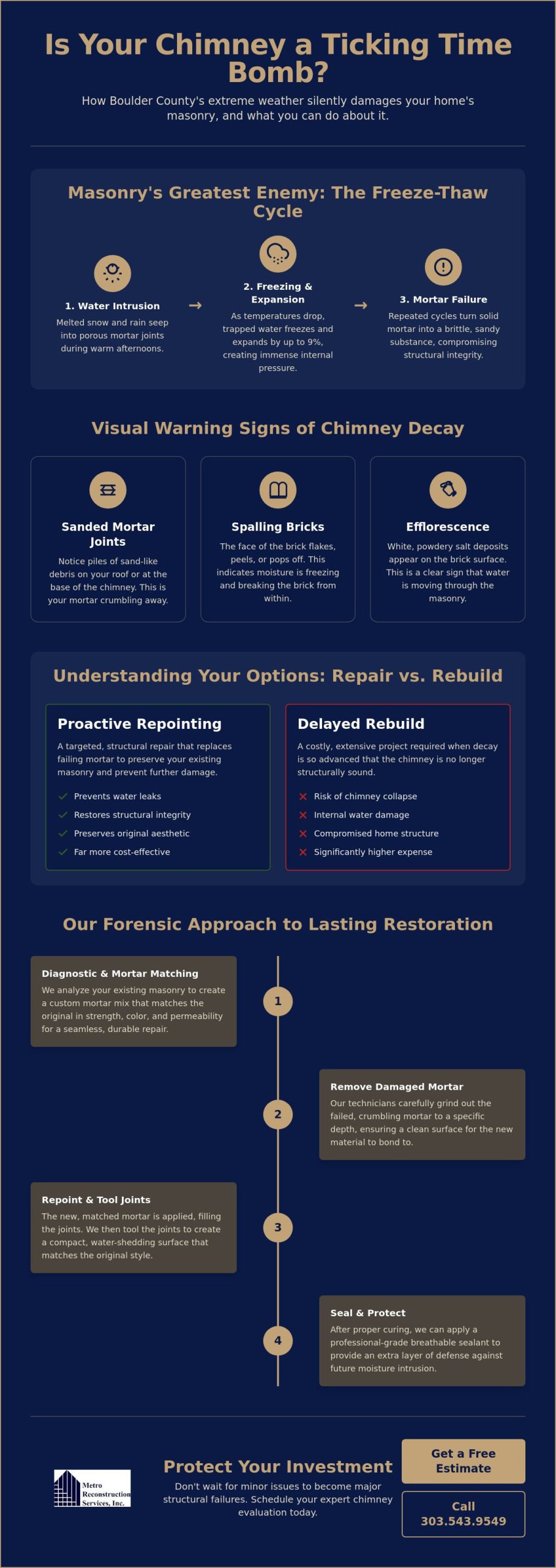
Mortar is naturally porous, allowing it to “breathe” and release moisture. However, when heavy snow melts during a warm Colorado afternoon, water seeps deep into these pores. When temperatures plummet at sunset, that water expands by approximately 9% as it turns to ice. This expansion creates internal pressure that microscopic cracks can’t contain. Over a single spring season, dozens of these cycles can turn solid mortar into a brittle, sandy substance that no longer supports the weight of the masonry. Standard mortar mixes often fail in these high-altitude environments because they lack the specific flexibility needed to survive our climate.
Why Early Intervention Prevents Structural Failure
Ignoring small hairline fractures is a gamble with the structural health of your home. As mortar fails, it allows moisture to reach the core of the chimney, leading to brick spalling where the outer face of the masonry literally pops off. Left unaddressed, this decay can compromise the internal flue or lead to a total chimney collapse. Proactive chimney repointing Boulder County experts provide is essential for Essential Exterior Home Repair in Boulder County, as it prevents the need for a far more expensive total reconstruction. Precision at this stage ensures your chimney remains a reliable shield against the elements and meets the updated 2026 local safety standards.
Identifying the Signs of Mortar Failure and Water Intrusion
Recognizing the early indicators of masonry decay is essential for maintaining the structural protection of your home. One of the most common visual cues is the presence of “sanded” mortar joints, where the material has lost its bonding properties and begun to crumble into a fine grit. You might find this debris collecting on your roof shingles or at the base of the chimney stack. When these joints recede, they create small gaps between bricks that act as funnels for rainwater. This is often when homeowners realize that chimney repointing Boulder County services are no longer optional, but a necessary step to halt further deterioration.
Another serious symptom of moisture distress is known as spalling. This occurs when the outer face of a brick begins to flake, peel, or pop off entirely. Because bricks are porous, they absorb water that becomes trapped behind the surface. When this water freezes and expands, it forces the brick to break apart from the inside out. You may also notice efflorescence, which appears as white, powdery salt deposits on the masonry surface. These salts are carried to the exterior by evaporating water and serve as a clear diagnostic signal that moisture is moving through your complete outer system. If you see damp spots on your interior ceilings or walls near the chimney, the transition from an exterior maintenance issue to an internal structural threat has already begun.
The Role of Moisture Mitigation in Chimney Health
A failing chimney often points to a breakdown in the secondary defenses of the structure. The chimney crown, which is the concrete cap at the top, and the metal flashing at the roofline must work in tandem to shed water away from the masonry. Many homeowners attempt a quick fix by applying silicone caulk to cracks. This is a significant mistake. Silicone traps moisture inside the brickwork, which accelerates the decay process by preventing the masonry from breathing. A forensic approach to masonry restoration requires identifying these underlying failures before applying new mortar.
Diagnostic Steps for Boulder Homeowners
You can perform a basic assessment of your chimney’s health using the “screwdriver test.” Gently press a flat-head screwdriver into a mortar joint; if the material crumbles easily or the tool sinks in, the bond has failed. For higher sections of the stack, use a pair of binoculars to safely inspect the joints from the ground. This simple diagnostic can help you determine if you need professional Stucco and Masonry Repairs in Boulder. If your inspection reveals gaps or flaking bricks, it’s time to seek a permanent solution. You can reach our team at 303.543.9549 or visit our contact page for a professional evaluation of your chimney’s structural integrity.
The Forensic Approach to Masonry Restoration
A truly permanent repair begins with an understanding of why the failure occurred in the first place. We approach every project with what we call the Wise Craftsman philosophy, which treats the symptoms of decay as clues to an underlying structural story. A successful chimney repointing Boulder County homeowners rely on begins with a forensic investigation into the relationship between the masonry, the environment, and the building’s complete outer system. We don’t simply apply a superficial patch; we identify the root cause of the moisture intrusion to ensure our solution lasts for decades rather than just a few seasons.
Precision in material selection is where many standard contractors fall short. For instance, using modern Portland cement on historic Boulder County brickwork is a common mistake that leads to catastrophic results. Modern cement is often much harder and less breathable than the original lime-based mortars used in older homes. When your home’s exterior shifts or breathes during our intense temperature swings, the mortar must be slightly softer than the bricks themselves. If the mortar is too rigid, the pressure from thermal expansion has nowhere to go, forcing the bricks to crack and shatter. This is why we prioritize matching the original mortar’s strength and composition before we ever pick up a trowel.
Analyzing Mortar Composition for Lasting Repairs
Our diagnostic process involves a careful analysis of the existing mortar’s lime-to-cement ratio. In older residences, a higher lime content provides the necessary flexibility to handle the natural movement of the structure. We also focus on meticulous color matching. While structural integrity is our primary goal, the aesthetic restoration must be seamless. We use specific sand types and pigments to ensure the new joints are indistinguishable from the original design, preserving the historic character of your property.
Structural Mitigation: Beyond the Surface
Sometimes, the cracks you see in your chimney aren’t caused by weather alone. They can be signs of foundation settling or other deep-seated structural shifts. If our forensic evaluation suggests that the masonry distress is tied to movement in the ground, we may recommend Foundation Repair Services in Boulder to stabilize the entire system. In the Front Range, we also frequently manage the complex transition points where masonry meets stucco or siding. Ensuring these different materials work together as a unified shield is the only way to prevent hidden water damage. If you’re concerned about the hidden mechanics of your chimney, call us at 303.543.9549 or visit our contact page for a thorough assessment.
The Professional Repointing Process: What to Expect
The integrity of a masonry project is established long before the first trowel of mortar is mixed. Proper chimney repointing Boulder County homes require involves a rigorous preparation phase where we set up secure access and shield your roof, windows, and landscaping from debris. We view your home as a complete outer system, a philosophy shared by roofing specialists like Renegade Roofing Co., and protecting every component during the restoration process is a foundational part of our professional standard. Once the site is secured, we begin the removal of failed mortar joints with surgical precision.
We then proceed to the grinding and removal stage. For a successful bond, we must remove old mortar to a depth of at least two to two and a half times the width of the joint. This creates a clean, square channel where the new material can anchor itself securely. To protect your home’s air quality and cleanliness, we utilize vacuum-shrouded tools that capture dust at the source. This level of care ensures that the fine particulate matter common in masonry work doesn’t settle on your property or enter your home’s ventilation system.
Once the joints are prepared, we apply the new mortar using the “lift” method. Instead of filling the entire gap at once, we apply thin layers and allow each to become thumbprint hard before adding the next. This layering process ensures maximum density and prevents the internal shrinkage that leads to early failure. In Colorado’s dry climate, moisture control is paramount. We carefully manage the curing phase by misting the new joints, preventing the mortar from drying too quickly and becoming brittle, which is a common cause of failure in high-altitude environments.
Precision Tooling and Finishing
The final shape of the joint, or its profile, is a functional choice that dictates how well your chimney sheds water. Concave or weathered joints are particularly effective at directing moisture away from the brick face, preventing the saturation that leads to spalling. After the mortar has set, we perform a final cleaning to remove any residue without damaging the brick’s natural texture. This ensures the aesthetic restoration matches your home’s original design perfectly.
Safety and Property Protection
High-reach chimneys in our mountain and foothills communities require specialized equipment for safe and effective access. We prioritize professional scaffolding over ladders to provide our craftsmen with a stable platform for precision work. This approach ensures the work is performed accurately while keeping the surrounding structure undisturbed. You can see our full commitment to these professional standards by reviewing Metro Reconstruction’s Services. If you are ready for a structural solution that lasts, call us at 303.543.9549 or visit our contact page to schedule your professional evaluation.
Protecting Your Investment with Metro Reconstruction Services
Choosing a partner for property preservation is a decision that directly impacts your home’s longevity and structural health. Metro Reconstruction Services brings over 40 years of specialized experience to the Front Range, serving homeowners across Boulder, Longmont, and the surrounding mountain communities. As a family-owned firm, we don’t rely on the high-pressure sales tactics often found in the construction industry. Instead, we offer the quiet confidence that comes from decades of solving complex structural challenges. When you engage us for chimney repointing Boulder County property owners trust, you’re partnering with local craftsmen who understand that our reputation is built on every joint we seal and every brick we preserve.
Our commitment to reliability is rooted in the belief that a home is a complete outer system. We don’t view a failing chimney as an isolated masonry issue; we see it as a vital component that must work in harmony with your roof, siding, and foundation. This holistic philosophy is shared by experts like Thoughtful Roofer Inc., who focus on residential roofing and gutter integrity to protect the entire structure. This perspective allows us to provide long-term solutions rather than superficial, short-term patches. We’d rather explain the difficult truth of a structural failure and provide a permanent fix than offer a low-quality repair that will fail within a few seasons. This integrity is why we’ve remained a dedicated partner in property preservation for four decades.
A Holistic Approach to Home Preservation
Our deep expertise in stucco restoration and foundation stabilization informs every masonry project we undertake. We understand how moisture moves through different building materials and how a failure in one area can signal a larger problem elsewhere. This forensic diagnostic approach provides you with the peace of mind that your home is being cared for by experts who understand its hidden mechanics. For those living in wildfire-prone regions, we also integrate Fire Mitigation and Prevention Services to ensure your chimney and exterior systems are hardened against regional environmental threats.
Scheduling Your Chimney Evaluation
The window for effective masonry restoration is dictated by the cycles of the seasons. Scheduling the chimney repointing Boulder County homes require before the peak of winter ensures your masonry is shielded against the harshest freeze-thaw cycles. Waiting until snow is on the ground often means existing cracks will worsen, leading to more expensive internal water damage. Precision and accuracy are our foundational promises, and we’re ready to help you protect your investment.
If you’ve noticed crumbling mortar or moisture near your fireplace, don’t wait for the damage to accelerate. You can Contact Metro Reconstruction Services today to schedule a thorough evaluation of your chimney’s structural integrity. Our team is here to provide the expert guidance and meticulous craftsmanship your home deserves. Call us directly at 303.543.9549 to discuss your project with a seasoned expert.
Securing Your Home’s Structural Future
Protecting your property’s complete outer system requires more than a superficial patch. It demands a deep understanding of how high-altitude stressors interact with masonry components. By identifying the underlying causes of failure and utilizing precise material matching, you ensure your chimney remains a stable defense against Colorado’s climate. Proactive chimney repointing Boulder County residents choose today prevents the necessity of a far more expensive structural overhaul tomorrow. It’s a decision that preserves both the aesthetic value and the physical safety of your residence.
As a family-owned firm with over 40 years of Front Range experience, Metro Reconstruction Services specializes in a forensic approach to identifying the root causes of masonry failure. We bring the quiet confidence of seasoned experts to every project, ensuring your home receives a long-term solution tailored to our unique regional environment. Don’t wait for the next freeze-thaw cycle to worsen existing damage. Contact our masonry experts today for a professional chimney evaluation or call us at 303.543.9549. We look forward to being your partner in property preservation.
Frequently Asked Questions
How much does chimney repointing cost in Boulder County?
The cost of restoration depends on several factors, including the height of the stack, the accessibility of the work area, and the severity of the mortar decay. Because we provide long-term structural solutions rather than temporary fixes, a forensic evaluation is necessary to determine the specific needs of your masonry. We focus on providing a precise scope of work that addresses the root cause of failure to ensure your investment is protected for decades.
How long does a typical chimney repointing project take to complete?
Most residential projects are completed within three to five business days, though the timeline can shift based on the size of the structure. This duration includes setting up safe access, the meticulous removal of old mortar, and the layered application of new material. We also account for the curing process, which is critical in our dry climate to ensure the new joints achieve their full structural strength and durability.
Can I repoint my own chimney using store-bought mortar?
We strongly advise against using generic, store-bought mixes for chimney repointing Boulder County homes. These off-the-shelf products often contain high levels of Portland cement, which is much harder than the original bricks found in many local residences. This lack of flexibility causes the bricks to shatter when they expand during temperature shifts. Professional restoration requires a custom mortar analysis to match the original composition and prevent irreversible masonry damage.
Is repointing the same thing as tuckpointing?
Repointing is a fundamental structural repair that involves replacing decayed mortar to restore the integrity of the masonry joints. Tuckpointing is primarily a cosmetic technique that uses contrasting colors to create the visual illusion of perfectly straight, thin joints. While tuckpointing may improve the appearance of a home, it doesn’t provide the same level of deep-seated moisture protection as a professional repointing project designed for our harsh regional environment.
Will repointing fix a chimney that is leaking water into my house?
Repointing stops moisture from entering through the mortar joints, but it’s only one part of the complete outer system. Leaks can also originate from a cracked chimney crown, failing roof flashing, or a compromised flue liner. We conduct a thorough diagnostic to identify all entry points, ensuring that we address the underlying structural origins of the leak rather than just the visible symptoms on your interior walls or ceilings.
How often should a masonry chimney be inspected in Colorado?
You should have your masonry inspected at least once a year to stay ahead of Colorado’s intense freeze-thaw cycles. Early detection of sanded joints or small gaps allows for proactive maintenance before water intrusion causes internal damage. These annual checkups are a vital part of property preservation, helping you avoid the high costs associated with a total chimney rebuild or significant interior repairs caused by hidden leaks.
Does the weather need to be a certain temperature for repointing to occur?
Yes, mortar must be applied within specific temperature ranges to cure correctly and form a permanent bond. We typically perform masonry work when temperatures are expected to stay above 40 degrees Fahrenheit. If the material freezes before it has fully cured, the joints will become brittle and fail prematurely. We carefully monitor local weather patterns to ensure each project is completed under optimal conditions for long-term reliability.
Can you match the color of my existing 50-year-old mortar?
We specialize in the aesthetic restoration of historic and aging masonry by carefully matching the color and texture of your original mortar. Our process involves analyzing the sand and pigment types used in the initial construction to ensure a seamless blend. This attention to detail is a hallmark of our Wise Craftsman philosophy, allowing us to preserve the original character of your home while providing modern structural protection. For a professional evaluation, call us at 303.543.9549 or visit our contact page.