
What if the most reliable solution for your home’s structural integrity was thinner than a coin and required absolutely no digging in your yard? If you’ve noticed a slight inward curve in your basement wall, the anxiety over a potential collapse is a heavy burden to carry. You likely want a permanent fix using carbon fiber straps for foundation repair but dread the thought of heavy machinery tearing up your landscaping or losing valuable square footage to bulky steel reinforcements. We understand that your home is your most significant investment; protecting it requires a solution that’s both scientifically sound and minimally disruptive.
In this 2026 guide, you’ll discover how this advanced technology provides a high-performance, non-invasive method for stabilizing bowing walls against Colorado’s challenging soil conditions. As a material that’s five times stronger than steel, carbon fiber represents a shift toward precision engineering where we address the underlying structural origins of movement rather than just masking the symptoms. We’ll walk you through the installation process, the long-term benefits of this paintable material, and how it ensures your basement remains a safe, functional part of your home for decades to come.
Key Takeaways
- Discover why aerospace-grade carbon fiber straps for foundation repair are five times stronger than steel and provide a permanent solution for bowing walls.
- Identify the specific warning signs in Colorado’s expansive clay soils that signal your foundation is under extreme pressure.
- Learn when to choose non-invasive straps over traditional steel I-beams to save basement square footage and avoid messy excavation.
- See how our forensic approach to stabilization protects your building’s complete outer system and preserves its long-term market value.
- Secure your home’s structural future by contacting our experts at 303.543.9549 or visiting our contact page.
What Are Carbon Fiber Straps for Foundation Repair?
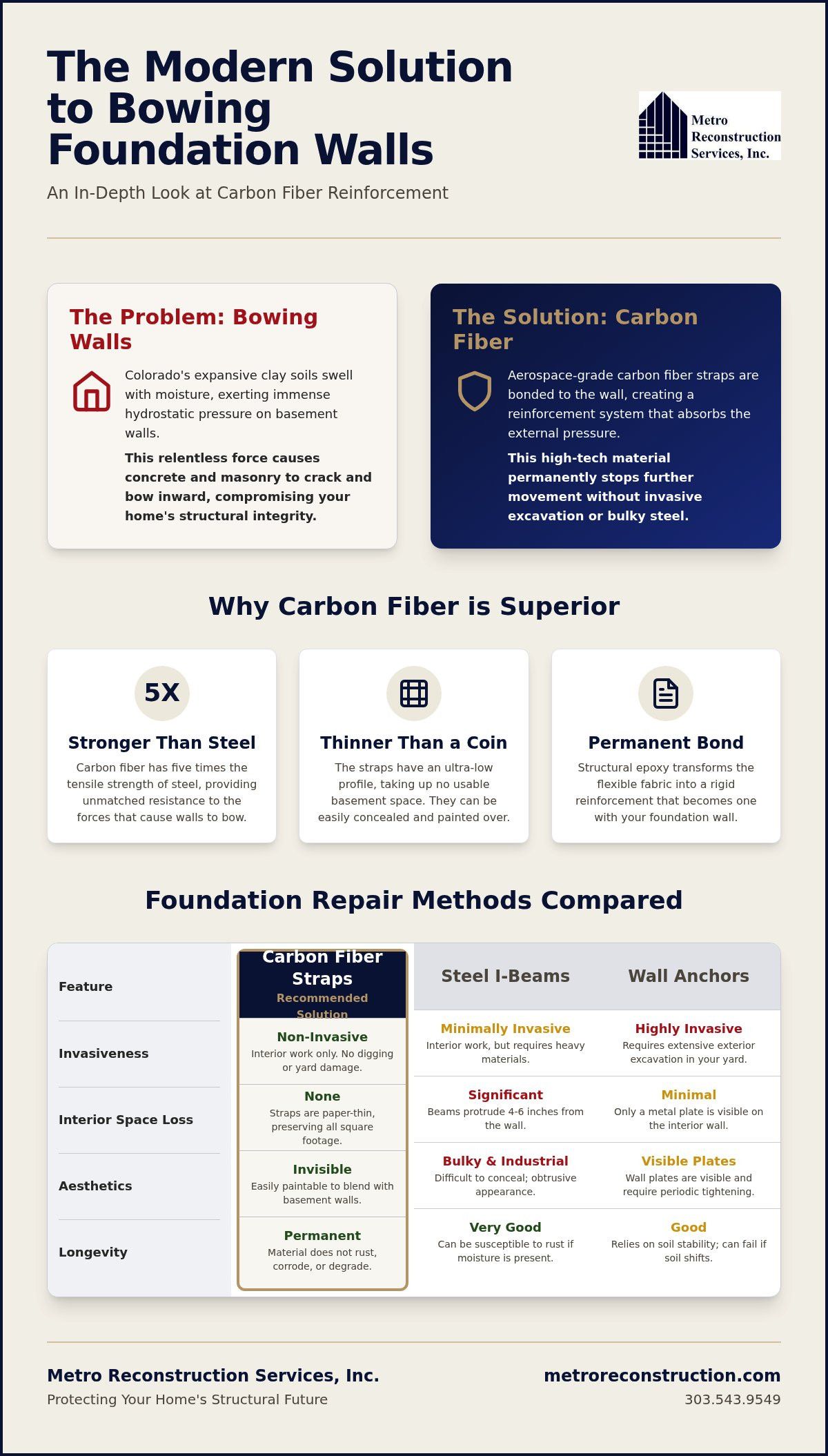
Carbon fiber straps for foundation repair are high-tensile reinforcement systems designed to stabilize walls that have begun to bow or crack under external pressure. These straps aren’t just heavy-duty tape; they’re composed of aerospace-grade carbon filaments woven into a flexible, ultra-strong fabric. By 2026, this technology has become the preferred non-invasive alternative to traditional steel I-beams, primarily because it provides incredible counter-tension without the bulk of metal supports. We view these straps as a critical component of a building’s complete outer system, ensuring that once a wall is stabilized, it remains so permanently.
The Science of Carbon Fiber Reinforcement
The effectiveness of this method relies on a material known as Carbon fiber reinforced polymer (CFRP). In structural terms, we focus on its tensile strength, which is the material’s ability to resist being pulled apart. While concrete is excellent at handling weight (compression), it’s relatively weak when soil pushes against it (tension). Carbon fiber is five times stronger than steel in this regard. During installation, the fabric is saturated with a specialized structural epoxy. This chemical process transforms the flexible strap into a rigid reinforcement that bonds directly to the concrete. This bond creates a unified structural element where the strap absorbs the outward force, effectively stopping any further movement of the wall.
Why Colorado Homeowners Choose Carbon Fiber
Living in the Front Range or mountain communities means dealing with highly expansive clay soils. These soils swell when wet and shrink when dry, exerting massive pressure on basement walls. Our specialized structural services prioritize carbon fiber because it addresses these environmental stressors without the need for invasive excavation. Homeowners appreciate several key advantages:
- Low Profile: The straps are only a fraction of an inch thick, meaning they don’t protrude into your living space.
- Aesthetic Flexibility: Once the epoxy cures, the straps are nearly invisible and can be painted over to match your basement walls.
- Interior Installation: All work is performed from inside the home, which protects your landscaping and prevents the mess of heavy machinery in your yard.
This approach reflects our commitment to precision. We aren’t just offering a quick fix; we’re applying a forensic understanding of how your home interacts with Colorado’s unique geology to provide a long-term solution. If you’re concerned about the integrity of your foundation, contact our team at 303.543.9549 or visit our contact page for a professional evaluation.
How Carbon Fiber Stabilizes Bowing Foundation Walls
Colorado foundations face a relentless enemy in hydrostatic pressure. When our heavy mountain snowmelts or spring rains saturate the clay soil surrounding your home, the earth acts like a sponge and exerts massive force. This pressure pushes against the exterior of your basement walls with surprising intensity. Since concrete is rigid, it eventually gives way, resulting in the characteristic inward bow that many homeowners first notice as a horizontal crack. By applying carbon fiber straps for foundation repair, we counteract this force using the tension side principle. Because the wall is bowing inward, the interior face is being stretched and pulled apart. Placing the reinforcement here allows the carbon fiber to absorb that pulling force, effectively locking the wall in its current position.
Unidirectional vs. Bidirectional Weaves
Choosing the right weave is a matter of directing strength where it’s needed most. For most bowing walls, we utilize unidirectional fibers. In this configuration, all the high-strength filaments run in one single direction, typically vertically from the floor to the ceiling. This vertical alignment maximizes the strap’s resistance to the horizontal pressure pushing the wall inward. Unidirectional fiber ensures that every ounce of material is actively working to support the specific load path created by the bowing wall.
A single strap doesn’t act in isolation. Instead, our team calculates the precise spacing required to ensure the entire wall span is reinforced. This collective load distribution prevents the external pressure from simply shifting to an unreinforced section of the masonry. Once the system is fully installed and cured, the wall is physically unable to move further. It’s a permanent stabilization that provides immediate security for your home’s structure. If you’ve noticed these warning signs, our specialized structural services can help identify the underlying cause before the damage progresses.
The Critical Role of Structural Epoxy
The carbon fiber provides the strength, but the structural epoxy provides the vital connection. This specialized resin is far more than a simple adhesive. When applied, the epoxy penetrates the microscopic pores of the concrete to create a deep mechanical lock. As it cures, it fuses the strap to the foundation wall, creating a single, high-strength unit. This bond is specifically designed to withstand the unique climate of the Front Range, remaining stable through extreme temperature shifts and dry conditions. This level of precision ensures the repair doesn’t just look good on the surface but performs at an engineering-led standard for decades. For a professional evaluation of your property, you can reach us at 303.543.9549 or visit our contact page.
Carbon Fiber vs. Steel Beams vs. Wall Anchors
Choosing the right stabilization method isn’t just about raw strength; it’s about the specific geometry of the structural failure. For walls with extreme bowing that exceeds two inches, steel I-beams remain a necessary, if bulky, choice. These beams are bolted to the floor and floor joists to provide a physical stop against further movement. However, for most homeowners in Colorado facing early or moderate structural shifts, carbon fiber straps for foundation repair represent a more balanced, engineering-led approach. While wall anchors offer another path, they involve digging deep trenches in your yard to install plates in the soil. This creates a lasting impact on your landscaping and requires heavy equipment that many residential neighborhoods aren’t designed to accommodate.
Space and Aesthetic Considerations
One of the most significant drawbacks of traditional steel beams is how they interfere with your home’s interior potential. Because these beams protrude several inches from the wall, finishing your basement becomes a complex and expensive task. You’re forced to build out thick false walls that eat into your square footage. In high-value markets like Boulder or Denver, losing even a few inches of living space can negatively affect your property’s resale value. Carbon fiber, by contrast, is the only structural repair that’s virtually invisible once painted. It allows you to install drywall directly over the reinforced area without any loss of usable area. This preservation of your home’s complete outer system ensures that the repair adds to your investment rather than detracting from its appeal. For property owners looking to extend this level of quality to their flooring, Polished Concrete Atlanta offers specialized restoration and finishing services for commercial and industrial facilities.
Project timelines vary significantly between these different methods. A typical carbon fiber installation is often completed in a single day, depending on the number of straps required. It’s a remarkably clean process. There’s no heavy drilling, minimal dust, and very little noise compared to the invasive nature of anchor systems. Because all work happens from the interior, your daily life remains largely undisturbed. We understand that your home is a sanctuary, not a construction site. Our forensic experts focus on efficiency and precision, ensuring the stabilization is permanent without the footprint of a major remodel. If you’re weighing these options for your property, contact us at 303.543.9549 or visit our contact page to discuss which method best suits your home’s unique structural needs.
Identifying Foundation Failure in Colorado’s Front Range
Colorado’s Front Range is home to some of the most challenging geological conditions in the country. The primary culprit is expansive clay, often containing bentonite, which swells significantly when saturated and contracts as it dries. This constant cycle of expansion and contraction creates a rhythmic pressure against your basement walls that can eventually lead to structural failure. Identifying these issues early is vital for preserving your home’s complete outer system, including any stucco or masonry work on the exterior. When we approach a property, we look past the surface to understand the hidden mechanics of the soil and how they interact with your specific foundation type.
The most alarming sign of distress is a horizontal crack running along the middle of a foundation wall. This indicates that the wall is under extreme pressure and has begun to bow inward. In block or masonry foundations, you might notice stair-step cracking, where the separation follows the mortar joints in a diagonal pattern. You should also watch for efflorescence, which is a white, powdery mineral deposit. While it looks like a simple cleaning issue, it’s actually a sign that water is migrating through the concrete, often preceding more serious structural bowing. If you see these signs, it’s time to consider a professional evaluation to see if carbon fiber straps for foundation repair are a viable solution for your home.
When is Carbon Fiber the Right Solution?
We typically apply the 2-inch rule when assessing whether carbon fiber is the appropriate choice. If a wall has bowed less than two inches from its original vertical position, high-tensile straps can effectively stabilize the structure and prevent further movement. Catching the problem within this window is critical because it allows for a non-invasive repair that avoids the high costs and mess of a total wall replacement. Our forensic approach ensures we aren’t just patching a crack; we’re reinforcing the wall to handle future soil stress while maintaining your home’s interior square footage. If you are researching foundation issues in other expansive soil regions, you can check out Foundation Werks for a detailed guide on soil erosion and settling repair in North Texas.
Our local climate adds another layer of complexity with rapid freeze-thaw cycles. When water in the soil freezes, it expands with immense force, pushing against the foundation. When it melts, the soil can shift, leaving the wall unsupported or under uneven pressure. This process is often made worse by poor drainage, such as clogged gutters or grading that slopes toward the house. For a more detailed look at these local challenges, you can read our guide on Foundation Repair Services in Boulder. If you suspect your foundation is failing, don’t wait for a total collapse. Call our experts at 303.543.9549 or visit our contact page to schedule a detailed structural inspection.
The Metro Reconstruction Forensic Approach to Stabilization
We believe that a structural repair is only as good as the diagnostic work that precedes it. While many companies offer generic kits, our team at Metro Reconstruction Services, Inc. approaches every project as forensic experts who seek to understand the hidden mechanics of your home’s failure. Since 1982, we’ve operated as a family-owned firm dedicated to property preservation across the Front Range. We don’t just look at a crack and suggest a patch; we analyze the building’s complete outer system to determine why the soil is exerting pressure and how that movement affects your home’s long-term value. This engineering-led perspective ensures that our use of carbon fiber straps for foundation repair is part of a comprehensive structural mitigation strategy rather than a temporary fix.
Our Step-by-Step Restoration Process
Accuracy is our foundational promise, and it begins with a detailed structural analysis that looks beyond the basement walls. We identify the root cause of the movement, whether it’s poor drainage, expansive clay, or regional freeze-thaw cycles. Once we’ve determined that carbon fiber is the ideal solution, we move into a meticulous preparation phase. Grinding the concrete surface is a vital step that many overlook. By removing the thin, weak surface layer that naturally forms on concrete over time, we expose the solid, open pores of the material. This allows our specialized structural epoxy to penetrate deeply and create a mechanical lock that’s far stronger than a surface-level bond. After the surface is prepared, we apply the high-tensile straps with surgical precision, followed by final quality control inspections to verify the integrity of the installation.
Protecting Your Investment
A stabilized foundation is the prerequisite for all other exterior work. If your foundation continues to shift, any investment in stucco restoration or masonry work will eventually fail as the movement creates new cracks in the exterior finishes. By choosing carbon fiber straps for foundation repair, you’re creating a permanent, rigid backbone for your home. This proactive maintenance protects your siding, windows, and masonry, ensuring that your home remains structurally sound for decades. We take pride in being a dedicated partner in your home’s preservation, offering the quiet confidence that comes from over four decades of specialized experience. Our restoration services are designed to provide you with peace of mind and lasting structural safety.
If you’ve noticed horizontal cracking or a slight bow in your basement walls, don’t wait for the problem to escalate into a total foundation failure. Contact our experts at Metro Reconstruction Services, Inc. today at 303.543.9549 or visit our contact page to schedule a professional structural evaluation. Let us help you protect your most significant investment with a solution built on technical precision and local expertise.
Securing Your Home’s Structural Integrity
Foundation failure doesn’t have to mean a loss of living space or a messy excavation. By choosing carbon fiber straps for foundation repair, you’re opting for an engineering-led solution that addresses soil pressure with technical precision. This method not only stabilizes your walls but also protects your home’s complete outer system. It ensures that your investment remains safe, functional, and aesthetically pleasing for decades to come.
At Metro Reconstruction Services, we bring over 40 years of Boulder County structural experience to every forensic diagnostic we perform. As a family-owned firm since 1982, we specialize in navigating Colorado’s unique expansive soil challenges with integrity and seasoned craftsmanship. We’d rather explain the difficult structural truth than offer a temporary patch. Secure your home’s future with a professional foundation evaluation from Metro Reconstruction. You can also reach our team directly at 303.543.9549. Your home deserves a permanent solution.
Frequently Asked Questions
How long do carbon fiber foundation straps last?
Carbon fiber straps provide a permanent stabilization solution that is designed to last as long as the structure itself. Because the material does not rust, stretch, or degrade when exposed to moisture, it maintains its high-tensile strength for decades. When integrated into your home’s complete outer system by Metro Reconstruction Services, Inc., these straps offer a long-term alternative to temporary patches that often fail under Colorado’s intense soil pressure cycles.
Can I install carbon fiber straps myself?
We do not recommend DIY installation for structural repairs because the success of the system depends on professional-grade surface preparation and precise epoxy saturation. Achieving a true mechanical bond requires grinding the concrete to a specific profile that typical home tools cannot easily reach. Furthermore, without a forensic diagnostic to understand the load paths, an improperly placed strap may fail to stop the bowing, leading to much more expensive repairs later.
Do carbon fiber straps stop all foundation movement?
These straps are specifically engineered to stop lateral movement, which is the inward bowing caused by soil pressure. They are incredibly effective at locking a wall in its current position to prevent further collapse. However, they do not address vertical settling or sinking foundations. Our team at Metro Reconstruction Services, Inc. performs a thorough evaluation to ensure we are applying the correct technology to the specific type of movement occurring in your foundation.
Will carbon fiber straps affect the resale value of my home?
Professional installation of carbon fiber straps for foundation repair generally protects your home’s market value by resolving structural red flags. Because the straps are thin and can be painted over, they don’t interfere with basement finishing or reduce usable square footage. This “invisible” repair is often preferred by buyers in competitive markets like Denver and Boulder over bulky steel beams that signal a more invasive and space-consuming structural history.
How many carbon fiber straps do I need for my basement wall?
The number of straps required is determined by the height of your wall and the intensity of the soil pressure. In the Front Range, we typically space straps every four feet to ensure the load is distributed evenly across the entire masonry span. A forensic analysis allows us to determine the exact placement needed to counteract the specific pressure points in your basement, ensuring the wall remains rigid and safe for the long term.
Can you paint over carbon fiber foundation straps?
Yes, once the structural epoxy has fully cured, the straps can be painted to match your basement walls. The resulting finish is smooth and low-profile, making the repair nearly unnoticeable to the naked eye. This allows you to maintain the aesthetic quality of your living space while benefiting from aerospace-grade reinforcement. It is an ideal solution for homeowners who want to preserve their basement’s interior design while ensuring structural safety.
What happens if my wall is bowing more than two inches?
When a foundation wall has bowed more than two inches, it often requires more traditional reinforcement methods like steel I-beams or wall anchors. At this level of deflection, the structural integrity of the concrete may be compromised beyond what fabric straps can support alone. We always prioritize the difficult truth over a quick fix; if your wall has moved significantly, we will recommend the robust engineering solution necessary to keep your home standing safely.
Are carbon fiber straps better than steel beams?
Carbon fiber is often the superior choice for early-stage bowing because it is non-invasive and does not require yard excavation. It offers a higher strength-to-weight ratio than steel and does not take up valuable floor space in your basement. However, the “best” solution is always the one that matches the specific severity of your structural failure. Our team at Metro Reconstruction Services, Inc. helps you navigate these choices through detailed diagnostics and 40 years of local expertise.
For a detailed structural evaluation and to see if carbon fiber is the right fit for your home, contact Metro Reconstruction Services, Inc. today at 303.543.9549. You can also reach our experts and schedule an inspection through our contact page. We are dedicated to providing the peace of mind that comes with permanent, professional property preservation.