
Most homeowners believe a slight curve in their basement wall is just a natural sign of an aging house, but it’s actually the first warning sign of a building’s complete outer system under siege by the earth itself. It’s deeply unsettling to stand in your lower level and realize the walls aren’t as straight as they were a year ago. You’re likely feeling the weight of uncertainty, wondering if your foundation is failing and which repair method actually works for the long haul. We understand that fear because we’ve seen how Colorado’s expansive soils can compromise even the most robust structures.
This guide explores the necessity of bowing basement wall repair Longmont and how a forensic approach to structural mitigation provides a permanent solution for your home. You’ll learn exactly why these walls move, how to identify the underlying structural origins of the failure, and why our engineering-led restoration offers lasting peace of mind. We’ll move past the confusion of quick fixes to focus on precision and reliability. By the end of this article, you’ll have a clear path toward a stable, safe foundation that protects your family’s investment for decades.
Key Takeaways
- Understand how the hidden interaction between the expansive clay soils in the Front Range and your foundation leads to inward wall movement.
- Learn to spot the early warning signs of structural failure, including the specific crack patterns that demand professional attention.
- Discover why a forensic approach is the only way to ensure your bowing basement wall repair Longmont provides a permanent solution rather than a temporary fix.
- Find out why stabilizing the wall is only one part of a complete outer system restoration designed to stop moisture at its source.
- Learn how to secure your home’s long-term safety by contacting our local experts at contact us or calling 303.543.9549.
Understanding Why Basement Walls Bow in Longmont
A bowing wall is rarely a standalone issue; it’s a clear signal that the building’s complete outer system is struggling against immense environmental stressors. When we speak about bowing, we’re describing the inward curve of foundation masonry that occurs when external lateral forces exceed the wall’s structural capacity. In our 40 years of experience across the Front Range, we’ve found that this movement is almost always a direct result of the specific earth surrounding the home. Gaining a deep perspective on Understanding Soil Mechanics is the first step in identifying why these structural failures occur in our local climate.
The Impact of Expansive Soils on Your Foundation
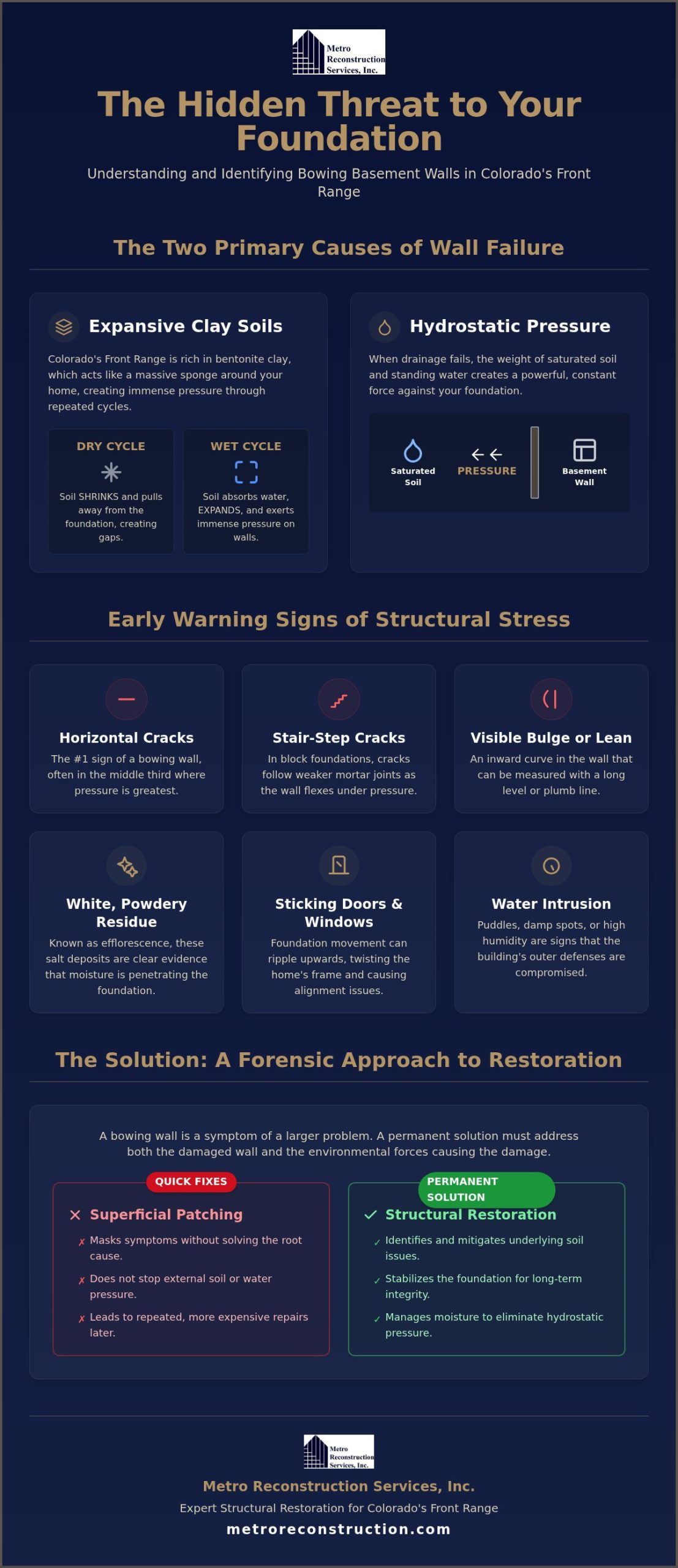
Longmont is situated in a region known for high concentrations of bentonite, a specific type of clay soil that is remarkably reactive to moisture. This soil behaves much like a biological sponge. It grows in volume significantly as it absorbs water and shrinks as it dries out. When the soil expands, it has nowhere to go but against your foundation, placing immense force on concrete and cinder block walls. As of 2026, intensifying drought conditions in Colorado have made these cycles even more aggressive. The soil pulls away from the house during dry spells and then exerts sudden, massive pressure during heavy spring runoffs. This repeated cycle of swelling and shrinking eventually fatigues the masonry, making bowing basement wall repair Longmont a technical necessity to prevent total failure.
Hydrostatic Pressure: The Invisible Force
Hydrostatic pressure is the weight of standing water pressing against your foundation. When rain or snowmelt cannot drain away from the home effectively, the ground becomes saturated. This trapped water is incredibly heavy and exerts a constant, invisible push. Basement walls are typically the first components to show signs of this stress because they serve as the primary barrier between your living space and the saturated earth. We focus on identifying the underlying structural origins of this pressure rather than offering a superficial patch. If the moisture isn’t managed, even a reinforced wall may face future challenges. Our restoration services prioritize long term structural integrity by addressing both the wall and the environment causing the damage.
Protecting your home requires more than a quick fix; it requires a partner dedicated to property preservation. If you’ve noticed a horizontal crack or a slight inward curve in your basement, reach out to us for an expert evaluation. You can contact our team at contact us or call us directly at 303.543.9549 to begin your journey toward a safe and stable foundation.
Recognizing the Early Warning Signs of Structural Stress
Identifying structural failure early is often the difference between a controlled repair and a foundation emergency. While soil pressure is the underlying cause, your home communicates this distress through specific physical symptoms. Recognizing these signs requires a meticulous eye, as the first indicators are often subtle and easily dismissed as simple aging. If you suspect your foundation is shifting, a professional assessment for bowing basement wall repair Longmont can help you identify the underlying structural origins before they escalate into a total failure.
Horizontal cracks running along the middle third of the wall are the primary indicator of a bowing foundation. Unlike vertical cracks, which often result from minor settling, horizontal ones signal that the wall is actively yielding to lateral pressure. In masonry work, you’ll often see “stair-step” patterns where the mortar between blocks separates. This happens because the blocks themselves are rigid, so the force finds the weakest path through the joints. You should also look for a white, powdery residue known as efflorescence. This isn’t just a cosmetic issue; it’s salt left behind after water evaporates, confirming that moisture is moving through your foundation masonry. If you notice windows or doors on the upper floors sticking or refusing to latch, don’t assume it’s just seasonal humidity. Structural shifts in the basement often ripple upward, distorting the entire frame of the home.
Visual Indicators Inside the Basement
You can measure the severity of a lean by hanging a simple plumb line from the floor joists or using a long level against the wall. If the center of the wall protrudes more than the top or bottom, the structural integrity is compromised. It’s vital to distinguish between vertical settlement cracks and horizontal pressure cracks, as the latter represent a more immediate threat to the building’s stability. We recommend marking the ends of any visible crack with a pencil and dating it. This allows you to track active movement and determine if the crack is widening over time, which provides essential data for our forensic diagnostics.
External Signs Around Your Longmont Home
External checks are equally important for a complete understanding of your home’s health. Because of Colorado’s Expansive Soils, you might see significant gaps between the earth and the foundation during dry periods. Conversely, after a storm, observe if water is “ponding” near the basement walls. This standing water increases the weight on your foundation masonry. If you see cracks in your exterior stucco that align with interior damage, the entire outer system is likely under stress. If these signs feel familiar, it’s wise to seek a professional restoration evaluation to determine the exact state of your foundation. You can reach our specialists at 303.543.9549 or visit contact us to discuss your concerns.
Evaluating Foundation Stabilization Methods for Colorado Homes
Once you’ve identified the signs of movement, the focus shifts to selecting a stabilization method that addresses the specific environmental stressors of the Front Range. Selecting the right approach for bowing basement wall repair Longmont depends entirely on the degree of deflection and the soil’s current state. We don’t believe in a one size fits all fix. Instead, we evaluate the structural origins of the failure to determine which engineering led solution will provide the most reliable long term result.
Wall anchors are a robust option for walls that have bowed significantly, often over 2 inches. They work by utilizing the stable soil well beyond the foundation to provide external tension. We install an anchor plate in the yard and connect it to a plate on the interior wall with a steel rod. This configuration allows us to potentially pull the wall back toward its original position over time. It’s a powerful tool, especially since our region is notorious for expansive or swelling soils that exert unpredictable lateral pressure. If your foundation masonry is also showing signs of vertical sinking, we may integrate helical piers to provide deep seated support that reaches past the unstable surface layers.
Wall Anchors vs. Carbon Fiber Straps
The Role of Steel I-Beams
When a wall has reached a point of extreme structural failure, we often turn to steel I-beams, also known as soldier beams. These are bolted into the floor and floor joists, creating a rigid skeleton that prevents any further inward movement. These beams distribute pressure across the entire height of the wall, making them exceptionally reliable in high pressure soil zones. While they are more visible than carbon fiber, their strength is unmatched for severe cases where the masonry has been significantly weakened. We prioritize precision in every installation to ensure these beams function as a permanent part of your home’s structural integrity.
Our goal is to provide you with the quiet confidence that your home is safe. To discuss which stabilization method is right for your property, you can reach our team at contact us or call us directly at 303.543.9549. We’re here to help you navigate these technical choices with clarity and integrity.
The Importance of Moisture Mitigation and the Outer System
Stabilizing a foundation without addressing the water source is like patching a boat while it’s still taking on water. Our forensic approach begins by identifying the underlying structural origins of the pressure. While competitors might only offer internal braces, we view your home as a complete outer system where every component must work in harmony. If the surrounding earth remains saturated, the need for bowing basement wall repair Longmont will eventually return. True restoration requires a holistic view of how moisture interacts with your specific property. You can learn more about this methodology through our Foundation Repair Services in Boulder.
It’s a difficult truth that many homeowners learn too late: internal reinforcement is only a half-measure if the external drainage fails. When water isn’t directed away from the house, it pools against the foundation masonry, creating the hydrostatic pressure we discussed earlier. This constant stress fatigues the structure. We don’t just fix walls; we fix the environment that broke them. By focusing on the building’s complete outer system, we provide a solution that protects your investment for the long haul.
Managing Water Runoff in the Front Range
In the Longmont area, water management is your first line of defense. Downspout extensions are critical. They must direct roof runoff at least five to ten feet away from the foundation to prevent water from reaching the expansive clay layer. Proper landscape grading is equally vital. The ground should slope away from the house at a rate of at least six inches over the first ten feet. Simple maintenance, like clearing gutters and ensuring window wells are debris-free, prevents the soil saturation that triggers bowing. Precision in these small details protects your larger structural health.
Stucco and Masonry as a Protective Barrier
The exterior skin of your home, including your stucco and masonry, acts as a primary shield against moisture intrusion. When these finishes crack or fail, water seeps into the core structure, weakening the very foundation you’re trying to save. Our forensic diagnostic process looks for hidden moisture paths that aren’t visible to the untrained eye. By integrating Stucco and Masonry Repairs into our structural plan, we ensure the building’s complete outer system remains watertight. This proactive maintenance is the hallmark of a seasoned expert who values long-term value over a quick patch.
If you’re concerned about how water is affecting your home’s stability, reach out to us for a consultation. You can schedule a forensic evaluation at contact us or call us at 303.543.9549.
Professional Structural Restoration with Metro Reconstruction
Metro Reconstruction Services, Inc. brings a 40 year legacy of expertise to every project in the Longmont and Boulder area. We understand that facing a foundation failure is a stressful experience for any homeowner. Our approach is rooted in quiet confidence and authoritative professionalism, ensuring that you feel supported throughout the entire restoration process. For bowing basement wall repair Longmont, we focus on the relationship between the building’s complete outer system and the underlying structural origins of the damage. We believe in getting it right the first time because your home’s safety shouldn’t depend on a temporary patch.
Our Forensic Diagnostic Process
During an initial structural evaluation, you can expect a meticulous analysis of your property. We don’t just measure the curve of a wall; we investigate the entire environment surrounding your home. This includes checking for soil saturation levels, examining the health of your exterior masonry, and evaluating your drainage systems. By identifying the root cause of the stress, we can design a repair plan that offers long term value. Accuracy is our foundational promise. We prioritize identifying the hidden mechanics of a failure so that our solutions are as precise as they are durable.
Partnering for Your Home’s Preservation
As a family owned and operated firm, we have a deep connection to the regional environments of the Front Range. We know how Colorado’s soils behave, and we use that knowledge to protect your investment. Our commitment to integrity means we offer transparent communication and fixed price project fees for complex structural repairs. You won’t have to worry about hidden costs or high pressure sales tactics. Instead, you’ll work with a dedicated partner focused on property preservation. We would rather explain the difficult truth of a structural issue than offer a low quality fix that won’t last.
If you’re ready to secure your foundation, we’re here to help. You can Schedule your structural evaluation today to begin the process. For immediate assistance, call us at 303.543.9549. Let’s work together to ensure your home remains safe and stable for decades to come.
Securing Your Home’s Structural Future
Protecting your home from the relentless pressure of Front Range soils requires a strategy that looks beyond the surface. We’ve explained how identifying the underlying structural origins of movement allows for a restoration that actually lasts. By addressing the building’s complete outer system, from moisture mitigation to precise stabilization, you can stop the cycle of damage before it leads to total failure. Our family-owned firm has specialized in Colorado expansive soil mitigation since 1982, bringing over 40 years of industry expertise to every project.
When you choose Metro Reconstruction for bowing basement wall repair Longmont, you’re partnering with a team that values long-term structural integrity over quick fixes. We’re committed to providing the quiet confidence that comes from a safe and stable foundation. Don’t let uncertainty wait. Contact our structural experts for a professional evaluation or call us directly at 303.543.9549 to secure your investment. You deserve the peace of mind that only a meticulous, engineering-led approach can provide. Your home is in capable hands.
Frequently Asked Questions
How much does it cost to fix a bowing basement wall in Longmont?
The total investment for stabilization depends on several variables, including the degree of wall deflection and the specific repair method chosen. Minor movement might only require low profile reinforcement, while severe bowing often necessitates more intensive structural systems and excavation. We provide transparent, fixed price project fees after a forensic evaluation of your property. This approach ensures you understand the relationship between the technical components and the total value of the permanent solution.
Is a bowing basement wall an emergency that requires immediate repair?
A bowing wall is a serious structural concern that requires professional attention, but it doesn’t always constitute an immediate collapse emergency. However, if the inward curve is accompanied by widening horizontal cracks or significant water intrusion, the stability of the entire outer system is at risk. Addressing bowing basement wall repair Longmont early prevents catastrophic failure. We advise homeowners to monitor movement and seek expert advice if the wall deflects more than two inches.
Can I sell my house if it has a bowing basement wall?
You can sell a home with foundation issues, but you must legally disclose the condition to potential buyers. Most mortgage lenders won’t approve a loan for a property with active structural failure, which often narrows the buyer pool to cash investors. Repairing the wall before listing often yields a high return on investment. Fixing the issue before the sale increases property value and provides the buyer with the quiet confidence needed to close the deal.
Do wall anchors or I-beams work better for Colorado soil?
Both methods are effective, but the choice depends on the specific behavior of the expansive clay surrounding your foundation. Wall anchors are ideal for pulling a wall back toward its original position by utilizing stable soil further from the home. Steel I-beams provide unmatched internal support for walls under extreme lateral pressure. We analyze the underlying structural origins of the movement to determine which system will withstand Colorado’s unique and demanding regional environmental stressors.
How long does the foundation stabilization process typically take?
Most foundation stabilization projects are completed within one to three days, depending on the complexity of the installation. Carbon fiber reinforcement is often the fastest, sometimes taking less than a day, while wall anchor systems require more time due to external excavation. Our process is designed to be steady and logical, minimizing disruption to your daily life. We provide a detailed timeline during the project management phase so you know exactly what to expect before we begin.
Will insurance cover the cost of repairing a bowing basement wall?
Ignoring a bowing wall leads to a progressive loss of structural integrity that eventually compromises the entire building. Over time, the pressure from saturated soil causes cracks to widen, allowing more moisture to enter and further weaken the foundation masonry. This can lead to the total collapse of the foundation wall, resulting in extensive damage to the upper floors. Proactive maintenance and early diagnostics are the most cost effective ways to ensure the permanent safety of your home.
If you have more questions about your foundation’s health, reach out to our team at contact us or call us at 303.543.9549.