
Selecting the right basement waterproofing (below-grade waterproofing systems) depends on site hydrogeology, membrane type, and total package budget. Market material costs range widely from basic sheet membranes to specialized fluid-applied systems based on site requirements. In local markets like Boulder, CO, choosing proper subterranean barriers requires evaluating groundwater pressure and soil conditions to protect your foundation.
Key Takeaways: Select your below grade waterproofing system based on excavation access, using pre-applied membranes for blindside shoring and post-applied fluid or sheets for open foundations.
- Choose fluid-applied membranes for complex geometries to eliminate seams, provided temperatures remain above 40°F.
- Avoid liquid coatings unless the substrate is completely dry to prevent blistering and adhesion failure.
- Install a complete package including bentonite waterstops and drainage boards to manage hydrostatic pressure.
- The article’s installation sequence confirms that surface preparation is the primary cause of system failure.
Match your subgrade profile to the barrier that holds hydrostatic load
Your optimal baseline strategy depends on hydrostatic head, site access, and active soil lateral pressures. Selecting improper subsurface barriers leads to hydrostatic failure; high water tables need positive-side, fully adhered tanking systems that resist persistent fluid force.
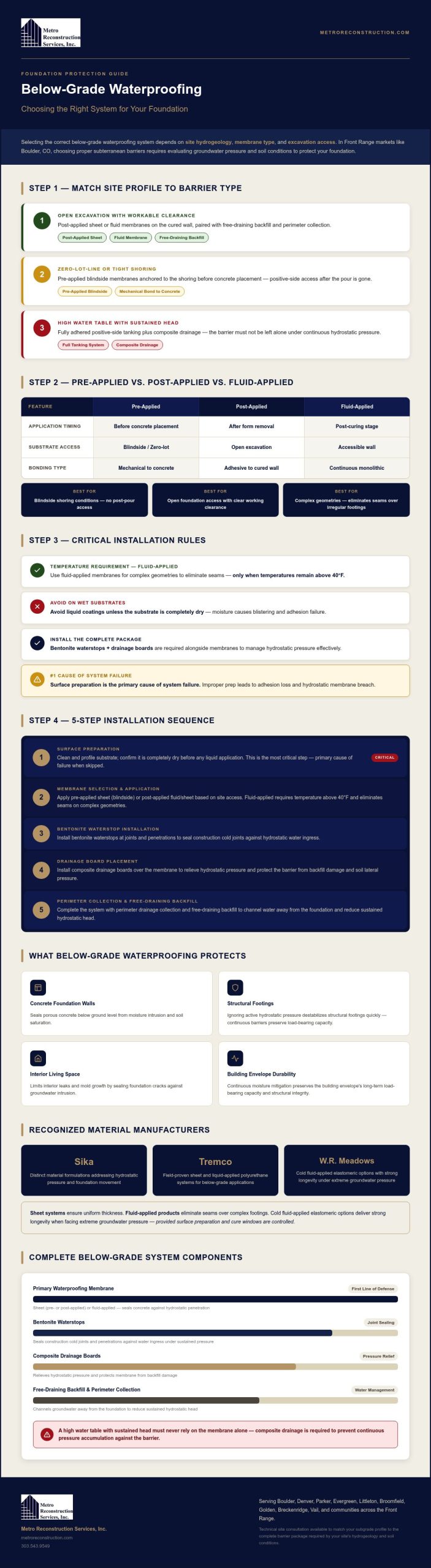
Three situations you will meet on Front Range sites, and the path that fits each:
- Open excavation with workable clearance: post-applied sheet or fluid membranes on the cured wall, paired with free-draining backfill and perimeter collection.
- Zero-lot-line or tight shoring: pre-applied blindside membranes anchored to the shoring before concrete placement, because positive-side access after the pour is gone.
- High water table with sustained head: fully adhered positive-side tanking plus composite drainage so the barrier is not left alone under continuous pressure.
Profile analysis dictates your path. For zero-lot-line excavations with minimal clearance, positive-side application after the wall is cast is impossible. Pre-applied blindside membranes become necessary, anchoring directly to shoring before concrete placement.
Our exterior specialists evaluate soil shear loads to prevent structural displacement in high-pressure profiles. Standard basement waterproofing relies on free-draining backfill coupled with primary surface barriers. Managing underground waterproofing (subgrade waterproofing) means addressing hydrostatic pressure through adequate internal or external drainage channels.
Flexible waterproofing stickers/sheets (self-adhered membranes) absorb minor foundation settling. Matching the membrane to soil chemistry supports long-term envelope durability across Boulder’s diverse geological conditions. Request a technical site consultation when you need the profile matched to a full barrier package.
What below-grade waterproofing protects in your foundation
Basement waterproofing prevents hydrostatic pressure from forcing groundwater into your subgrade foundation elements. This barrier protects concrete structures below ground level from moisture intrusion, soil saturation, and structural degradation.
Water collects against subgrade walls; underground waterproofing diverts that fluid away from porous concrete surfaces. Applied liquid membranes and waterproofing stickers/sheets seal foundation cracks, limiting interior leaks and mold growth. Standard waterproofing and integrate tightly with structural drainage matrices. Continuous moisture mitigation preserves your building envelope’s load-bearing capacity over time. Ignoring active hydrostatic pressure destabilizes structural footings quickly, so you select full-coverage continuous exterior barrier systems when the site shows sustained head.
Pre-Applied vs. Post-Applied: 4 differences that change access and bond
Pre-applied sheets bond directly to concrete as it is placed, whereas post-applied layers attach to existing foundation walls. Selecting subgrade waterproofing (underground waterproofing) depends on your access space and blindside shoring needs. Choosing self-adhered waterproofing membranes early preserves workable space in tight excavations; liquid-applied coatings suit complex shapes where a continuous film can follow the geometry.
When you upgrade exterior envelopes, fire-resistant siding systems protect high-risk structures in the same building-envelope scope.
| Feature | Pre-Applied | Post-Applied | Fluid-Applied |
|---|---|---|---|
| Application Timing | Before concrete placement | After form removal | Post-curing stage |
| Substrate Access | Blindside / Zero-lot | Open excavation | Accessible wall |
| Bonding Type | Mechanical to concrete | Adhesive to cured wall | Continuous monolithic |
For blindside conditions, pre-applied membranes fit the sequence. Post-applied systems suit open foundations. Metro Reconstruction Services, INC. prioritizes long-term structural integrity when sequencing either path.
Sika, Tremco, and W.R. Meadows: material choices under pressure
Sika, Tremco, and W.R. Meadows offer distinct material formulations that address hydrostatic pressure and foundation movement in basement waterproofing.
In field applications, selecting liquid-applied polyurethanes versus sheet membranes depends on substrate conditions and site geometry. Sheet systems ensure uniform thickness; fluid-applied products eliminate seams over complex footings. Cold fluid-applied elastomeric options deliver strong longevity when you face extreme groundwater pressure, provided surface preparation and cure windows are controlled.
Contracting a qualified Front Range construction team keeps surface preparation and fluid application aligned with structural integrity. Certified installers reduce premature system failure during hydrostatic load events.
Among Google reviews, one client (5★) wrote:
"Can’t say enough about Metro! I needed to get new windows and my patio redone and I chose them. They were so patient during the whole process and helped me make the correct choices. I couldn’t be happier with the work they did!"
A commenter in the metrogeneralcontractorsinc.com thread "Client Reviews, Metro General Contractors, Inc.":
"We have been working with Metro General Contractors Inc. for over ten years and have built many Jimmy John’s together." (source)
Reliable subgrade protection rests on long-term collaboration with proven trade partners across commercial projects, and on pairing the brand system with an installer who will stand behind the assembly.
Cost factors in blindside and post-applied below grade waterproofing systems
Choosing between pre-applied blindside and post-applied basement waterproofing depends on property lines and excavation clearance, and that choice drives labor more than any single product line.
Zero-lot-line urban builds require blindside systems: workers install waterproofing stickers/sheets against temporary shoring before concrete placement. From field observations, labor costs for blindside jobs rise because crews work in tight installation access. Post-applied underground waterproofing works best for open excavations, where you reach foundation walls directly.
Excavation depth drives labor expenses. Complex sites with high hydrostatic pressure demand thicker composite drainage boards, which increases material spending. Metro Reconstruction Services, INC. engineers moisture management to those structural conditions on your specific site.
A commenter in the homeadvisor.com thread "Metro Reconstruction Reviews, Dale, TX":
"Very good work. I needed a store built crom ground up. Didnt take them long at all. Thank you metro reconstruction!" (source)
Situation → action → result: the client needed a brand-new store built from scratch under a tight schedule; the crew completed the full structural build quickly; the feedback confirms efficient execution on foundation-to-envelope work of the same type you face when blindside or post-applied waterproofing must land on deadline in Boulder. Contact the Boulder, CO team for a quote sized to your clearance, depth, and head pressure.
5 Installation steps that keep moisture out of the envelope
Proper basement waterproofing follows a fixed sequence so hydrostatic pressure does not build against foundation walls. Unmitigated capillary action can draw groundwater upward through concrete footings even when primary wall barriers remain intact; the steps below close that path as well as the wall face.
- Surface preparation: Clean the concrete substrate thoroughly to ensure full adhesion of all applied materials.
- Primer application: Apply a compatible substrate conditioner across the entire surface area.
- Membrane installation: Apply waterproofing stickers/sheets starting from the base of the foundation wall.
- Protection board placement: Attach durable drainage panels over the primary barrier to protect against backfill impact.
- Drainage pipe installation: Position perforated collection pipes at the footing level surrounded by washed aggregate.
System failure often stems from inadequate surface preparation rather than material defects. Improper installation techniques compromise barrier durability against subterranean water movement, so crews treat prep as a forensic checkpoint, not a formality. Ask Metro Reconstruction Services, INC. for a personalized quote when you want this sequence documented for your foundation.
Waterstops and drainage that finish the complete outer system
Waterstops and subsurface drainage systems prevent hydrostatic pressure from forcing groundwater through vulnerable cold joints into subterranean spaces. Concrete construction cold joints create natural paths for liquid migration. In field observations, improperly sealed slab-to-wall intersections cause most foundation moisture failures. Installing expanding bentonite or hydrophobic PVC waterstops inside concrete joints blocks those paths.
External dimple boards relieve water pressure against structural walls by channeling fluid down to perimeter weeping tiles. Without active groundwater collection, even heavy-duty barrier layers degrade under continuous head pressure.
In Boulder, local building codes mandate continuous drainage paths to handle regional snowmelt cycles. Metro Reconstruction Services, INC. integrates engineered drainage cores with swelling waterstops so the complete outer system protects the envelope, not only the membrane face. Reach out when you need a moisture-management package designed around your joints and perimeter drains.
Risk factors that cause fluid membranes to fail
Fluid-applied basement waterproofing fails when high hydrostatic pressure or extreme temperatures disrupt the curing process.
Arc from field work: liquid coatings were installed over damp foundation walls; trapped moisture blocked adhesion; blistering followed and the seal failed early. That sequence is why substrate dryness is checked before any fluid film goes down.
Subgrade temperatures present another obstacle. Liquid products require specific thermal conditions to vulcanize properly. Applying these coatings below 40°F stops polymer chain cross-linking and leaves a soft, vulnerable barrier.
Excessive ground moisture during application creates pinholes before the film solidifies; sub-surface water then forces its way through those microscopic voids.
For severe groundwater conditions, sheet-based waterproofing stickers/sheets fit high-water-table properties better than liquid options. Verify local moisture levels before you select a liquid barrier in Boulder, CO, and have the site constraints reviewed before specification.
Warranty terms that cover below-grade failure, not only product swap
Comprehensive warranty coverage protects your foundation against hydrostatic pressure failures by requiring full material and labor accountability. Check whether a manufacturer covers total remediation costs or only simple product replacement. For long-term underground waterproofing, single-source warranties that bind both the installer and manufacturer give you clearer recourse when intrusion appears years later.
From client work, coverage gaps often emerge when installers use incompatible drainage composites from different suppliers. Split liability leads to disputed claims when groundwater intrusion occurs.
Coverage Scope │ Material Only vs Material + Labor
Installer Status │ Certified vs Uncertified
Diagnostic Step │ Water Test vs Visual Inspection
Warranties require strict adherence to local building codes during installation, and material selection drives how long the assembly performs under head. Review the terms against your soil and drainage design before you lock the specification for basement waterproofing in Boulder, CO.
Frequently asked questions
What is below-grade waterproofing?
Basement waterproofing is the application of protective barriers to prevent subsurface water intrusion into structural foundations. Hydrostatic pressure forces groundwater through porous concrete and wall joints below ground level. Proper subgrade protection diverts moisture away from the foundation to preserve concrete structural integrity. Metro Reconstruction Services, INC. designs these systems to meet strict building codes in Boulder, CO.
How much does below-grade waterproofing cost?
Total investment depends on foundation depth, excavation requirements, and the selected membrane technology for your specific soil conditions. Complex foundation geometries or high water tables increase labor demands and material volume. Request a personalized quote tailored to your property when you have depth and access figures ready.
Which membrane types are available (pre‑applied, post‑applied, self‑adhered)?
Pre-applied membranes attach to the form or shoring before concrete placement, whereas post-applied liquid or sheet barriers attach directly to cured foundation walls. Waterproofing stickers/sheets use an adhesive backing to form a thick protective barrier against lateral water movement. Fluid-applied coatings create a jointless shield across irregular concrete surfaces. Sheet goods offer uniform thickness across blindside applications.
What ancillary components are included (waterstops, accessories, drainage)?
Complete subgrade protection integrates specialized waterstops, surface protection boards, and subsurface drainage composites. Expansion joints require rubberized waterstops to seal construction gaps against high moisture pressure. Dimple boards relieve hydrostatic pressure while directing water toward weeping tiles. Termination bars and elastomeric mastics secure all top edges against backfill soil displacement.
What products are available for below-grade waterproofing?
Contractors install bentonite clay sheets, rubberized asphalt barriers, and heavy-duty polyolefin membranes to isolate below-grade walls. Cold-applied liquid membranes seal intricate penetrations where rigid sheets cannot conform tightly. Crystalline chemical treatments penetrate deep into concrete pores to block internal micro-cracks. Selection hinges on soil salinity, water table heights, and structural load requirements.
Final Considerations for Foundation Protection
Evaluating basement waterproofing still comes down to the same three decision questions you started with: site hydrogeology, membrane type, and total package budget. In 2026, proper hydrostatic pressure relief remains essential for protecting structural integrity against lateral earth loads.
From field assessments, persistent moisture intrusion usually traces back to compromised exterior seals or inadequate subgrade drainage. Addressing those root causes limits concrete degradation over time and keeps the building envelope in quiet, durable service.
For tailored advice on structural repairs and exterior envelope protection, connect with advisers at Metro Reconstruction Services. The Metro Reconstruction Services, INC. team provides targeted solutions that maintain continuous moisture control and safeguard your property investment. Share your site specifications when you are ready to compare barrier options against measured head and access.