
Your windows are more than just glass panes; they represent the most vulnerable points in your home’s complete outer system. In the Denver and Boulder area, intense high-altitude sun and extreme temperature shifts put immense pressure on seals and frames every single day. Understanding when its time to replace your windows is not just about aesthetics; it’s about protecting the structural integrity of your entire property from the outside in. You likely already feel the frustration of rising energy costs during a Colorado winter or the annoyance of condensation blurring your views. We agree that a home is your most significant investment, and seeing it compromised by failing components is a serious concern for any homeowner. This guide will help you identify the critical indicators of window failure, from hidden moisture intrusion to mechanical shifts. We will also explain how the new 2026 ENERGY STAR 7.0 standards impact your next steps, ensuring you achieve lasting noise reduction and restored energy efficiency.
Key Takeaways
- Learn how to identify visible frame deterioration and the underlying causes of seal failure to determine exactly when its time to replace your windows.
- Discover how Colorado’s high-altitude UV rays and dramatic temperature shifts create unique thermal stress that compromises your home’s exterior integrity.
- Understand the importance of the “complete outer system” and how the junction between windows, stucco, and masonry affects moisture protection.
- Evaluate the long-term value of upgrading to modern energy standards, including the mandatory 2026 ENERGY STAR 7.0 requirements for Colorado homeowners.
- See why a detailed, expert approach to installation is the most reliable way to prevent recurring leaks and protect your property’s structural health.
Recognizing the Primary Indicators of Window Failure
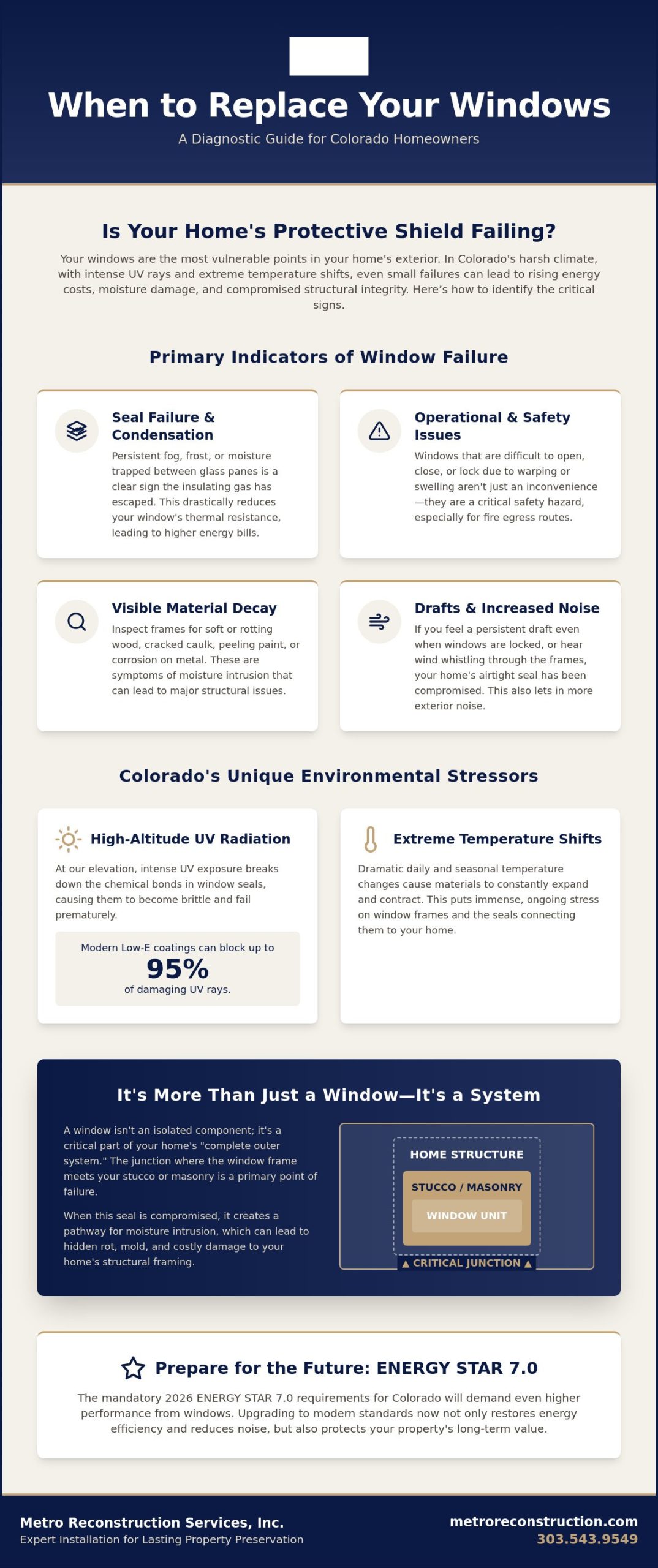
Identifying window failure requires a forensic perspective that looks beyond the surface of the glass. In our four decades of experience throughout the Front Range, we’ve found that homeowners often overlook the early warning signs of a compromised building envelope. Determining when its time to replace your windows starts with observing how your home reacts to the external environment. If you notice a persistent draft even when the sash is locked, or if you hear the wind whistling through the frames during a typical Boulder gust, the structural integrity of the unit has likely reached its limit. These aren’t just minor inconveniences; they are clear signals that the “complete outer system” of your home is no longer providing the protection your investment deserves.
Seal failure is perhaps the most common technical issue we encounter. This occurs when the specialized gas trapped between double or triple panes escapes, allowing moisture-laden air to take its place. This results in persistent fogging or condensation that you cannot wipe away. Once this barrier is broken, the window loses its thermal resistance, leading to the rising energy costs many homeowners face during our extreme winters. Deciding to invest in Replacement windows is a significant step in property preservation, as it restores the airtight seal necessary for long-term comfort and efficiency.
Functional Deficiencies and Safety Risks
Windows must do more than just provide a view; they must function reliably as part of your home’s safety system. A window that refuses to stay open or is difficult to crank is a critical fire safety hazard, especially in basement egress areas. Frames often warp due to the intense Colorado sun or underlying structural shifts, making them nearly impossible to operate. You might also find that sashes become swollen or “painted shut” over the years. These operational failures indicate that the internal mechanics or the frame materials have degraded beyond simple repair. When a window fails to open or close smoothly, the safety of your family is at stake.
Visual Clues of Material Decay
Material decay often hides in plain sight. For those with traditional wood frames, rot can start deep within the joint where the window meets the stucco or siding. Look for soft spots in the wood, peeling paint, or dark water stains on your interior trim. In metal or older composite frames, corrosion and pitting can compromise the frame’s strength. These visual cues are symptoms of moisture intrusion that can eventually lead to more complex structural challenges if left unaddressed. We recommend a thorough diagnostic check if you see:
- Cracked or brittle caulking at the frame edges
- Discoloration on the drywall surrounding the window
- Visible gaps between the sash and the frame
- Fungal growth or mold on the wooden components
If you recognize these signs in your home, it’s essential to address the root cause rather than applying a temporary patch. Our team is here to provide the precision and expertise needed for a permanent solution. For a professional evaluation of your home’s exterior system, contact Metro Reconstruction Services, Inc. at 303.543.9549 or visit our contact page to schedule a consultation.
Environmental Factors: Why Colorado Homes Face Unique Window Stress
Colorado’s environment is uniquely demanding on building materials. While a window in a milder climate might last decades, the high-altitude conditions of the Front Range accelerate the aging process significantly. Understanding how these regional stressors affect your home’s exterior is essential when determining when its time to replace your windows. It’s not just about the age of the unit; it’s about how the thin atmosphere and intense solar exposure degrade the components that keep your home airtight and structurally sound.
High-Altitude UV and Seal Degradation
At our elevation, UV radiation is significantly more intense than at sea level. This constant exposure acts as a catalyst for the breakdown of the chemical bonds in window seals and spacers. Standard seals often become brittle and crack under this pressure, leading to the loss of insulating gases like Argon or Krypton. High-performance windows designed for our region often include capillary tubes to equalize pressure at high altitudes, preventing the glass from bowing or the seals from popping. Additionally, modern Low-E coatings can block up to 95% of harmful UV rays. This technology doesn’t just protect your interior flooring and furniture from fading; it maintains the thermal integrity of the glass unit itself.
Thermal Expansion and Contraction
The Front Range is famous for rapid temperature shifts, sometimes swinging 50 degrees in a single day. This creates a relentless cycle of thermal expansion and contraction that puts immense stress on the junction where the window frame meets your home’s siding or stucco. Rigid materials that cannot flex with these cycles often develop micro-cracks, allowing moisture to seep into the wall cavity. If you’ve noticed drafts during high winds or moisture pooling on the sill after a snowstorm, it’s a sign that your weather stripping has lost its elasticity and is no longer providing an effective barrier. Ensuring your replacement windows are rated for the Northern Climate Zone, with a U-factor of 0.22 or less, is critical for managing these extreme shifts.
For homeowners in the foothills of Boulder or near wildfire-prone areas, windows are a critical component of home hardening services. Choosing the right materials can improve your home’s defensibility against extreme heat and embers, adding a layer of protection that goes beyond simple energy efficiency. If you suspect your windows are failing due to environmental stress, our team can provide a forensic evaluation to identify the root cause. You can reach Metro Reconstruction Services, Inc. at 303.543.9549 or through our contact page to discuss a long-term solution for your home’s outer system.
Beyond the Glass: Assessing the Complete Outer System
A window is only as effective as the system surrounding it. While many homeowners focus exclusively on the glass or the frame material, the most critical component of a window’s performance is how it integrates with your home’s exterior walls. When we conduct a forensic evaluation, we look at the “complete outer system.” This includes the transition points where window frames meet stucco, masonry, or siding. These junctions are the most common sites for structural failure. Determining when its time to replace your windows often involves looking past the glass to see if the surrounding materials are showing signs of distress.
If a window was improperly flashed during its initial installation, water can bypass the frame entirely and drain directly into your wall cavity. This often happens silently. By the time you see a stain on your drywall, the internal wood framing may have already suffered significant rot. We believe in identifying these underlying structural origins rather than offering a superficial fix. A simple glass replacement won’t solve a flashing failure. Understanding when its time to replace your windows is about more than just aesthetics; it’s about the long-term preservation of your home’s envelope. This commitment to structural integrity should extend to your entryways as well; for those seeking specialized expertise, Liberty Door Repair is a leading provider of professional door maintenance and installation services.
Stucco Integration and Window Flashing
Replacing windows in homes with stucco requires a high level of specialized expertise. Stucco is a rigid, porous material that must be carefully integrated with the window’s weather barrier. Many installers rely on “caulk-only” solutions to bridge the gap between the window and the wall. This is a dangerous shortcut. Over time, the caulk dries and cracks, creating a direct path for moisture intrusion. At Metro Reconstruction Services, Inc., we ensure a seamless, watertight seal by properly layering the flashing and the moisture-resistant barrier. This precision prevents leaks before they start and ensures the new window performs as intended.
Preventing Moisture Intrusion
Moisture intrusion is the primary enemy of structural integrity. When window seals fail or flashing is compromised, the resulting moisture can lead to mold growth and wood decay hidden behind your siding. A holistic evaluation of your exterior system is the only way to ensure your home’s envelope remains secure. By addressing these issues now, you avoid the much higher costs of future structural repairs. We view ourselves as partners in property preservation, helping you maintain the long-term value of your home through meticulous diagnostics and restoration.
If you are concerned about the health of your home’s exterior, we are here to help. You can view our full range of restoration and installation services to learn more about our approach. For a detailed diagnostic of your window system, contact Metro Reconstruction Services, Inc. at 303.543.9549 or visit our contact page to schedule a consultation.
The Decision Matrix: When to Repair vs. When to Replace
Deciding between a minor fix and a full investment requires a clear-eyed assessment of your home’s future. While small hardware adjustments or glass-only replacements can address superficial issues, they rarely solve the deep-seated problems of an aging exterior system. We’ve seen many homeowners spend money on temporary repairs only to realize later that the internal frame was already compromised. Determining when its time to replace your windows often comes down to the health of the rough opening. Because the thin atmosphere in our region accelerates material fatigue, a frame that appears fine on the surface may have lost its structural tension. If the wood or masonry surrounding the unit is soft or discolored, a patch won’t suffice.
Energy Efficiency and Long-Term Value
The financial impact of old windows is measurable in every utility bill. Moving from single-pane units to high-performance windows can reduce energy loss by up to 30%. As of January 1, 2026, Colorado regulations require windows to meet ENERGY STAR 7.0 standards, which means a U-factor of 0.22 or less. These aren’t just arbitrary numbers; they represent the window’s ability to keep heat inside during a Boulder winter. Homeowners in the Denver area can expect an ROI of 68% to 85% over a decade. Plus, the Federal Energy Efficient Home Improvement Credit allows you to claim 30% of the cost, up to $600 annually for these upgrades.
For homeowners interested in how these 2026 efficiency standards are being applied by industry experts in other regions, you can visit Long Island Windows and Siding to explore their comprehensive 2026 guide on high-performance double-hung units.
Structural Necessity vs. Aesthetic Upgrade
Sometimes the choice is driven by structural safety. If frame rot has set in, the unit can no longer support its own weight or provide a secure seal. This is a non-negotiable sign that when its time to replace your windows has arrived. Beyond safety, new windows significantly boost curb appeal and property value. We specialize in matching modern, high-performance units to your home’s existing architectural heritage, ensuring that the new installation feels like a natural part of the design build process. This holistic approach ensures that your home remains both beautiful and structurally sound for years to come.
If you’re unsure whether your windows need a simple repair or a full replacement, our forensic experts can provide a definitive answer. Contact Metro Reconstruction Services at 303.543.9549 or visit our contact page to schedule your professional evaluation and protect your home’s long-term integrity.
Professional Window Installation and Property Preservation
A high-performance window unit is only as reliable as the precision of its installation. While many homeowners spend weeks researching different brands, the reality is that even the most advanced triple-pane glass will fail if it isn’t properly integrated into your home’s unique structure. At Metro Reconstruction Services, we approach every project as a forensic challenge. We don’t just swap out glass; we evaluate the complete outer system to ensure that your new investment is protected from the ground up. Recognizing when its time to replace your windows is the first step, but ensuring that replacement lasts for another forty years requires a partner who understands the hidden mechanics of your home’s envelope.
Our methodology is rooted in a commitment to initial accuracy. We’ve spent over four decades serving the Front Range, and we’ve seen the damage caused by superficial fixes. Our project management team oversees every detail, ensuring that the transition between your window frame and your stucco or masonry is watertight. This level of care provides the peace of mind that comes from a long-term solution rather than a temporary patch. By choosing a dedicated partner in property preservation, you ensure that your home remains a secure and energy-efficient sanctuary.
Expert Methodology and Quiet Confidence
Our 40-year legacy of structural excellence in the Front Range is built on a foundation of quiet confidence and technical precision. We avoid high-pressure sales tactics because we believe the facts of a forensic diagnostic speak for themselves. We prioritize the long-term structural health of your property, addressing root causes like improper flashing or moisture intrusion that others might ignore. This grounded approach is why we are a trusted construction company in Boulder, CO, known for solving complex exterior challenges.
Taking Action for Your Home
If you’ve identified the signs of window failure discussed in this guide, the next step is a professional evaluation. To prepare for your consultation, it’s helpful to note which rooms feel drafty or where you’ve noticed condensation between panes. During our forensic inspection process, we’ll examine the exterior seals, the condition of the surrounding wall materials, and the operational integrity of your current units. We provide a transparent assessment so you can make an informed decision about when its time to replace your windows and how to best protect your home.
Protect your home’s value and restore your peace of mind. Contact Metro Reconstruction Services or call us at 303.543.9549 for an expert evaluation of your home’s complete outer system.
Restoring the Integrity of Your Home’s Complete Outer System
Protecting your home from the demanding Colorado environment requires a shift in perspective. We’ve explored how high-altitude UV rays and dramatic temperature shifts accelerate the breakdown of seals and frames. Determining when its time to replace your windows involves looking beyond the glass to ensure the entire building envelope remains watertight and structurally sound. Since 1982, our family-owned firm has specialized in moisture mitigation and the forensic diagnostics necessary to identify the root causes of window failure. We believe that precision in initial installation is the only way to guarantee long-term value and comfort for your property. By addressing failing components now, you prevent catastrophic moisture intrusion and restore the peace of mind you deserve. Our team brings over 40 years of local expertise to every project, ensuring your home is preserved with the highest level of craftsmanship and technical accuracy. We’re ready to help you navigate these technical challenges with quiet confidence and reliable results.
Secure your home’s structural integrity; schedule a forensic window evaluation today. You can also reach us directly at 303.543.9549 to discuss your specific restoration needs. We look forward to partnering with you on your next property preservation project.
Frequently Asked Questions
How long do windows typically last in Colorado’s climate?
Windows in the Front Range typically have a functional lifespan of 15 to 20 years due to the intense high-altitude UV radiation and rapid temperature fluctuations. While the glass may remain intact, the chemical bonds in the seals often degrade under these environmental stressors, leading to gas loss and reduced efficiency. Regular inspections of your home’s complete outer system can help identify early signs of failure before moisture causes structural rot.
Is it worth replacing just the glass if the frame is still good?
Replacing just the glass is only a viable short-term fix if the existing frame is structurally sound and perfectly integrated with your home’s exterior. If you have warped frames or failing seals, new glass won’t address the underlying energy loss or moisture risks. It’s often more cost-effective to invest in a full unit to ensure long-term reliability and proper weather stripping for the building envelope.
Can I replace my windows without damaging my stucco exterior?
You can replace windows without causing widespread damage to your stucco, provided you use an installer specialized in exterior restoration. Our team uses a forensic approach to carefully integrate new flashing with the existing moisture barrier. This precision ensures a watertight seal without the need for extensive stucco repairs, preserving both the aesthetic and structural integrity of your home’s outer system.
What is the best time of year to replace windows in Boulder?
Late spring and early fall are the most favorable times for window installation in Boulder because the mild temperatures allow for optimal sealant curing. Installing during extreme winter cold or summer heat can sometimes affect the flexibility of the materials used to create the airtight seal. However, professional crews can perform installations year-round by working on one opening at a time to minimize heat loss during the process.
How much can I expect to save on energy bills with new windows?
Upgrading to high-performance windows can reduce your home’s heating and cooling energy loss by up to 30%. This is a significant factor in determining when its time to replace your windows, especially with the new 2026 ENERGY STAR 7.0 standards now in effect. These savings are achieved through advanced Low-E coatings and superior U-factors that keep your interior temperature stable regardless of the external weather.
What is the difference between a window repair and a full-frame replacement?
A window repair typically involves replacing hardware or reapplying caulk, while a full-frame replacement removes the entire unit down to the rough opening. Full-frame replacement is the only way to inspect and fix damaged flashing or hidden wood rot within the wall cavity. This holistic method ensures that the new window is perfectly integrated with the building’s complete outer system for maximum structural protection.
Do new windows help with noise reduction near busy Denver streets?
New windows provide substantial noise reduction, which is a major benefit for homes near busy Denver corridors or construction zones. Modern units featuring triple-pane glass or specialized laminated layers act as a dense sound barrier against traffic and wind. This significant improvement in indoor tranquility is often a primary indicator of when its time to replace your windows for enhanced quality of life.
How do I know if my window leaks are caused by the window or the roof?
Water stains appearing directly on the window sill or frame usually indicate a failure in the window’s flashing or seal. If the staining appears on the ceiling or high on the wall above the window, the root cause is likely a roof or gutter issue. A forensic evaluation is the most accurate way to identify the underlying structural origin of moisture intrusion before it leads to complex mold problems.
For more information on property preservation or to schedule a consultation, contact Metro Reconstruction Services at 303.543.9549 or visit our contact page.