
For vapor barrier installation crawl space Superior work, plastic sheeting thickness (mil thickness) needs a minimum 12-inch seam overlap sealed with specialized tape to prevent soil moisture intrusion. Regional installation projects across the market typically vary in cost depending on material thickness and foundation complexity. Soil gas migration and ground moisture will pass through unsealed gaps if you skip this step.
Key Takeaways: Install a minimum 12-mil vapor barrier with 12-inch taped overlaps and mechanical wall fasteners to meet Superior code and prevent structural rot.
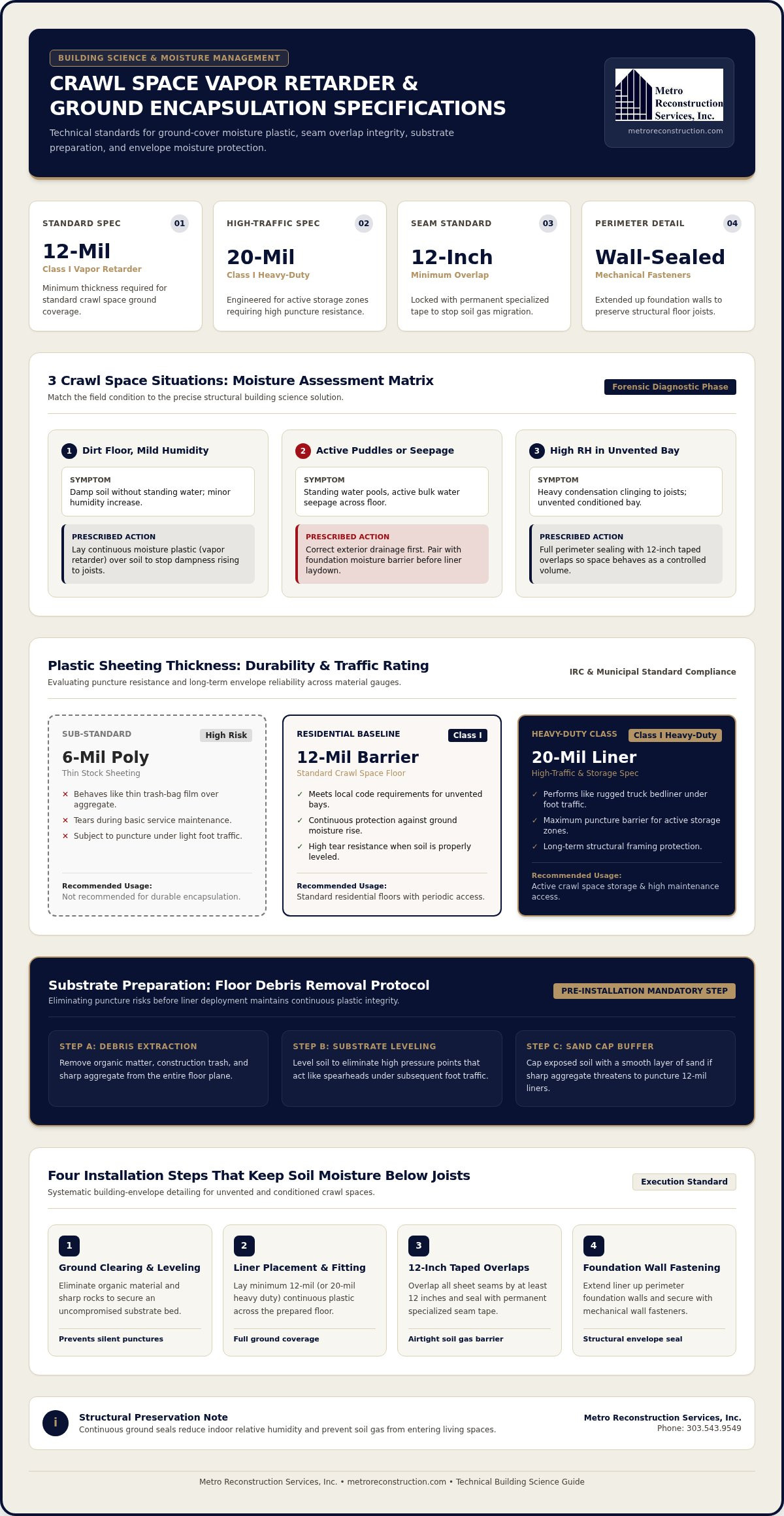
- Select 12-mil thickness for standard residential floors or 20-mil for active storage areas.
- Skip the installation if you have active puddles until you first correct exterior drainage.
- Professional installation is recommended for unvented spaces to ensure airtight 12-inch seam sealing.
- Market pricing typically ranges from $1,000 to $4,000 based on square footage and accessibility.
3 Crawl space situations: match the fix to the moisture you see
You step into your lower structure and notice damp soil, standing pools, or heavy condensation clinging to joists. The path you choose here sets cost, durability, and whether soil gas stays out of the living space.
Three common scenes and a concrete next move drawn from the same field rules:
- Dirt floor, mild humidity only. Lay a continuous moisture plastic (vapor retarder) over the soil so ground dampness cannot rise into the joists.
- Active puddles or seepage. Pair drainage correction with a high-performance moisture barrier on the foundation plane before you trust any liner.
- High relative humidity in an unvented bay. Specify adequate plastic sheeting thickness, full perimeter sealing, and taped 12-inch overlaps so the space behaves like a controlled volume.
Wrong thickness or an unsealed seam wastes the budget twice: once on the first attempt, again on the retrofit. Basic sheeting fits dry earth; full sealing suits humid, unvented zones.
Read the crawl space encapsulation guidance for a structural integrity view of complete perimeter sealing.
Inspect every corner, then contact Metro Reconstruction Services, Inc. by form or phone consult to evaluate your home and engineer a durable defense.
Superior code path: sealed ground cover before 2026 assessments
Installing a crawl space vapor retarder in Superior requires strict adherence to local energy conservation standards. Ground-cover moisture plastic must be properly sealed and extended up foundation walls to manage soil gas and humidity. Unvented crawl spaces behave like conditioned basements, so you need a continuous high-performance moisture barrier that preserves structural framing.
Continuous ground seals reduce indoor relative humidity and limit energy loss when the liner is detailed as a true building-envelope layer. Permits confirm that your plastic sheeting thickness meets local durability expectations. Navigating municipal approvals alongside exterior upgrades can be complex, so reviewing window installation details helps align the full envelope project with local standards. Full code compliance now prevents costly retrofits during later home assessments.
A poster in the metrogeneralcontractorsinc.com discussion "Client Reviews, Metro General Contractors, Inc." stated:
"My company has been subcontracting with Metro for over eight years. Their bidding and scheduling processes are painless and accurate." (source)
Subcontractors depend on accurate bids and reliable scheduling to finish crawl space encasements without municipal delays. That long-standing coordination is the execution standard code-compliant local work requires.
Send your building plans for a code-path review before you order materials.
Clear the floor first: debris removal that protects the liner
Sharp objects under the sheet defeat the barrier before the tape ever goes down. Remove organic matter, sharp rocks, and construction trash from the crawl space floor, then level the soil so the substrate supports structural integrity and long-term durability.
Unmitigated ground debris behaves like miniature spearheads under foot traffic during later maintenance. Thin film laid over a jagged bed fails at the first puncture; smooth ground keeps plastic sheeting thickness continuous without silent tears.
If exterior envelope defects may be feeding bulk water, siding installation review helps stop intrusion before interior laydown. Clean ground conditions are mandatory for any forensic approach to property preservation, and thorough surface clearing is how crews meet strict building standards.
Tip: Always cap exposed soil with a smooth layer of sand if sharp aggregate threatens to puncture 12-mil liners.
6-Mil, 12-mil, or 20-mil: thickness that matches traffic and risk
Plastic sheeting thickness decides whether your high-performance moisture barrier survives ordinary service. Thinner stock tears during basic maintenance; you need moisture plastic performance that keeps ground dampness off structural timbers.
| Thickness | Primary Class Rating | Recommended Usage |
|---|---|---|
| 12-mil | Class I | Standard crawl space floors |
| 12-mil | Class I | Standard crawl space floors |
| 20-mil | Class I Heavy-Duty | High-traffic storage areas |
A 6-mil sheet behaves like thin trash-bag film over sharp rocks. Heavy 20-mil poly reads more like a rugged truck bedliner under repeated traffic. For lasting protection, Metro Reconstruction Services, Inc. installs durable materials rated for heavy foot traffic.
Building standards stress material durability, as reflected in home-improvement project details documented by This Old House 1999 (seasons_11%E2%80%9320). Thicker membranes protect long-term value when the floor sees storage or service visits.
Light 6-mil poly suits temporary covers, 12-mil fits typical residential soil floors, and 20-mil fits active crawl space storage. Selecting high-mil poly protects a Boulder structural foundation from subterranean vapor intrusion. Request a site evaluation to match mil rating to your floor use.
Four installation steps that keep soil moisture below the joists
Proper installation seals the soil so ground moisture cannot enter the home.
- Prepare the space. Clear debris, sharp rocks, and organic material from the crawl space floor.
- Lay the sheet. Spread moisture plastic over the exposed ground for a complete baseline cover.
- Overlap the seams. Join adjoining edges with a generous overlap and secure them with heavy-duty seam tape.
- Fasten to walls. Carry plastic sheeting thickness up the foundation walls and mechanically fasten it above the dirt line as part of the high-performance moisture barrier detail.
Treat the barrier as a continuous outer-system layer for the dirt floor, not a loose drop cloth. Metro Reconstruction Services, Inc. details each installation to building-code moisture management so precision holds for the life of the assembly.
For crawl space protection in Boulder, CO, schedule a professional evaluation before you cut the first sheet.
12-Inch overlaps locked with permanent seam tape
Overlapping plastic sheeting thickness by 12 inches builds an airtight moisture plastic plane across the foundation floor. Sealing every joint stops soil gas migration and damp capillary rise into the home.
Unsealed seams act like open chimneys for ground humidity under negative pressure. Sheets overlapped without high-tack acrylic tape open up over time: acrylic adhesives bond permanently to polyethylene, while ordinary duct tape degrades in dark crawl spaces. Heavy-duty seam tape is the durable choice because moisture finds the weakest opening first. An unzipped winter jacket in a blizzard is the same failure mode: air and vapor move straight through the gap.
High-performance moisture barrier work depends on meticulous sealing practice to preserve structural integrity in Boulder, CO, including complete perimeter attachment at walls and piers. Homeowners often want clear technical guidance before they commit to a moisture-mitigation scope.
Among Metro Reconstruction Services, Inc.’s Google reviews, Mandy (5★) wrote:
"Ben spoke with me for well over a half hour on the phone. He was helpful and informative and took time with me even though I was unable to hire him due to location.I was incredibly impressed with his customer service."
Direct consultation with the client’s specialist walks you through the technical steps proper vapor-barrier sealing requires. Call or write through the site contact channel when you want that walkthrough on your floor plan.
What drives the $1,000 to $4,000 market price band
Crawl space protection cost tracks accessibility and total square footage. Quotes reflect site conditions, and plastic sheeting thickness choices affect long-term durability. Quality moisture plastic stops ground dampness from rising into floor joists.
According to regional crawl space installer data, the market price band ranges widely around a typical midpoint. Professional high-performance moisture barrier pricing reflects labor intensity and structural prep. Full professional installation functions as a continuous shield against structural rot; DIY work often fails at complex seams, while trained crews work tight soil clearances safely.
A commenter in the homeadvisor.com thread "Metro Reconstruction Reviews, Dale, TX":
"Very good work. I needed a store built crom ground up. Didnt take them long at all. Thank you metro reconstruction!" (source)
Property owners often note rapid completion when experienced structural contractors run the schedule. Skilled crews are what lasting crawl space encapsulation depends on.
Metro Reconstruction Services, Inc. delivers code-compliant protection; ask local Boulder, CO specialists for a tailored estimate on your square footage.
Where DIY vapor barriers fail and pros close the gaps
Crawl space encapsulation without professional detailing often leaves hidden gaps that undermine moisture plastic performance.
Poorly fitted plastic sheeting thickness lets ground water vapor bypass the cover. That migration raises relative humidity and creates conditions for organic decay and fungal growth in structural floor joists.
Self-installation also fails at wall terminations. Securing a high-performance moisture barrier to masonry needs mechanical fasteners and specialized masonry caulking that can resist hydrostatic pressure. Without continuous sealing around piers and plumbing penetrations, soil gases enter the living space unimpeded.
Repairing a failed self-installation usually costs more than a correct first install. Metro Reconstruction Services, Inc. holds seam overlaps and Boulder code compliance so the complete outer system keeps envelope integrity intact. Book a comprehensive site assessment when you want the gaps closed once.
Frequently asked questions
What mil thickness do you actually need?
You need a minimum plastic sheeting thickness of 6 to 20 mils for effective crawl space encapsulation. Thicker polyethylene membranes resist punctures and soil gas migration better over time. A heavy-duty vapor barrier installation crawl space Superior detail favors puncture resistance under real foot traffic.
How do I prepare a crawl space before installing a vapor barrier?
Clear debris, sharp rocks, and organic material from the dirt floor first. Level the soil surface so water cannot pool beneath the material. Correct drainage problems or groundwater leaks before you lay moisture plastic.
How much overlap is required for seams?
Seams must overlap by at least 12 inches so ground moisture cannot leak into the air path. Seal overlapping edges continuously with high-grade butyl tape (a distinct adhesive chemistry from acrylic seam tapes used on some polyethylene details). Proper sealing protects the structural integrity of your indoor air space.
How do I attach the barrier to foundation walls?
Secure the heavy plastic to the concrete with mechanical fasteners and specialized termination strips. Seal the top edge with acoustic sealant for an airtight line against wall dampness. That high-performance moisture barrier detail keeps unconditioned air out of the home.
Do I need a vapor barrier in my crawl space?
You need a barrier to stop ground moisture from rising and damaging wood floor joists. Uncontrolled humidity drives mold growth, structural decay, and higher cooling bills. According to current market rates based on 12 industry samples, professional installation across the broader market ranges from $1,000 to $4,000 depending on square footage. In Boulder, CO, request a personalized quote sized to your exact floor plan.
Protecting Your Foundation
Correct vapor barrier installation crawl space Superior projects depend on precise plastic sheeting thickness selection and 12-inch seam overlaps that satisfy local codes.
Address soil dampness with proper moisture plastic so ground humidity cannot migrate into the subfloor. Heavy external seepage and rising water tables call for comprehensive high-performance moisture barrier detailing across the property, not a partial floor patch.
In 2026, the Metro Reconstruction Services, Inc. team can evaluate your complete structural envelope to stop water intrusion. You can learn more about external home envelope protection to safeguard the building. More on this: High-Performance Window Installation Service.
Use the site contact form to request a personalized assessment for your Boulder property.