
What if the most alarming sentence in your structural engineer’s report isn’t an instruction to begin repairs immediately? Technical terms, measurements, and photos of visible damage can be concerning, especially when the report doesn’t include a repair plan. Understanding a structural engineer’s report means separating what the engineer observed from what those observations indicate and what action, if any, the report recommends.
A report connects evidence, interpretation, and next steps. It is not automatically a repair estimate or an assessment of every part of your home. This guide explains how to read the scope, observations, conclusions, and limitations, and how to identify recommendations that need clarification. You’ll also see why a finding such as cracking or movement may need to be considered alongside moisture, drainage, and the home’s complete exterior envelope. With a clearer understanding of the report, you can plan follow-up based on its findings rather than reacting to technical language alone.
Key Takeaways
- Understanding a structural engineer’s report starts with distinguishing documented observations from the engineer’s conclusions and recommendations.
- Read each finding alongside its location and supporting evidence. A crack or uneven surface needs context before its cause can be understood.
- A listed defect does not automatically mean immediate danger. Follow the report’s specific direction, such as repair, monitoring, further investigation, or restricting access.
- Organize report pages, photos, dates, and notes about changes to clarify uncertainties and plan follow-up.
- Durable repairs should address the documented cause and related moisture pathways. Contact Metro Reconstruction or call 303.543.9549 to discuss property repair and preservation.
What a Structural Engineer’s Report Covers, and What It Does Not
An engineering report may combine technical terms, measurements, photographs, and recommendations. To understand it, first treat it as a record of a specific assessment, not a verdict on the entire home. The report documents what the engineer observed, how the evidence was analyzed, what conclusions were drawn, and which next steps were recommended.
The report’s purpose and limits depend on its stated scope. Structural engineering addresses how buildings and other structures carry loads and respond to forces, but an assessment applies only to the areas and conditions included in the engineer’s work. You can read a general overview of structural engineering for background, then use the report to determine what was assessed at your property.
Which sections should you look for first?
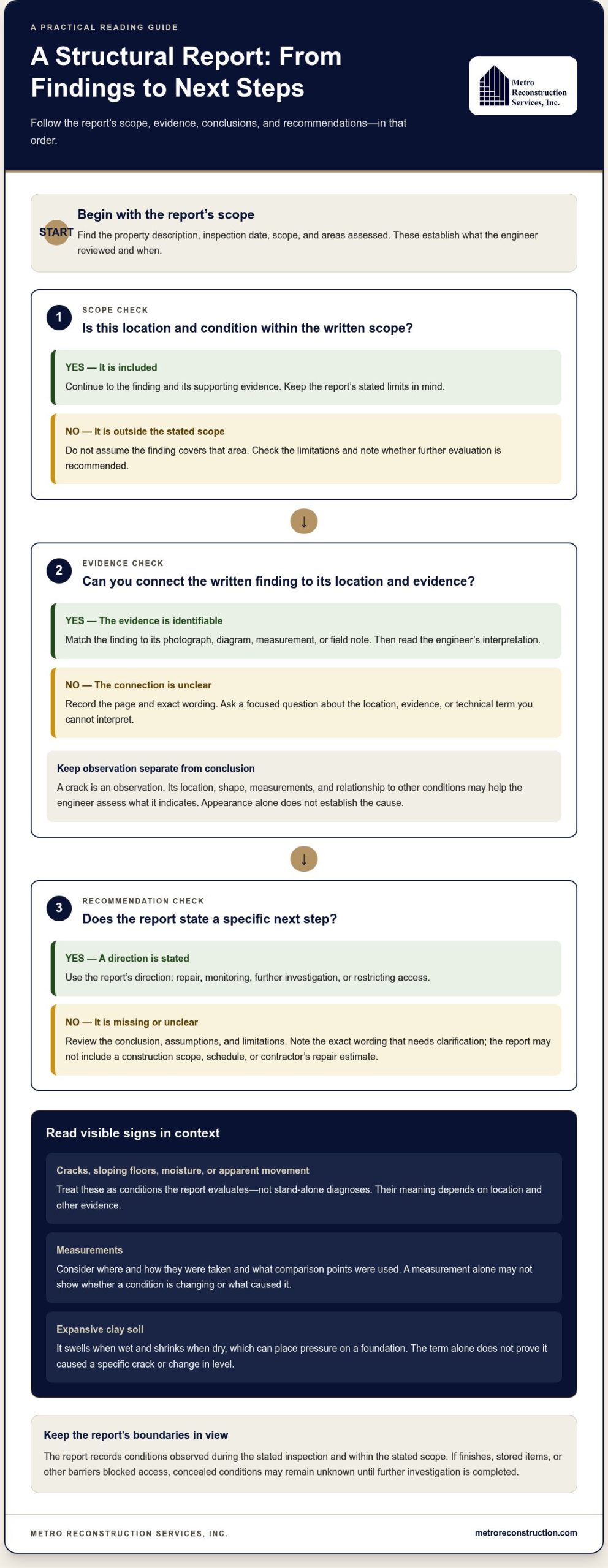
Begin with the property description, inspection date, scope, and areas assessed. These details establish what the engineer reviewed and when. Then read the summary or conclusion before returning to the detailed observations and supporting evidence. This order helps you connect the overall finding to the locations, photographs, measurements, or other information behind it.
Next, review the recommendations, limitations, assumptions, and any statement that further evaluation is needed. If the report addresses one foundation wall, for example, don’t assume it also covers every foundation area or the full building envelope. The written scope defines what the assessment includes.
What the report cannot tell you by itself
A report describes conditions observed during the stated inspection and within the stated scope. It may identify a concern, explain a likely cause, or recommend monitoring or further investigation. It does not necessarily provide a complete construction scope, project schedule, or contractor’s repair estimate. Those planning details may depend on the engineer’s recommendations and the work required.
Access and testing affect what an engineer can assess. If finishes, stored items, or other barriers blocked access to an area, the report may state that the area wasn’t inspected. Concealed conditions can remain unknown until materials are opened or additional investigation is completed. Review the limitations and assumptions before applying a finding to areas the engineer couldn’t examine.
If the scope or recommendations are unclear, note the page and exact wording so you can ask a focused question. When findings point to property repairs or moisture management, contact Metro Reconstruction or call 303.543.9549 to discuss construction planning.
How to Interpret Structural Findings, Evidence, and Engineering Terms
Read each finding as a connection between a location, an observed condition, supporting evidence, and the engineer’s interpretation. A crack in a wall, for example, is an observation. Its location, shape, measurements, and relationship to other conditions may help the engineer assess what it indicates. The appearance alone does not establish the cause.
A documented observation records what was seen or measured; an engineering conclusion explains what that evidence may mean for the structure. Keeping these concepts separate is central to understanding a structural engineer’s report. It also helps prevent treating every visible defect as a diagnosis.
How observations and evidence work together
Match each written finding to its photograph, diagram, measurement, or field note. Confirm the location first: a reference to a basement wall may concern one section rather than the entire foundation. Then read the engineer’s explanation and any stated limits on the assessment.
Interpret measurements in context. Their location, comparison points, and measurement method affect what they can tell you. A measurement alone may not show whether a condition is changing, how it relates to other parts of the building, or what caused it. Use the report’s explanation rather than drawing a conclusion from the number by itself.
Cracks, sloping floors, moisture, and apparent movement can have different meanings depending on where they occur and what other evidence is present. Treat the visible condition as a clue the report evaluates, not a stand-alone answer. If the report defines a technical term, use that definition because wording can vary by context.
Terms that may appear in a foundation report
Expansive clay soil swells when wet and shrinks when dry. Those changes can place pressure on a foundation, but the term alone doesn’t prove that soil movement caused a particular crack or change in level. The engineer’s observations and analysis need to support that connection.
Movement describes a change in position. Distress generally refers to signs that a building element may be affected. Neither term, by itself, tells you the severity, cause, or urgency. Check which evidence the report cites and whether it recommends repair, monitoring, or further evaluation. Moisture conditions around the foundation may also be relevant because water movement can affect soil and exterior building systems.
If the findings call for repairs or moisture management, Metro Reconstruction can discuss construction planning that responds to the documented conditions. Contact our team or call 303.543.9549.
Does a Finding Mean Immediate Danger, or Just Further Investigation?
A defect in a report does not, by itself, establish immediate danger. Its significance depends on the engineer’s evidence, conclusions, recommendations, and any stated limits on the assessment. When understanding a structural engineer’s report, don’t assign urgency based on one alarming phrase or photograph. Use the report’s instructions to guide your next step.
Pay close attention to action words. “Repair,” “monitor,” and “investigate further” describe different responses. “Restrict access” is a safety instruction when the report explicitly states it. Follow any direction given. If urgency or access guidance is unclear, seek clarification from the engineer who prepared the report rather than guessing.
Repair, monitoring, and further investigation are different recommendations
A repair recommendation identifies work intended to address a reported condition. Monitoring means observing and documenting whether that condition changes. Follow any interval or method specified in the report. Further investigation means gathering more information, such as gaining access to an area that wasn’t assessed. It doesn’t, on its own, prove a particular structural failure.
- “Repair”: The report identifies an action. Review the recommendation and the finding it addresses.
- “Monitor”: Track the condition for change. Check what the report says to observe and when.
- “Investigate further”: Additional evidence is needed. Review which area, test, or information the report identifies.
- “Restrict access”: Treat this as an explicit safety instruction if it appears in the report. Follow its stated limits and seek clarification if any part is unclear.
These phrases are examples, not universal classifications. The engineer’s exact wording and explanation matter.
How to handle uncertainty without overreacting
List what the report leaves open, such as unanswered questions, assumptions, inaccessible areas, or conditions requiring follow-up. Note the relevant page and quote the recommendation accurately. A clarification from the report’s author is more reliable than interpreting a phrase without its surrounding evidence.
Don’t create your own severity rating. The engineer’s stated conclusions and limitations define what the assessment supports. Follow explicit safety or access instructions. If the report gives none, don’t infer restrictions from a defect description alone. Focused questions help separate what the report establishes from what still needs to be determined.
Once the report’s direction is clear, construction planning can address the documented condition without confusing investigation with repair. To discuss property repair and preservation, contact Metro Reconstruction or call 303.543.9549.
How to Turn the Report into a Clear Repair and Follow-Up Plan
After reviewing the findings and recommendations, organize the information before planning work. Understanding a structural engineer’s report includes knowing what it establishes and what still needs clarification. Use this sequence to keep next steps tied to the documented conditions:
- Mark each finding. Note the report page, location in the home, and matching photo, diagram, or measurement.
- Record the recommendation. Separate findings identified for repair from those to monitor or investigate further. Copy the wording accurately.
- Clarify uncertainties. List questions about the finding, its extent, assumptions, and areas the engineer couldn’t access.
- Plan follow-up. Organize the report and your notes for a discussion about the appropriate repair or next investigation step.
Keep dated photographs and brief notes about changes together. If the report documents a crack in a specific area, label later photos with the location and date rather than relying on memory. This record helps keep project discussions focused on the same condition and evidence.
Questions that make the report easier to act on
Use the report’s wording to guide questions for the engineer or construction team. Which findings call for action, monitoring, or more information? Where is each recommended repair, what area does it address, and what purpose does the report assign to it? If part of the property was inaccessible, ask how that limit affects the conclusions and whether further evaluation is recommended.
For foundation concerns, record any notes about moisture, drainage, or site conditions. These details may inform repair planning, but they don’t prove a cause on their own. Foundation repair services may be part of a construction plan when the findings call for that work. Foundation drainage solutions can also be considered where appropriate to manage water around the foundation, based on the property’s conditions.
Keep the full exterior system in view
A foundation finding may need to be considered alongside how water moves around the home. Roof drainage, walls, windows, and the foundation all contribute to the building’s complete exterior envelope. Note whether the report or your records identify water near the foundation, but don’t assume drainage caused structural movement. Moisture management can support durable repair planning, but it doesn’t replace diagnosis or the engineer’s conclusions.
When you’re ready to discuss repair planning for documented property conditions, contact Metro Reconstruction or call 303.543.9549.
From Engineering Findings to Durable Repairs in the Boulder Region
Once you understand what the engineer documented, plan repairs around the reported cause rather than only the visible damage. A crack, for example, may need more than a surface repair if the report connects it to foundation movement or another underlying condition. The appropriate work depends on the report’s conclusions and the property’s circumstances.
Why local soil and moisture conditions matter
Properties in Boulder, Parker, Morrison, Longmont, Niwot, Evergreen, Cherry Creek, Cherry Hills Village, Golden, Genesee, Littleton, Broomfield, and Denver may have site-specific soil and water conditions relevant to foundation assessment. Expansive clay soil swells when wet and shrinks when dry. These changes can place pressure on foundations, but the term alone doesn’t establish what caused movement at a particular property. The report’s evidence and conclusions should guide that determination.
Water management is another factor to consider. Drainage patterns and moisture near a foundation may inform stability and repair planning, though they don’t prove a diagnosis on their own. Where the project calls for them, foundation drainage solutions can be part of a plan to manage water around the structure. Assess each site on its own conditions, including properties in Silverthorn, Breckenridge, Vail, and Larkspur, rather than assuming every community has the same conditions.
References to building codes in a report also need context. Applicable requirements depend on project details and the jurisdiction responsible for the property. Check current code information with authoritative local sources rather than assuming a code reference applies uniformly across these communities.
Plan repairs around the documented cause
A repair scope should respond to the engineer’s findings and account for related parts of the building’s complete exterior envelope. If moisture is part of the documented concern, planning may need to consider how water moves through or around the foundation, walls, windows, and roof drainage. Repairing a visible symptom without addressing a supported underlying cause may leave the original condition unresolved.
Metro Reconstruction is based in Boulder and brings more than four decades of construction experience to foundation repair, moisture mitigation, and restoration work across the Front Range and Mountain communities. The team can help translate understood findings into practical property repairs while keeping the scope grounded in the report and the conditions at the home.
If you’re ready to discuss repair planning based on your report, contact Metro Reconstruction or call 303.543.9549.
Make Your Next Step Clear and Informed
Understanding a structural engineer’s report means separating observed conditions from conclusions, recommendations, and the limits of the assessment. A listed finding doesn’t automatically signal immediate danger. Follow any explicit safety instructions and seek clarification when the report’s urgency or next steps are unclear.
Use the report’s evidence to organize questions and plan follow-up. Durable repairs should address the documented cause and consider related moisture pathways, including conditions around the foundation and the home’s complete exterior envelope.
Metro Reconstruction is a family-owned, Boulder-based construction firm with more than four decades of experience serving Front Range and Mountain communities. Our work includes foundation repairs and moisture mitigation, helping property owners plan repairs in response to identified conditions.
To discuss repair planning, contact Metro Reconstruction Services or call 303.543.9549.
Frequently Asked Questions
What should I read first in a structural engineer’s report?
Start with the property description, inspection date, scope, and areas assessed so you know what the engineer reviewed. Then read the summary or conclusion before examining the detailed findings and supporting evidence. Review the recommendations, assumptions, limitations, and any request for further evaluation. This order helps connect each conclusion to the inspected areas and clarifies what the report does and doesn’t address.
Does a crack in a structural engineer’s report mean my house is unsafe?
No, a crack listed in a report doesn’t by itself mean your house is unsafe. Its significance depends on location, supporting evidence, the engineer’s conclusions, and any stated limits on the assessment. Read the recommendation tied to the finding. Follow explicit safety or access instructions in the report, and ask its author for clarification if you can’t tell what action or urgency is intended.
What is the difference between an observation and a recommendation in an engineering report?
An observation records a condition the engineer saw or measured, such as a crack in a particular location. A conclusion interprets what the evidence may indicate, while a recommendation describes a suggested next step, such as repair, monitoring, or further evaluation. When understanding a structural engineer’s report, keep these parts distinct and connect each recommendation to the finding it addresses rather than treating a visible condition as a diagnosis.
What does it mean when a structural engineer recommends further investigation?
It means the engineer needs additional information to assess the condition or answer a specific question. The report may identify an area that wasn’t accessible or explain that more observation or testing is needed. Further investigation isn’t, on its own, proof of a particular failure. Review the report for the reason, location, and suggested next step, and ask its author for clarification if those details aren’t clear.
Can a structural engineer’s report include a repair estimate?
It can include repair recommendations, but a report isn’t automatically a contractor’s repair estimate. Its main purpose is to document the assessment, analysis, conclusions, and recommendations within the stated scope. A construction plan may require additional detail about the work and site conditions. Check whether the document specifies a repair scope or only describes an engineering recommendation, and clarify what remains to be developed before planning the work.
How do expansive clay soil and moisture relate to foundation findings?
Expansive clay soil swells when wet and shrinks when dry, which can exert pressure on foundations. Moisture patterns and drainage may therefore be relevant when assessing foundation conditions in Boulder and across the Front Range. That regional context doesn’t establish the cause of movement at any specific home. Use the engineer’s evidence and conclusions to guide assessment, and consider water management as part of repair planning when the findings support it.
What should I do if I do not understand a structural engineer’s report?
Write down the terms, findings, or recommendations you don’t understand, along with their page numbers and locations in the home. Ask the engineer who prepared the report to explain how the evidence supports the conclusions and what follow-up is recommended. Keep photos and dated notes organized for repair discussions. To discuss property repair and moisture management, contact Metro Reconstruction or call 303.543.9549.