
The most expensive exterior project isn’t the one with the highest initial quote; it’s the repair that fails because a contractor addressed the symptom rather than the source. Many homeowners in Boulder County find themselves caught in a cycle of recurring cracks and hidden moisture damage, often because they’ve hired stucco companies that prioritize aesthetics over structural integrity. It’s frustrating to invest in your property only to see the same issues return after a single Colorado winter. You deserve a solution that addresses the fundamental diagnostics of your home’s exterior rather than just applying a temporary mask.
This guide explains how to identify true professional restoration that protects your property’s value for the long term. You’ll learn to navigate technical jargon and understand why the March 31, 2025, building code updates are essential for modern moisture management. We’ll walk through the specific standards for water-resistive barriers and how to select a partner who views your home as a complete outer system. By focusing on forensic accuracy from the start, you can secure the peace of mind that comes with a permanent, high-quality solution.
Key Takeaways
- Recognize that stucco is a technical moisture-barrier system rather than a cosmetic layer, requiring a precise understanding of building science and moisture management.
- Distinguish between superficial “patch-and-paint” methods and professional structural restoration that addresses the underlying origins of exterior degradation.
- Evaluate how Boulder’s intense UV radiation and rapid freeze-thaw cycles impact material binders, making it essential to vet stucco companies for specialized regional expertise.
- Utilize a comprehensive vetting checklist to verify that your contractor prioritizes diagnostic accuracy and understands the interplay of the building’s complete outer system.
Evaluating Stucco Companies: Beyond the Surface Level
Property owners often view an exterior finish as a purely aesthetic choice, yet the reality of building science suggests otherwise. High-quality stucco companies act more like forensic engineers than simple applicators. They understand that a home’s exterior is a complex assembly where different materials must interact seamlessly under environmental stress. Selecting a contractor based on a low bid or a quick timeline frequently overlooks the essential structural diagnostics required for a result that lasts decades rather than seasons. Precision matters from the very first inspection.
To appreciate the technical demands of this trade, one must first understand the material itself. When asking What is Stucco?, it’s helpful to look beyond the historical definition of a simple lime or cement plaster. In modern Colorado construction, it’s a technical moisture-barrier system. It isn’t a thick layer of “paint” intended to hide flaws. Instead, it’s a specialized building system designed to shed bulk water while allowing the internal structure to manage vapor. Without this technical perspective, a contractor is merely covering up problems that will inevitably resurface.
Forensic restoration has emerged as the industry gold standard for property preservation. This methodology focuses on identifying the underlying structural origins of a failure before any new material is applied. If a crack appears, a seasoned expert asks why it formed. Was it a foundation shift, a failure in the flashing, or a compromised drainage plane? By diagnosing the “why,” professional stucco companies ensure that the restoration is permanent, protecting the building’s complete outer system from the inside out.
The Evolution of Stucco Systems
Traditional hard-coat stucco and modern Exterior Insulation and Finish Systems (EIFS) require vastly different skill sets. Older homes in Boulder County often rely on traditional three-coat systems that may lack modern drainage efficiencies. This is particularly relevant given that as of March 31, 2025, all new permit applications in unincorporated Boulder County must comply with the 2021 International Residential Code. These updated standards mandate specific water-resistive barriers and drainage planes. A contractor must understand these evolving requirements to ensure that a restoration project meets current safety and performance benchmarks.
Why Your Choice of Contractor Impacts Property Value
Poorly executed work is a liability that extends far beyond a home’s curb appeal. When moisture bypasses the exterior skin due to improper installation, the resulting wood rot and structural degradation can be catastrophic. Choosing a specialist for stucco restoration is an investment in the long-term ROI of the property. Precision in the building envelope preserves the home’s structural skeleton. This meticulous care not only prevents expensive future repairs but also protects the asset’s resale value by ensuring a clean bill of health during a structural inspection.
The Difference Between Cosmetic Patches and Structural Restoration
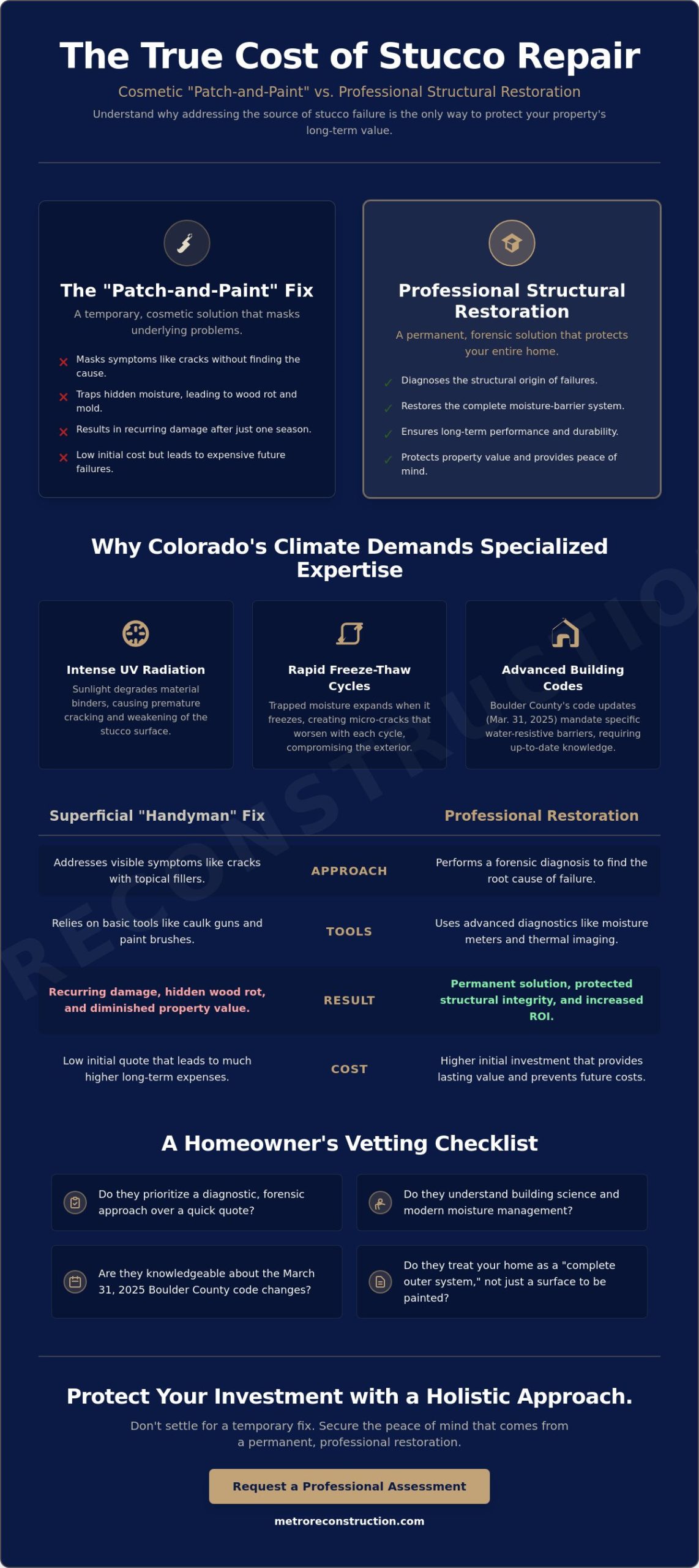
A primary challenge for property owners is distinguishing between a temporary cosmetic fix and a permanent structural solution. Many stucco companies offer a “patch-and-paint” service that addresses visible cracking with elastomeric coatings or topical fillers. While this may provide immediate visual improvement, it often masks deeper systemic failures. True restoration requires a holistic analysis of the building’s complete outer system, where the interaction between windows, masonry, and the stucco cladding is evaluated as a single, unified barrier against the elements.
Identifying the underlying structural origins of a crack is non-negotiable for long-term property preservation. A crack is rarely just a surface flaw; it’s a symptom of stress, movement, or moisture intrusion within the wall assembly. To provide an accurate diagnosis, top-tier specialists utilize advanced diagnostic tools such as moisture meters and thermal imaging. These technologies allow experts to see through the exterior skin, identifying hidden “hot spots” of moisture that would otherwise lead to internal rot and mold. For those seeking a deeper understanding of these technical standards, the NPS Preservation Brief on Stucco provides an excellent framework for the material science required to maintain building integrity.
Signs of a Superficial “Handyman” Fix
Inexperienced contractors often rely on incompatible caulking materials to fill gaps around windows and doors. This mistake is critical because non-breathable sealants can trap moisture behind the stucco, accelerating the degradation of the wooden substrate. Another common error is ignoring the complex transition points between stucco and masonry repairs. When these two distinct materials meet, they expand and contract at different rates; failing to account for this movement leads to premature bond failure. Applying a new finish over delaminating or “blown-out” brown coats is equally problematic, as the new layer lacks a sound foundation to adhere to.
The Forensic Restoration Process
A professional restoration begins with meticulous moisture mitigation to ensure the wall cavity is completely dry and structurally sound. Once the substrate is prepared, the focus shifts to ensuring proper lath installation and mechanical bonding. This foundational accuracy is what prevents the return of recurring cracks. To maintain transparency and trust, a seasoned firm will often utilize fixed-price reconstruction fees. This approach eliminates the “scope creep” that frequently occurs when contractors discover hidden damage mid-project, providing the client with financial predictability. If you’re concerned about the hidden mechanics of your home’s exterior, consulting with a specialist in structural preservation can provide the clarity needed to make an informed decision.
Why Colorado Climate Demands Specialized Stucco Expertise
The environmental stressors of the Front Range present a unique set of challenges that standard application methods often fail to address. At high altitudes, the intensity of UV radiation is significantly higher than at sea level. This constant bombardment of ultraviolet light acts as a catalyst for the chemical degradation of stucco binders, leading to premature embrittlement and surface chalking. Professional stucco companies operating in Boulder County must select materials specifically engineered with high-quality resins that can withstand this solar load without losing their structural flexibility. Precision in material selection is the first line of defense against the elements.
Beyond the sun, the region is defined by its volatile temperature swings. A rapid freeze-thaw cycle can see temperatures drop fifty degrees in a matter of hours, causing the building’s complete outer system to contract and expand violently. If moisture has infiltrated the stucco matrix through capillary action, it expands upon freezing, creating internal pressure that shatters the bond between layers. This thermal shock is the primary cause of the spalling and delamination often seen on improperly prepared exteriors. Success in this climate requires meticulous temperature monitoring and winter-specific application techniques to ensure that the material cures correctly before the next cold front arrives. A seasoned expert knows that the curing process is a delicate balance of chemistry and timing.
Moisture Mitigation in the Front Range
Snowmelt is a persistent threat in the Boulder area, often lingering on horizontal surfaces longer than rain. When heavy snow accumulates on window sills or above headers, the resulting meltwater can infiltrate the wall assembly if the flashing is not perfectly integrated. This is why the role of professional window installation is so critical to the longevity of the stucco itself. A failure at the window transition is a failure of the entire moisture-barrier system. In Colorado’s semi-arid environment, “breathable” systems with high vapor permeability are essential. They allow incidental moisture to escape before it can cause structural rot, ensuring the substrate remains dry throughout the season.
Addressing Expansive Soil Stressors
Boulder County is known for its expansive clay soils, which swell and shrink with varying moisture levels. This subterranean movement often manifests as diagonal cracking in the exterior finish. These issues are rarely just surface-level; they are frequently connected to the need for foundation repair services to stabilize the entire structure. A seasoned expert understands that repairing the stucco without addressing the underlying soil movement is a temporary gesture. By identifying these structural origins, a specialized contractor can implement repair methodologies that account for future movement, ensuring long-term wall stability and property preservation.
A Property Owner’s Checklist for Vetting Stucco Contractors
Vetting the right partner for your home’s exterior requires moving past surface-level impressions and into the technical specifics of building science. While many stucco companies can provide a clean finish, few possess the specialized insurance and forensic diagnostic skills necessary to handle complex moisture mitigation. Begin by verifying that a contractor holds active licensing and specific coverage for moisture-related claims, as standard general liability often excludes the very issues that plague stucco properties. Requesting local references is a baseline step, but the true test of expertise lies in their analytical approach to your specific structural challenges. Precision matters long before the first coat of plaster is applied.
A professional should always prioritize a substrate inspection over a quick visual estimate. When evaluating a potential partner, ask about their experience with exterior home repair beyond the simple application of plaster. A seasoned expert will look for the underlying origins of every crack, examining the relationship between the building’s framing and the exterior skin. If a contractor doesn’t mention the condition of the underlying lath or the integrity of the drainage plane, they’re likely offering a cosmetic fix rather than a structural solution. Identifying the root cause of failure is the only way to ensure the restoration is permanent.
Technical Questions Every Homeowner Should Ask
Engagement with a contractor should feel like a consultation with a specialist. Use these specific questions to gauge their technical depth:
- How do you handle the transition between the stucco and my existing windows? Proper flashing and sealant integration at these critical points are the primary failure zones in Boulder County homes.
- What is your process for identifying moisture intrusion behind the lath? Top-tier firms use non-invasive moisture meters or thermal imaging to map hidden damage before any demolition begins.
- Do you provide a fixed-price fee or a time-and-materials estimate? Fixed-price reconstruction fees demonstrate a company’s confidence in their diagnostic accuracy and protect you from the “scope creep” often found in low-bid estimates.
Reviewing the Portfolio for Structural Substance
A portfolio should offer more than just “after” photos of freshly painted walls. Look for documentation of the preparation phase, specifically images showing the installation of weep screeds, expansion joints, and high-performance water-resistive barriers. These components are mandated by the 2021 IRC standards now in effect across Boulder County. Their presence in a company’s past work signals a commitment to code compliance and long-term durability. Prioritize contractors who can show case studies of projects completed five or ten years ago. This longevity is the ultimate proof of a Wise Craftsman’s methodology. If you’re ready to move beyond temporary patches and secure your home’s integrity, consult with a forensic restoration specialist to begin a proper diagnostic assessment.
Metro Reconstruction: A Holistic Approach to Building Integrity
Metro Reconstruction stands apart from typical stucco companies by operating as a dedicated partner in property preservation rather than a high-volume contractor. Our firm is built on a foundation of four decades of Boulder-specific expertise, a tenure that has allowed us to witness firsthand how regional environmental stressors impact various building systems over time. This long-term perspective enables us to offer more than just a surface-level fix. We provide a path toward permanent structural health through a lens of quiet confidence and authoritative professionalism. Integrity is our foundational promise to every property owner we serve.
A building’s exterior is only as strong as its weakest transition point. This reality is why our approach integrates specialized masonry work, window replacement, and window installation into our broader restoration strategies. We understand that a stucco failure is frequently the result of a compromised window seal or a shifting substrate. By addressing these components simultaneously, we ensure the building’s complete outer system is restored to its original engineering intent. This holistic viewpoint distinguishes our work from providers who only focus on isolated cosmetic issues without considering the structural mechanics at play.
The Metro Methodology: Forensic Diagnostics
Our process begins with a commitment to initial accuracy. We utilize forensic diagnostics to identify the structural origins of every crack or moisture pocket before recommending a restoration path. This analytical depth ensures that we aren’t simply treating symptoms while the underlying issues continue to degrade your home’s skeleton. Once the root cause is identified, we provide clear, professional communication regarding the necessary steps for a full recovery, guiding you through technical complexities toward a decisive conclusion.
Transparency is essential when dealing with complex structural challenges. To instill immediate trust, we utilize a fixed-price fee structure for our reconstruction projects. This model provides property owners with the peace of mind that comes from financial predictability, as it eliminates the risk of hidden costs once the project is underway. We believe that a seasoned expert should be able to accurately diagnose a problem and stand by their assessment. This meticulous attention to detail is what allows us to deliver premium, engineering-led solutions that stand the test of time.
Start Your Structural Restoration Today
Choosing to ignore a structural failure only increases the eventual cost of restoration. If you’ve noticed recurring cracks or suspect hidden moisture damage behind your exterior walls, it’s time to seek an expert diagnostic rather than another temporary patch. Our team is ready to provide the meticulous, detail-oriented assessment your property deserves to maintain its long-term value. We invite you to visit Metro Reconstruction to schedule a professional assessment of your home’s exterior integrity. We don’t just fix walls; we preserve investments.
Securing Your Property’s Future with Structural Accuracy
Understanding that your home’s exterior is a complex moisture-barrier system is the first step toward effective preservation. While generic stucco companies may offer quick aesthetic fixes, long-term durability depends on a contractor’s ability to diagnose underlying structural origins. By focusing on the building’s complete outer system rather than isolated surface cracks, you protect your investment from the inevitable stresses of the Colorado environment. Precision in the diagnostic phase is what prevents the cycle of recurring damage.
Metro Reconstruction leverages more than 40 years of Boulder County expertise to provide specialized moisture mitigation and structural restoration. Our methodology emphasizes initial accuracy, and we offer fixed-price reconstruction project fees to ensure complete transparency throughout the process. Don’t settle for a cosmetic mask when you can secure a permanent solution rooted in technical precision. Request a Forensic Stucco Assessment from Metro Reconstruction to ensure your property remains sound for decades to come. Professional care today provides the peace of mind you deserve for the future of your home.
Frequently Asked Questions
How do I know if my stucco cracks are structural or just cosmetic?
Distinguishing between surface-level stress and systemic failure requires a careful examination of the crack’s size and orientation. Hairline cracks often result from natural curing or minor thermal expansion, whereas diagonal cracks or those wider than one-eighth of an inch typically signal foundation movement or moisture-driven substrate swelling. Identifying the underlying structural origins is essential, as a crack is often the first visible symptom of a compromised building envelope.
Can stucco be applied over existing siding or brick?
Stucco can be applied over masonry or wood-based sheathing, but it requires a specialized assembly to ensure long-term durability. Applying it directly over existing siding is generally avoided because it creates a risk of trapping moisture against the original structure. For brick applications, a professional lath system and a clear drainage plane must be established to comply with the 2021 IRC standards now in effect across Boulder County.
How much do professional stucco companies charge for restoration?
Fees for restoration work are determined by the complexity of the structural damage rather than a simple square-footage calculation. Professional stucco companies prioritize a forensic diagnostic process to uncover hidden moisture intrusion or wood rot before providing a quote. This approach ensures that the project addresses the root cause of the failure, providing a permanent solution that protects the home’s value rather than offering a temporary patch.
What is the difference between EIFS and traditional hard-coat stucco?
Traditional hard-coat stucco is a cement-based, three-coat system known for its impact resistance and breathability. Exterior Insulation and Finish Systems, or EIFS, utilize a synthetic multi-layered approach that incorporates a layer of foam insulation for enhanced energy efficiency. While EIFS provides superior thermal performance, it demands meticulous moisture management and precise flashing to prevent incidental water from becoming trapped behind the insulation layer.
How long should a professional stucco restoration last in Colorado?
A technically sound restoration should maintain its integrity for 20 to 50 years when supported by proactive maintenance. In the Front Range, this longevity is heavily dependent on the quality of the initial moisture mitigation and the material’s resistance to high-altitude UV radiation. Systems that are designed as a complete outer system rather than a cosmetic finish are much better equipped to handle the region’s aggressive freeze-thaw cycles.
Why is moisture mitigation so important during a stucco repair?
Moisture is the primary catalyst for structural degradation in stucco-clad properties. If a repair fails to address the drainage plane or the flashing around window headers, water will eventually infiltrate the wall assembly and cause catastrophic wood rot. Effective mitigation ensures that the internal substrate remains dry, which is the only way to prevent the recurrence of cracks and the growth of internal mold.
Is it possible to match the texture and color of my existing stucco?
Achieving a seamless match requires the precision of a seasoned craftsman who understands the chemistry of modern finishes. Color matching involves custom tinting that accounts for the natural UV fading of the original material. Texture matching is equally complex, as the specialist must replicate the original application technique, whether it was a heavy lace, a fine sand finish, or a smooth troweled surface.
Should I hire a general contractor or a specialized stucco company?
Specialized firms are generally better equipped to handle the technical complexities of a building’s moisture-barrier system. While a general contractor manages a broad scope of work, specialized stucco companies possess the forensic diagnostic tools and deep material knowledge required for structural restoration. This specialization ensures that the project focuses on long-term property preservation rather than just managing a construction timeline.