
What if the material protecting your home is actually its greatest structural weakness? In 2026, the comparison of stucco vs hardie siding has shifted from a simple style choice to a critical decision about property safety and long-term preservation. We understand the frustration of dealing with persistent woodpecker damage, surface cracking from our shifting Colorado soils, and the constant threat of wildfire in our high-altitude environment. You deserve a solution that goes beyond a superficial fix to offer genuine security for your investment.
This article provides a detailed look at the forensic differences between traditional finishes and engineered fiber cement so you can determine which system truly safeguards your home. We will preview how each material performs against the unique stresses of the Front Range, guiding you toward a maintenance-free exterior and the peace of mind that comes from a professional installation. To evaluate your home’s current health, contact the experts at Metro Reconstruction Services, Inc. at 303.543.9549 or visit our contact page today to schedule your assessment.
Key Takeaways
- Learn how the 2026 Colorado Wildfire Resiliency Code impacts your material choice and how specific exterior systems can help lower your insurance premiums.
- Understand the forensic differences between traditional finishes and engineered fiber cement to determine which provides the best protection against high-altitude hail and sun exposure.
- Compare the long-term maintenance requirements of stucco vs hardie siding, specifically regarding woodpecker prevention and the management of hairline cracks.
- Discover why a complete outer system approach is necessary to prevent moisture intrusion and protect your home’s structural integrity over time.
- Identify the critical diagnostic steps every homeowner should take to evaluate foundation stability before investing in a siding replacement or restoration project.
The Basics of Stucco and James Hardie in the Colorado Climate
For decades, homeowners in Boulder and across the Front Range have favored traditional stucco for its seamless and classic appearance. It is a material that provides a sense of permanence and architectural weight. However, as our local environment faces more intense weather patterns, the discussion around stucco vs hardie siding has become a priority for property preservation. Choosing between these materials is not just a matter of style; it is a decision about which protective system will best defend your home’s foundation and wooden frame. This choice is foundational to the longevity of your property.
We believe the surface material is only one part of a complete outer protective system. Whether you choose a cement-based finish or an engineered panel, the underlying layers must be installed with absolute precision to ensure they work together. This accuracy is vital. If the drainage paths behind the siding are neglected, the exterior material cannot do its job because moisture will stay trapped against the structure. We focus on the forensic details that ensure your home can breathe and shed water effectively.
What is Traditional Stucco Restoration?
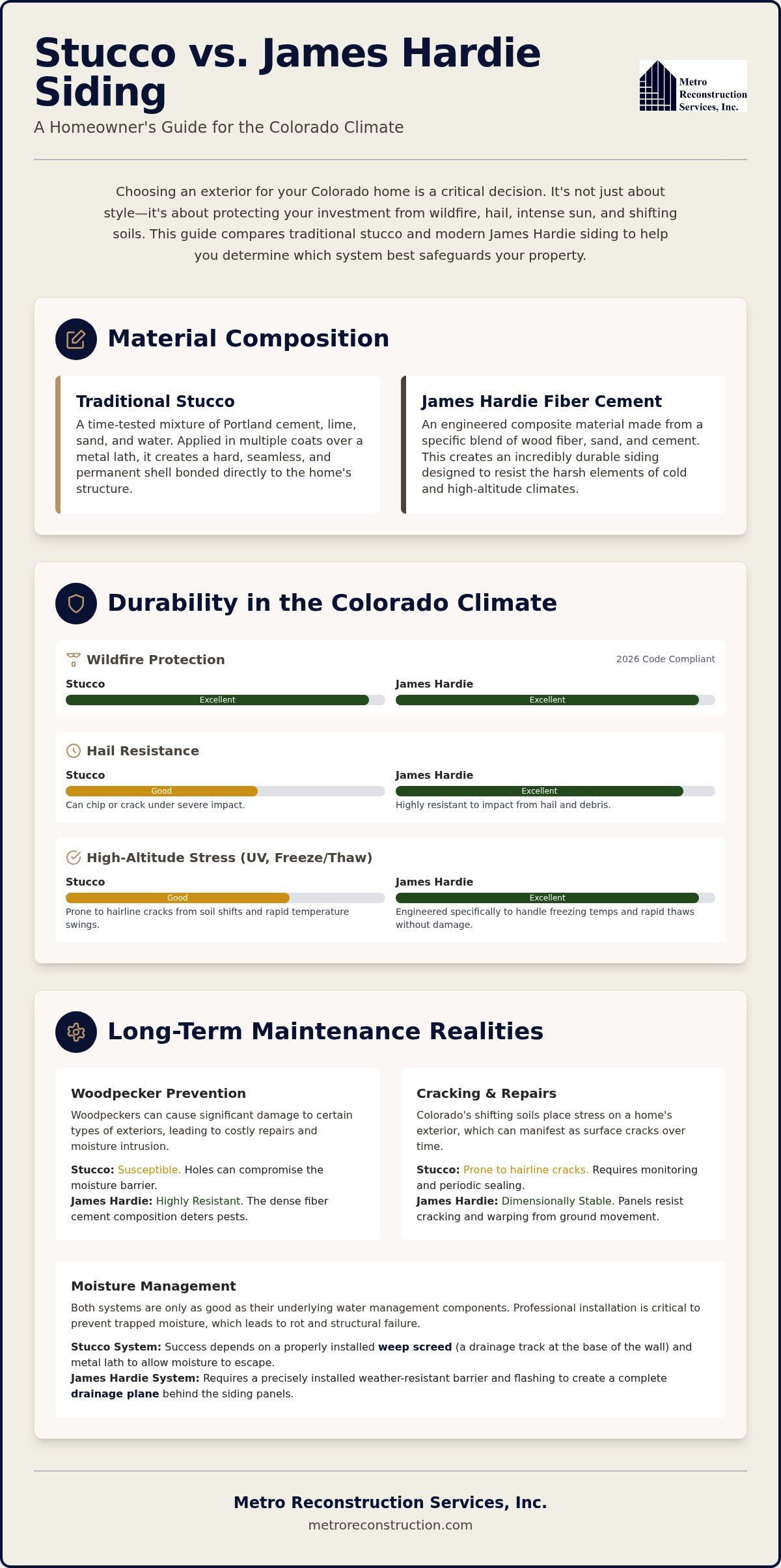
Traditional stucco is a time-tested mixture of Portland cement, lime, sand, and water. When it is applied in a standard three-coat process, it creates a hard shell that bonds to your home. During a restoration, we focus heavily on the metal mesh that holds the stucco in place and the drainage track at the bottom of the wall. This track, often called a weep screed, is essential because it allows any moisture that gets behind the hard shell to drain away safely. Without these functional paths, water stays trapped, which leads to wood rot and expensive structural repairs. Metro Reconstruction Services, Inc. specializes in ensuring these hidden components are functioning perfectly.
What is James Hardie Fiber Cement Siding?
James Hardie siding is a modern engineered alternative that has gained massive popularity in Colorado. It is made from a specific blend of wood fibers, sand, and cement, making it incredibly durable against our heavy snow and high-altitude sun. James Hardie designs products specifically for our cold climate, using a version engineered to handle freezing temperatures and rapid thaws. It is available in many styles, including planks that look like wood and modern flat panels. This versatility allows you to update your home’s look while ensuring the structure stays protected from the elements.
Understanding these basics is the first step in deciding which path is right for your property. To see our full range of restoration and installation services, or to speak with an expert, contact Metro Reconstruction Services, Inc. at 303.543.9549. You can also visit our contact page today to start your project evaluation.
Durability and Performance: Fire, Hail, and High-Altitude Stress
Living in high-altitude areas like Evergreen, Genesee, or the mountain foothills requires an exterior that does more than simply look attractive. It must be capable of surviving extreme conditions. In Colorado, your home’s outer shell faces intense UV radiation, rapid temperature swings, and the constant threat of wildfire. When evaluating stucco vs hardie siding, you have to look at how these materials react to these specific environmental pressures. A failure in the home’s protective system during a storm or fire is a significant threat to your entire property investment.
Wildfire Protection and Home Hardening
The Colorado Wildfire Resiliency Code reached full enforcement on July 1, 2026, requiring noncombustible materials for many major renovations. While both materials meet these strict safety requirements, they defend your home differently. Stucco acts as a thick heat shield, which is excellent at blocking high heat from reaching the wooden framing of your house. James Hardie fiber cement is also noncombustible and won’t ignite or act as fuel if exposed to direct flame. If you’re concerned about your home’s vulnerability, our Fire Mitigation and Prevention Services provide a detailed roadmap for hardening your exterior. Metro Reconstruction Services, Inc. can evaluate your current structure to ensure it meets these new standards.
Hail Resistance and Colorado Storms
Colorado’s hail season is a major factor in how long your exterior will last. Traditional stucco is incredibly hard, but large hail can cause surface chipping or small star-shaped cracks. If these small breaks aren’t addressed quickly, moisture can seep behind the protective layer and cause damage to the wood underneath. James Hardie siding is specifically engineered to resist impact damage from hail and wind-blown debris, and it doesn’t crack or dent as easily as other materials. From a forensic perspective, the repair process is quite different. Patching stucco requires a skilled hand to match the existing texture perfectly, while with James Hardie, we can often replace individual boards, which simplifies the restoration after a major storm.
Our high-altitude environment also means your home faces intense sun that can cause colors to fade over time. By 2026, advancements in factory-finished coatings have made color retention much more reliable for both systems. However, the extreme daily temperature swings in the Front Range cause materials to expand and contract. Stucco handles this through specific joints that allow movement, while fiber cement panels are installed with small gaps that prevent buckling. If you’re unsure which system fits your local microclimate, contact Metro Reconstruction Services, Inc. at 303.543.9549 or visit our contact page for a professional evaluation.
Maintenance Realities: Woodpeckers, Cracking, and Moisture
Maintaining your home’s exterior requires a clear understanding of how specific materials interact with local wildlife and shifting soils. When homeowners compare stucco vs hardie siding, they often focus on initial appearance while overlooking the long term labor involved in property preservation. Each system has distinct needs. Ignoring these requirements can lead to structural failures that are far more expensive than routine care. This reality makes maintenance a primary factor in your decision.
The Woodpecker Prevention Factor
Woodpeckers can turn a beautiful facade into a sieve in just a few seasons. These birds are often attracted to the hollow resonance of certain exterior systems, specifically synthetic stucco or EIFS. James Hardie siding is virtually immune to this type of damage. Its dense fiber cement composition is too hard for birds to penetrate, which eliminates the need for constant repairs. If your home currently has holes, Professional Stucco Restoration is necessary to seal the building envelope. We use specialized techniques to repair bird damage and reinforce the surface to discourage future nesting attempts. This proactive care prevents moisture from entering through these small openings.
Moisture Intrusion and Structural Mitigation
Moisture doesn’t just happen; it’s usually invited in by failed details like cracked caulking or improper flashing. In our forensic investigations, we often find that moisture issues are caused by poor installation rather than the material itself. Both systems require a complete outer system approach to shed water effectively. When water penetrates the building envelope through compromised sealants around windows, it often remains trapped. This leads to the silent degradation of the wooden framing underneath. Our team focuses on identifying these underlying structural origins rather than simply patching a surface crack. This ensures your home remains dry and stable for decades.
Cracking is another concern for Colorado homeowners due to our expansive soils. Hairline cracks in stucco are common and often cosmetic, but wider gaps can signal foundation movement. James Hardie siding handles this movement differently, as the individual boards can shift slightly without showing visible damage. Regarding long term care, both materials benefit from occasional cleaning with a low pressure garden hose. James Hardie typically holds paint longer than traditional finishes, which reduces the frequency of full repaints. If you’re noticing new cracks or suspect moisture behind your siding, contact Metro Reconstruction Services at 303.543.9549 or visit our contact page for a detailed evaluation.
Aesthetics, Curb Appeal, and Long-Term Investment Value
Aesthetics are often the first consideration for homeowners, but the true value of an exterior lies in its long-term investment potential. When evaluating stucco vs hardie siding in 2026, you must consider how these materials perform within the high-end Boulder and Front Range real estate markets. In neighborhoods like Cherry Hills Village, the monolithic and timeless look of European-style stucco remains a gold standard for luxury estates. This system provides a sense of architectural weight and permanence that is difficult to replicate with other materials. Because we prioritize a complete outer system, we ensure that these aesthetic choices are backed by structural integrity.
Resale value is increasingly tied to how well a home’s exterior can withstand our local climate while maintaining its original beauty. James Hardie siding has redefined the modern farmhouse and contemporary look, offering crisp lines and deep shadow lines that appeal to modern buyers. The choice between a custom-pigmented finish and a factory-applied coating often comes down to the desired level of customization. Custom stucco allows for an infinite palette of colors, while Hardie’s ColorPlus Technology provides a consistent, durable finish that is engineered to resist UV degradation at high altitudes.
Custom Textures vs. Factory Finishes
The artistry involved in traditional finishes is a significant differentiator. You can select from various texture types, such as smooth, lace, or dash, to perfectly complement your home’s unique style. This level of hand-crafted detail is a hallmark of premium properties. In contrast, James Hardie products excel at wood-grain mimicry. This makes them an excellent choice for homes in historic districts where the look of natural cedar is required but the maintenance of wood is unwanted. If your current exterior is showing signs of age, our restoration and repair services can revitalize your facade while addressing the underlying structural origins of any wear. Accuracy in these early stages ensures a finish that lasts.
Calculating the Real ROI
Calculating your return on investment requires looking beyond the initial installation. You must consider the 30-year maintenance cycle and the impact on your monthly expenses. Homes with fire-hardened exteriors frequently qualify for lower insurance premiums, which adds immediate financial value. Additionally, the energy efficiency of your home is impacted by your siding choice. Stucco provides excellent thermal mass, which helps regulate indoor temperatures during our extreme temperature swings. James Hardie systems, when installed with proper insulation, also offer significant R-value benefits. Both choices are premium, engineering-led solutions that distance your property from low-cost, high-maintenance alternatives.
If you are ready to enhance your home’s curb appeal and long-term value, contact Metro Reconstruction Services at 303.543.9549. You can also visit our contact page to schedule a forensic evaluation of your property’s exterior system. We are here to help you make a decisive, professional choice for your home’s future.
The Forensic Decision: Which System is Right for Your Property?
Choosing between stucco vs hardie siding requires more than a surface level inspection. It demands a deep understanding of your home’s structural origins. You must evaluate how the building sits on its site and interacts with local environmental stressors before committing to a specific material. This forensic approach ensures that your investment won’t be undermined by hidden mechanical failures that a standard contractor might miss. We believe that initial accuracy is the only way to achieve true peace of mind. It’s the difference between a temporary patch and a permanent solution.
Assessing Foundation and Soil Movement
In areas like Parker and Broomfield, expansive soils create significant pressure on residential structures. These clay-heavy soils expand and contract with seasonal moisture changes, which often leads to foundation shifting. Traditional stucco is a rigid, cement-based shell. When the foundation moves, the stucco lacks the elasticity to bend, so it must crack to accommodate that stress. In these specific environments, James Hardie siding offers a distinct forensic advantage. Because the system consists of individual panels and planks, it has the inherent flexibility to handle minor structural shifts without visible failure. If you suspect your current exterior issues are tied to ground movement, our specialized diagnostic services can identify if you need structural stabilization before new siding is installed.
Final Recommendation Checklist
Before making your final selection, use this diagnostic framework to ensure the system matches your specific needs and long-term goals:
- Environmental Risk: Are you in a high-risk wildfire zone where noncombustible materials are mandated by the 2026 building codes?
- Soil Conditions: Has a professional forensic inspection confirmed your foundation is stable enough for a rigid stucco finish?
- HOA Requirements: Does your neighborhood association have specific architectural guidelines regarding textures or lap siding widths?
- Maintenance Tolerance: Are you prepared for the specialized care stucco requires, or do you prefer the durability of fiber cement?
Selecting the right protective system is a complex task that should not be rushed. It requires a partner who understands the intricate relationship between environmental stressors and specialized building elements. We focus on long term reliability and the preservation of your home’s complete outer system rather than offering superficial, low-quality patches. This engineering-led approach is what distinguishes a premium restoration from a temporary fix. Accuracy in this final decision phase acts as the foundation of your property’s future value. If you’re ready to move forward with a professional forensic evaluation of your home, contact Metro Reconstruction Services at 303.543.9549 or visit our contact page to begin your project.
Protecting Your Home’s Future with a Precision Exterior
Your home’s exterior is its first line of defense against Colorado’s demanding environment. Choosing between stucco vs hardie siding is a decision that impacts your property’s safety, value, and structural health for decades. As the 2026 wildfire codes and shifting soil patterns change how we build, focusing on a complete outer system becomes more than an aesthetic choice. It’s a necessary step in property preservation. We focus on identifying underlying structural origins to ensure your home remains a secure sanctuary.
Since 1982, our family-owned company has specialized in high-altitude restoration as Certified James Hardie Installers. We bring 40+ years of expertise to every project and understand the forensic details required to shield homes from hail, fire, and moisture. Whether you’re restoring a classic look or upgrading to modern engineered panels, our team provides the reliability you deserve. Let us help you navigate these complex structural choices with confidence and precision.
Ready to ensure your building envelope is truly secure? Schedule Your Forensic Exterior Assessment Today with Metro Reconstruction Services. You can reach our experts at 303.543.9549 to discuss your home’s unique needs. We look forward to being your partner in long-term property protection.
Frequently Asked Questions
Is James Hardie siding cheaper than traditional stucco?
Stucco often has a lower initial installation cost compared to engineered fiber cement. When comparing stucco vs hardie siding, you must also evaluate the long term expenses related to maintenance and repairs. While the upfront price for traditional finishes is typically lower, James Hardie products often provide better value over a 30 year cycle. This is because they require less frequent repainting and are more resistant to impact damage. To better understand these costs, you can explore Project-based exterior installation fees from Advantage Plus Construction Group.
Which siding material is best for wildfire protection in Colorado?
Both materials are excellent for home hardening and meet the 2026 Colorado Wildfire Resiliency Code. Stucco serves as a superior thermal barrier that blocks radiant heat from reaching your home’s wooden frame. James Hardie is a noncombustible material that won’t ignite or contribute fuel to a fire. Choosing either system significantly improves your home’s safety in the wildland-urban interface areas of the Front Range.
Can woodpeckers damage James Hardie board like they do stucco?
James Hardie board is essentially immune to woodpecker damage due to its dense composition of cement and sand. Woodpeckers are often attracted to the hollow sound of synthetic stucco or wood siding, but they cannot penetrate fiber cement. If you’re tired of repairing bird holes every spring, switching to an engineered siding system provides a permanent solution that protects your home’s structural integrity.
How often does stucco need to be repainted or recoated?
Does Hardie siding increase the resale value of a home?
Yes, James Hardie siding is known for providing a strong return on investment in the Colorado real estate market. It’s a premium material that signals to potential buyers that the home has been protected with a durable, long lasting system. Because it has a lifespan of 30 to 50 years, it often increases property value more effectively than vinyl or other low cost siding alternatives.
What causes stucco to crack, and can it be permanently fixed?
Cracks are frequently caused by our state’s expansive soils or rapid temperature changes that cause materials to expand and contract. While cosmetic hairline cracks can be patched, deep or recurring cracks suggest underlying structural origins. We focus on a forensic approach to identify why the movement is happening. This ensures that any repairs address the root cause rather than just hiding the surface damage. We prioritize precision.
Can I install Hardie siding over existing stucco?
We generally advise against installing new material over an existing exterior finish. When deciding on stucco vs hardie siding, a forensic approach requires a clean tear off to inspect the underlying building envelope for moisture or structural rot. Installing over old surfaces can trap water and add excessive weight to your home’s frame. Removing the old system ensures the new installation is accurate and durable.
How long does a professional siding installation take in Boulder?
A professional installation for a standard residential property in Boulder usually takes between two and four weeks. This duration allows our team to focus on the precision required for proper flashing, caulking, and moisture mitigation. Complex architectural designs or restoration work may extend this timeline. If you have questions about your specific project, contact Metro Reconstruction Services at 303.543.9549 or visit our contact page today.